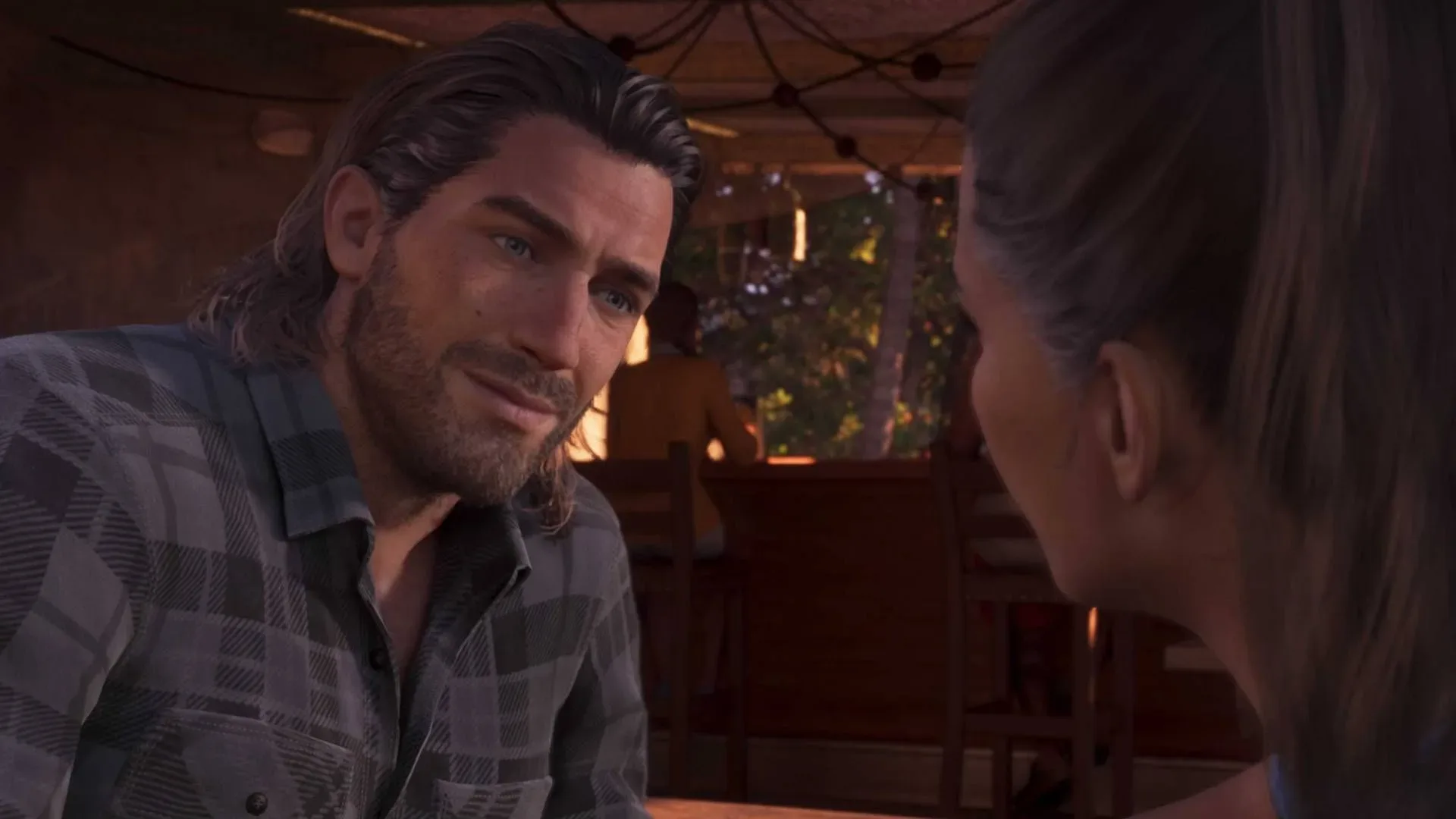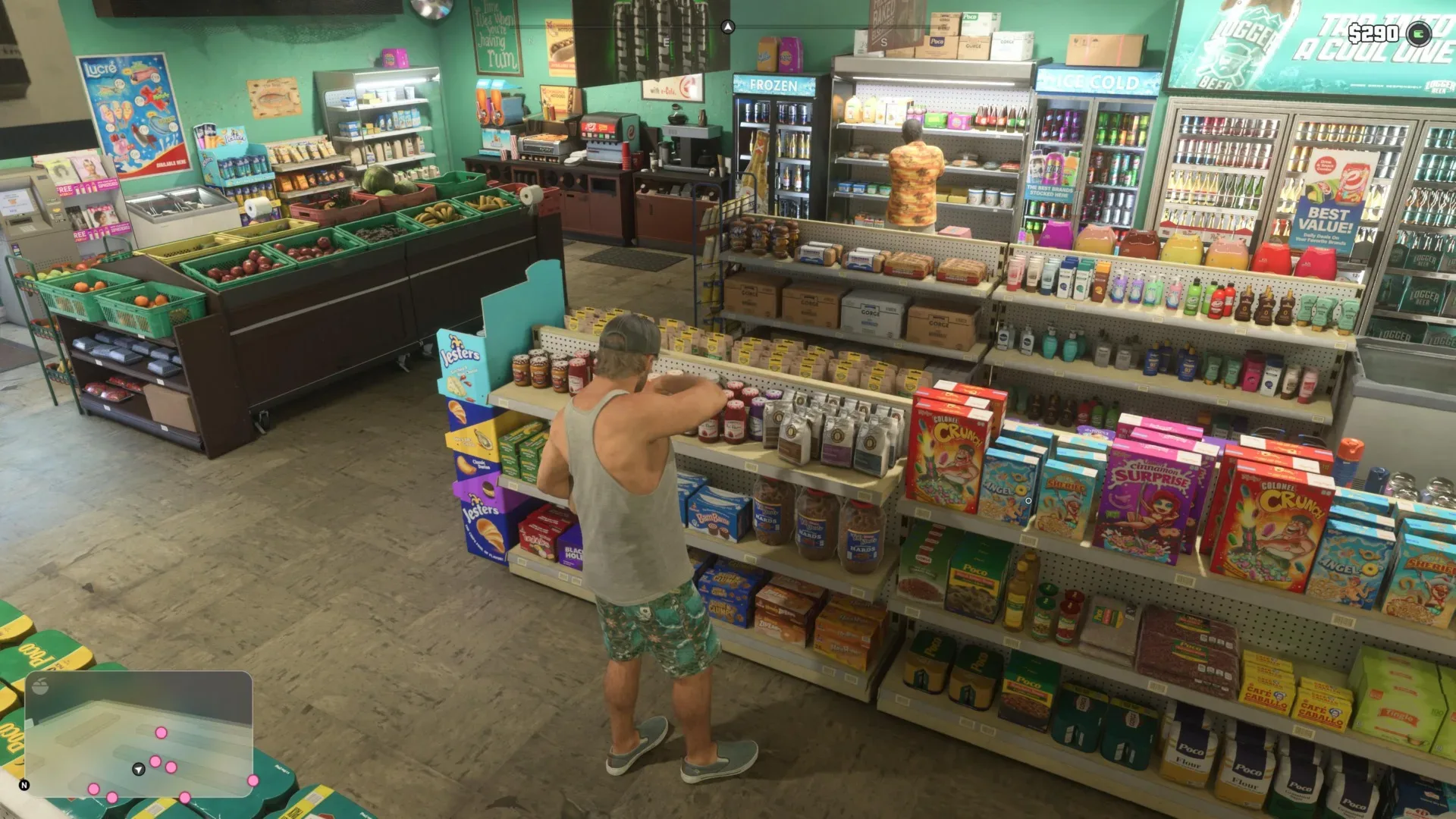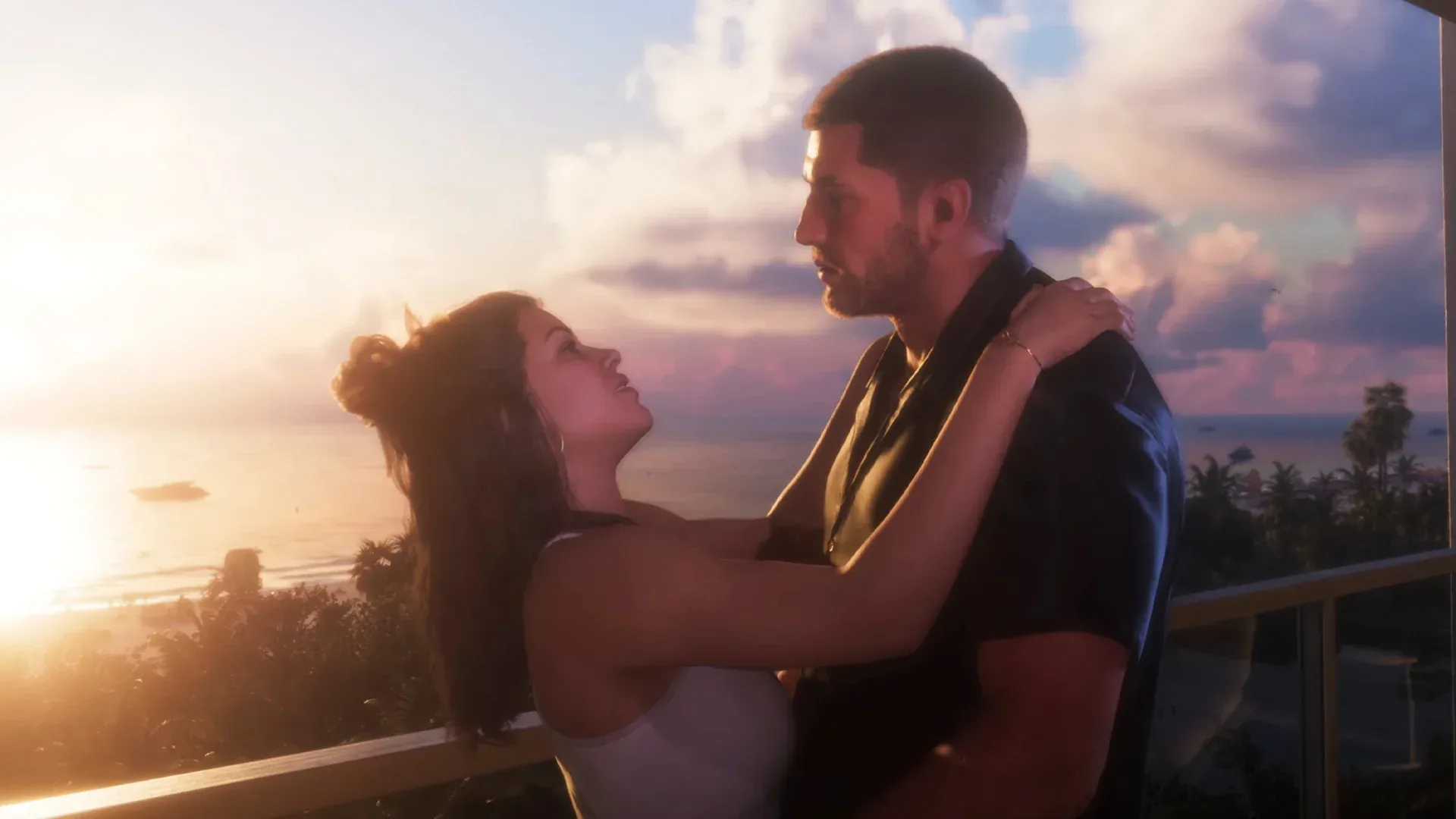

Grand Theft Auto 6 can make a player feel unusually confident that an odd idea might work. Pick up a seemingly incidental object, take an unexpected route, turn a quiet optional encounter into a chaotic loot sweep, then carry the consequences somewhere the game plainly did not expect you to go: that is the kind of unscripted chain of events a richly reactive open world invites.
That confidence makes a very small moment in an early GTA 6 mission especially funny. During an optional Kingfisher stash-house raid, a player wound up carrying a six-pack of beer while escaping by stolen airboat. After drinking one by accident, the character returned home with five beers still in hand—just in time for Cal to ask him to fetch beer from the fridge during the mission “Feng Shui.”
In the most literal sense, the problem had already been solved. The player had beer. Cal wanted beer. Yet carrying the drinks into the house did not satisfy the mission’s objective. Placing the pack on surfaces and trying to make the game recognize it did not advance the scene. Opening the refrigerator did, triggering the sequence required to move on.
It is not evidence that GTA 6 lacks detail, nor does it establish that there is definitively no hidden interaction that would have worked. The player even allowed for the possibility that one existed. But the incident is an entertaining illustration of the dividing line between a simulation-like sandbox and a designed mission: freedom can be broad, while an individual story beat may still be built around one particular state change.
A tiny continuity joke that could not become an alternate solution
The setup is good enough to sound like a deliberately written gag. A character comes home from a violent side job accidentally prepared for a low-key gaming hangout, beers in hand. The game’s scene then ignores that physical comedy and insists on the ordinary refrigerator run. Instead of being a meaningful gameplay failure, the result is a missed bit of acknowledgement—a small chance for the mission to say, in effect, “yes, that counts.”
That distinction matters. Players often use immersion to describe whether a game preserves the internal logic of its world. Here, the logic is easy to understand. If the character visibly possesses the item another character requests, a natural response would be for the dialogue or objective to adapt. When it does not, the player becomes aware of the objective machinery underneath the scene.
But immersion is not the same thing as unlimited systemic possibility. An open-world game can support responsive movement, vehicles, combat, objects, loot and environmental behavior, then still use a narrowly defined trigger for a cinematic or scripted mission event. The fridge was not necessarily being treated as a generic supplier of any beer. It was probably the specific interaction the mission needed before it could safely proceed to its next line, animation, inventory adjustment, or scene state.
Why the fridge likely mattered more than the beer
In game-design terms, the objective appears to have been about an event trigger rather than merely item ownership. An event trigger is a condition that tells the game to advance: enter a place, speak to a character, activate an object, or possess a defined item. In this case, opening the fridge initiated the expected sequence. The beers carried in from the stash house were visually and mechanically adjacent to the goal, but were apparently not the item or flag that objective checked.
Related coverage includes GTA 6's Tiny Beer Hiccup Shows Where Even a Huge Open World Can Draw the Line.
That can sound needlessly rigid when described from outside the game. However, it is also an understandable way to keep a mission stable. A bespoke social scene might rely on a specific prop, character positioning, conversation timing and animation sequence. Allowing any item that resembles beer to substitute for the fridge interaction could require extra checks and alternate responses. Then designers would need to account for whether the carried six-pack was full, partially consumed, dropped, destroyed, unavailable, or being held alongside another object.
The reported sequence contains exactly the kind of edge case that reveals the cost of deeper reactivity. The player did not simply buy a six-pack and walk through the front door. The item was acquired somewhere during a raid, its pickup was not even noticed at the time, one beer was consumed unintentionally, and the remainder traveled by airboat into a mission encounter. Designing every narrative beat to account for every plausible history of every portable object is an enormous task.
None of that makes the missed response less amusing. Quite the opposite: it explains why the moment feels so tantalizing. It is close enough to a sensible alternate solution that players immediately imagine the version where Cal notices the five-pack, makes a joke, and the scene continues. The required change may be small from a player’s perspective, but the underlying exception can be surprisingly large from a production perspective.
Optional chaos meets authored storytelling
The beers only became relevant because two types of GTA play collided. First came the player-driven sandbox behavior: approaching the Kingfisher location from the rear by airboat, attempting stealth, losing control of the situation, then looting aggressively during combat. This was optional activity producing a personal, messy little story.
Then came an authored mission moment with Cal. Authored does not mean inferior or artificial; it means the developers have arranged a particular progression and presentation. It can deliver pacing, characterization and a coherent scene in ways a completely freeform system may not. The trade-off is that authored content sometimes asks the player to perform an action that feels redundant because their improvised journey has created circumstances the scene was not written to recognize.
The contrast is especially sharp in games that are good at making incidental behavior feel consequential. When a world routinely responds to player movement and disruption, players reasonably start testing it. Can this item be brought there? Will this person react? Does the game remember what just happened? Every successful surprise raises expectations for the next one.
That is why small seams can be more memorable than much larger limitations in a plainly linear game. The game has persuaded the player to treat it as a place with flexible rules. A fridge objective that will not accept the beer already in the protagonist’s hand is not a major defect; it is a reminder that some rules are still narrowly authored beneath the convincing surface.
What players should take from this—not a warning, but a useful mindset
There is no practical reason to avoid side activities or carrying objects before “Feng Shui” based on this single anecdote. The mission progressed normally once the fridge was opened. Nor should players assume that every other object or mission interaction behaves in the same way. The account specifically leaves open the possibility that another method might have existed.
The more useful takeaway is about expectations. GTA 6’s systems may encourage experimentation, but players should not read every realistic-looking object as a universal solution to every related objective. An item can be physically present in the world without being connected to the quest logic. Likewise, a task phrased in everyday language—get beer—may really mean interact with this marked appliance at this point in the mission.
- If a story objective does not acknowledge an apparently relevant item, look for the interactable object or location named by the prompt.
- Do not assume a carried prop shares the same quest state as an identical-looking item created by a mission interaction.
- When an improvised solution fails, it may be a scripting boundary rather than an indication that the game is broken.
- Keep experimenting anyway: the charm of an open world is discovering which unexpected actions are accounted for.
That last point is important. A game does not need to simulate every imaginable handoff to create strong player stories. In fact, the six-pack anecdote is memorable precisely because the player’s route through the game was so unusually specific. An optional raid, a stolen airboat, a frantic escape, an accidental drink, and a domestic mission intersected in a way no conventional walkthrough would tell someone to reproduce.
It also lands amid a broader conversation about when GTA 6 lets players roam most freely. A recent discussion of the game’s early chapters and sandbox freedom underscores the same central tension: a structured opening and a reactive world do not have to be opposites, but the balance between them is felt most clearly in these odd, player-made scenarios.
The best bugs and limits are often stories, not disasters
Calling this a “bug” would go too far based on what is known. The fridge interaction functioned, the scene advanced, and there is no confirmed evidence that the carried beer was intended to be valid. “Limitation,” “oversight,” or simply “unrecognized edge case” are safer descriptions. The basic result was a minor break in the fantasy, not a broken quest.
Yet these are the moments players trade with each other because they capture the ambition of a massive game as much as its boundaries. The game made it possible to arrive at a casual beer-fetching scene already carrying a looted and partially consumed six-pack. That alone is a strange, funny level of continuity. It simply stopped one step short of turning that continuity into a bespoke response.
Perfection is not a useful standard for an open world with countless combinations of combat, travel, objects and mission states. The more relevant measure is whether the game creates enough believable possibilities that players keep trying things. In this case, it clearly did. The disappointment came not from expecting nothing, but from expecting that GTA 6 might once again recognize a piece of unscripted chaos and turn it into a tiny payoff.
Instead, the fridge got its moment. Cal got the beer through the intended route. And somewhere in the game world, a five-pack briefly became the most technically complicated six-pack imaginable.