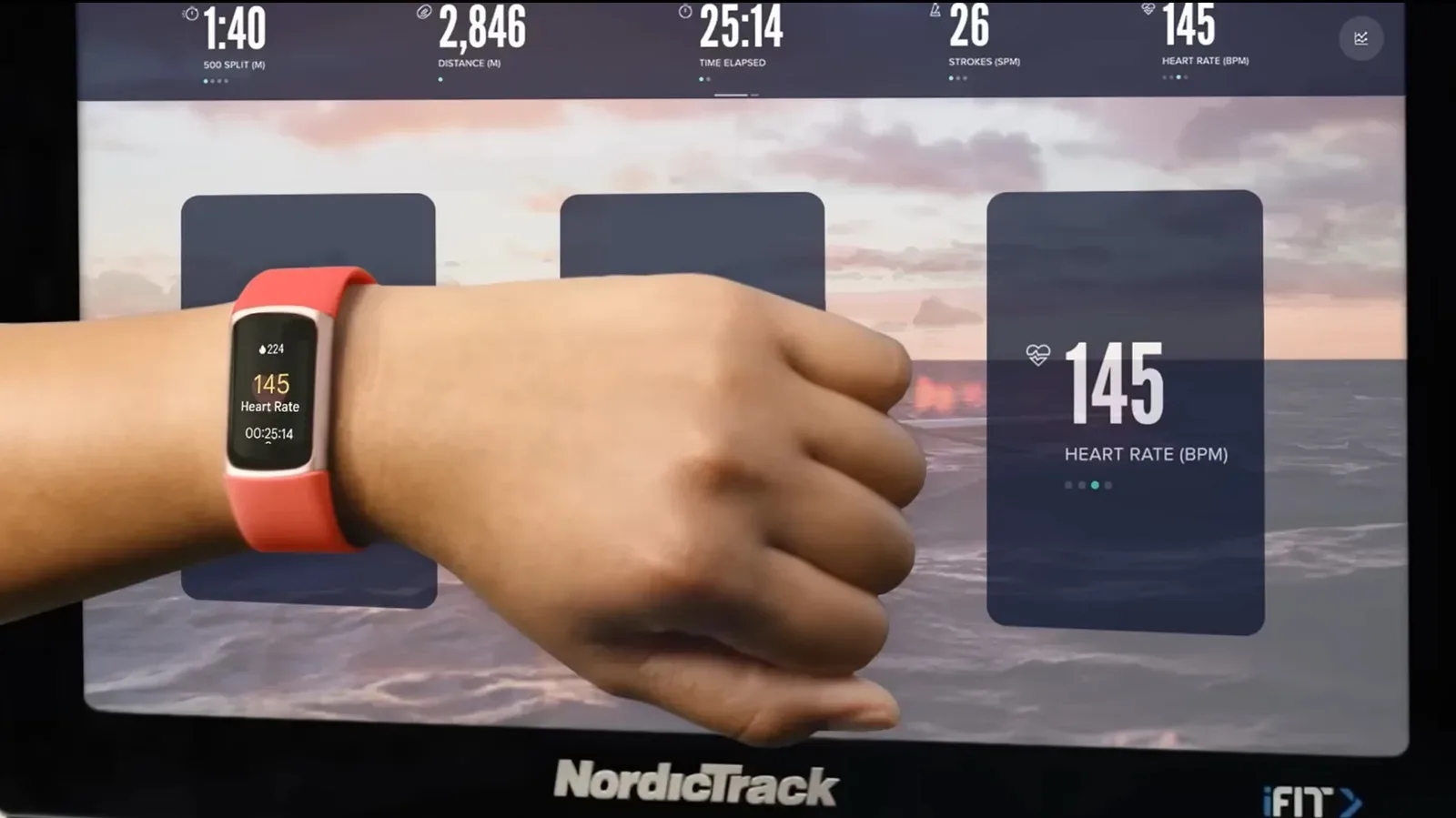
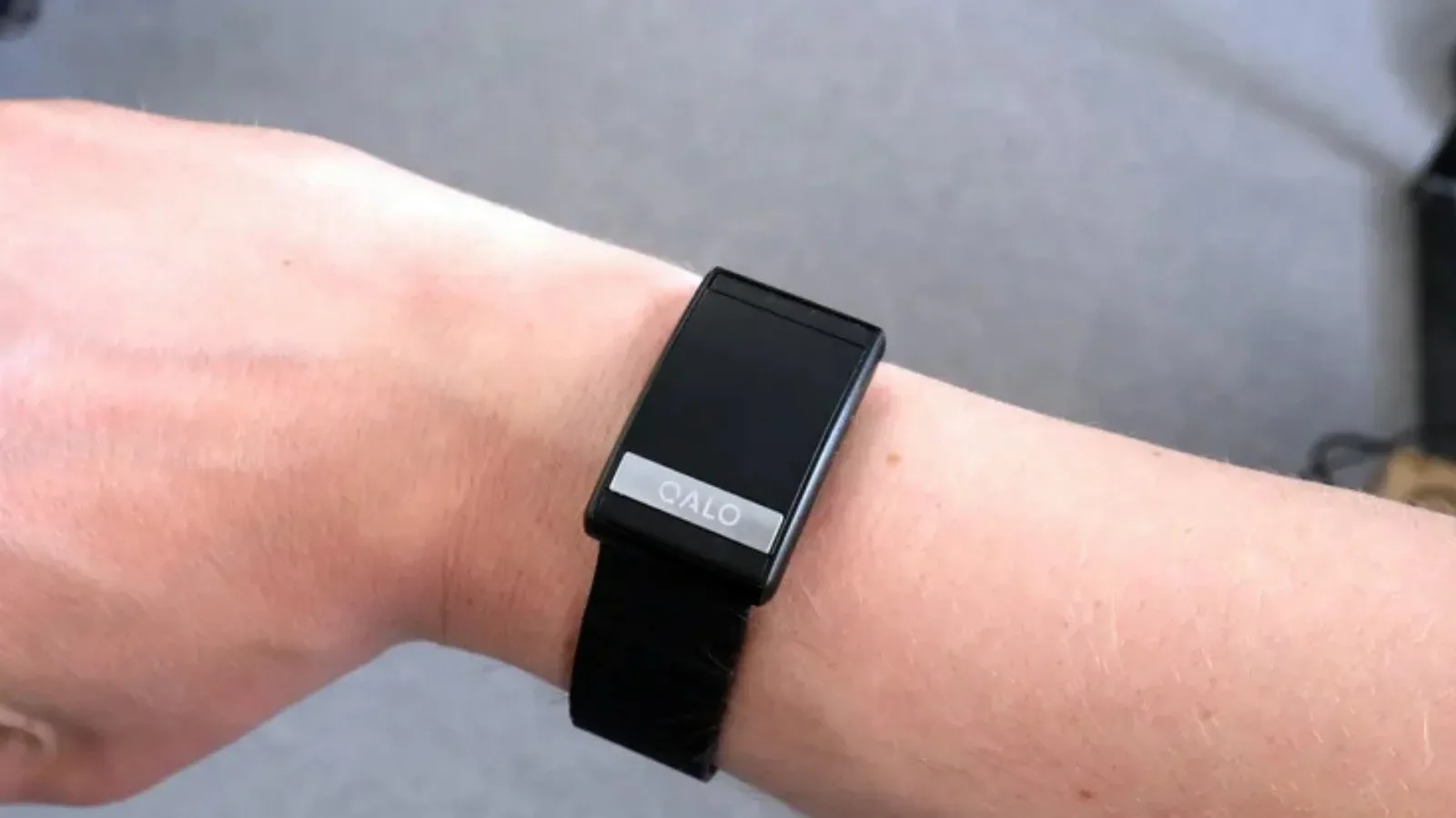
The Garmin Cirqa and Qalo SL-1 arrive at nearly identical prices with the same broad proposition: a screenless fitness band that does not demand an ongoing membership for its core tracking. Garmin announced Cirqa on July 21, while Qalo followed with SL-1 on September 29. At $199.99 and $199.95 respectively, the four-cent gap is functionally meaningless. What matters is that the two devices make very different tradeoffs once they are on a wrist.
Both are intended for people who want passive health and activity data without a display competing for attention. Both cover a substantial set of baseline measurements, including optical heart rate, blood oxygen, skin temperature, heart-rate variability, stress, sleep stages and menstrual-cycle tracking. But Garmin puts considerably more emphasis on activity coverage, coaching-oriented metrics and physical flexibility, while Qalo presents a more streamlined daily score and claims the longer battery life.
On the available evidence, Cirqa is the more complete all-round tracker at this price. SL-1 has meaningful appeal for someone who values long stretches between charges and wants to avoid any chance of a paid software layer, but its execution raises more questions around automatic workout detection, strap security and how much the companion app does with the information it gathers.
The headline: no mandatory subscription, with an important Garmin asterisk
A key shared advantage is that neither band requires a subscription to function. That immediately distinguishes them from membership-first fitness bands, where the hardware purchase can be only the beginning of the cost.
Qalo sells the SL-1 for $199.95, including a black silicone strap and charging dock. The app is free and there is no recurring paid plan attached to the band. Additional straps cost $34.95, and a woven option is available.
Garmin prices Cirqa at $199.99 and says its tracking features work without a subscription. However, the company also offers Connect+, an optional service priced at $6.99 a month or $69.99 a year. Features listed behind that tier include AI-generated insights, nutrition logging, Live Activity Stats, training guidance and a performance dashboard. Guided workouts require the subscription, and some activities may as well.
That distinction is worth making clearly. Subscription-free does not mean every software feature is free. Cirqa can record and provide its baseline functions without Connect+, but buyers who specifically want guided training or richer interpretation should account for the possibility of an annual fee. SL-1’s simpler proposition may be more attractive to someone who sees a recurring software tier as a deal-breaker rather than an optional extra.
Both products are eligible for HSA and FSA spending, which could affect the effective cost for buyers with access to those accounts. For a broader look at why recurring connected-device services matter beyond wearables, see this breakdown of telematics subscriptions and what users actually receive.
Screenless does not mean featureless
A screenless wearable shifts nearly all interaction to the phone app, haptics and small hardware cues. The benefit is a less distracting device and potentially a more comfortable, lower-maintenance object to wear continuously. The downside is immediate visibility: neither band can give a glanceable on-device readout in the way a smartwatch can.
Cirqa does provide somewhat more physical feedback than its rival. It has one side button, a multicolor status LED and vibration alerts for alarms and the Find My Band feature. The button is a practical control, but it is not a wholly graceful one: a poorly timed press while dismissing an alarm can start a workout. This is a small usability flaw, but on a device with just one control it becomes a recurring part of the experience rather than an obscure edge case.
SL-1 documentation describes a charging-status light, but does not indicate an equivalent combination of button controls, multicolor status feedback and vibration alerts. Its approach is closer to an unobtrusive sensor band whose meaningful interaction happens after data syncs to the app.
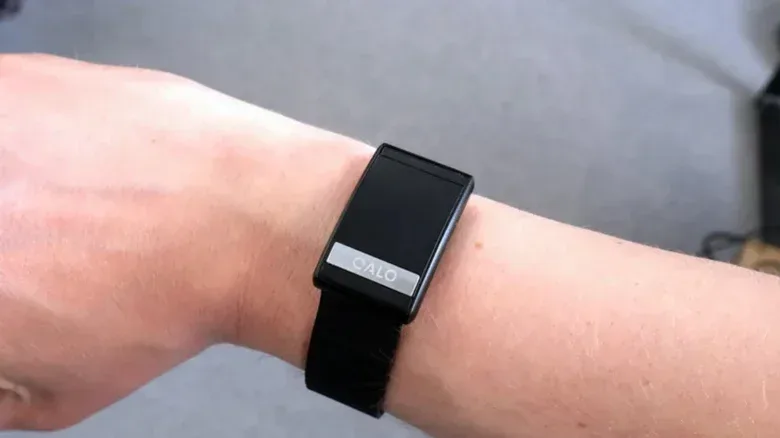
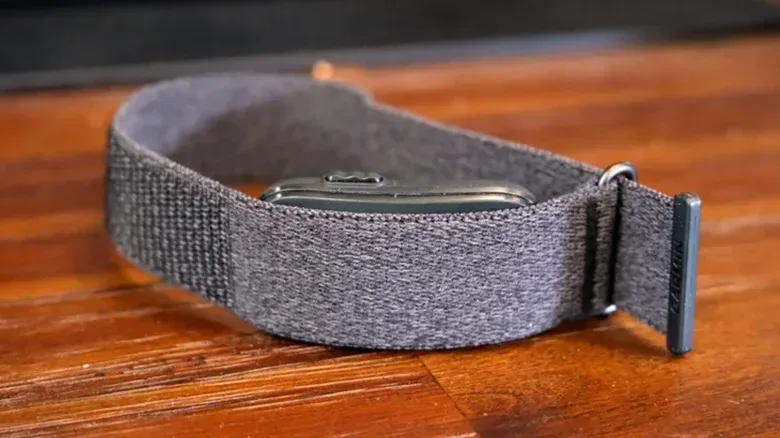
The physical designs also diverge. SL-1 is made for the wrist, positioned roughly an inch above the wrist bone. Its standard silicone strap uses a magnetic clasp, and Qalo sells a woven strap separately. Cirqa has a fabric hook-and-loop band, ships in two wrist sizes and can also be worn on the upper arm with a long arm band. Garmin offers it in four colors.
Wear position is more than a style decision. The option to move Cirqa to the upper arm could be useful for people who prefer not to wear a band at the wrist during particular activities or throughout the day. Meanwhile, the SL-1’s magnetic closure is a notable concern: it can come loose when a sleeve catches it at an unfortunate angle. Anyone who needs confidence that a tracker will stay secured through a normal day should not treat that as a minor specification footnote.
Weight, water resistance and the practical durability gap
Qalo lists SL-1 at 18 grams and 10.5mm thick, although it does not clarify whether the stated weight includes the strap. Garmin says Cirqa weighs 14.8 grams without a strap and 20.7 grams total with the smaller wristband. These figures are not directly identical measurements, so they do not settle which device feels lighter in real-world use. They do, however, reinforce that both are designed as relatively lightweight, all-day bands rather than watch-sized computers.
Garmin holds a clearer advantage in the stated water and temperature specifications. Cirqa carries a 5 ATM rating. In its documentation, Garmin describes that as withstanding pressure equivalent to a 50-meter depth, and the wearable includes a Swim activity. “ATM” is a pressure-resistance rating; it is not simply a promise that a device survives being splashed. Buyers should still follow the maker’s use guidance, but Cirqa’s rating and swim mode establish it as the stronger candidate for people who expect regular water exposure.
Qalo lists SL-1 as water-resistant to 10 meters and specifically warns against scuba diving and deep-water pressure. Its support materials also cite an IP68 rating. An IP rating describes resistance to ingress from solids and water under its stated test conditions, while ATM ratings relate to pressure resistance; the labels are not interchangeable shorthand for the same guarantee. The more useful practical point is straightforward: Garmin specifies the deeper rating and supplies a dedicated swimming activity, while Qalo identifies tighter water-use limits.
The stated operating-temperature range also favors Cirqa. Garmin lists -4 to 140 degrees Fahrenheit, compared with Qalo’s 14 to 113 degrees Fahrenheit for SL-1. That is not a reason to deliberately expose either gadget to extreme conditions, but it gives Cirqa a broader stated margin at both ends of the range.
Battery life: Qalo’s strongest case, with one documentation wrinkle
Battery endurance is the area where SL-1 has the most compelling headline number. Qalo advertises 12 or more days, compared with Garmin’s estimate of up to 10 days for Cirqa. A week of use left SL-1 at 59%, supporting the impression that its battery can be a genuine strength rather than merely optimistic marketing.
For a screenless tracker, battery life is not just about convenience. The point of health and sleep tracking is continuity. Every charge period can create a gap in overnight data, workout history or longer-term trends. A band that can remain on the body for longer may be more useful to a person who is likely to forget a charging routine.
Cirqa takes up to 90 minutes to charge through a proprietary Garmin cable. SL-1 uses a magnetic dock and USB-C cable. USB-C can be convenient because it is a widespread cable standard, though the dock remains a proprietary physical accessory. Qalo’s own charging-time guidance is inconsistent: its product page cites 60 to 120 minutes, while its support material says two to three hours. The device may still offer strong endurance, but shoppers should not assume a precise recharge time until Qalo resolves that discrepancy.
What each band measures—and how they frame the numbers
The sensors overlap considerably. Both track heart rate using an optical sensor, estimate blood oxygen, measure skin temperature and observe HRV, stress and sleep stages. HRV, short for heart-rate variability, refers to variation in timing between heartbeats. Wearables commonly use it as one input for interpreting recovery, stress or readiness, rather than as a standalone verdict on a person’s health.
The bigger contrast is presentation. Qalo condenses sleep, HRV, movement and stress into a daily Q Score from 1 to 100. That can be appealing for users who want a quick, consolidated picture without scrolling across numerous dashboards.
Garmin distributes its analysis across Body Battery, Training Readiness, training status, VO2 max and HRV status. VO2 max is an estimate associated with the body’s capacity to use oxygen during exertion, and it is commonly used as a fitness-related training metric. This multi-metric approach offers more ways to examine activity and recovery, but it can also make interpretation feel less immediate. Garmin’s app is data-rich, yet the available assessment found it stronger at displaying information than explaining what a user should do with it.
Neither band has built-in GPS. Cirqa can use a paired phone’s GPS, so location-based tracking depends on taking a phone along. That matters most for outdoor runners, cyclists and walkers who want routes or distance data based on GPS. SL-1’s supplied information does not identify a comparable phone-GPS feature.
Activity tracking is the largest performance separation
Cirqa lists more than 80 activity types; SL-1 lists 54. A longer activity list does not automatically make a wearable better, particularly if someone only uses a few common modes. Still, the gap supports Garmin’s broader sports-and-training emphasis. Cirqa can also broadcast heart-rate data to other devices, a useful option for people with compatible fitness equipment or another device that accepts an external heart-rate signal.
More consequential than the activity count is automatic detection. Qalo says SL-1’s modes include automatic activity detection, but workout detection did not successfully pick up workouts in use, including walks. Cirqa’s automatic detection was dependable enough that manually starting a workout was rarely necessary.
This is an important distinction for the target audience. A screenless band is often purchased precisely because the wearer does not want to think about operating it. If someone must regularly open an app or remember to begin a session for accurate records, the device starts behaving less like passive tracking and more like a chore with no visible on-wrist payoff. Garmin’s ability to capture the basics automatically therefore carries more weight than the raw difference between 80-plus modes and 54.
Qalo says its movement tracking is up to 12.5% more accurate than unspecified popular alternatives. That claim should be read narrowly because no accuracy comparison was performed for SL-1 here. Garmin’s tracking accuracy, by contrast, was identified as reliable in assessment. The responsible buying takeaway is not that SL-1 is necessarily inaccurate; it is that Cirqa has stronger support in the available evidence for getting fundamental activity tracking right.
Which $200 band makes more sense?
Choose Garmin Cirqa for activity breadth, automatic detection and tougher stated durability. It has the deeper 5 ATM water rating, a Swim activity, a wider operating-temperature range, phone-assisted GPS, heart-rate broadcasting, upper-arm wear capability and a considerably larger activity catalog. It also has a more developed set of training and recovery labels for users who want to explore their data. The tradeoff is a busier app, an awkward one-button alarm interaction, proprietary charging and the existence of an optional subscription tier for certain advanced features.
Choose Qalo SL-1 only if its particular simplicity and longer battery proposition are the priority. It avoids a software membership entirely, has a clear one-score approach to daily data and demonstrated excellent remaining charge after a week. For a user who wants a low-intervention wellness band rather than a training device, those attributes have value.
But the equal pricing makes the omissions harder to overlook. The SL-1’s automatic detection did not deliver as expected, its app offers limited interpretation beyond collecting readings, and the magnetic silicone clasp can release accidentally. Its lower stated water resistance also gives Cirqa a more obvious edge for swimming and wetter conditions. Qalo’s band would be easier to recommend as an entry-level screenless tracker at a lower cost. At essentially the same $200 price, Garmin’s Cirqa offers the more persuasive package despite its own software and interface frustrations.