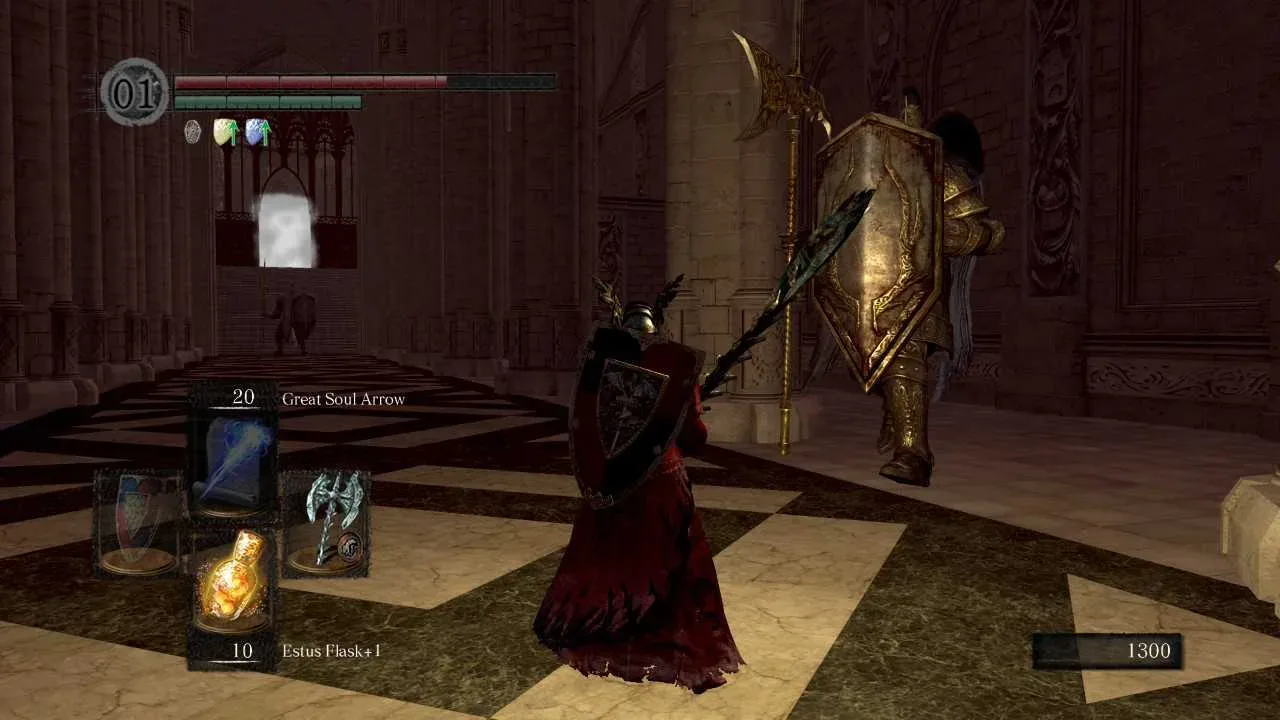
Dark Souls has a special talent for making a player’s most feared obstacle look obvious from a distance, then revealing that the real problem is something much smaller, meaner, and positioned 30 seconds earlier. In Anor Londo, that looming obstacle is normally Ornstein and Smough: the famous two-on-one boss encounter that waits beyond a fog door. But for one determined player revisiting the original game, the true waking nightmare is the unremarkable room immediately outside it.
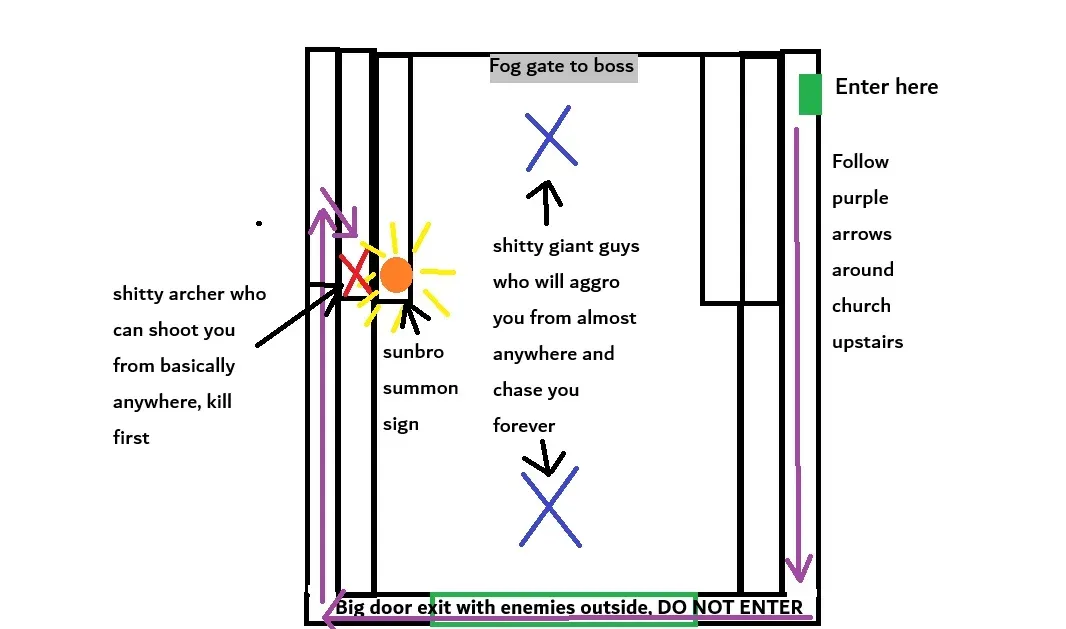
That is not because the player cannot reach the boss. The route from either of two nearby bonfires is long, but manageable. One path is relatively empty before ending in two unavoidable large knights; the other contains Silver Knights who can be outrun. Neither is especially hazardous on its own. The complication begins in the final church-like room, where a desire to bring Solaire of Astora into the boss battle turns an otherwise simple sprint through the fog into a repeating combat chore.
It is an extremely Dark Souls kind of problem. The game’s reputation for difficult bosses is deserved, but its more particular cruelty often comes from the systems surrounding those bosses: enemy placement, limited healing, resource consumption, a long reset after death, and the stubborn human belief that the preferred plan will surely work perfectly on the next attempt. While plenty of players may be passing time on a long GTA VI countdown, Anor Londo offers a reminder that an older challenge can still find fresh ways to become personal.
The boss door is close. The sun bro is not.
A player who intends to face Ornstein and Smough alone can simply run through the room and enter the fog gate. The friction comes from choosing to summon Solaire, the memorable NPC ally whose sign lies on the far side of the space. Reaching it means moving from the upper right side of the room to the left, descending stairs, activating the sign, then leading Solaire back down toward the boss entrance.
That sounds like a small detour. In practice, the room’s enemies have such a wide aggro range that the detour cannot be treated as a harmless jog. “Aggro” is player shorthand for the state in which an enemy has detected a character and commits to attacking or pursuing them. Here, enemies can detect the player from much of the church, making it difficult to route around them or shake their attention before summoning help.
There is another delay built into the system: activating a summon sign takes several seconds. That removes the dream of racing past the hostiles, grabbing Solaire instantly, and escaping to the fog door before anything matters. Once Solaire appears, the problem becomes more complicated rather than less. If hostile enemies remain alive, he can engage them instead of following the player into the boss arena.
Sometimes that means Solaire loses health in an unnecessary skirmish before reaching Ornstein and Smough. Sometimes it means he simply stays behind, fighting indefinitely while the player goes on alone. Since an NPC companion is meant to split attention and create openings in a difficult dual encounter, having him arrive damaged—or not arrive at all—undercuts the exact reason he was summoned.
The practical answer is brutally clear: clear the room first. The emotional answer is less cooperative. Clearing the room means turning every boss attempt into a miniature endurance test, even when the player would much rather preserve time, Estus, weapon-buff uses, and patience for the battle beyond the gate.
A three-enemy tax on every attempt
The room contains three enemies that matter to this route: an archer upstairs and two large shield-bearing opponents below. The archer is the easy part. Sprinting directly at him avoids the arrows reliably enough, and he falls in two axe swings in normal circumstances, or three on a poorer run. He is not free, but he is predictable.
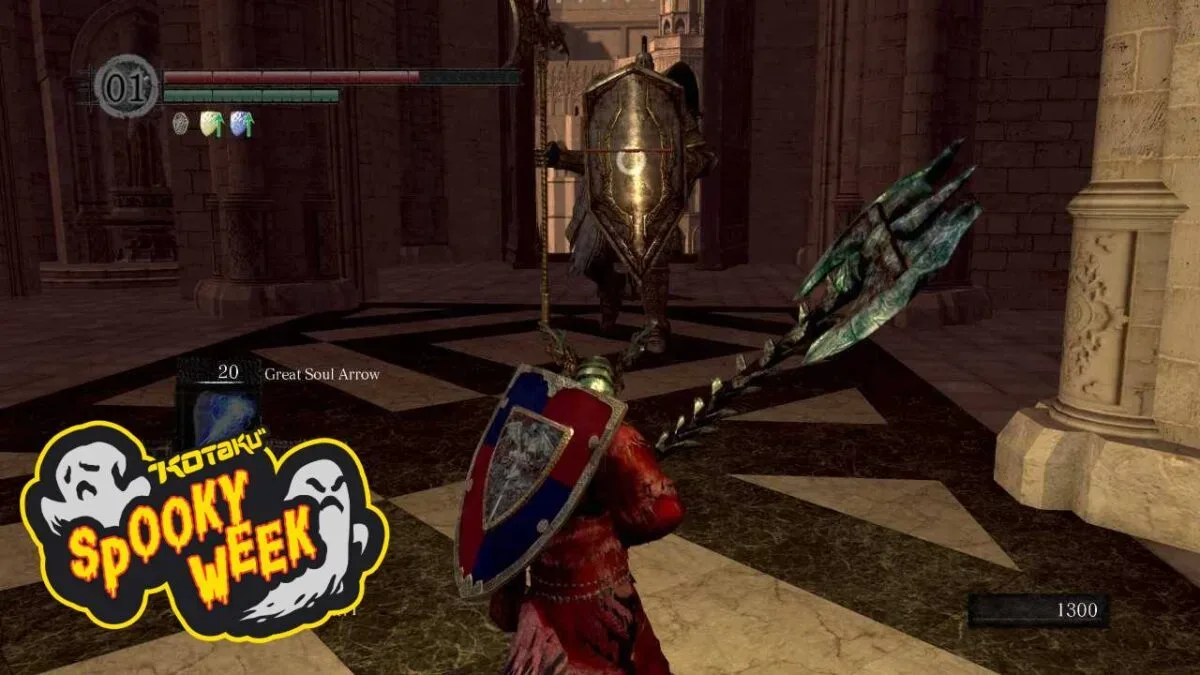
The two larger enemies are where the routine becomes oppressive. Their large shields negate frontal attacks, so the player must maneuver behind them for effective hits. They take several successful swings to defeat, can leap backward to disrupt positioning, and can use a knockback spell that pushes the player away. More irritatingly, they can heal themselves, extending a fight that is already being repeated before every serious boss attempt.
Their shield-slam attack is the real momentum breaker. It resembles a spear action closely enough to invite a mistaken read, but it has a much wider, more punishing impact. A player caught in it takes substantial damage, gets knocked down, must slowly recover to their feet, and can then be met with a spear attack immediately afterward. The sequence is a compact expression of the game’s central language: a readable move is not necessarily an easy move, and recognizing it a fraction too late can be enough to turn a stable attempt into a bad one.
None of this means the enemies are mechanically inscrutable. In fact, that contrast is what makes the room especially aggravating. They are slow. Their attacks are telegraphed. They can be killed cleanly. But a fight does not have to be inherently difficult to become difficult after being performed again and again under pressure.
When knowledge stops being the problem
There is a difference between understanding an encounter and executing it while frustrated. The room outside Ornstein and Smough demonstrates that difference perfectly. On paper, the player knows what to do: rush the archer, circle behind the shielded enemies, respect the slam, avoid wasting too much healing, summon Solaire, and go through the fog.
In reality, every repetition changes the stakes. Taking a hit from the shield slam no longer feels like one mistake; it feels like another flaw in a long chain of attempts. Spending Estus before the boss can produce an immediate sense that the run is compromised. A self-heal from an enemy is not merely a mechanic but a demand to repeat more of a task the player has already decided should be over. By the time the boss fight starts, mental fatigue may be doing as much damage as any knight.
This is where Dark Souls is both funny and merciless. Its worst moments are often not the grand set pieces that everyone expects to lose to. They are the tiny routines that become ritualized: a corridor run, an enemy pull, a mistimed dodge, a resource spent, a return to the bonfire, then another attempt to make the ideal plan work. The game does not need to change the room. The player’s relationship with the room changes for it.
The Anor Londo archers on the ramparts are a well-known frustration point, but this particular room can feel worse precisely because it lacks that spectacle. There is no narrow ledge and no immediately obvious punchline. It is a basic interior with a basic-looking group of enemies. Yet it stands between the player and a chosen version of the boss fight. The less dramatic obstruction becomes the more memorable one.
Solaire changes the value of the route
Why insist on taking Solaire at all? Partly, he is useful in a battle against two bosses. An ally can draw one opponent’s attention, giving the player breathing room and making the fight’s chaos more manageable. But that is only part of the calculation. Summoning a recognizable story character for a major fight gives the encounter a different texture. It turns survival from a solitary duel into a small act of companionship.
That preference is rational even when it is inefficient. Players do not make every choice solely to minimize completion time. They pursue strategies that are satisfying, thematic, or simply fun. In this case, “Praise the Sun” is not merely an in-joke; it is a commitment to entering the fight with a particular ally, even if the price is a miserable pre-boss cleaning job.
The irony is that the route makes the ally’s value conditional on a series of flawless or near-flawless chores. To use Solaire effectively, the player must keep him out of a battle, then spend additional effort ensuring he can participate in another battle. It is a wonderfully awkward example of emergent difficulty: no single rule is bizarre, but their combination creates a headache.
Humanity makes failure cost more
The pressure is intensified by Humanity. To summon Solaire, the player must use Humanity at a bonfire. That means an attempt can consume a finite resource before the boss encounter even begins. If the room kills the player before the summon is completed, the Humanity is gone without delivering the companion it was meant to secure.
Humanity is therefore more than a number in the inventory in this scenario. It represents permission to attempt the preferred strategy. Running out does not make Ornstein and Smough impossible, but it removes the option of trying them with Solaire until more Humanity is acquired. The player is pushed toward an unwanted detour: leaving Anor Londo, passing back through Sen’s Fortress, and returning toward Firelink to improve Estus and farm resources.
That detour is the final twist. A player trying to solve a local problem—getting an NPC across one room—can end up retracing a much larger section of the world to replenish the means of trying again. It is an inconvenience, certainly, but it also illustrates why the first Dark Souls remains so good at making its spaces feel consequential. Resources, location, route selection, and enemy behavior are tangled together. The game seldom lets one decision stay isolated.
The room is awful, and that is the point
There is no mystery solution promised by this horror story. The cleanest practical path is already apparent: eliminate the three enemies, summon Solaire, and save enough health and healing to make the boss attempt worthwhile. But recognizing the answer does not magically make the answer pleasant.
That is the enduring joke of this Anor Londo nightmare. Ornstein and Smough may be the legendary test waiting beyond the fog, yet the encounter that gets under the player’s skin is the ordinary room before it: an archer, two shields, a temperamental NPC ally, a dwindling Humanity supply, and one unwavering refusal to abandon the sun bro.
In a game built around death, repetition, and eventual mastery, that kind of stubbornness is not a side note. It is practically the whole sport.