A long-running mystery in the original PlayStation release of Tales of Destiny has apparently been solved: Lilith Aileros can be recruited legitimately. The catch is that the path is so restrictive that most ordinary playthroughs would shut it down almost immediately—and permanently.
The discovery arrives nearly 29 years after Tales of Destiny launched in Japan in 1997. It concerns the original PS1 edition, not the PlayStation 2 re-release, where Lilith’s status was changed. For players of the first version, she had long seemed unavailable through normal play. A newly circulated 26-step route says otherwise.
It is an especially striking find because this is not a secret unlocked by simply defeating an optional boss, finding a tucked-away switch, or reaching a high enough level. The reported route depends on a broad pattern of behavior across the game’s first part: what the player picks up, whether Stahn Aileron changes weapons manually, how certain conversations are handled, and even how often Lilith is spoken to in a particular location.
A hidden recruit route built around not doing things
In role-playing game terms, recruiting a character usually means meeting an explicit condition: completing a quest, choosing a dialogue branch, winning a fight, or finding an event trigger. Lilith’s apparent PS1 recruitment route is stranger. Its requirements are primarily prohibitions. Progress depends on avoiding actions that many players would regard as harmless, useful, or completely routine.
The broad principle has been described as keeping Stahn “clean” and obedient: follow the game’s destination prompts, avoid needless disruption, and move conversations forward. That sounds manageable until the individual failure states come into view.
- Taking items from homes can invalidate the route.
- Dungeon treasure is reportedly permitted, but items found in houses—including early healing or food items—can be disqualifying.
- Manually changing Stahn’s weapon during Part 1 can end the attempt.
- The silver ladle weapon must not be sold or discarded.
- Being reprimanded by certain NPCs, including Rutee Katrea, may lock the route.
- Skipping or interrupting particular conversations can cause failure.
- Some merchant interactions are apparently important enough to matter.
- Speaking to Lilith more than once in Leene’s Village can also break the sequence.
Those conditions should make clear why the discovery is significant, while also explaining why players did not simply stumble into it over the past several decades. The route is not merely obscure; it is fragile. A player can make what seems like a sensible inventory decision, grab a visible consumable from a house, or revisit an NPC out of curiosity and unknowingly close the door.
What happens if the route is preserved
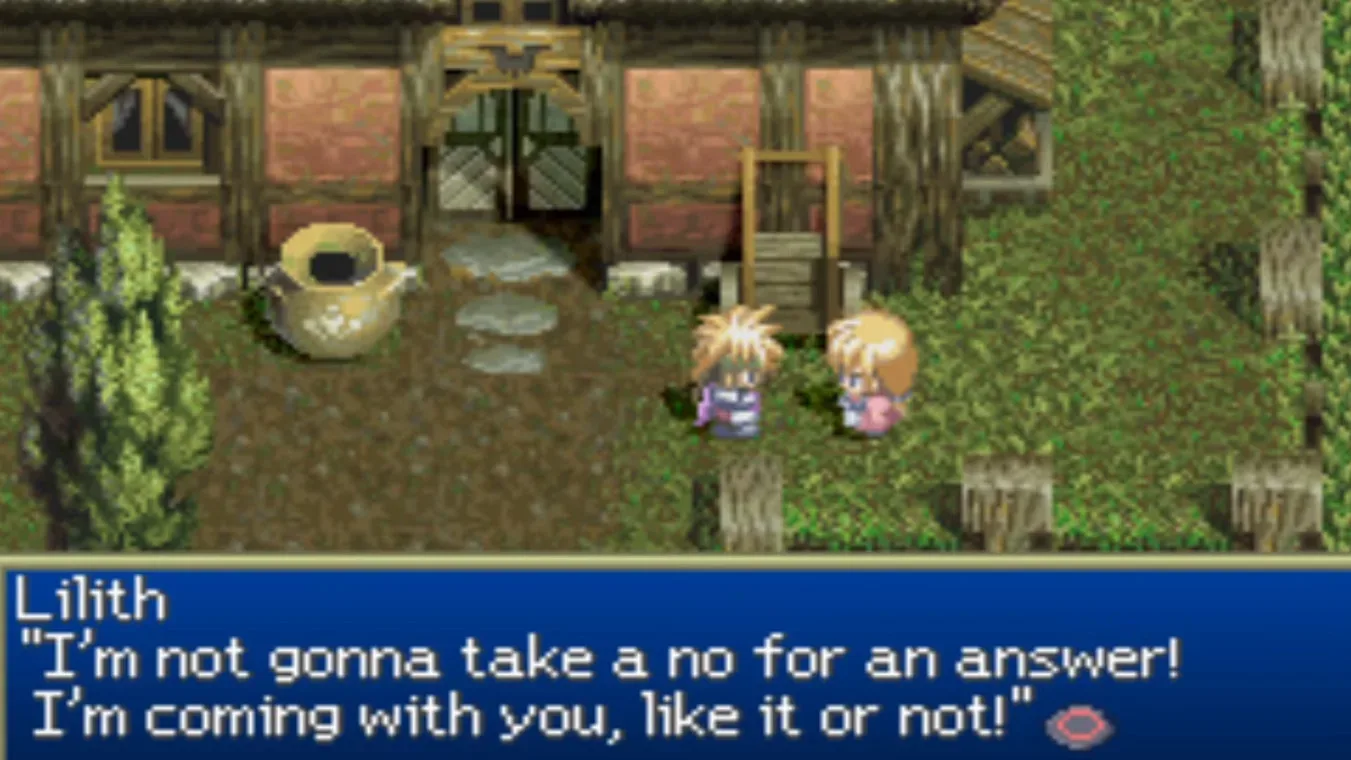
If all of the necessary conditions are maintained, Lilith joins the party in Part 2. Her recruitment scene is hardly shy about the outcome: she declares, “I’m coming with you, like it or not!” It is a delightful line for a character whose availability has been treated as impossible or inaccessible for years.
The available information supports the existence of a route and identifies several ways it can fail, but it should not be mistaken for a complete replacement for the full 26-step instructions. Players hoping to attempt it should work from the detailed sequence rather than assuming this checklist is exhaustive. With a condition set this exacting, one omitted conversation rule or misunderstood timing point may be enough to spoil a run.
Related coverage includes Tales of Destiny Players Finally Uncover a Legitimate Way to Recruit Lilith on PS1.
There is also an important practical distinction between a legitimate route and an exploit. A legitimate route means the result occurs through the game’s own intended event logic rather than through external modification, cheating hardware, save editing, or a glitch that corrupts normal progression. The fact that Lilith can be made to join through an in-game scene is the central revelation. It suggests that the original release contains a heavily guarded path that players had not successfully mapped.
Why this remained undiscovered for so long
Old games are often called “fully explored” once fans have written guides, documented items, and tested well-known secrets. This find is a useful reminder that full exploration is a much higher bar. A hidden condition can survive undetected when it is distributed over many ordinary decisions instead of attached to a single unusual event.
Consider the design of the reported requirements. Players are normally encouraged to search homes for supplies. RPG players regularly experiment with equipment. Talking to NPCs repeatedly is a standard habit, especially in older games where dialogue can change as the story moves. Selling a weapon that seems unimportant is an understandable way to manage inventory or obtain money. None of those behaviors reads as suspicious in isolation.
That makes the route a kind of negative-space Easter egg: it is revealed not by doing one obviously secret action, but by leaving a surprisingly large number of expected actions undone. More importantly, there is no indication that a typical player would be clearly told they had failed. A hidden flag—an internal variable used by a game to track a choice or state—can be altered long before its eventual consequence is visible. By the time Part 2 arrives, the player may have no reason to connect a missed recruitment scene with an Apple Gel picked up hours earlier.
That is the technical heart of why secrets like this can endure. A game can combine multiple flags, dialogue checks, inventory checks, and event states into one conditional scene. If all conditions are true, the event plays. If even one is false, it does not. Without a known trigger, a complete disassembly or data investigation, or an extraordinarily patient community testing every variable, the secret can remain buried.
A route for careful replay, not a casual first run
For anyone planning to replay the PS1 version specifically for Lilith, the sensible approach is to treat the attempt as a guided challenge rather than a normal adventure. Make a dedicated save at the start, consult the complete step-by-step sequence before entering a new story section, and resist the urge to improvise. Do not assume an innocent detour is harmless just because it would be in another playthrough.
That may sound severe, but it also gives the discovery its charm. The route does not simply add another party member; it asks players to see familiar opening hours through an entirely different lens. Homes become potential hazards rather than free-item caches. Routine conversations become state-sensitive. The silver ladle becomes an object worth protecting. The story’s early prompts become directions to follow with almost comical discipline.
This sort of preservation-minded replay fits the appeal of retro game communities. A title can be decades old, documented, replayed and revisited, yet still yield something concrete when players compare notes and test assumptions. The PS1 library continues to produce that kind of surprise; the era remains a point of fascination well beyond Tales of Destiny, as shown by ongoing discussion around other foundational PlayStation games such as the original Tomb Raider.
What the discovery does—and does not—mean
The newly identified sequence does not establish that every rumored secret in every older RPG is real. It does demonstrate why certainty should be handled carefully. A character believed unobtainable in one edition may not be absent from the game at all; their event may be obscured behind requirements that no conventional guide had pieced together.
It also underscores the need to keep versions separate. The PS2 re-release altered Lilith’s availability, while the revelation here concerns the original PlayStation version. “Can Lilith be recruited?” is therefore not a single universal question. The answer depends on which release is being played and, for the PS1 game, whether the exact condition chain remains intact.
For Tales of Destiny fans, the immediate reward is straightforward: a fresh reason to revisit a 1997 JRPG with a strict new objective. For game preservation enthusiasts, it is a compact example of why old software is not exhausted merely because it is old. Sometimes the secret is not in a forbidden room or at the end of an impossible dungeon. Sometimes it is hidden in every little thing a player was never supposed to do.