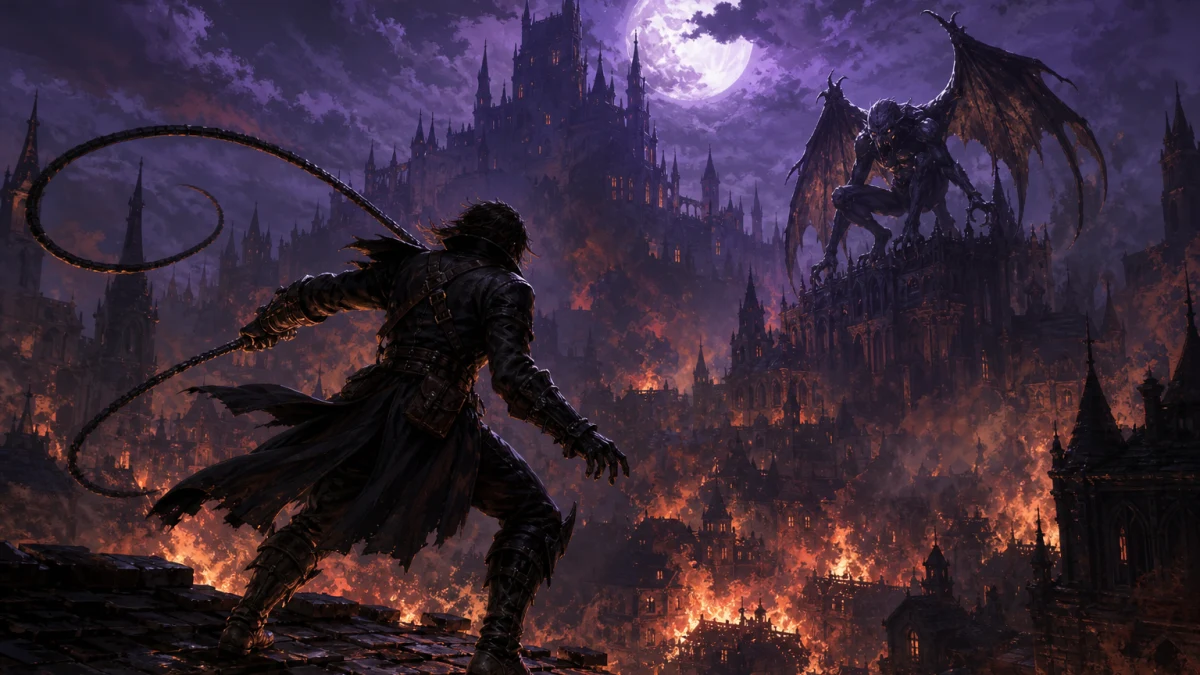
Castlevania: Belmont’s Curse has a more precise fast-travel system than its Ferryman route initially suggests. If you are trying to revisit a particular room in Paris or Dracula’s Manor, do not settle for transport that only drops you in a broad region. Save-point mirrors can become direct travel points, letting Rose move from one unlocked mirror to another.
The catch is that the interaction is easy to overlook: approach a save-point mirror, crouch or kneel in front of it, and wait for Rose to enter the mirror world. That is where the mirror-travel options appear.
How mirror fast travel works
- Find a save-point mirror you have already unlocked.
- Stand in front of the mirror.
- Crouch or kneel and wait for Rose to transition into the mirror world.
- Select from the other unlocked mirrors available to you.
Early on, this system provides access to nearly every mirror you have activated within the current zone. After progressing far enough in the story, its reach expands: Rose can travel among mirrors throughout the game. At that point, the mirror network is the better choice when the destination is a specific area rather than simply the correct general territory.
That distinction matters in a large exploration game. The Ferryman remains a route between broad zones, while mirrors can cut down the backtracking needed to reach an individual boss door, unexplored passage, optional encounter, or suspected secret. Before setting off on a long return trip, check whether the location is closer to an activated mirror than to the Ferryman’s drop-off point.
The important detail the game can leave too quiet
Belmont’s Curse uses diegetic hints for much of its guidance. In plain language, that means clues are presented as part of the game world rather than as a prominent tutorial prompt or an objective marker. Notes, environmental details, and map information can all point players toward what to do next.
That approach suits a game built around exploration, but it has a downside: a player can miss a system even when it is fundamental to comfortably navigating the map. The mirror feature is especially vulnerable to that problem because its input is not the kind of action many players would automatically try at a save point. A person who uses mirrors only to save may never discover that crouching in front of one opens an entirely different layer of travel.
In practical terms, make kneeling at a newly found mirror part of your routine. If a mirror is available, test it immediately after activating the save point. Doing so reveals whether it connects to other mirrors in the zone and helps establish a mental map of the routes you can use later.
When to use mirrors instead of the Ferryman
The Ferryman is not useless; it serves the purpose of moving between major areas. But it is less efficient when the task is highly specific. Mirror travel is the stronger option in several common situations:
Related coverage includes Castlevania: Belmont’s Curse Has a Crucial Mirror Fast-Travel Trick.
- Returning to an unfinished room: If you remember a locked route or obstacle near a particular save mirror, use that point rather than entering the entire zone from its broad travel destination.
- Chasing optional content: Bonus bosses and other side content are outside the critical path, so their routes may require repeated visits to older sections.
- Following clue chains: A hint may send you back to an area you thought was complete. Direct mirror travel reduces the time spent retracing familiar screens.
- Cleaning up secrets: The map can tell you whether a section still contains something undiscovered, making mirrors useful for targeted return trips.
There is also a simple planning benefit. Before choosing a transport method, decide whether your destination is a zone or a room-adjacent checkpoint. Choose the Ferryman for the former and a mirror for the latter, assuming the relevant mirror has been unlocked and your story progress has opened the necessary range of travel.
Use map colors to focus your backtracking
Mirror fast travel becomes even more useful alongside Belmont’s Curse’s map-color system. A map section with a brown background is complete. A section with a purple background still has a secret waiting to be found.
This is an important distinction: the color is not merely decoration or a vague measure of how much of the map has been uncovered. It can serve as a direct signal that an area still contains hidden content. That means players looking to fully clear the game do not need to sweep every room equally. Start with purple sections, then use the closest available mirror to narrow the search.
The system is especially helpful before obtaining the item that alerts Rose to nearby secrets. Until then, purple map areas can serve as a broader investigation list. They do not identify the exact wall, floor, or route containing the secret, but they confirm that another discovery remains in that section. Brown areas, meanwhile, can be set aside with more confidence.
A clean-up route that avoids wasted travel
- Open the map and identify purple-background sections.
- Pick one section rather than bouncing between several regions.
- Travel to the nearest unlocked mirror.
- Search the local rooms and follow any environmental clues you have found.
- Check the map again after finding an item, route, or encounter.
- Move on once the section turns brown, or return later if the remaining secret needs an ability or story progression you do not yet have.
This method does not replace exploration, and it does not guarantee that every secret is immediately accessible. It does, however, stop a full-completion attempt from becoming a series of long, unfocused trips through places that are already cleared.
Optional bosses make navigation knowledge more valuable
Belmont’s Curse includes bonus bosses and other discoveries that are not required by the main route. The Mammon encounter is one example: its door opens only after collecting three special items. Clues found through exploration indicate where those items can be sought.
That structure explains why efficient travel matters. Optional objectives often ask players to interpret a clue, recall an earlier location, collect several separate requirements, and then return to the relevant gate or arena. Without mirror travel, every leg of that process can involve an unnecessary detour through a large zone. With it, the player can treat unlocked mirrors as a working network of investigation points.
It is also worth keeping story progression in mind. The system does not immediately provide game-wide mirror access. Early on, its use is more limited to mirrors in a specific zone. The wider network comes only after reaching a certain point in the story. If a desired mirror destination is unavailable, that may be a progression limitation rather than a missed input or a broken route.
Why this is more than a convenience trick
Fast travel is sometimes viewed as a purely optional quality-of-life feature, but in a game with a large map and substantial optional content, it also changes how approachable exploration feels. A broad-zone transport system is enough for forward story progress. Precise checkpoint travel is what makes revisiting old mysteries, gathering multi-part requirements, and checking incomplete map sectors less laborious.
Belmont’s Curse is clearly designed to reward observation. Its world-integrated clue system, the Mammon requirements, and the brown-versus-purple map readout all encourage players to pay attention. The mirror network fits that philosophy as a hidden discovery in its own right. Yet a movement tool that can remove repeated traversal is valuable enough that it is worth knowing plainly, rather than hoping to happen upon it.
For players who enjoy the game’s riddles, the best compromise is straightforward: preserve the joy of solving the world’s optional puzzles, but remove avoidable travel time. Kneel at each save-point mirror, learn the network as it expands, and reserve the Ferryman for cases where a broad zone transfer is all you need. For more thoughts on horror games that embrace unusual design choices, see our look at games that refuse to behave.