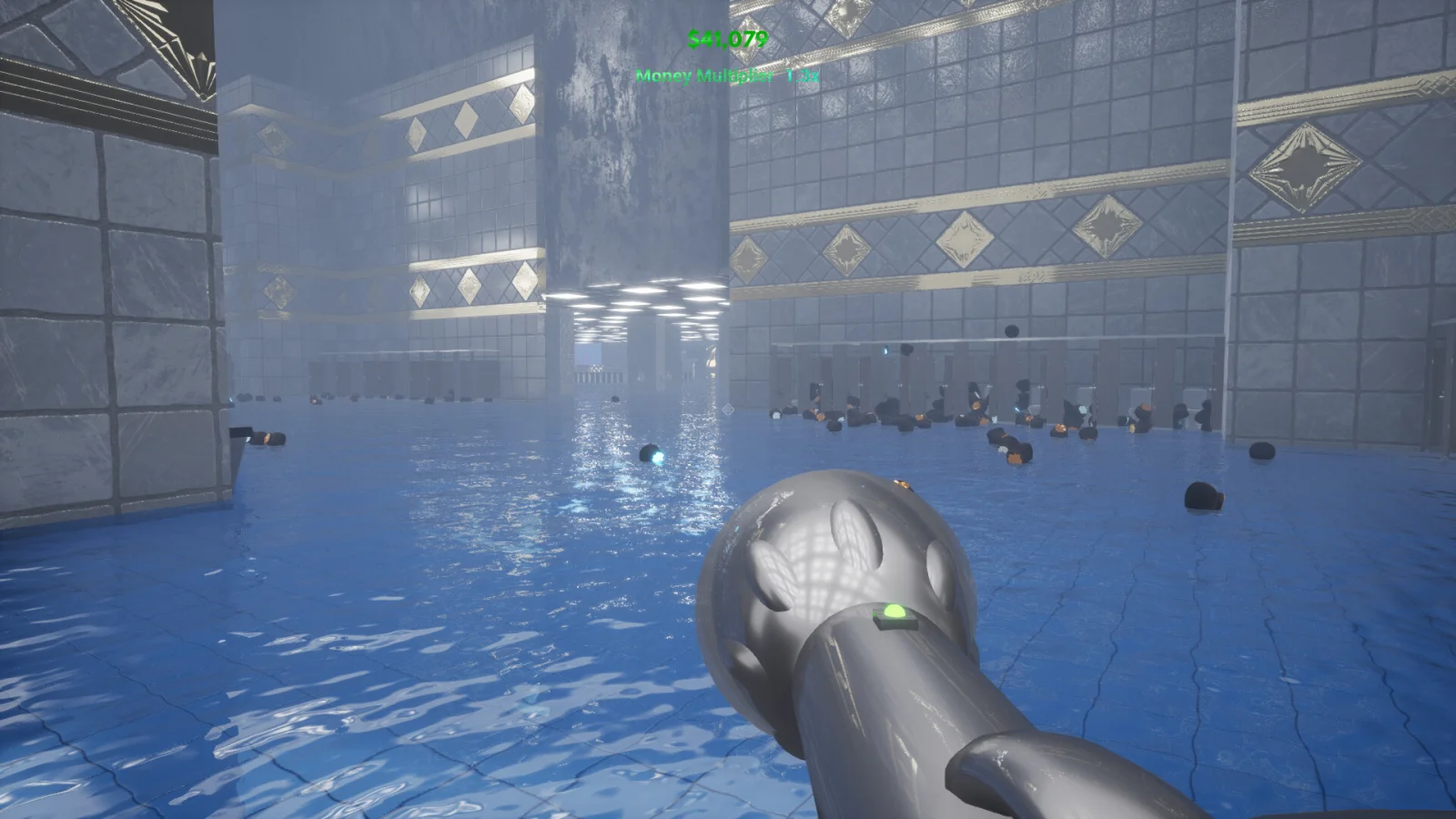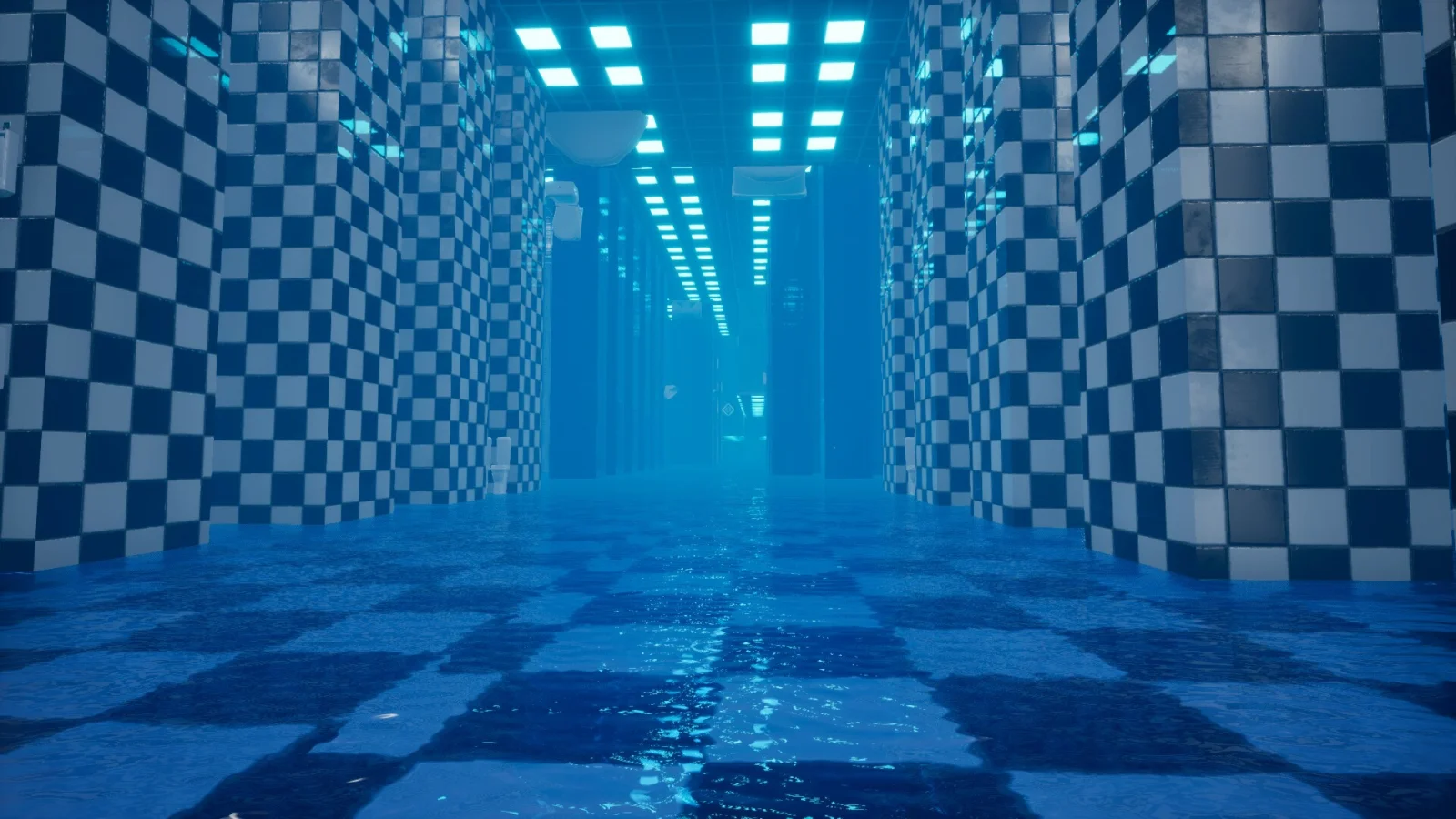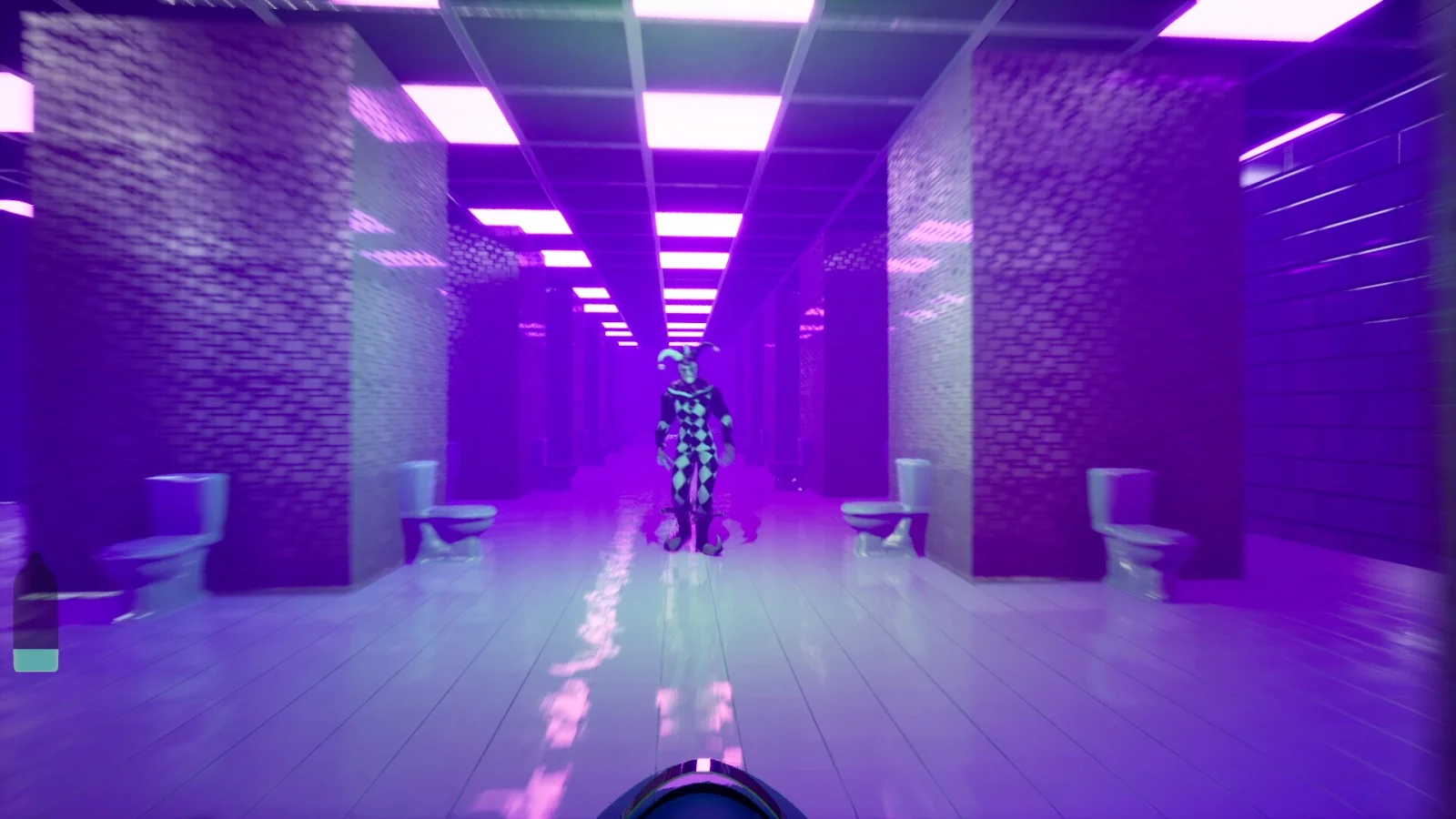
THE BATHROOMS is a first-person horror and adventure game for Windows PC, released on May 17, 2024. Developed and published by Alien Palace, it begins with an immediately unsettling transformation: after a ritual, a school bathroom becomes a shifting tiled labyrinth. That premise has an inherent advantage over a generic haunted building. A bathroom is usually a confined, mundane, highly functional space, defined by fixtures, stalls, mirrors, and the expectation that its layout should be easy to understand. Turning that familiar environment into a maze attacks the assumption that a recognizable place will remain navigable.
The game’s larger hook is that leaving is not presented as a simple matter of finding a door. Players collect coins to purchase an exit ticket, and an upgradeable vacuum can gather those coins faster. Keys can also be sought to rescue a pet Shiba, creating an alternative stated objective. Meanwhile, the Custodian pursues the player, with stalls identified as one hiding option; an orb can locate keys and sense danger, while a clown gun can be used to confront the threat. Optional slot-machine gambling and copium, which increases coin value, add still more pressure around risk and reward.
This is a crowded set of ideas for a single-location horror premise. The essential question is not whether THE BATHROOMS has systems to spare. It plainly does. The more interesting question is whether its collection tools, escape objectives, pursuit threat, and surreal humor reinforce one another. At its best, the design could make every extra minute in the labyrinth feel like a decision between safety, profit, rescue, and uncertainty.
Escape as an economic decision
The exit-ticket objective gives THE BATHROOMS a notably transactional form of dread. In a conventional chase-horror setup, danger generally creates a straightforward instruction: run, hide, or reach the next safe point. Here, coins are tied directly to the stated route out. That changes the emotional texture of exploration. The labyrinth is not merely a place to survive; it is also a place from which value must be extracted.
The upgradeable vacuum reinforces that logic. Rather than treating coins as isolated pickups, the game frames their collection as something that can become more efficient. Copium, which raises coin value, adds another documented economic lever. Together, these systems suggest a loop in which gathering resources, improving collection, and judging when to stop may matter as much as simply avoiding the Custodian.
That can be a strong horror structure because it creates temptation. A player may have a reason to stay in an unsafe space even after finding a path forward. More coins could bring the exit closer. A vacuum upgrade could make future collection more productive. A higher-value resource could make a risky detour appear worthwhile. None of those possibilities guarantee satisfying tension on their own; their effectiveness depends on practical details such as costs, availability, and the clarity of the game’s feedback. But the design premise is coherent: greed and self-preservation are intended to pull in opposite directions.
There is also a potential tonal benefit to making escape purchasable. It makes the maze feel less like a purely supernatural puzzle and more like a hostile, absurd institution with its own perverse rules. A ticket is an ordinary object associated with access and transit, but using one to leave a nightmare bathroom labyrinth makes the goal faintly bureaucratic as well as frightening. That kind of mundane absurdity fits the setting’s warped familiarity.
Two objectives, different stakes
The ticket is not the game’s only stated way forward. Players can alternatively find keys and rescue a pet Shiba. This matters because the two objectives suggest different emotional priorities. Purchasing an exit ticket is direct and self-protective: gather value, obtain access, leave. Looking for keys to save the dog has a more outward-facing appeal. It offers a reason to enter or remain in dangerous territory that is not simply about the player’s own escape.
There is no basis to define how these routes intersect, whether both can be pursued in one run, or what outcomes attach to either objective. Still, their contrast is meaningful at the level of design. One route is built around accumulation; the other is built around rescue. One may appeal to players who prefer a clear resource target, while the other may carry greater emotional urgency for players who want horror objectives to mean more than personal survival.
The crucial issue is distinctiveness. Alternative goals become genuinely compelling when they demand different decisions, not merely different collectibles. If coins, keys, and danger information draw attention toward separate parts of the labyrinth, the game could make navigation feel less predictable. If their demands substantially overlap, the thematic difference between escape and rescue may matter more than the moment-to-moment play. Either way, THE BATHROOMS has a stronger premise than a maze with only one declared endpoint.
The Custodian, hiding, and confrontation
The Custodian is the game’s pursuing threat, and Alien Palace describes it as adapting to the player. That wording should not be expanded into claims about exactly how its behavior changes, how frequently it adjusts, or how much information players receive about its responses. What it does establish is an intended concern with habits. A pursuer described as adaptive invites the possibility that a dependable tactic may not remain dependable forever.
Hiding in stalls is one documented option for escaping the Custodian. In a school bathroom setting, that is a particularly apt use of space: the stalls are not just set dressing but a stated refuge. The clown gun offers a sharply different response by allowing players to confront the Custodian. These facts position THE BATHROOMS between evasion and resistance rather than declaring a single mandatory approach to danger.
That range has the potential to produce useful tension. Hiding can support vulnerability and suspense, while confrontation can give a player a more assertive answer to pressure. The value of offering both is not that one is automatically superior, but that the player may need to decide how much danger is worth engaging. If the game’s information and resource systems make that choice legible, the Custodian could become a force that changes priorities instead of simply interrupting exploration.
The clown gun is also revealing as a tonal signal. A tiled school labyrinth, a ritual, and a pursuing Custodian evoke claustrophobic institutional horror. A weapon marked by clown imagery introduces a strain of absurd or comic-horror strangeness. That contrast may be part of what separates THE BATHROOMS from a more uniformly solemn chase game. Players drawn to horror that mixes unease with bizarre imagery may find the idea appealing; players seeking an unbroken atmosphere of seriousness may be more selective about that blend.
Navigation, uncertainty, and partial information
The orb is described as both a key-finding tool and a way to sense danger. In a shifting labyrinth, that combination is potentially central. A maze becomes frustrating when uncertainty provides no actionable information, but it can become tense when players have incomplete clues they must interpret. An orb that points toward objectives while also warning of danger could connect navigation directly to survival.
Whether its signals are precise, limited, or easy to read is not established. Yet the broad design logic is sound. The player is not merely looking for keys; they may be weighing the value of a lead against the possibility of approaching the Custodian. The orb therefore has the potential to make information feel like a resource rather than a simple convenience.
A favorable critical perspective has discussed the game’s first-person interaction, movement, visual detail, music, copium, and guiding orb, while also identifying procedural layouts and the apparent choice between fighting and fleeing as sources of unpredictability. Procedural layouts, if central to the game’s structure, suit the premise of a bathroom that no longer obeys ordinary spatial logic. They may make memorization less reliable and preserve uncertainty around routes, hiding places, and objectives.
That same approach involves a trade-off. Randomized or procedural space can encourage surprise, but it may provide less of the carefully authored pacing associated with a fixed environment full of deliberate landmarks and sequences. Players who enjoy adapting to partial information may appreciate that uncertainty. Those who primarily want tightly controlled environmental storytelling may want the labyrinth’s readability to be especially convincing.
A deliberately off-kilter horror mix
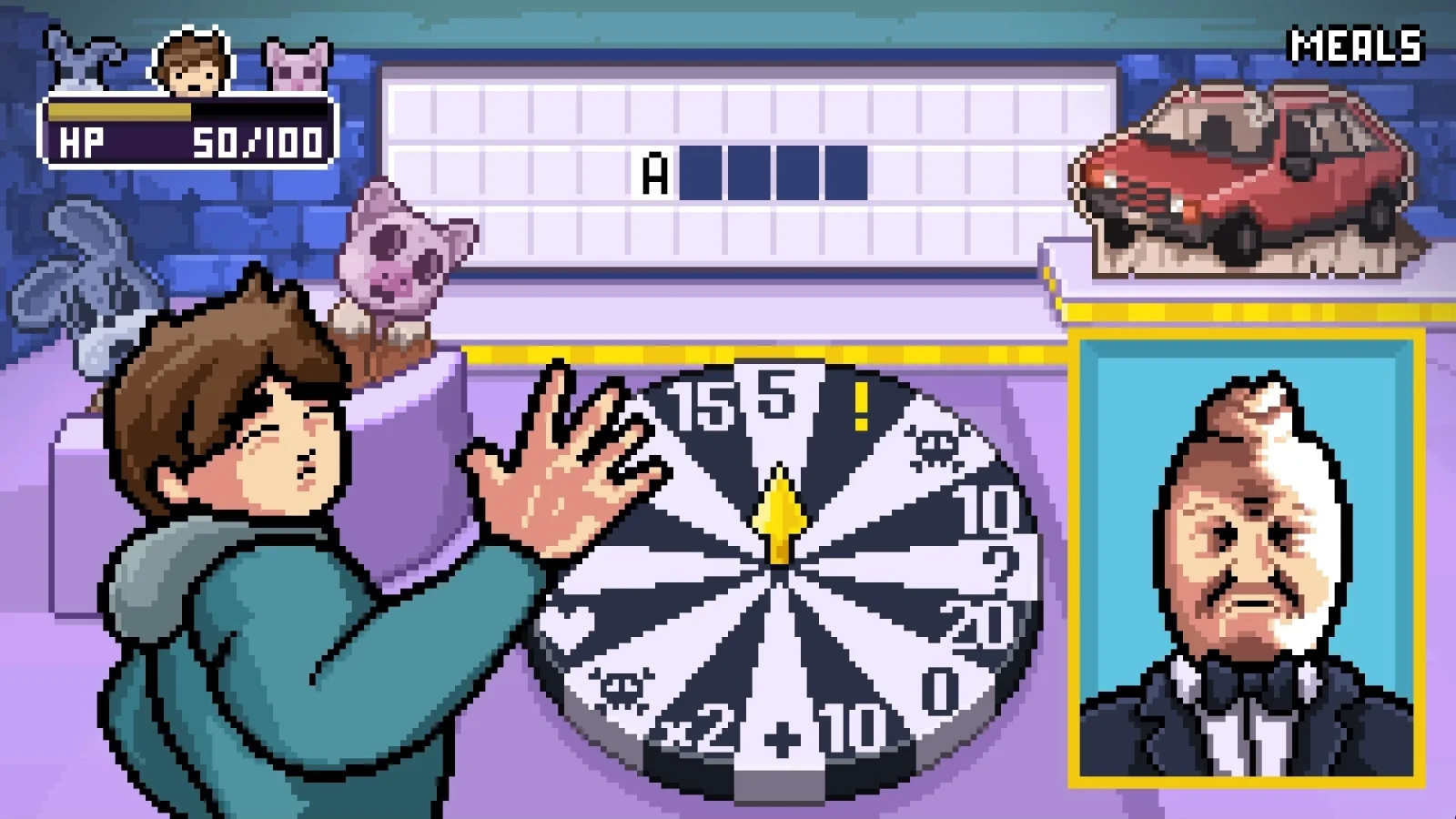
Optional slot-machine gambling extends the game’s interest in risky value-seeking. Coins already make it possible to imagine a player lingering in danger for greater returns. Gambling introduces another layer in which value itself may be subject to chance. That is consistent with THE BATHROOMS as a horror design about opportunism: leave with what is available, or risk more in pursuit of a better outcome.
It is also where the game’s abundance of odd components becomes most visible. Copium, vacuum upgrades, slot machines, a clown gun, a rescue dog, keys, tickets, and a pursuing Custodian could form a deliberately unruly identity. This may prevent the bathroom-maze concept from feeling interchangeable with other first-person horror setups. It could also ask a great deal of the game’s presentation. Horror depends heavily on focus, and a design with many competing incentives needs to make their relationships understandable.
For a different PC assessment focused on how a busy premise depends on clear player-facing information, read Grannies on Wheels and its test of chaos and legibility.
Who THE BATHROOMS may suit
THE BATHROOMS may be a strong match for players who want horror built around navigation, gathering, and shifting priorities rather than a strictly linear sequence of scares. Its most distinctive documented quality is the way objectives appear to complicate the basic desire to leave. The ticket offers a defined escape target. The Shiba rescue adds another kind of stake. Upgrades and copium suggest reasons to seek further value. The orb turns knowledge about objectives and danger into part of the decision-making. The Custodian ensures that those decisions take place under threat.
Players interested in one consistent mood should note the game’s conspicuously eccentric tools and optional gambling. That is not inherently a weakness; it is an indication that THE BATHROOMS appears to pursue a stranger flavor of horror than a purely bleak school-labyrinth story. Likewise, the possibility of procedural layouts may appeal to players who value uncertainty over route memorization, while making it less immediately suited to those who prefer carefully authored spatial progression.
Unscored verdict
THE BATHROOMS presents a memorable horror proposition: a school bathroom made monstrous by a ritual, an exit that must be financed, keys that may lead to a Shiba rescue, and a pursuing Custodian that can be hidden from or confronted. Its documented systems suggest a game where fear is not isolated from incentive. Coins, upgrades, danger sensing, optional gambling, and competing objectives all potentially make staying in the labyrinth as important a choice as leaving it.
The promise lies in that collision of motives. If its tools provide enough clarity to make risk feel deliberate, THE BATHROOMS could offer a distinctive blend of pursuit horror and resource-driven exploration. If its many components compete too loudly for attention, its strongest atmosphere may have to work harder to hold them together. Either way, the game’s identity is unmistakably strange, and its best idea is that escape is not simply found: it must be decided upon.