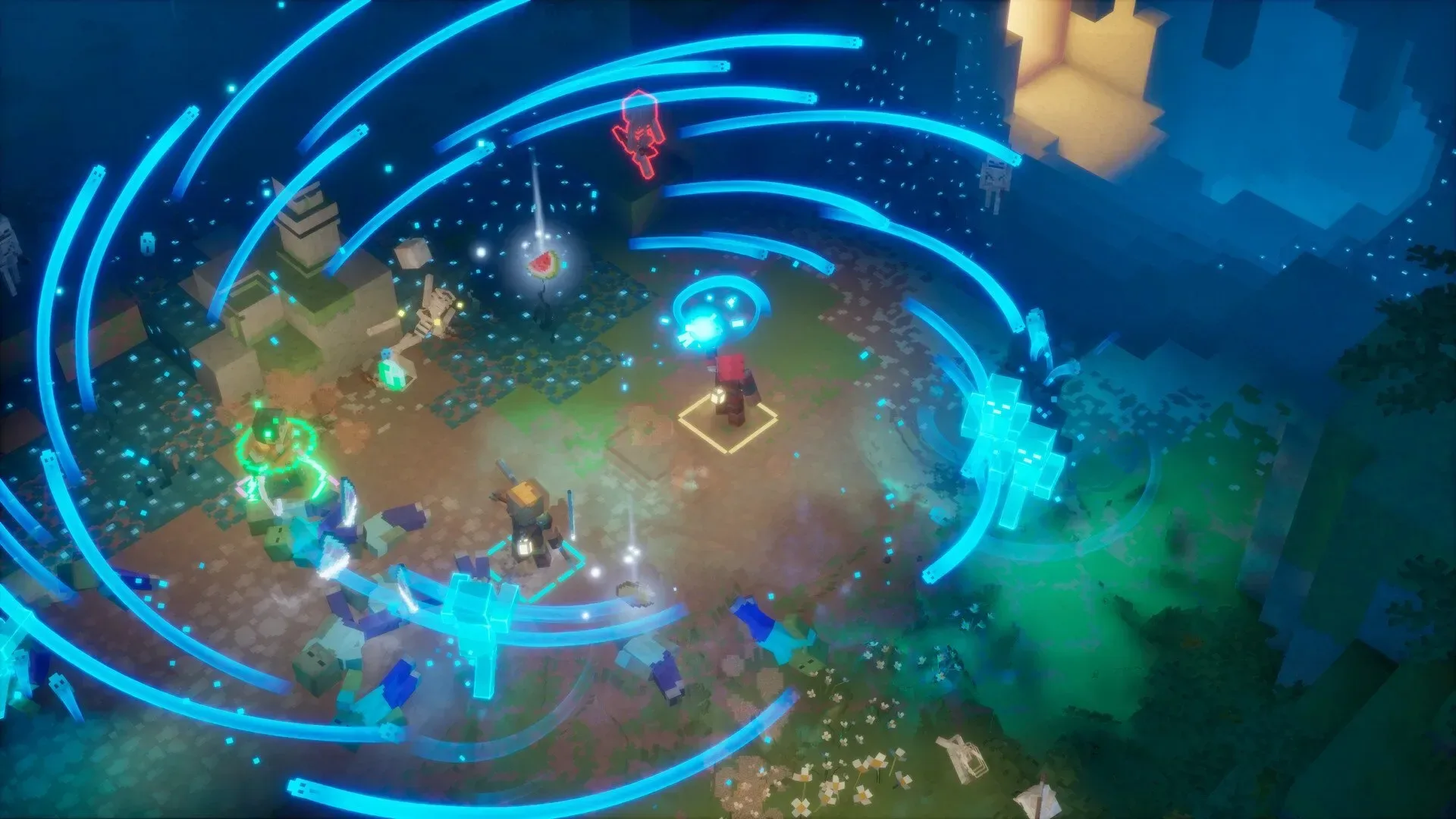
Minecraft Dungeons II understands the appeal of an approachable action-RPG: enter a hostile space, clear a crowd, collect a new tool, and chase the possibility that the next combination will make the whole machine click. It is a more polished and more ambitious follow-up to Minecraft Dungeons, with a jump that makes navigation feel freer, clearer menus, more enemy and weapon variety, and a broader setting that reaches beyond the familiar Overworld. Yet its central pleasure arrives unevenly. The game can eventually produce a wonderfully forceful character build, but it asks players to spend much of its short run accepting upgrades without a strong sense of ownership over their direction.
That split defines the experience. As a straightforward entry point to the action-RPG dungeon crawl, it has real strengths: accessible systems, readable information, recognizable Minecraft-inspired equipment, and co-op matchmaking that can turn a completed personal progression path into an opportunity to assist others. Players seeking a long-term loot game with a rich endgame, however, should temper expectations. The adventure is short, its narrative does not land with much force, and the available post-campaign routine appears narrow.
Movement and presentation make the sequel immediately easier to read
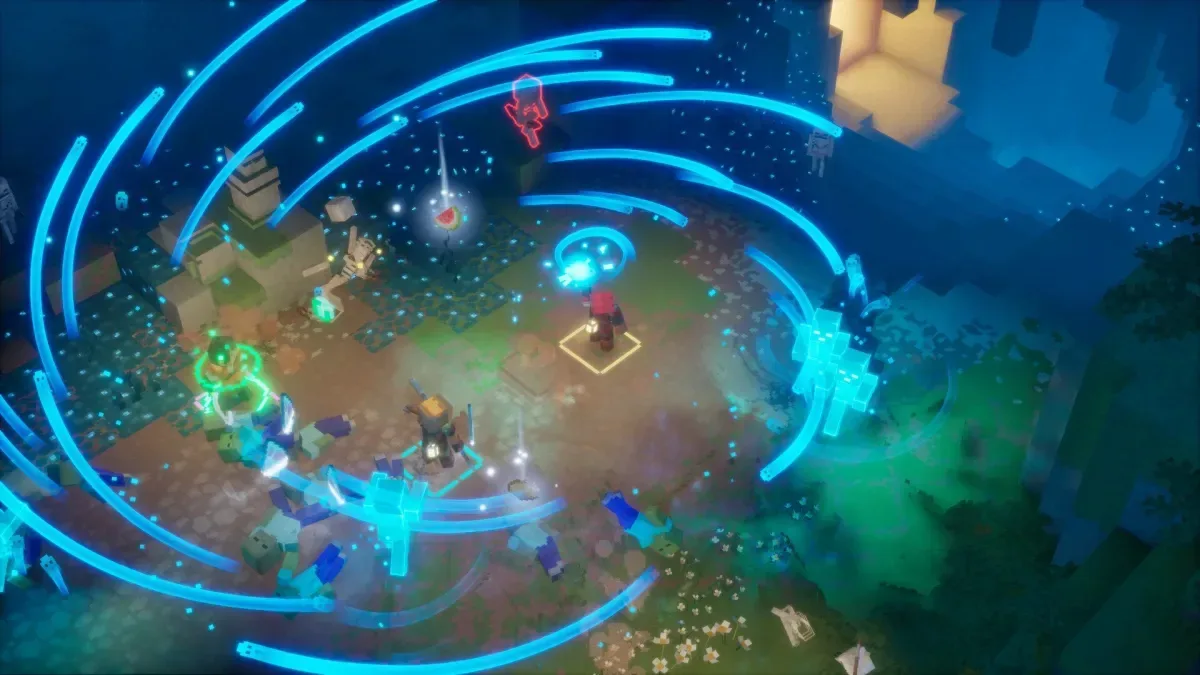
The most obvious advancement is not necessarily a new weapon or a bigger damage number; it is mobility. Adding a jump gives traversal and moment-to-moment positioning more fluidity than before. In an isometric action game, even a modest expansion of movement options can make spaces feel less like corridors between fights and more like places a player actively navigates. Here, the jump helps the sequel feel less stiff while supporting a more comfortable rhythm through its environments.
The interface improvements matter for the same reason. An item-driven game lives or dies on whether players can understand what they have acquired and why it might matter. Minecraft Dungeons II does a better job of surfacing important information through its menus, a practical enhancement that supports experimentation even when the wider progression design is less persuasive. More enemy and weapon variety also gives the game a stronger baseline texture. It is not merely revisiting the first game’s formula with a new map; it is refining several of the small, essential pieces that keep a loot-driven crawl moving.
The visual connection to Minecraft remains a major part of its appeal. The Overworld is rendered from an isometric perspective, and recognizable tools are repurposed as weapons. That makes the game legible to Minecraft fans without requiring it to reproduce Minecraft’s usual activities. Mining and crafting are not major parts of this adventure, so prospective players should approach it as an action-RPG spin-off with Minecraft aesthetics and lore rather than a substitute for the sandbox game.
A flexible build system without a convincing sense of direction
Minecraft Dungeons II avoids class-based progression. There is no fixed commitment to a conventional archetype such as a Barbarian or Monk. Instead, weapons, armor, artifacts, and talismans provide different effects, while vendors allow them to be upgraded and enchanted. In principle, that is a permissive structure. A player can alter their approach as loot changes, rather than being permanently boxed into an early decision.
In practice, freedom is not the same as authorship. Progression can feel linear yet strangely aimless because individual drops do not necessarily become interesting until they have been improved with enchantments. The difference is important. Finding a powerful item can be exciting, but repeatedly using whatever is currently strongest does not automatically create the feeling of developing a preferred style. The system encourages adaptation, though not always intentional specialization.
There is nevertheless a convincing payoff waiting near the end. A build built around an Emerald Hammer that electrocuted nearby enemies, a piercing crossbow, and armor improvements that supported healing or enhanced potion effectiveness demonstrates the kind of synergy the game can produce. That setup turns the action into a more controlled power fantasy: enemies are handled through complementary effects, survivability has a clear role, and equipment choices begin to read as parts of a coherent plan rather than a pile of upgrades.
That is exactly the version of Minecraft Dungeons II worth wanting. The criticism is that it is reached too late. A game with a compact campaign should be especially careful not to reserve its clearest build expression for the point where much of the journey is already finished. Earlier opportunities to recognize a playstyle, pursue a meaningful equipment goal, or assemble a partial synergy could have made the road to the endgame feel more purposeful.
Bosses carry the early excitement
Before ordinary encounters become consistently entertaining through stronger artifacts and improved loot, boss fights provide much of the game’s energy. That creates an awkward progression curve. Boss battles supply the early highlights, while the broader enemy-clearing loop only gathers momentum once the character’s equipment has matured. The result is a sequel whose best systems are present, but not always synchronized: combat depth improves as the remaining content becomes less novel.
This does not make the core action ineffective. Rather, it makes the game feel as though it needs a little more time to demonstrate what its own item system can do. A player who enjoys adjusting gear, upgrading pieces, and discovering how effects interact may still find the path rewarding. Someone who wants standard encounters to feel compelling from the outset may notice the delay more sharply.
For readers interested in other games where a central design system determines how satisfying the whole experience becomes, our look at Furyball: Rogue Revenge considers a very different action framework facing a similarly consequential design question.
A short campaign and a limited reason to stay
The campaign can be completed in under 10 hours, with the available offering largely exhausted after roughly 15 hours. Brevity is not automatically a problem; a tightly focused action-RPG can be a welcome alternative to an endless seasonal commitment. The issue is where Minecraft Dungeons II places its strongest build satisfaction. If the most enjoyable character expression arrives around the endgame, then the game needs compelling reasons to keep using it. At present, those reasons appear limited.
Endgame activity consists of finishing incomplete side quests and destroying Storm Generators for randomized loot and upgrade currency. This can support a few more runs for players who enjoy tuning a build or simply want better equipment. It does not sound like a deep set of distinct endgame goals, however, and repetition is likely to become visible quickly. The game may be best treated as a concise action-RPG campaign with an extra loot loop, not as a destination designed to occupy hundreds of hours.
Co-op adds a warmer afterlife to that limited structure. Random matchmaking can be used to join weaker players and offer assistance, which gives a completed, powerful character a social purpose even after personal discovery slows down. That will not replace a more varied endgame for everyone, but it is a useful fit for players who enjoy helping in public sessions more than endlessly optimizing alone.
A light lore expansion with an incomplete dramatic finish
The story pits players against the Illager High Council after it discovers the soul-filled Sift dimension and seeks to use its power to control the Overworld. The Sift is an ethereal new dimension that is also set to arrive in Minecraft proper in 2027, giving this spin-off an unusually meaningful place in the larger fiction. Players who follow the scattered lore of the Minecraft universe have a tangible reason to pay attention.
Still, the narrative is light and breezy rather than the primary attraction, and its ending is unsatisfying. The game’s open-world setup across the Overworld and Sift offers an appealing frame, but player actions do not appear to change the world much. The environments provide flavor and scale; they do not deliver a strong sense of consequence. That is adequate for a loot-first adventure, but less effective when the story asks its new dimension and antagonists to carry dramatic weight.
Who should delve into the Sift?
Minecraft Dungeons II is easiest to recommend to players who want an accessible, relatively brief action-RPG and value Minecraft’s visual identity more than its crafting and mining traditions. It is also a sensible choice for players interested in flexible gear experimentation, boss encounters, or low-pressure co-op matchmaking. Its systems are noticeably improved, and its eventual build synergies can feel excellent.
Those looking for a class-led role-playing journey, a campaign full of lasting narrative consequence, or a broad and durable endgame should be more cautious. The item-first design offers options but does not always establish a satisfying personal path, and the content reaches its limits soon after the best builds start to shine. Minecraft Dungeons II is built better than its predecessor in key practical ways. It just needs to bring its most compelling version of itself closer to the beginning.