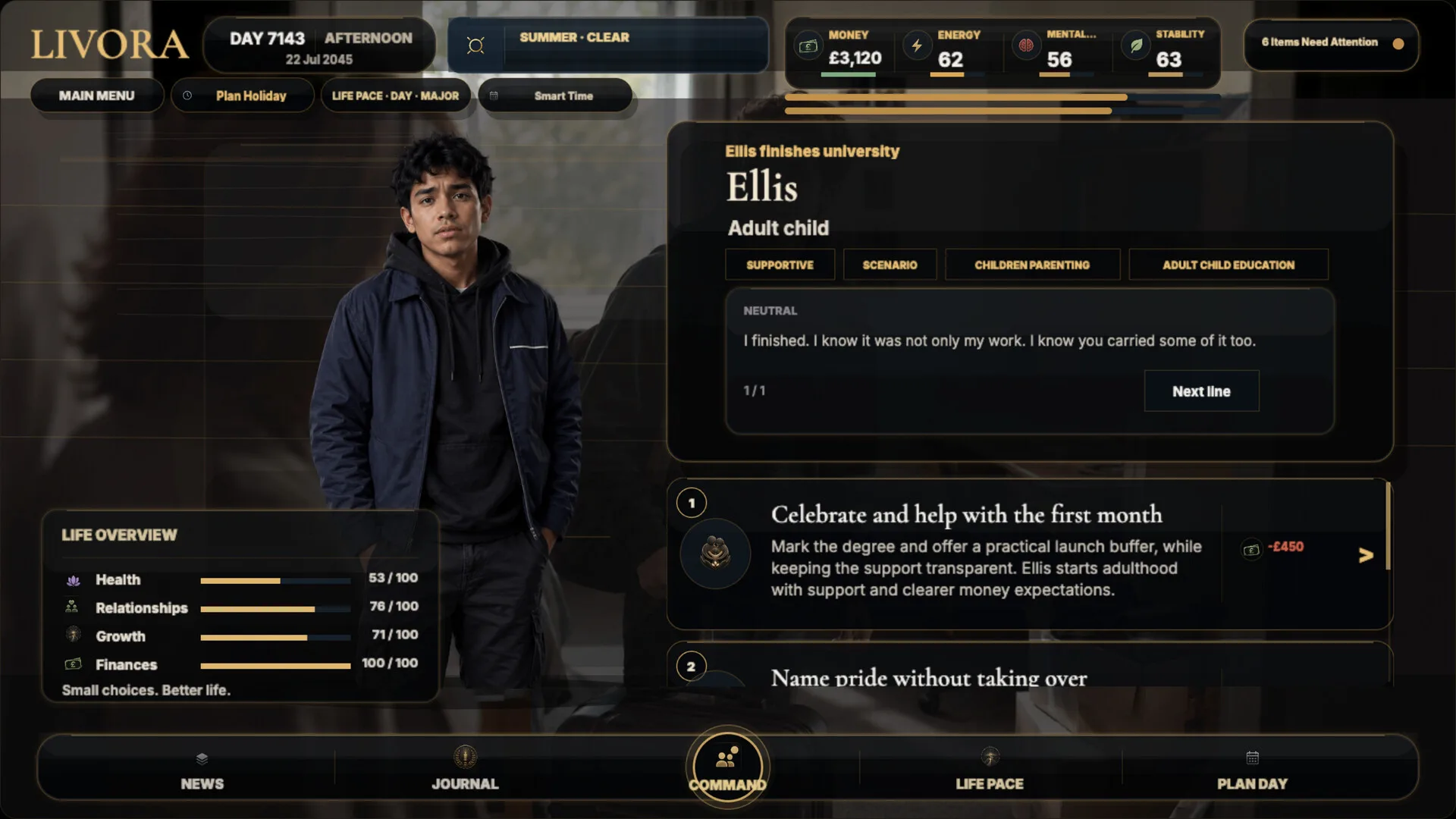
LIVORA is a single-player, choice-driven life simulation from developer and publisher Shift The Story, released for Windows PC on July 3, 2026. LIVORA presents education, work, money, relationships, family, health, time, housing, and location as connected parts of a life developing over years. That gives LIVORA an unusually wide brief: it is interested not merely in what a character does next, but in how one commitment can shape the options, pressures, and priorities surrounding another.
The result, at least in concept, is a game for players who enjoy considering the consequences of choices across a long horizon. It is also a useful contrast with life-sim expectations shaped primarily by visual home construction or freeform domestic staging. LIVORA’s published overview foregrounds personal planning, connected decisions, and the passage of time. That does not define every activity the game may contain, but it does establish a different central question: how does a player steer a life when there is no fixed class, perfect route, or single checklist of milestones that defines success?
LIVORA supports interfaces in English, French, German, Spanish as used in Spain, and Brazilian Portuguese. This gives readers who prefer one of those languages a confirmed interface option.
A life begins before adulthood, or at adulthood
LIVORA allows a character to begin in either Formative Years or Adult Life. This is more than a simple starting-age choice in the game’s stated structure. Formative Years covers childhood and adolescence, with family, school, friendships, memories, and qualifications carrying forward into adulthood. Adult Life, by comparison, offers a direct route into the later portion of the simulation.
Starting in childhood potentially changes the narrative setup before an adult career or household decision is even available. Family circumstances, school experiences, friendships, and qualifications are all described as elements that can be built during those earlier years. If those pieces meaningfully persist, then the adult character would not arrive as a blank slate. Their later choices could be framed by a history the player helped establish rather than by a standardized opening position.
This creates an appealing contrast in approaches. A Formative Years start may suit players who want to trace a longer personal arc and regard education or early relationships as part of the story’s foundation. An Adult Life start may appeal to those who would rather begin where work, finances, housing, and independent relationships are likely to become immediate concerns. Neither approach is presented as the correct one, which fits LIVORA’s broader rejection of a prescribed ideal path.
The important open question is how clearly the game expresses the significance of those earlier choices. Continuity is most interesting when players can understand not only that prior events are remembered, but why a qualification, friendship, family setting, or earlier decision matters later. A long-running simulation does not need to turn every childhood moment into a permanent advantage or penalty. It does, however, need enough legible connective tissue for a player to recognize an evolving life rather than a collection of disconnected time periods.
Time is the resource shared by every ambition
The most important connective system in LIVORA’s announced design may be time. The game includes a day planner, calendar, Life Pace, and Smart Time Advance, giving players tools to manage life over both everyday and longer-term intervals. Those features suggest that the game sees time not simply as a clock to accelerate through, but as the common resource behind its major decisions.
Money can be earned or spent, qualifications can be pursued, and relationships can be developed, but all of them require room in a schedule if the simulation makes its connections matter. A character considering study, a job change, a business venture, family obligations, health, or a move may have to weigh more than the immediate financial result. The potential design strength is in making these commitments compete for attention. A plan that improves one area of life might create pressure elsewhere, not because the game insists on a single right balance, but because time cannot be assigned everywhere at once.
That is where a calendar can become more than an organizational screen. It can establish rhythm: days for routine, periods for education or work, and longer phases where a decision gradually reveals its implications. Life Pace and Smart Time Advance could, depending on their implementation, help players choose how closely they want to manage that rhythm. A player interested in considered planning may want to pause over individual commitments, while another may want to move efficiently through established routines to reach a larger decision point.
A game about interconnected lives needs a way to prevent its many systems from becoming a pile of simultaneous abstractions. A planner and calendar can give the player a visible framework for deciding what deserves attention now and what must wait.
Work, money, home, and family as connected decisions
LIVORA describes career changes, business and self-employment, financial obligations, housing, property, relationships, and family decisions as connected systems. That language matters because it shifts the focus away from a narrow career ladder. Work is not presented solely as a rank to maximize, and housing is not framed solely as a decorative endpoint. Each belongs to a wider web of practical and personal decisions.
A career change, for example, has the potential to be more interesting when considered alongside money, time, qualifications, location, and family rather than as an isolated promotion choice. Similarly, business or self-employment can imply a different relationship to security and planning than conventional employment, with different demands on the player. Financial obligations may make a housing decision feel more consequential; a relationship or family decision may change what kind of home, schedule, or location seems workable.
The notable thing is that LIVORA does not advertise a perfect route through these subjects. That can be a valuable principle for a simulation of ordinary and extraordinary life turns alike. If every system points toward one optimal income, property, relationship, or family outcome, choice becomes decoration around a solution. A broader model can instead make different priorities meaningful: stability, study, independence, relocation, relationships, or family continuity might each lead a player to assess opportunities differently.
Five countries make location a continuing choice
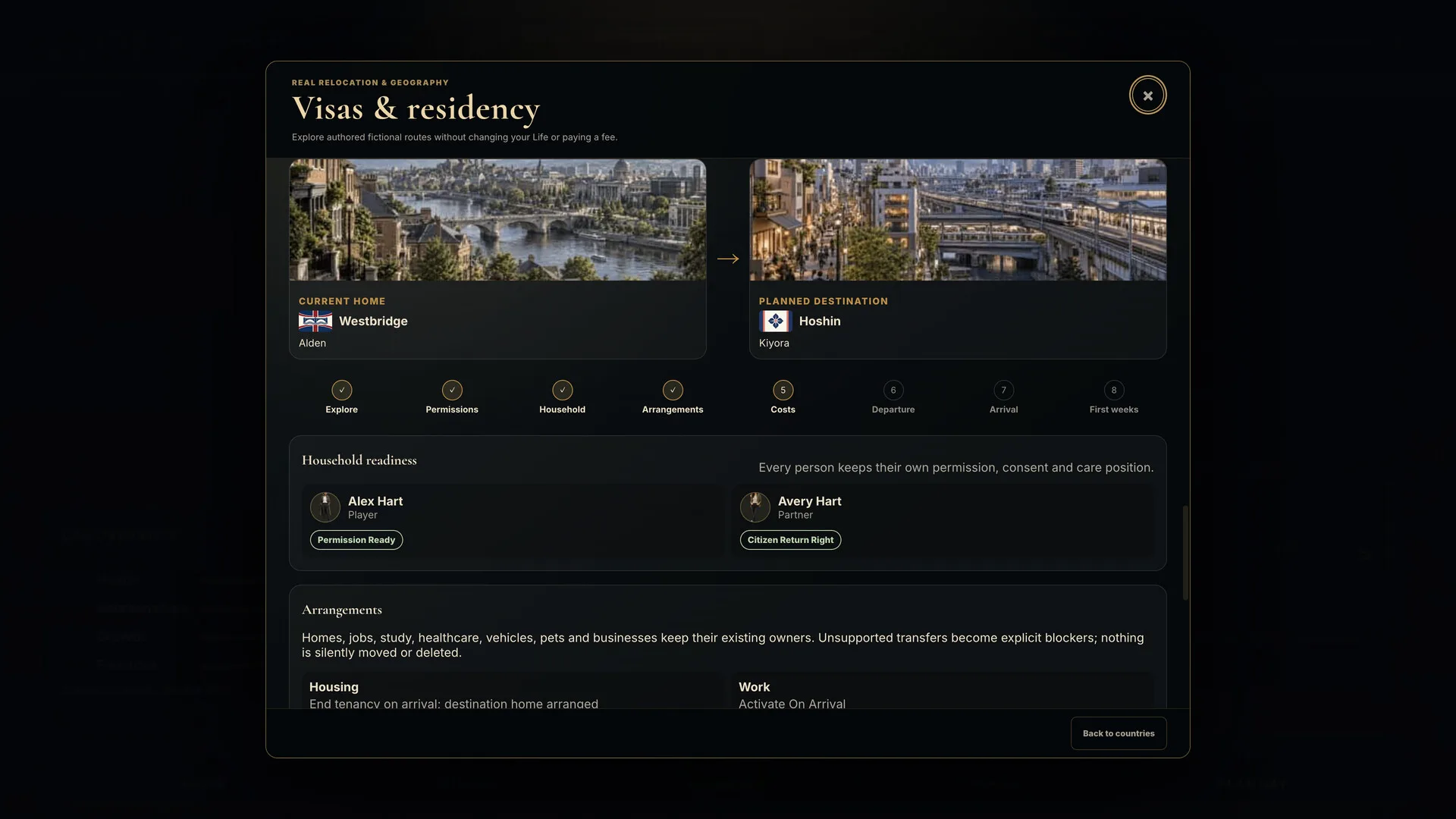
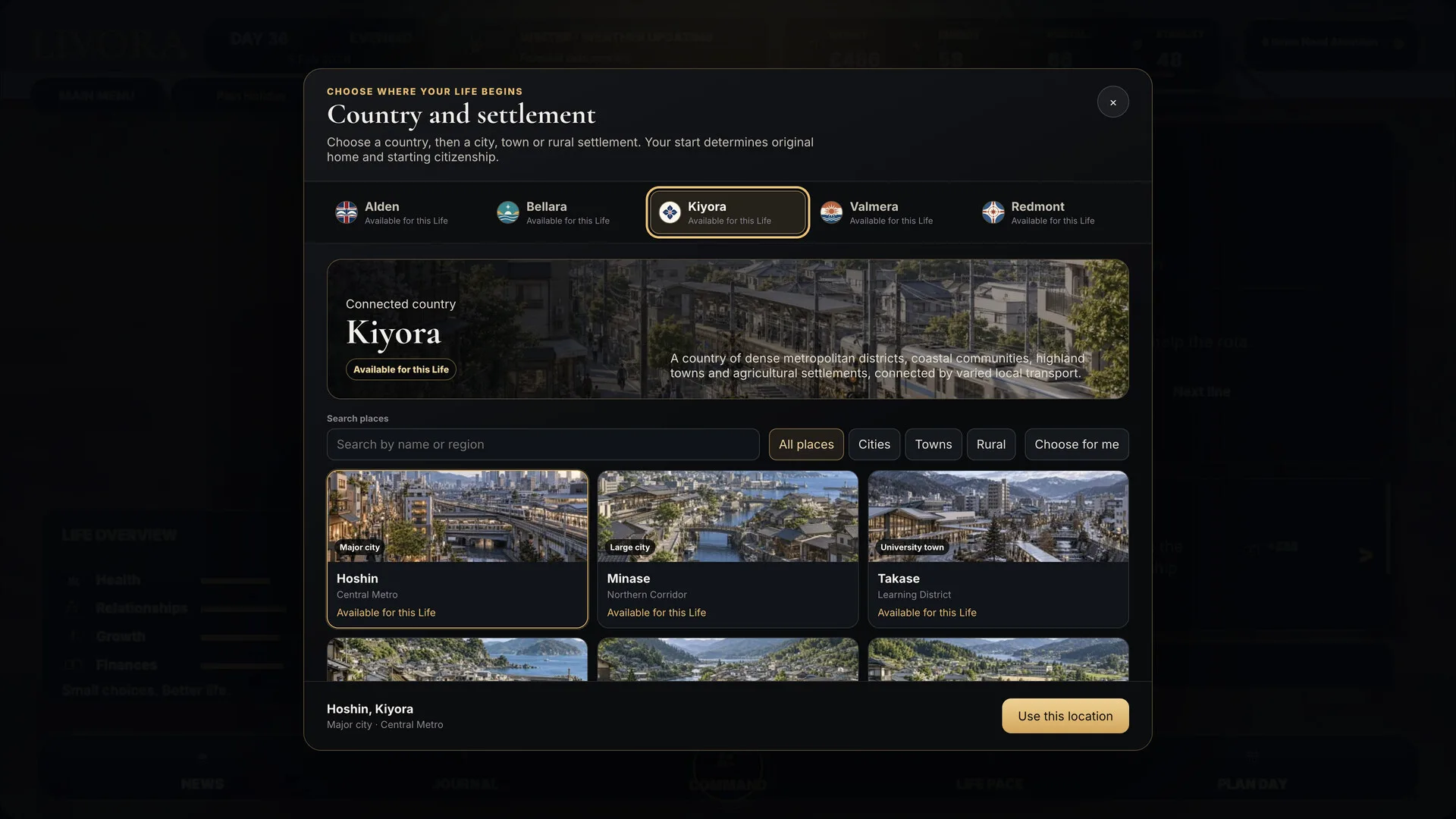
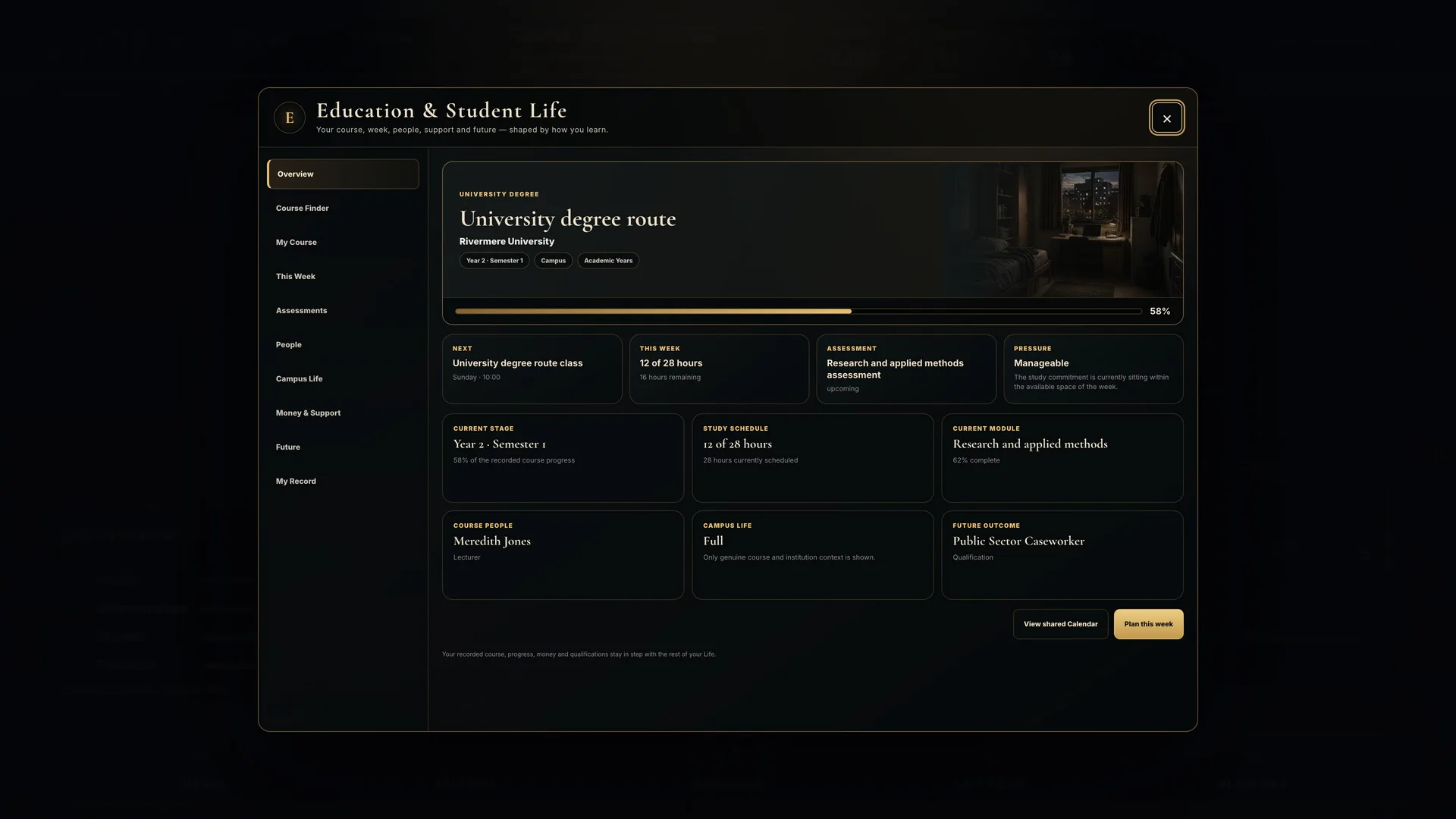
The September 24 LIVORA 5.0 major update expanded the game’s world to five fictional countries and 36 playable locations. It also added visas, relocation and life abroad, alongside a fuller education and student-life journey. These additions make geography a more substantial part of the game’s stated life-simulation framework.
Location can easily become cosmetic in a broad simulation: a new backdrop with little effect on planning. LIVORA’s inclusion of visas and relocation suggests a different possibility. Moving across borders may make place an ongoing decision with its own preparation, trade-offs, and consequences, rather than a one-time aesthetic selection. The presence of multiple fictional countries also gives the game space to treat a move as a transition between life contexts instead of merely a change of address.
The education expansion is especially relevant here. Student life is often a period when location, qualifications, finances, independence, friendships, and future work become entangled. LIVORA’s updated scope could allow those threads to meet in a way that supports its broader premise. Together, those systems position education and relocation as linked choices that could change the direction of a character’s life.
For players drawn to life sims about migration, studying elsewhere, or remaking a routine in a new place, this is one of LIVORA’s most distinctive stated directions. The stated relocation and visa features raise a worthwhile design question: can the game communicate the stakes of a move clearly enough to make it feel like a life decision rather than an administrative gate?
A family story that can outlast one character
LIVORA also allows a later generation to continue the family story. This feature potentially changes the scale of decision-making. A housing, education, relationship, or financial choice can matter differently when a player is not only considering one character’s immediate circumstances, but the conditions inherited by whoever comes next.
Generational continuity can make a life simulation feel less like a run toward a final screen and more like an accumulating family history. It may encourage players to view memories, qualifications, property, relationships, and family choices through a longer lens. Earlier decisions might become part of the context for a later generation, giving the player a reason to consider legacy without demanding that every life conform to a single ideal.
Who LIVORA may suit
LIVORA appears best suited to players who enjoy choice-heavy life simulations and are interested in planning across education, work, finances, relationships, family, health, and place. Its stated appeal lies in the interaction among those categories. Readers looking for a game where a character’s life can begin in childhood or adulthood, develop over years, and potentially continue into another generation have a clear reason to investigate it.
It may be particularly interesting for players who prefer decisions with wider context over a narrowly defined win condition. The game’s refusal to prescribe a fixed class, perfect route, or required milestone list suggests a framework built around personal direction rather than a single approved life plan. The 5.0 update’s five countries, 36 locations, visas, relocation, and expanded student-life material further broaden that framework.
The breadth of LIVORA’s feature list leaves important practical questions open: how readily players can understand its interface, how its pacing feels, and whether choices produce clear and varied consequences. Those qualities matter greatly to a simulation with this many moving parts. For another PC feature concerned with a clearly defined design premise, see this PC design feature on Last Call.
An expansive life-sim proposition
LIVORA’s strongest established idea is that life choices should not sit in separate boxes. Education can inform work; work can affect money and time; time can shape health, relationships, and family; location can alter the circumstances around all of them. Starting young or starting as an adult changes the setup, while generational continuation extends the possible meaning of earlier decisions.
That is an ambitious framework for a released PC life simulation. The design challenge is to communicate those systems clearly, support different priorities, and turn years of choices into a coherent life story. LIVORA provides the outline for that kind of experience: a calendar of competing commitments, a world expanded by relocation, and a family history that may continue beyond one character. Its potential rests in how those pieces meet.