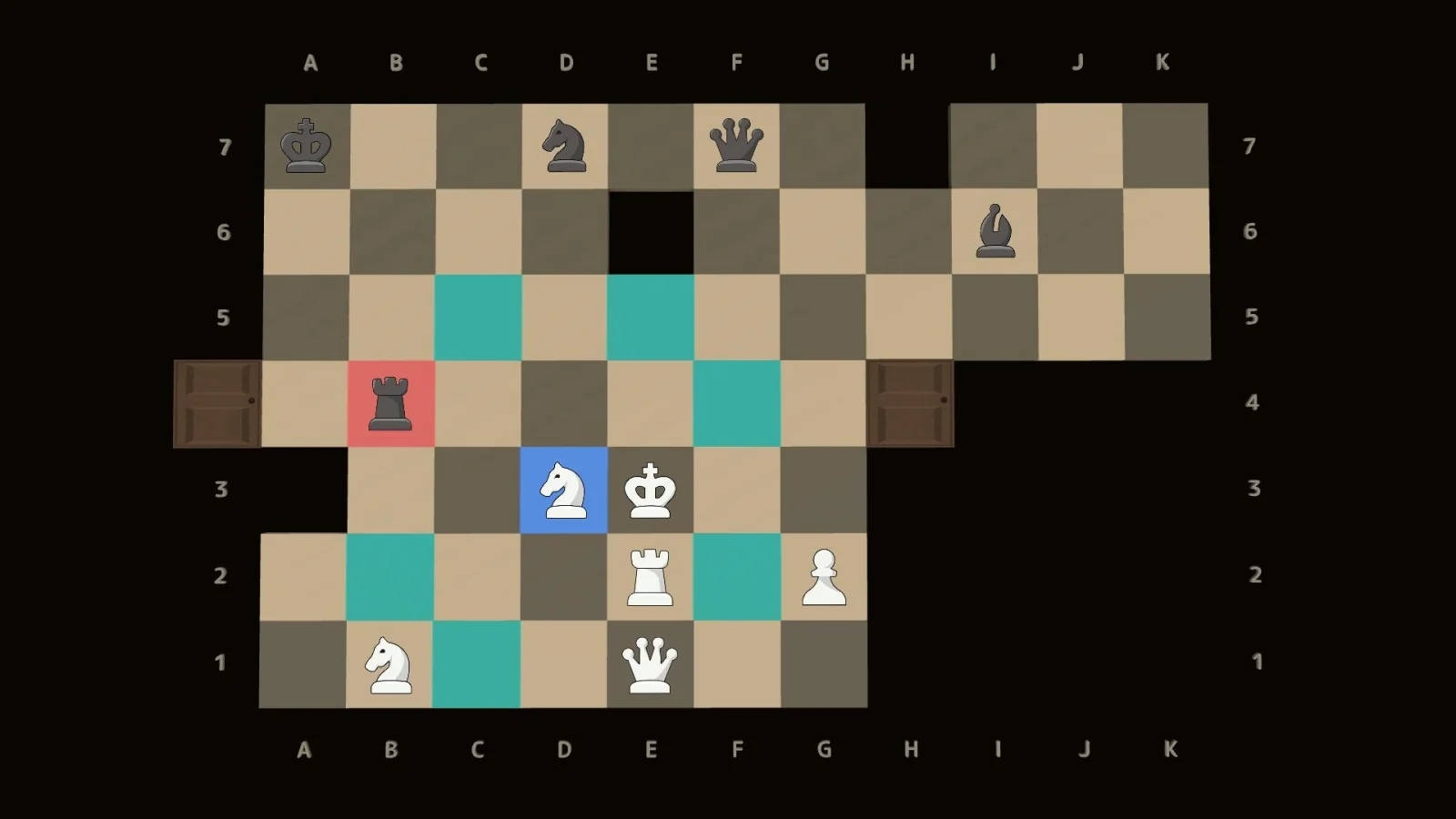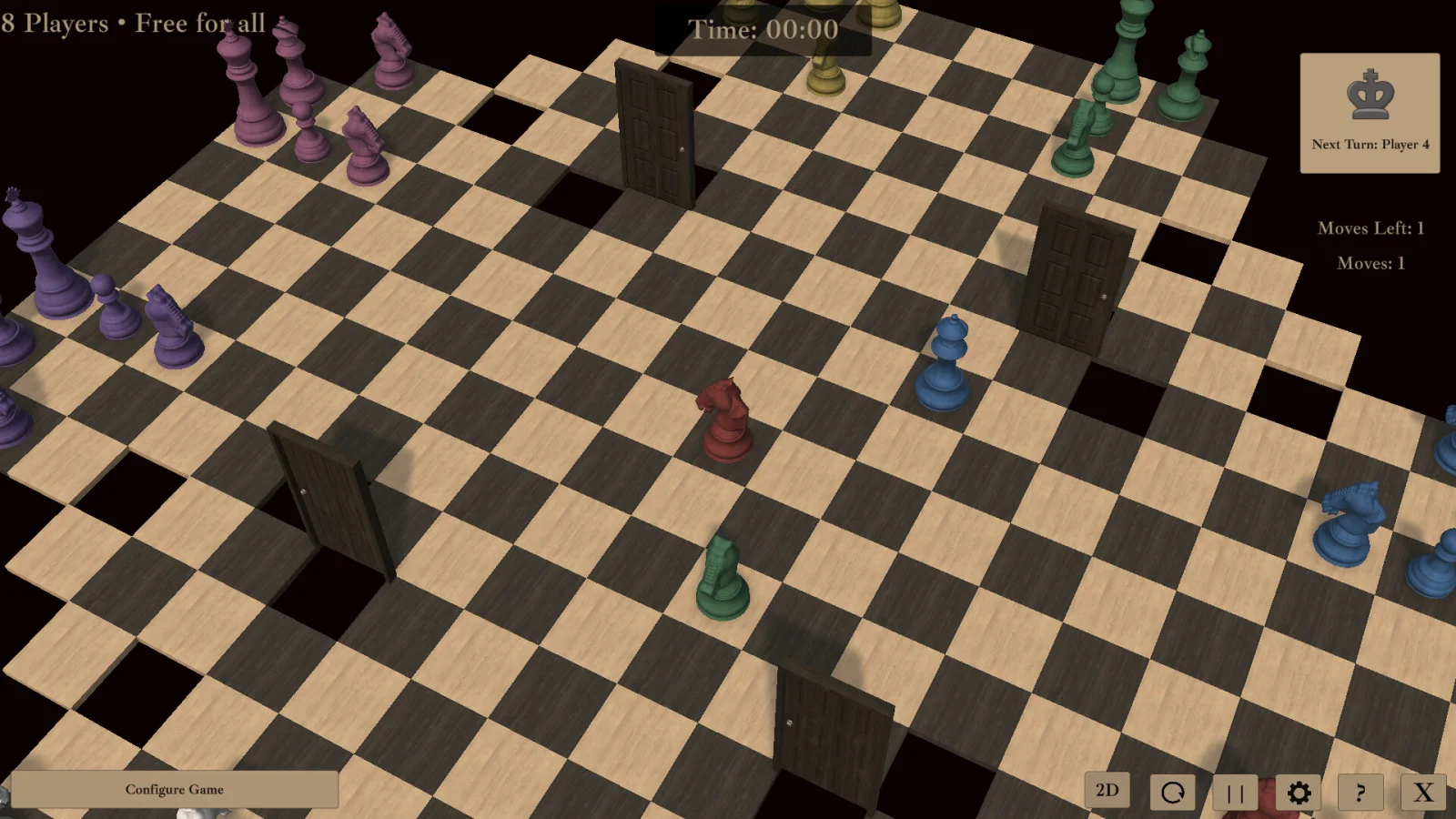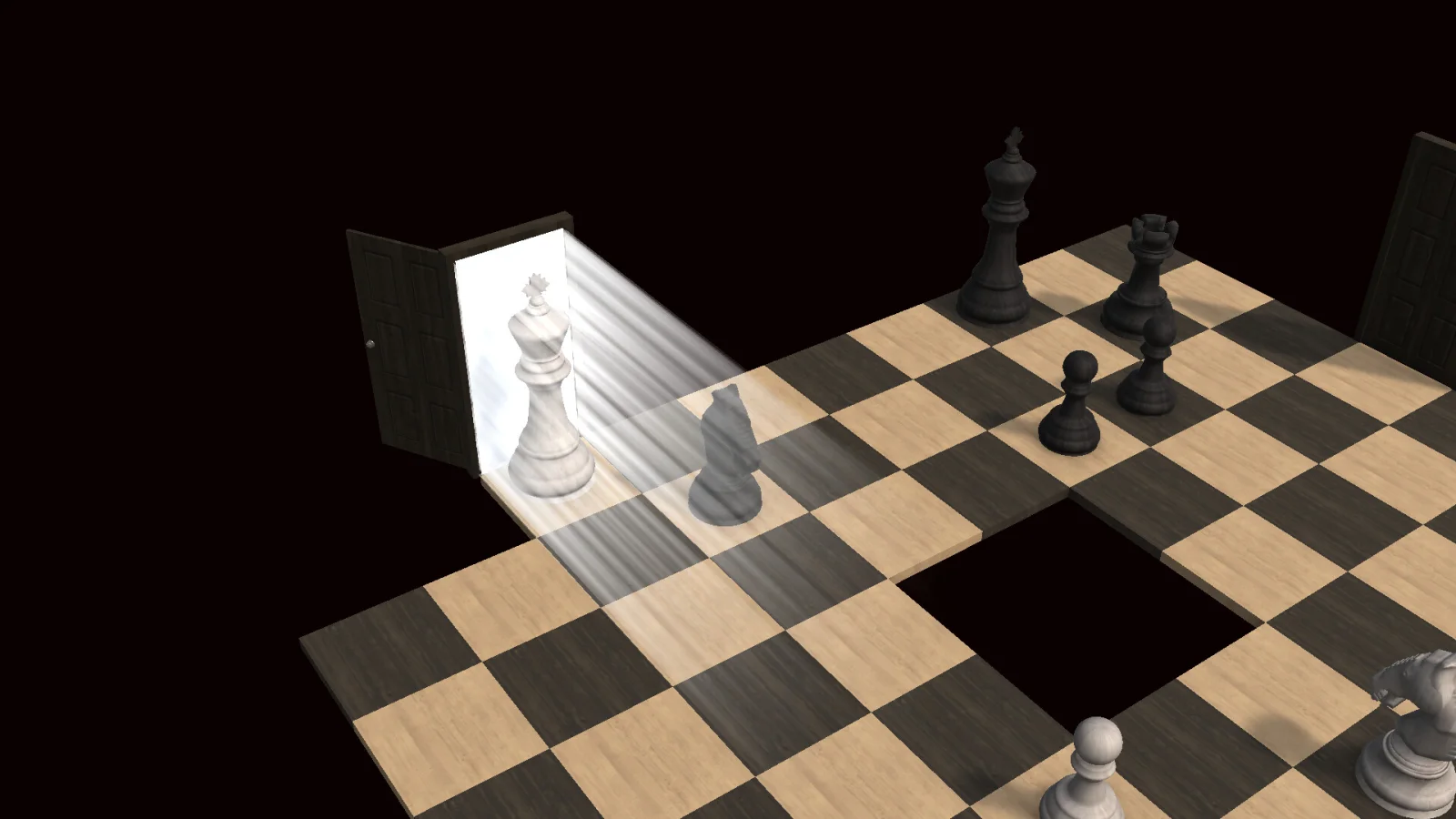
Chesscape Room is an unscored Early Access assessment, not a review based on JokingJoystick hands-on play. The available information describes a focused chess-variant proposition: the king becomes an escape piece that must reach a door, while an opponent hunts it across custom boards. That stated objective is simple enough to explain quickly, but it potentially changes the purpose of every decision around it. Instead of treating the board solely as a contest governed by familiar chess expectations, players are asked to consider a physical route, the space between the king and an exit, and the moves available to the side trying to close that route.
Figmenthol develops and publishes Chesscape Room. It entered Windows Early Access on January 26, 2026. Official materials checked September 22, 2026 advertise campaigns, puzzles, local play, ranked online competition, an editor for puzzles and campaigns, achievements, controller support, difficulty options, save-anytime support, leaderboards, Remote Play Together and Family Sharing.
That is a substantial advertised package around a compact central idea. It should not, however, be treated as proof that every feature is equally mature, balanced, populated or polished at this point in development. Early Access can change its content, rules, interface, competitive environment and priorities. The most responsible reading of Chesscape Room today is therefore to separate what its official description establishes from what its escape objective could achieve if the surrounding boards, teaching and community systems support it.
Established facts: the king is trying to leave
The defining official fact is that Chesscape Room turns the king into an escape piece whose goal is reaching a door. The opposing side attempts to hunt that king on custom boards. This creates an asymmetric arrangement with immediately understandable roles: one side is pursuing an exit, while the other is trying to prevent that outcome.
The familiar chess framework is a useful entry point, but the exit supplies a different destination for the player’s attention. The stated objective suggests that a square may be important because it belongs to a route toward the door, because it offers a temporary place to pause, or because controlling it could delay the escape. A move may matter chiefly because it shortens or lengthens the path. The same is true of a piece exchange or sacrifice: under the announced premise, its value may be tied to whether it changes access to the exit or forces a crucial response.
This is the central tradeoff in Chesscape Room’s design. Familiar pieces can make the initial premise less intimidating than an entirely new abstract strategy game. Yet the asymmetric escape objective may ask players to reassess what those familiar pieces are for. The recognition of a chess-derived piece does not automatically explain whether it should protect a route, disrupt a pursuit, force a detour, or be offered up to create an opening. If the game communicates that altered priority well, the contrast could be its strongest asset. If it does not, the recognizable foundation could leave players expecting goals that the variant has deliberately changed.
Custom boards are not a peripheral detail in that equation. The official description places the pursuit on custom boards, and a door gives the arrangement of those boards direct strategic meaning. The placement of routes, barriers, approach squares and the exit itself could determine the character of a scenario. This may allow Chesscape Room to distinguish one challenge from another through geography rather than only through the pieces on display. It also means that visual legibility could be especially important. Players may need to understand where the meaningful route lies and why a position has become safer or more dangerous before they can make informed decisions.
Officially advertised scope, with Early Access limits
Chesscape Room advertises campaigns and puzzles, as well as local and ranked online competition. The list indicates an intended mix of authored solo material and direct play against another person. Puzzles appear particularly compatible with the stated escape premise: an authored position could ask a player to identify a route, a delay, a redirection or a move that changes the opponent’s available responses. A campaign could potentially present such ideas in a sequence rather than as isolated positions.
Those are design possibilities, not established details of the existing campaign or puzzle content. The supplied information does not document the quantity of either mode, their structure, their difficulty curve, or their instructional quality. It does not establish how the difficulty options operate, whether puzzles cover all important interactions, or how any solo material relates to competitive play. Prospective players should read the mode list as the developer’s advertised scope, not as a guarantee of a finished learning path.
The editor for puzzles and campaigns is another official feature with potentially large implications. In a game built around custom boards and a spatial escape objective, creation tools could enable more than incidental extra content. Creators could potentially make positions built around a narrowly timed escape, a particular route, a defensive bottleneck or a tactical sequence. The editor may therefore become a valuable source of variation beyond developer-authored material.
That potential remains conditional. The available evidence confirms the advertised editor, but not how its tools work, how creations are shared, how players discover them, or whether any form of curation exists. An editor can be significant without automatically producing a durable ecosystem. Its eventual importance would depend on whether making content is understandable, whether good work can be found, and whether creators and players remain interested in exploring the variant’s possibilities.
Ranked online competition and leaderboards establish a competitive aspiration. Local play and Remote Play Together provide additional advertised ways to play with another person, while Family Sharing is also listed. Still, the availability of a ranked mode does not establish current player population, matchmaking conditions, queue times, skill distribution or long-term competitive activity. The evidence includes limited current audience information, so a prospective buyer should not assume an active ranked environment simply because the feature is advertised.
Controller support, achievements, difficulty options and save-anytime support round out the announced feature set. Save-anytime support may suit a strategy game in which a player wants to return to a position later, but the official listing alone does not establish how it functions in each mode. Similarly, difficulty options may be helpful for accessibility or learning, but the provided facts do not define what those settings change. It would be unsupported to infer specific assistance systems, opponent behavior or progression rules from their presence alone.
Outside observations: space, sacrifice and tempo
The supplied outside impressions praised how the escape goal shifts attention away from opening theory and toward spatial reading, distance, sacrifice and tempo. These observations are not proof that every board will produce the same quality of decision-making, but they identify a credible consequence of the stated premise. A door creates a destination. Once a destination exists, the number of moves separating the king from that destination and the ability of the pursuing side to interfere may become immediate concerns.
One detailed player example described sacrificing a bishop to redirect a rook and create a one-tempo escape. That example should be understood as an outside observation about a particular situation, not as a claim that it is a standard tactic or a universal expression of Chesscape Room’s play. It is nevertheless a useful illustration of the game’s potential logic. A sacrifice can be meaningful not because it produces a familiar material outcome, but because it changes where an opposing piece goes and opens a single needed turn.
This is where the asymmetric goal may create satisfying tactical tension. The player can encounter an action recognizable as a sacrifice or redirection, while evaluating it according to the immediate problem of escape. The stated goal suggests that material may matter chiefly when it affects the route, the time available to travel it, or the other side’s ability to block it. That could give a small tactical sequence unusual urgency: the payoff is not necessarily a broad positional advantage, but access to the door before the opponent can react.
The same outside impressions identified the editor as a promising possible source of community longevity. That assessment fits the official custom-board and creation-tool proposition. A puzzle editor could support concise tactical questions, while a campaign editor could potentially support longer authored collections of scenarios. But promise is not confirmation. Whether the editor becomes a lasting advantage will depend on factors not established by the current evidence, including the usefulness of the tools, the discoverability of player creations and the size of the community interested in building or solving them.
Familiarity may help, but clarity is a separate challenge
Chesscape Room appears to rely on a productive tension. The game can invite attention through the recognizability of chess-derived pieces and then complicate that familiarity with a king that must escape through a door. This could make the premise accessible at a glance while still presenting unfamiliar priorities once a player begins thinking about a position.
Accessibility and clarity are not necessarily the same thing, though. A player may recognize the pieces yet still need to learn how to read a route, judge whether an interception is possible, identify the significance of a one-turn delay, or understand when preserving a piece is less important than opening a path. The official feature list includes campaigns, puzzles and difficulty options, all of which could potentially help with this work. It does not establish that they do, so onboarding remains an open question rather than a confirmed strength or shortcoming.
A strong introductory path could teach the escape role in layers: first communicating the goal, then presenting the spatial consequences of the door, then showing how tempo and sacrifice can alter a route. A weaker path could leave players with familiar pieces but insufficient guidance about the altered objective. This is conditional design analysis, not a claim about the current build. It highlights why Chesscape Room’s teaching matters as much as its premise. The more its game asks players to rethink inherited assumptions, the more useful it may be to explain the new priorities directly.
Board balance is another unresolved consideration. Custom boards can offer meaningful variety because the geography of a route is part of the challenge. They could also make small differences in setup feel consequential. Door placement, starting arrangements and the available paths could all affect whether both the escaping and hunting roles have understandable opportunities to respond. A future competitive community could reveal whether particular boards encourage rich counterplay, repeated patterns or questions that require further tuning.
This does not mean every board needs to produce the same kind of contest. A tightly authored puzzle may benefit from a precise answer, while a competitive scenario may be better served by broader room for adaptation. The key issue is whether Chesscape Room’s different modes eventually make good use of their formats. Puzzles can focus on discovery. Campaigns could focus on teaching or sequencing ideas. Ranked competition, if it develops a sustainable audience, may place greater pressure on the readability and resilience of board design. None of those outcomes can be assumed from the present feature list.
What to watch during Early Access
The most useful question is not merely whether Chesscape Room changes chess. Its official description clearly announces an altered objective. The more revealing question is whether that objective creates a repeatable decision space in which route planning, piece placement, pursuit, sacrifice and tempo remain legible and varied across custom boards.
Several future signals would help answer that question. First is board readability: players may need to see relevant paths, threats and door access clearly enough to understand the consequences of a move. Second is onboarding: campaigns and puzzles could establish whether the game teaches its changed priorities instead of simply assuming them. Third is balance: updates and player experience may clarify whether boards give both roles credible, intelligible counterplay. Fourth is the editor: its impact may depend on the path from creating a puzzle or campaign to finding and playing one. Fifth is online participation: ranked play’s practical value will be easier to judge once there is stronger evidence about the community using it.
These are not declarations that the current game fails any of those tests. They are the points most directly connected to the game’s announced ambition and the risks identified in outside observations. Early Access is specifically the context in which a compelling premise can be refined, expanded or redirected. It is sensible to distinguish that process from a final judgment about depth, polish or long-term activity.
That same caution applies across unscored work-in-progress assessments, including our Sublight Early Access assessment. The systems are different, but Early Access status means an advertised feature set should not be mistaken for settled evidence of final balance, onboarding, content depth or community health.
Unscored verdict
Chesscape Room has a direct and potentially fertile premise: the king is an escape piece moving toward a door, while an opponent attempts to stop it on custom boards. The supplied outside observations give that idea a concrete tactical shape, particularly in their emphasis on spatial reading, distance, sacrifice and the importance of a single tempo. The advertised campaigns, puzzles, local play, ranked online competition, creation tools and support features indicate that Figmenthol is pursuing a broader package than a one-note variant.
Its most important questions remain open. Early Access can change materially, and current evidence does not establish the final quality of its onboarding, balance, campaigns, puzzles, editor ecosystem or ranked population. The editor could become a major long-term asset; the familiar chess framework could provide an inviting way into a distinct objective; and custom boards could generate a wide range of scenarios. Each possibility depends on execution that the supplied evidence cannot yet confirm. For now, Chesscape Room is best approached as a promising, unscored Early Access strategy game whose central tradeoff is clear: it uses familiar pieces to begin the conversation, then asks players to rethink what success looks like when the king’s destination is an exit.