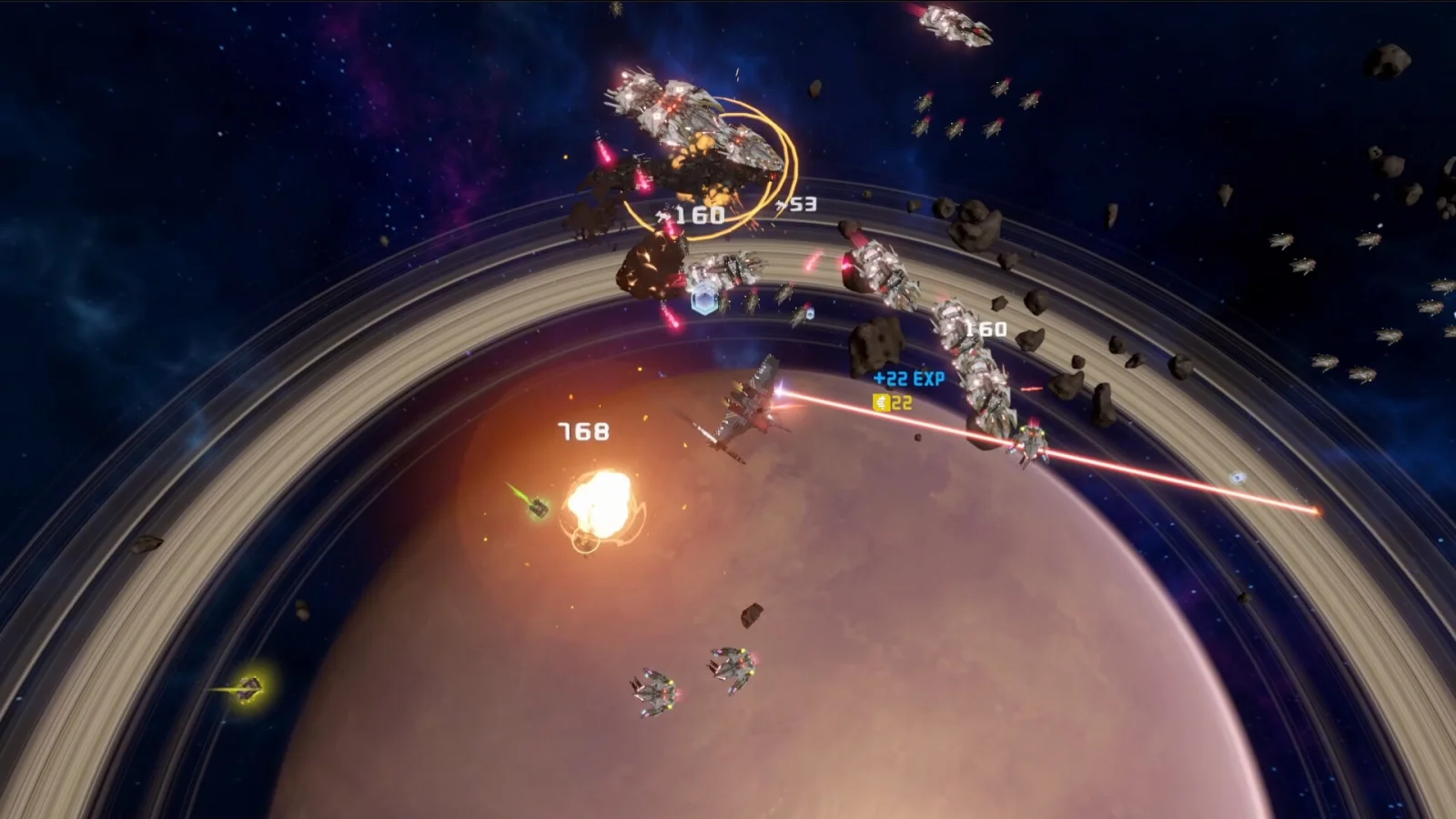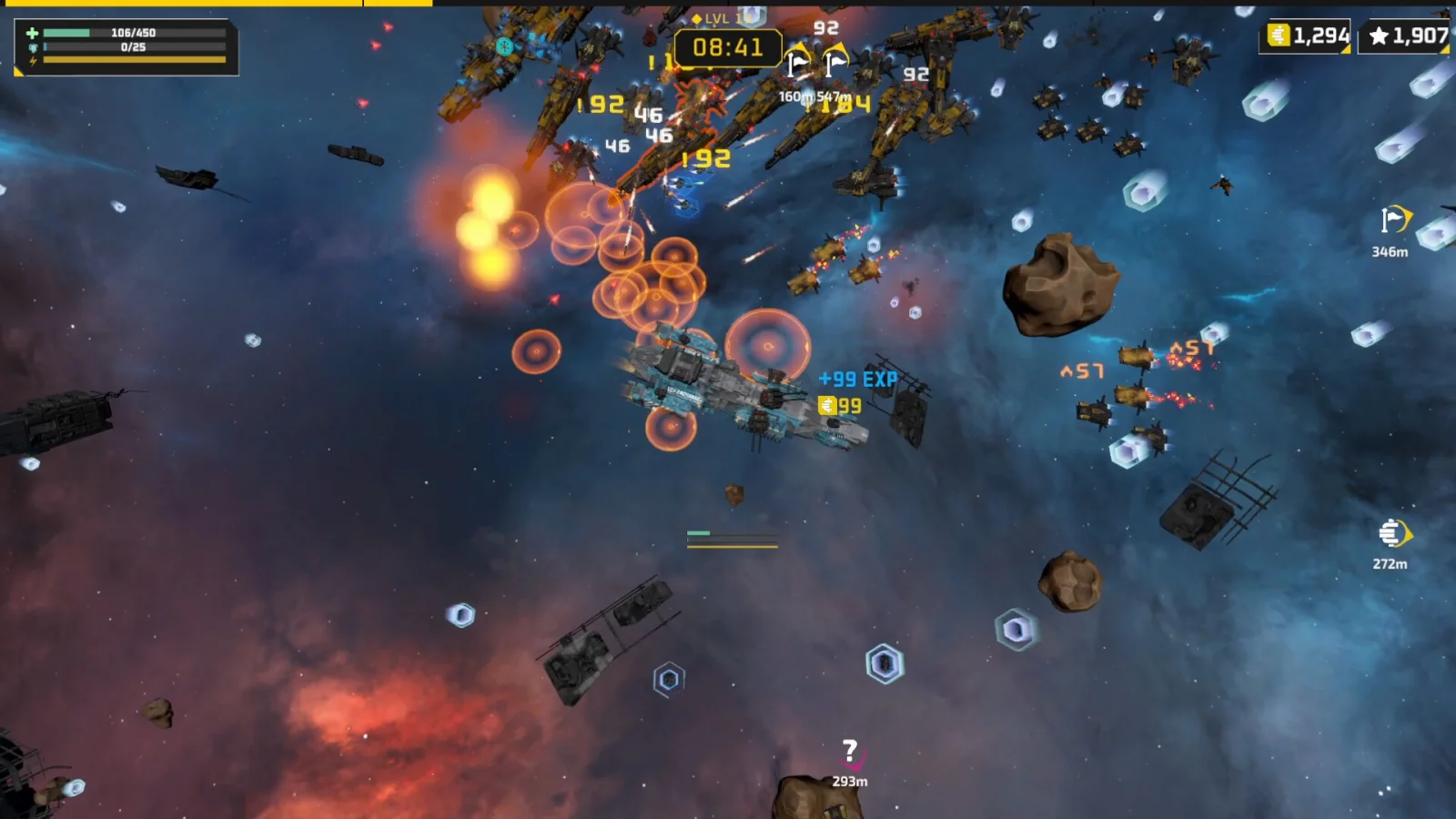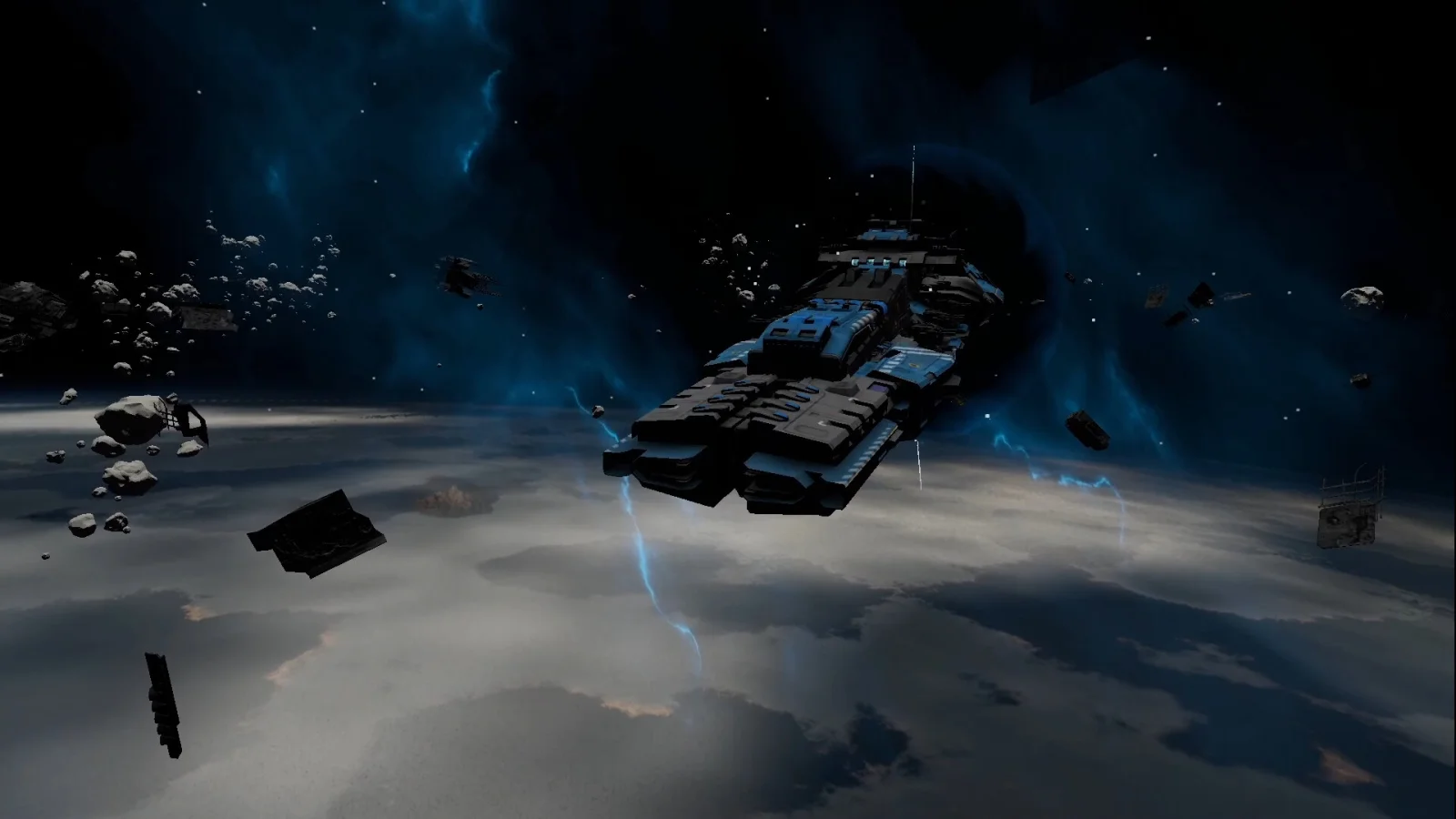
Sublight is an unscored Early Access assessment, not a final review. Developed and published by Codebrew Software Ltd, this single-player space bullet-heaven entered Early Access on September 15, 2026. Its stated premise is direct: captain a warship through escalating waves, upgrade an arsenal, unlock ships, and construct builds. The most consequential design detail described in available critical coverage is not simply the ship theme or the automatic weaponry, but directional firing arcs. Weapons are understood to cover particular areas around the vessel rather than treating every threat as equally targetable from every angle.
That constraint gives Sublight a potentially distinctive answer to a familiar survival-action question. Bullet-heaven games commonly ask players to endure growing pressure while upgrades compound into increasingly forceful attacks. Sublight appears to retain that broad structure, yet directional coverage could make where the ship faces, where it moves, and which weapons occupy which slots matter as much as the raw strength of an upgrade. If that relationship remains legible and varied as development continues, it could give the game’s build-making more spatial meaning than an arsenal that fires with identical effectiveness in all directions.
The important qualification is that Sublight remains in Early Access and the available critical evidence is limited. Early coverage identifies firing arcs as central to the game’s appeal, while also cautioning against treating a small sample as broad confirmation. There is no basis here for a verdict on long-term balance, the extent of content, or how reliably the design sustains repeated runs. The useful question at this stage is narrower: does the announced and observed design proposition have a coherent hook? On the evidence available, it does.
A survival loop with a facing problem
Automatic weapons are a natural fit for a bullet-heaven framework because they keep attention on movement, threat management, and upgrade selection rather than demanding constant manual aiming. In Sublight, the reported firing-arc structure may complicate that comfort in a productive way. A weapon is not only an effect to acquire. It is also a commitment to a section of the ship’s perimeter. A powerful turret oriented toward one side may offer less help when danger develops elsewhere, making an apparently excellent pickup conditional on placement and navigation.
This matters because the usual genre loop can flatten positioning once a build becomes sufficiently destructive. If attacks reach in every direction or automatically solve targeting with little limitation, movement can become principally evasive: stay away from hazards and let the build operate. Directional arcs introduce another possible layer. The captain may need to steer so a defended side faces the immediate pressure, preserve room to swing vulnerable areas away from danger, or choose a route that lets several weapons overlap on an approaching group. These are design possibilities rather than confirmed moment-to-moment outcomes, but they follow directly from a system where coverage has direction.
The distinction is substantial. Pure avoidance asks whether the player can escape a dangerous space. Arc-based combat can also ask whether the player can arrange dangerous space into a favorable formation. Enemies behind a ship may not be merely nearby; they may be approaching through a section of the vessel that the current loadout covers poorly. Conversely, a crowded front or flank could become an opportunity when that is where the strongest guns are concentrated. The system has the potential to convert the geometry of an arena into a tactical resource.
That is why turret slot choice deserves as much attention as the weapon list itself. Available observations specifically point to the relationship between directional arcs, slot selection, and ship positioning. In design terms, a slot is meaningful when it changes the consequences of a choice. If two placements provide the same practical coverage, the decision is cosmetic. If their arcs overlap differently, leave different blind areas, or support different ways of moving through a wave, placement becomes part of the build. Sublight’s promise is not just a larger-looking version of automatic shooting; it is the prospect of assembling a perimeter plan.
Capital-ship scale changes the fantasy
Calling the player vehicle a warship establishes expectations beyond its visual scale. A capital ship suggests mass, an arsenal distributed across a hull, and a command problem rather than the reflex fantasy of a nimble lone craft. Available early commentary singled out this capital-ship framing as a strength. That framing aligns especially well with directional weapons because an array of turrets makes intuitive sense on a large vessel: different stations can guard different approaches, and the shape of a defensive line can become part of the fantasy.
There is a useful tension in that premise. Bullet-heaven design often emphasizes immediacy and accumulation: survive, select an upgrade, and watch a build become more formidable. A warship suggests deliberation, however. Players may expect choices that feel like outfitting a vessel instead of merely attaching another effect to an avatar. Firing arcs can bridge those impulses. They allow an upgrade to create an immediately visible combat result while also altering the ship’s larger tactical identity.
The official store listing identifies ship unlocks, but the current evidence does not establish how many ships exist, how they differ, or the conditions attached to unlocking them. It would be premature to assume distinct classes, special rules, or a particular progression structure. Still, the confirmed presence of unlockable ships gives the central premise a plausible avenue for variety. Different vessels could matter most if their relationship to weapon placement and coverage produces new spatial questions, not simply different starting numbers. Whether Sublight reaches that standard is an open Early Access question.
Scale can also raise the bar for clarity. A capital ship needs players to understand which parts are protected, which guns are contributing, and why a chosen route is succeeding or failing. This is not a claim about Sublight’s current interface or readability; the supplied evidence does not support one. It is a conditional design test. When directional systems are clear, a loss can teach the player that a certain approach exposed a weak side or that a different turret arrangement would have covered a key lane. When they are unclear, failure can feel arbitrary because the player cannot connect their ship layout to the result. The same feature that differentiates Sublight therefore creates one of its largest presentation challenges.
Buildcraft should have geography
Sublight’s official description promises arsenal upgrades and build creation. Those terms are common to the genre, so their value will depend on the relationships among individual choices. Directional arcs offer a strong foundation for such relationships. A build may not be defined only by damage categories or by a stack of upgrades that all point toward a single universal ideal. It may instead be defined by where its power resides around the hull and what movement pattern lets that power operate.
Consider the general design consequences without assuming any specific weapon behavior. A loadout concentrated across neighboring arcs could encourage presenting one side toward the heaviest pressure. A more distributed arrangement could trade peak focus for broader safety. An option that improves an already defended section might create a high-risk, high-reward orientation problem, while an option that covers a neglected approach might make navigation more forgiving. These are analytical examples of what arc-based buildcraft can enable, not reports of confirmed Sublight items or tactics.
The attraction of this approach is that it may make upgrades contextual. The best selection is not necessarily the effect with the largest apparent output; it can be the one that solves the most immediate coverage issue or reinforces a plan the player has already chosen. That kind of context is valuable in a roguelike structure because it can make successive decisions feel connected. Instead of collecting isolated improvements, players are potentially building a ship whose vulnerabilities and strengths emerge from the same set of choices.
There is also a potential antidote to passive escalation. Automatic fire can make a survival game approachable, but it risks reducing attention to periodic upgrade selection if the weapons do all meaningful combat work. Directionality can preserve player agency without abandoning automatic attacks. The captain’s ongoing job becomes arranging contact between the arsenal and the opposition. In the strongest version of this idea, movement is neither busywork nor merely panic. It is the method by which the build is expressed.
For a related examination of how survivor-style design can make planning meaningful amid sustained pressure, see this assessment of build planning under pressure.
Escalation, sectors, and the need for readable stakes
The official store description identifies escalating waves as part of Sublight’s premise, and an independent early impression also described node-based sector progression. The latter is a critic observation rather than a fuller official specification, so its breadth and final implementation should not be assumed. Even so, the reported pairing is conceptually coherent. Escalating waves supply the immediate survival pressure; a sector structure can potentially give that pressure a broader route or rhythm.
A node-based progression layer can matter in this genre if it makes preparation decisions feel situated. The value need not come from complexity for its own sake. Its purpose could be to frame a run as a sequence of choices about exposure, opportunity, and readiness. Yet there is not enough evidence to say which decisions Sublight’s sectors presently offer, whether their options are persistent, or how they interact with upgrades and unlocks. The existence of reported nodes should be treated as a promising structural note, not a detailed map of the game’s progression.
Wave escalation carries a separate design burden. Difficulty should ideally reveal the limits of a ship’s current plan in ways the player can read. Because firing arcs may produce intentional weak approaches, pressure can test whether a build has sufficient coverage, enough concentrated force, or an appropriate movement pattern. But balance remains wholly unresolved. A game can make blind spots strategically interesting, or it can make them frustratingly punitive; it can encourage adaptation, or it can funnel every successful run toward the same coverage pattern. No available evidence is sufficient to choose between those outcomes.
This uncertainty is not a minor footnote. It is central to judging an Early Access roguelike. A compelling core rule can support many hours of decisions, but only if future content, tuning, and progression continue to generate different meaningful circumstances for that rule. Sublight should be assessed on the quality of its basic proposition now, while reserving final judgment for the execution that follows.
Unlocks and leaderboards point toward repetition, not proof of it
The official store listing includes unlockable ships and leaderboards. Both features naturally point toward replay-minded design, but neither independently proves the depth or durability of a run structure. Unlocks can give players new starting points or new strategic identities; leaderboards can offer an external measure for repeated attempts. Their actual significance depends on details that are not established here, including what is measured, how comparisons are presented, and how ships alter play.
Still, the fit with Sublight’s stated design is easy to see. A leaderboard has more meaning in a game where players can plausibly refine route choices, loadout plans, and positioning rather than only hope for stronger upgrades. Likewise, unlocking a ship could be more than a collection incentive if it changes the geometry of the arsenal and prompts different uses of directional coverage. These are opportunities, not confirmed results. Early Access development will determine whether the game makes them substantial.
The store listing also identifies cloud saves and partial controller support. These are established listing features, but the available evidence does not establish the details of controller implementation, how each input configuration feels, or whether cloud synchronization works consistently. They should be understood as listed support information rather than performance or usability conclusions.
Current assessment
Sublight’s strongest identifiable idea is remarkably focused: make the angles of a warship’s weapons matter. Available critical observations repeatedly place directional firing arcs at the center of the experience, and the official premise of escalating waves, arsenal upgrades, builds, and ship unlocks provides a credible structure around that rule. The design has the potential to make a crowded space survival game about more than evasive movement and incremental firepower. It may ask players to shape their own safe and dangerous directions.
That potential is not the same as a finished recommendation. Content scope, progression depth, balance across builds, clarity of feedback, and the lasting value of leaderboard-driven repetition all remain open questions. The available evidence is too limited for claims about the final quality of those elements. For now, Sublight is best regarded as a promising Early Access design proposition: a capital-ship bullet-heaven whose central constraint could make every upgrade and every turn of the hull carry more tactical weight.