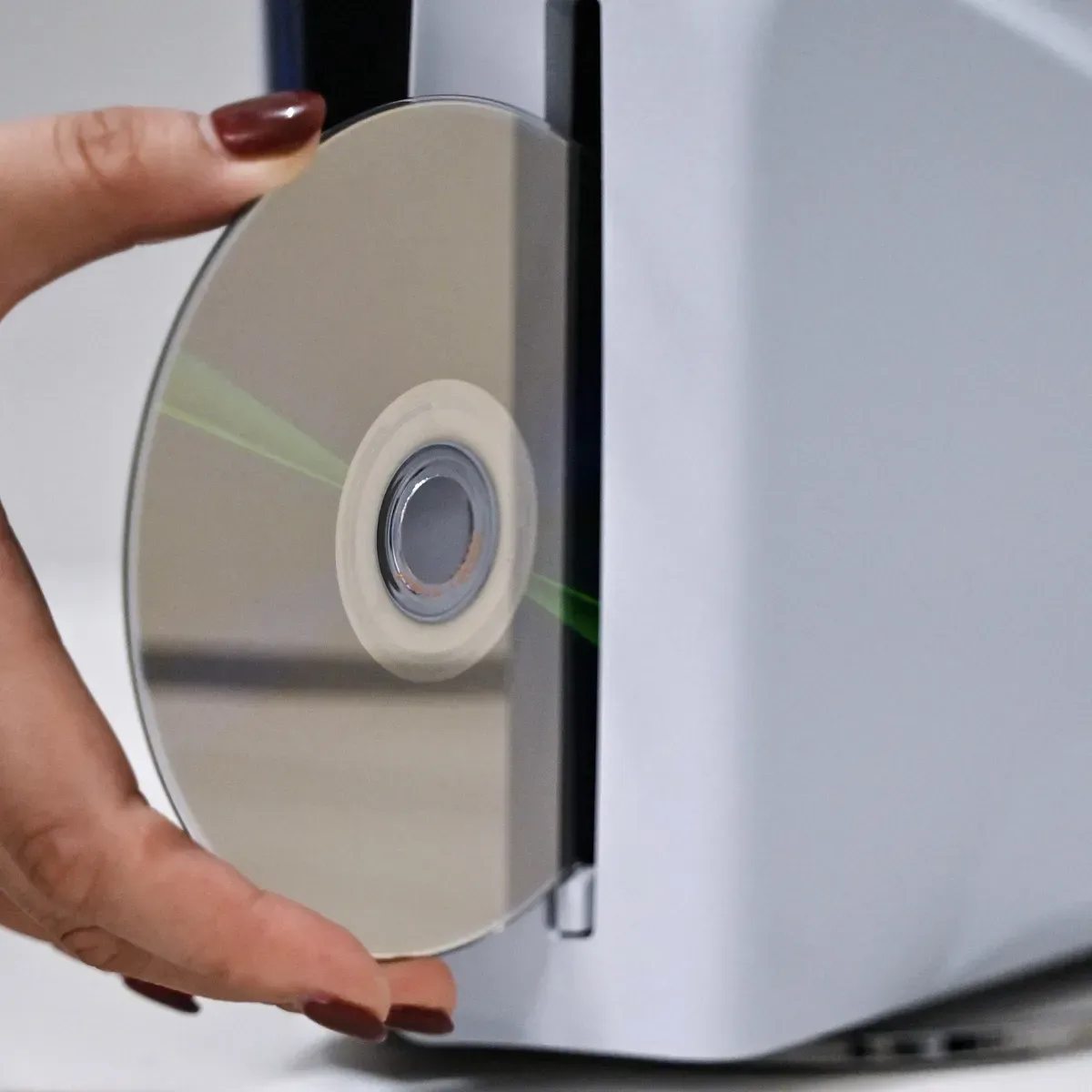
It is easy to call the physical-versus-digital argument settled if the only question is which purchase gets us into a game fastest. That is not the question we are asking. Games live as software, but they also live as boxes, manuals, memories, accounts, store listings, servers, collections, and shared culture. Those things age differently. A download can be the right way to play tonight and still leave a different kind of uncertainty for a player who wants to return decades later. A disc can be a wonderful artifact and still fail to preserve a complete playable game. We favor a future with genuinely meaningful physical editions, not because every digital purchase is bad, but because the choice to keep something should remain real. Here is the longer case for that position—and for treating collectors, casual players, publishers, and preservationists as people asking related but distinct questions.
The shelf and the button
There is a particular contrast between a game kept on a shelf and one summoned from a library with a button. The physical edition asks us to handle it: to lift the case, read its spine, open it, and place something into a machine. The download is quieter and quicker. It can be purchased late at night, installed without a trip, and carried across a room in the same device that holds dozens of other games. Neither experience is inherently more serious. Yet they represent different relationships with what we have paid to play, and that difference deserves more attention than it usually receives.
Our position is straightforward but not absolute: meaningful physical editions should continue to exist, and players should be allowed to choose them. We are not arguing against downloads, subscription libraries, or the convenience of a digital storefront. Digital games have made access easier for many people, reduced the need for storage, and removed barriers that can make collecting impractical. A player who prefers an uncluttered library is not less devoted to the medium. The mistake is treating convenience as a complete replacement for every other value a game can have.
Access, use, possession, and preservation are related but distinct. Access means that a platform currently lets us obtain or launch a game. Use concerns what we can actually do with it on a particular device, under particular technical conditions. Possession describes having a tangible item in our care; it does not automatically settle what that item can do. Preservation is a longer and more demanding question: whether a work, its necessary materials, and a workable means of running it can remain available beyond the commercial moment that produced it. A download may satisfy the first two beautifully while offering a different answer to the latter questions.
That distinction matters because a physical copy is not a deed to the game. The disc, cartridge, box, manual, or printed insert is an object associated with a copyrighted work, not ownership of the copyright itself. It does not give us permission to reproduce the game, rewrite its code, or ignore the conditions attached to network services and other components. Nor is a box magically independent of its contents. A disc may contain only part of the necessary program; a cartridge may depend on updates; an included code may be redeemable once, or not at all, after a particular account claims it. Physicality is a meaningful form of custody, not a universal guarantee of future function.
Still, custody is not nothing. An object can remain visible, transferable in ordinary personal ways, and understandable without requiring a storefront to display it before us. Its label identifies a particular release; its packaging records choices about a moment in the medium’s history. Even when its technical limits are real, it gives a household, library, or archive something concrete to catalogue and care for. A download can be equally beloved, but its existence is more closely tied to files, accounts, hardware, and permissions that may be difficult to separate from one another. The distinction is practical rather than romantic.
Digital ownership language also needs care. On some services, the customer receives a license or account entitlement rather than an unrestricted, independent copy that can be moved wherever they please. That does not make digital play insincere, nor does it mean every platform operates under the same terms. It means that “buying” a download can describe a pleasant and reliable use of software without describing possession of a durable object. Where a legally portable digital copy is supported, portability can be a genuine strength. Where access is bound to an account or platform, the player’s relationship is correspondingly more conditional.
Physical releases, then, should be judged by what they actually provide rather than by the mere presence of a case. A thoughtfully produced edition might preserve playable code, include a manual or useful documentation, identify its dependencies clearly, and avoid turning the disc into a decorative token for an online entitlement. Another may offer little beyond packaging around a download code. Both are called physical, but they do not carry the same practical or historical weight. Asking for better editions is not nostalgia disguised as criticism; it is asking publishers to be honest about which parts of a game are being placed in our hands.
That honesty also protects player choice. Some of us need digital distribution because shelves cost space, discs are easy to damage, and accessibility features or immediate delivery matter more than a box. Others want a game that can be lent, displayed, catalogued, or revisited as an object rather than merely remembered as an account entry. Many players move between both habits depending on the title and circumstance. A healthy medium does not force one definition of ownership onto everyone. It leaves room for the frictionless button and the kept game, while admitting that they do not promise the same kind of relationship with the work.
The convenience argument deserves respect
We should begin with the strongest case for digital games, not the easiest one to dismiss. For many players, a download is not a preference formed in opposition to “real” games; it is the format that makes playing possible. Physical stock can be scarce, unevenly distributed, or unavailable in a player’s region. A disc or cartridge may be difficult to obtain when someone cannot travel easily, lives far from a retailer, shares a home with limited storage, or simply needs to avoid the cost and uncertainty of shipping. Digital delivery removes those barriers with admirable directness. A game can arrive at the moment curiosity strikes, without a trip, a wait, or a search through second-hand listings.
That immediacy matters even when access is easy. A digital library can travel with the player across a console, handheld, or computer ecosystem, subject to that platform’s rules. It does not require a shelf, a case, or a careful system for storing hundreds of small objects. For people in small homes, for families sharing space, and for players who move frequently, “just keep the collection somewhere” is not a neutral suggestion. A download also avoids the physical wear that can make used copies unreliable, and it can make switching between games nearly frictionless. Convenience is not laziness here. It is time, space, money, and reduced logistical strain converted into more opportunities to play.
Digital storefronts have also widened the path to discovery. Independent developers can put a game in front of an international audience without manufacturing a run of cartridges, negotiating shelf space, or asking a publisher to predict demand years in advance. A tiny project can sit beside a major release and be found through a sale, a demo, a recommendation, or an informed conversation. That visibility is not guaranteed, and storefront algorithms create their own problems, but physical distribution has never been a perfect gateway for unusual or low-volume work. For many players, digital availability is the reason a particular game is accessible at all rather than an object they might never encounter.
The format can be generous in ways that are easy to overlook. Digital releases can receive patches quickly, correct errors, add language support, and incorporate accessibility settings that were difficult or impossible to provide on a fixed piece of media. Large text, remappable controls, subtitle options, color adjustments, difficulty choices, and other accommodations are not ornamental features; they determine whether some people can participate. A physical edition may benefit from those same updates, but digital distribution makes delivery and installation more immediate. Nor should we pretend that every download demands a permanent connection. Some ecosystems and individual games support legitimate offline play after installation or authorization, while others require more frequent checks. The important point is that the answer varies, and a fair argument must leave room for that variation.
For the player, the practical advantages remain real even when the contractual language is complicated. One account can restore a library after a hardware replacement, synchronize saves, provide family or household features where supported, and reduce the risk of losing a small disc. Digital storefronts can also preserve access to games that never received a broad physical run. It would be perverse to treat every account-based convenience as a moral failure, especially when the alternative may be an overpriced resale copy, an import with compatibility concerns, or no legitimate route at all. People should not be judged for choosing the format that fits their finances, mobility, home, or habits.
Respecting that choice does not require us to accept digital convenience as the only acceptable future. An account entitlement is useful precisely because a platform continues to recognize it. A download can be backed by servers, an authentication process, a storefront, or a company’s decision to keep distributing the necessary files. None of this means every digital game is fragile, or that every physical game is durable: online-only software can defeat a disc, while some downloaded games function perfectly offline. It means the player deserves to know which relationship they are entering. A physical edition can offer a different kind of access and a different kind of custody, even when it still relies on updates or services.
That is why choice matters more than format loyalty. Digital should remain the easiest route for players who need instant delivery, compact libraries, accessible features, or broad independent discovery. Meaningful physical editions should remain available for players who value a tangible object, local resale, a less account-dependent relationship, or the possibility of keeping a particular release in a household’s care. Neither audience needs to apologize for its priorities. The mistake would be allowing convenience to become a quiet argument for disappearance: once physical production ends, the people who need or prefer it are not merely nostalgic consumers being asked to adapt. They have lost an option, and a healthy games culture should be measured partly by how many legitimate ways it preserves to play.
What is actually on the disc?
“Physical” describes the format we hold, not automatically the experience it delivers. A disc or cartridge can contain a complete, playable build of a game, a partial installation that expects a download, or little more than an authentication token for files obtained elsewhere. Modern consoles often install the contents to internal storage, so the object in the case may function as a permission to use code rather than as a self-sufficient library. That distinction matters. A box can be substantial, attractive, and entirely genuine while still failing to preserve the game in any meaningful offline sense.
The first question, then, is not whether a release has a disc, but what the disc does on a console that has never connected to the internet. Some editions boot into a complete version, even if later patches improve performance or repair defects. Others demand a day-one download before reaching the title screen. A few include a cartridge or disc with one component of a larger package and a code for the rest, shifting the decisive content into an account-bound entitlement. None of these arrangements is inherently dishonest; large games and late manufacturing schedules create real practical pressures. But they are materially different forms of preservation, and treating them as interchangeable makes the physical label misleading.
Patches introduce a second layer of uncertainty. A launch disc may be playable, yet represent a rough or incomplete version compared with the one most people experienced after updates. A patch can correct serious bugs, add accessibility options, improve loading, or make a game function properly on newer hardware. It can also disappear from ordinary reach when a storefront or service closes. We should not romanticize an unpatched build as the pure form of a game, nor assume that an updated download has somehow made the physical edition irrelevant. The honest description is that the disc preserves one state of the software, while the network may have supplied another, sometimes better and sometimes indispensable state.
Downloadable expansions make the boundary sharper. A “complete edition” may place its base game on the disc and provide codes for expansions; those codes can expire, become tied to one account, or depend on a storefront that no longer sells them. Other releases print the expansion data on the disc but still require an update or entitlement check. This is why a collector’s case, however appealing, cannot by itself establish completeness. We need to know whether the extra content is present as local data, activated by a code, or delivered through a service. The answer affects not only future convenience but what the edition can preserve when commercial support ends.
None of this makes digital play careless or inferior. Digital distribution is often the more practical choice: it can provide immediate access, accessibility features, cross-device options, smaller shelves, and updates that keep older software usable. Some digital purchases remain downloadable after a storefront stops selling new copies, and some games offer robust offline modes. Even on consoles, platform documentation can distinguish between online features and offline play rather than treating the two as identical. The useful opposition is not physical versus digital as competing moral identities. It is transparent access versus misunderstood dependency, with players allowed to choose the trade-offs that fit their lives.
For that reason, we should ask precise questions before calling an edition durable: Does the first boot work offline? Is the campaign entirely local, or does it consult a server? Is the cartridge the game, or a key to a download? Are updates optional improvements or necessary repairs? Are expansions on the media, activated by a code, or streamed through an account? Will the hardware still read the disc or cartridge, and can the installed software be moved to a replacement machine? These are not demands for certainty that no modern release can provide. They are a demand for accurate language. A disc is not a magic backup, but neither is it meaningless. Its value lies in exactly what it contains, what it can launch without permission from elsewhere, and how honestly the publisher explains those limits.
Sealed collectors and the paradox of never opening
A factory seal can be a remarkable piece of evidence. It suggests that a box left the retail chain without being opened, altered, or handled as a playable copy, and it preserves a particular moment in a game’s commercial history. That matters to collectors who care about how an edition was presented, not merely about the game code inside it. Yet “sealed” is not the same as “authentic,” and it is certainly not the same as “preserved.” A seal records a condition claim; it does not, by itself, establish a complete history.
Packaging is more complicated than the word “original” implies. A single release may appear in regional versions, later printings, budget editions, retailer bundles, promotional sleeves, or revisions made to correct a rating, manual, disc, or copyright notice. Small differences in logos, barcodes, security stickers, plastic seams, shrink-wrap patterns, and included inserts can distinguish one legitimate variant from another. Those details are valuable because they tell us how a product moved through production and distribution. They can also mislead us when we assume that the most pristine-looking box is automatically the earliest, rarest, or most historically important one.
That uncertainty makes provenance useful, even when it is imperfect. A purchase record, period photograph, original receipt, family collection, or documented chain of ownership can add context that a grading label cannot. None of these proves everything, and an old box can still have been resealed, but a coherent history gives us more to assess than plastic alone. Counterfeit packaging and professional reseals exploit the visual language of legitimacy: convincing artwork, replacement shrink-wrap, recreated stickers, and carefully arranged contents. Collectors therefore need to examine construction and context rather than treating a taut seam as a certificate of truth.
Third-party grading can impose helpful discipline on a market that otherwise relies heavily on personal judgment. A holder can protect a package from casual damage, and a written assessment can make condition easier to describe consistently. But grading has limits. It evaluates an object according to a defined standard; it does not turn that standard into an objective measure of cultural importance. Nor does a high condition score confirm that the disc, cartridge, manual, or included code is functional. Encapsulation may preserve the exterior while making inspection less convenient, and it can encourage us to confuse a tidy presentation with a complete account of what is inside.
The central paradox is simple: a sealed game is often strongest as a collectible precisely because no one has tested it. Opening the box can reduce its display or condition value, while leaving it closed means we cannot responsibly call it a playable archival copy. The game code may be present, but physical presence does not guarantee that the medium still reads. Optical discs can suffer storage-related deterioration, plastics and adhesives can age, paper can yellow or warp, and cartridges may depend on components that were never designed for indefinite life. A sealed package is evidence that an object survived unopened; it is not a demonstration that the software survived intact.
There is a further distinction between the work and the edition that carries it. A sealed cartridge or disc is a collectible object, while the game itself is copyrighted software distributed under whatever access terms apply to that release. An account entitlement is a different thing again, as is the server or platform needed to activate, update, or run a particular version. A pristine physical package can contain a game that later depends on an online service, a patch, an account, or hardware that is increasingly difficult to maintain. The wrapping cannot preserve those surrounding conditions. In some cases, it preserves only the promise that a retail experience once existed.
That does not make sealed collecting empty or foolish. Display value is real, and emotional value is not disqualified by its resistance to measurement. A familiar cover, an intact manual, or a particular regional variant can connect a collection to design history, family memory, local retail culture, or a period when games were encountered as tangible products. We should not demand that every collection serve as a playable library. A museum may preserve an unopened artifact because its untouched state communicates something that an opened example cannot. The mistake is not valuing that state; the mistake is pretending it answers every preservation need.
Collectors who want access and preservation may reasonably choose a different balance: one sealed copy for display and another opened copy for inspection, maintenance, and play, where that is financially and practically possible. Others may decide that the cost of duplication is unjustifiable, especially when a sealed edition commands a large premium without offering greater access. There is no universal correct ratio between object and software. We should, however, be candid about the tradeoff. Money spent protecting a sealed package cannot also be spent acquiring working hardware, documenting its contents, or supporting legitimate means of access. The best collection is not necessarily the most unopened one. It is the one whose owner understands what each object can prove, what it cannot, and whether preserving a perfect exterior is worth leaving the playable history inside untested.
Completeness collectors and the contents of a box
For a completeness collector, a game is not quite the same thing as its disc or cartridge. The object is the assembled edition: case, cover art, manual, map, registration card, inserts, cardboard tray, cartridge sleeve, and whatever small piece of paper the publisher decided belonged inside. “Complete in box” is therefore more precise than “owned.” It describes a relationship among parts, and the pleasure comes partly from recognizing that those parts were designed to meet one another. A loose cartridge can still be playable and historically important. A boxed copy can be both a game and a preserved example of how that game was presented to its first audience.
That distinction matters because physical completeness has gradations. A registration card may be present but filled out, a manual may carry a crease, a case may have been replaced with a later rental-store shell, or a regional insert may not belong to the same market as the disc. Matching serial information, correct artwork, original trays, and the right edition can change how a collector understands a copy. None of this makes one condition morally better than another. It simply gives the object a discernible history. A carefully described incomplete copy is more honest, and often more useful, than a supposedly complete one assembled from mismatched parts.
The contents of a box also preserve decisions that the game itself cannot fully explain. A map shows which locations designers expected players to study, annotate, and keep beside the television. A manual reveals the vocabulary used to teach systems before interactive tutorials became commonplace. A registration card can show how publishers imagined their audience, while a regional warning, catalog slip, or promotional leaflet records the commercial surroundings of the release. Even an awkwardly translated paragraph or a conspicuous advertisement can become evidence of production priorities. These pieces are not neutral artifacts, but neither are they disposable clutter. They document the meeting point between design, manufacturing, retail, and marketing.
We should not romanticize every scrap of paper. Some inserts were generic, some manuals repeated instructions already printed on the box, and some maps were little more than thin promotional dressing. Physical media also brought its own inconveniences: faded ink, crushed corners, disc rot, missing batteries, warped cardboard, and storage demands that digital libraries avoid entirely. A player who wants immediate access across several devices has good reasons to prefer a download. Digital manuals and art books can be clearer, searchable, and more accessible than their printed counterparts. The argument for physical editions is not that paper automatically has more value than pixels. It is that the physical version can preserve a kind of context that convenience-oriented distribution often leaves behind.
Digital extras rarely provide an equivalent object because their existence is usually tied to a game’s code, a storefront account, or a download entitlement. A scanned manual is valuable as information, but it does not have the same relationship to a particular box as the original booklet tucked beneath its tray. A downloadable soundtrack can be easier to listen to, yet it does not show the typography, paper stock, or publisher branding of a soundtrack CD included at launch. This is a distinction between content and artifact. The file may reproduce words or images perfectly while losing the evidence of scale, sequence, material, and intended placement that makes a boxed edition legible as an edition.
Physical copies also offer a form of transferability that should be described carefully. A disc or cartridge is a tangible object that can be lent, displayed, resold, or passed to another person, subject to the condition of the medium and the rights attached to the software. That does not mean the buyer owns the copyrighted game code outright, nor does it guarantee that every feature will remain available. A physical release may still require patches, account access, downloadable content, or an operating online service. By contrast, a digital copy may be a perfectly legitimate purchase while remaining practically bound to a platform account and its rules. These are different kinds of possession, not a simple contest between “real” and “fake” ownership.
The ritual of opening a complete copy has meaning beyond nostalgia. There is an order to it: lifting the lid, finding the manual under the disc, unfolding a map, noticing whether the registration card is untouched, and seeing how the artwork continues around the spine or inner tray. That sequence lets us encounter a release as its publisher arranged it, before wear, replacement parts, and years of storage altered the presentation. We need not own a particular edition to understand the pleasure. The appeal lies in the small act of reconstruction: the box becomes a readable object, and its contents explain what the release wanted to be.
Completeness collecting is strongest when it remains curious rather than punitive. A missing insert should not erase the value of a playable game, and a pristine box should not automatically outrank a well-used copy with a visible history. Different players will reasonably choose different priorities: affordability, condition, regional authenticity, preservation, or simply the ability to put a favorite title on a shelf. What physical editions give us, at their best, is room for those priorities to coexist. They keep the game code alongside the traces of its arrival in the world, allowing a box to function not only as packaging, but as a compact record of design, commerce, and the people a release hoped to reach.
Special editions: promise, spectacle, and substance
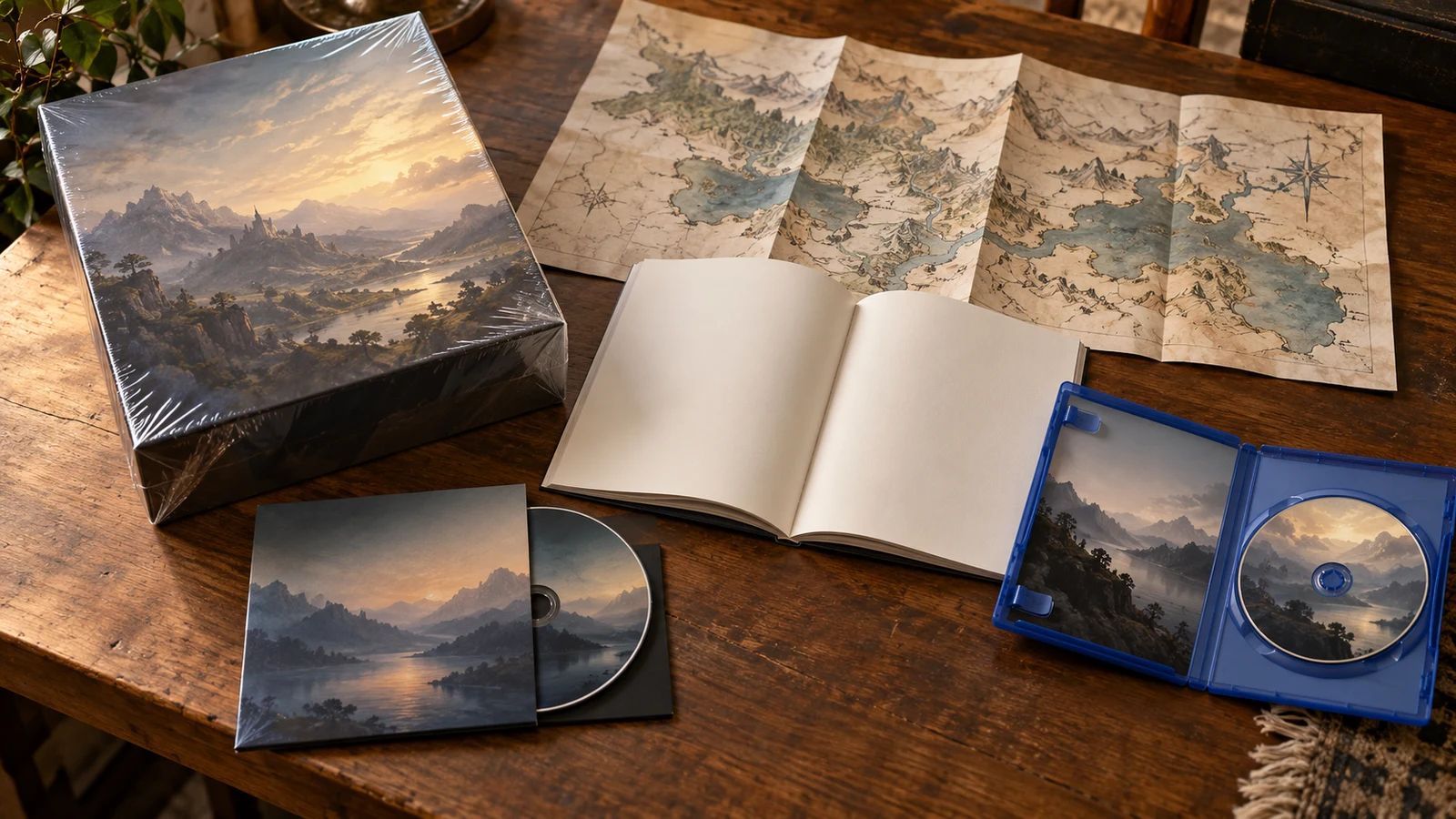
Collector editions turn a game into a proposition larger than the game itself. A steelbook, art book, soundtrack, statue, map, enamel pin, or fabric banner can give a release a physical presence that a download cannot replicate. That presence is not automatically meaningful, however. A box may be heavy with objects and light on substance, while a modest edition can preserve a richer sense of authorship, place, and craft. We should judge these packages not by their volume, but by what they allow us to keep, use, understand, and remember when the launch campaign has faded.
The first useful distinction is between the game and everything arranged around it. A disc may contain game code, an installation key, or only a route to a download; a cartridge may hold some code while still depending on patches, account permissions, or online services. A steelbook can be a handsome collectible even when it contains no disc at all. An art book is not a game, and a soundtrack code is not the same thing as a soundtrack pressed on physical media. These are obvious distinctions when stated plainly, yet packaging often encourages us to experience them as one unified promise. We should resist that blur. What we receive may be a physical copy, an account entitlement, a collection of licensed files, and a set of objects with entirely different futures.
Mixed physical-and-code packages deserve particular scrutiny because they can satisfy the eye while weakening the very permanence that makes a special edition attractive. A box may include a disc for the base game but put the expansion, bonus missions, costumes, or soundtrack behind a one-time code. Those extras can be tied to a platform account, limited by regional availability, dependent on a publisher’s redemption system, or vulnerable to a code deadline. The physical object remains after the entitlement has been claimed or lost, but its contents may no longer match its original description. That is not necessarily deceptive; sometimes a code is the practical way to distribute large or evolving content. It does mean that “complete edition” can describe a moment of access rather than a durable archive.
The best special editions understand that objects can outlast the release without pretending they preserve everything. A carefully made art book can remain worth opening after the game’s servers close because it records visual development, discarded ideas, and the texture of a fictional world in a stable form. A soundtrack on a real disc or properly documented physical format can be played independently of a storefront. A thoughtfully designed statue can function as a piece of character or production design rather than a branded ornament. Even a steelbook earns its place when its artwork is distinctive, its construction is durable, and the edition does not imply that an empty case is equivalent to a preserved game.
“Survives the game itself” should not mean that every object must become an heirloom. It means the object has a reason to exist beyond launch-day excitement. A good art book offers context rather than a handful of enlarged promotional images. A soundtrack has value beyond being a redemption card hidden beneath cardboard. A map or replica gains substance when it reflects the game’s world and materials instead of merely displaying a logo. Such things can remain legible even if a player stops enjoying the game, never finishes it, or encounters a future technical failure. They preserve a work’s surrounding culture, not just its marketing moment.
Scarcity complicates the judgment. Numbered runs, “while supplies last” language, retailer exclusives, and countdowns can make hesitation feel like a mistake rather than a choice. Limited production is sometimes a genuine constraint, especially for elaborate physical manufacturing, but the label itself proves little about quality or significance. Scarcity can manufacture urgency around an ordinary assortment of branded goods, and it can encourage us to confuse difficulty of acquisition with artistic importance. We should be especially wary when the package’s emotional pitch depends on imagined future regret. A collectible is allowed to be delightful without being rare, and a rare package is not thereby a good one.
None of this requires contempt for spectacle or for players who prefer digital releases. Digital storefronts offer immediate access, lower physical clutter, frequent discounts, and practical convenience; many players quite reasonably value those advantages above a shelf of boxes. The issue is choice and clarity. If an edition advertises a physical game, we should be able to tell how much of that game is actually on the disc or cartridge, what requires an account, which bonuses are codes, and whether online services are part of the experience. An online-only title can remain dependent on its servers even when sold in an elaborate box; the fate of The Crew showed why a physical edition cannot by itself guarantee continued play when the service is essential.
Our skepticism should therefore be proportionate, not cynical. Special editions can be generous acts of preservation, design, and appreciation, or they can be elaborate containers for temporary access and manufactured urgency. The difference lies in substance: what is physically present, what remains usable, what is merely licensed through an account, and what retains meaning apart from the launch window. When publishers make those boundaries clear, players can decide what kind of relationship they want with a release. The strongest editions do not demand that we treat a pile of branded objects as history. They give us something worth keeping, and let the game’s value—not the pressure to acquire it—do the persuading.
The second-hand life of a game
A game’s life does not have to end with its first purchase. One of the most persuasive arguments for physical editions is that they can enter a second-hand circuit: lent to a friend, traded at a local shop, donated to a library, passed through a family, or found years later in an estate sale. That circuit is not merely sentimental. It gives a game more chances to be played, discussed, and understood. A new release can be expensive or uncertain; a used copy lowers the threshold for discovery. A shelf, meanwhile, can preserve a work’s presence even after its marketing campaign has disappeared.
We should be exact about what changes hands. A disc or cartridge is a physical object, while the game code encoded on it remains part of a copyrighted work. Selling or lending the object does not mean selling the copyright, nor does it automatically create a right to reproduce the game. In many ordinary cases, the practical value of the object is that a console can read it and grant access to the software it contains. Yet modern editions vary. Some require an account, a one-time activation, a substantial download, or an online service before they function. Others contain only part of the playable game. “Physical” describes a format, not a universal promise of independence.
That does not make every physical copy freely transferable in every region or circumstance. License terms, platform policies, regional rules, copy protection, and the presence of server-dependent features all matter. A used disc may launch only after a patch has been downloaded; a cartridge may contain a key that triggers an account-bound download; a box may represent little more than a ticket to a service that can later change. Some games also require personal accounts for multiplayer, purchased expansions, or other features that do not travel with the original item. We should describe these limitations without treating them as reasons to abandon physical media altogether. They are reasons to inspect what an edition actually contains.
Lending is the simplest form of this second life, and perhaps the most revealing. A friend can try a game without committing to its full price, while the owner gets the satisfaction of seeing an overlooked title become part of another person’s vocabulary. Libraries extend that principle beyond a private circle. Their collections can make games available to people who have no interest in accumulating shelves of cases, and their circulation systems acknowledge games as works meant to be encountered, not merely possessed. Libraries still have to navigate lending policies, regional law, platform restrictions, damaged media, and online requirements, but those complications should encourage better editions and clearer access rather than erase the public value of circulation.
Local trade and used shops add a different kind of discovery. Their shelves preserve a visible history of what people once bought, abandoned, treasured, or failed to understand. A player looking for one title may encounter several others by accident, guided by cover art, a familiar publisher, or a recommendation from someone who knows the stock. The transaction also gives owners an exit that digital stores generally do not provide. When tastes change or a collection must shrink, a physical copy can move onward instead of remaining tied to an account that cannot be separated from its original owner. That flexibility does not guarantee a fair price, and it should not be confused with a universal legal right to resell. It does provide a meaningful form of player choice.
Estate questions expose the difference especially sharply. A physical library of games can be sorted, donated, or offered to relatives along with books, records, and consoles, subject to the laws and agreements that apply where the transfer occurs. An account library is less straightforward. Passwords, personal data, platform terms, subscriptions, and nontransferable entitlements may prevent it from being treated like a box of cartridges. The person who inherits a console may inherit the hardware without inheriting the deceased owner’s digital access. That is not an argument for evading account rules; it is an argument for recognizing that digital ownership language often conceals a continuity problem. Cultural works should not become inaccessible merely because their first user can no longer authenticate.
Repair is part of this circulation too. A case can be replaced, a manual preserved, a cartridge cleaned, and a disc resurfaced; sometimes a local technician or enthusiast can keep the surrounding hardware alive. Such work does not restore a server that has been shut down, and it cannot lawfully turn a protected copy into a different product. It can, however, extend the useful life of an object and maintain the practical knowledge needed to handle it. Community repair events, preservation groups, independent shops, and collectors all contribute to that knowledge. Their value lies less in promising permanent access to every game than in refusing to let ordinary wear become an automatic sentence.
The second-hand life of a game therefore belongs neither solely to collectors nor solely to commerce. It is a social layer around the software: circulation that lets a title outlive its launch window, a storefront listing, or its original owner. Digital distribution remains essential, often more convenient, and for many players the best choice. But convenience should not be the only design principle. Meaningful physical editions give players an object they can share, maintain, trade, and place in a family’s history, while honest labeling can make clear where accounts, downloads, and servers still intervene. The goal is not to freeze games in the past. It is to keep their future from being limited to whoever still controls the original login.
A closed storefront is not always a lost purchase
When Nintendo ended new sales through the Wii U and 3DS eShops in the Americas on March 27, 2023, the most accurate description was also the least dramatic: the storefronts closed, but previously purchased content did not vanish overnight. Nintendo continued to allow redownloads of already acquired software afterward. That distinction matters because “the shop is gone” and “my purchase is gone” describe different events. One concerns the end of a marketplace; the other concerns the survival of an account entitlement, the company’s delivery systems, and a compatible way to access the game.
We should resist turning this case into either a corporate horror story or a reassurance that digital purchases are perfectly secure. The eShop closure narrowed the future without instantly erasing the past. Players who had bought games could still retrieve them, while people who had not bought those games lost the ordinary commercial route to do so. That is a meaningful loss in itself. A game can remain available to its existing audience while becoming unavailable to new players, researchers, friends, and the next generation of hardware owners.
It also clarifies what a digital purchase often consists of in practice. The game code may reside on a console, an SD card, or a download server, but access can be tied to an account entitlement recorded by a platform holder. The account must remain usable; the relevant servers must continue responding; the software must still recognize the device; and the device must remain capable of running it. A digital copy may be portable in a legally permitted sense, yet not practically portable in the way a cartridge can be handed to another person or placed in another compatible system. Portability is not a single switch.
That does not make digital ownership meaningless. Redownload access has real value, and the Wii U and 3DS example shows why we should not flatten every platform closure into a claim of immediate forfeiture. Digital distribution can keep obscure games available without manufacturing new cartridges, and an account can preserve a library across years of ordinary use. For players who prefer convenience, accessibility features, quick switching, or a shelf-free home, those benefits are not imaginary. We should defend the choice to buy digitally rather than pretending that every player wants a physical edition.
But an account is also a relationship with a service provider, not simply a box in our homes. Its longevity depends on policies, authentication infrastructure, password recovery, regional rules, compatible hardware, and the company’s willingness to maintain the necessary systems. Even when a platform promises or permits redownloads after a sales shutdown, that promise exists within a service lifetime. Hardware fails. Batteries age. Accounts become difficult to recover. Network requirements change. A future device may not support an old title, even if the original purchase record still exists.
The Wii U and 3DS closure therefore exposes a quieter form of uncertainty: availability can contract long before access ends. Once new sales stop, preservation is no longer being replenished through normal commerce. Fewer people can acquire legitimate copies, fewer new players can test the game, and the remaining route may depend on an old console and an old account ecosystem. The game has not disappeared, but its public foothold has weakened. That is different from saying every digital title is doomed, and more useful than making that sweeping prediction.
Physical editions help because they separate some parts of the equation. A cartridge or disc can preserve a tangible instance of the game code and make a title visible, transferable, and collectible outside the storefront that first sold it. It does not automatically preserve every update, downloadable feature, license, or online mode. Some physical games still depend on servers, patches, or account checks. The point is not that plastic defeats technological change. The point is that a physical copy gives players and preservationists another anchor rather than leaving access entirely inside one company’s service architecture.
That anchor also changes who can encounter a work. A closed eShop leaves previously purchased games with their original owners, but a physical edition can circulate through lending, resale, libraries, collections, and archival handling, subject to the ordinary limits of its hardware and software. Those activities do not recreate every lost storefront feature, nor do they settle questions about copyright or platform policy. They do, however, keep a game present as a cultural object rather than reducing its future to the continued health of an account database.
We should treat Nintendo’s decision as a case study, not a universal forecast. It did not prove that all digital purchases disappear when a storefront closes, just as it did not prove that redownload access will last indefinitely or transfer cleanly to whatever comes next. The sensible conclusion is narrower and stronger: a meaningful physical edition, alongside a well-supported digital option, gives players more than one path through time. Choice is valuable at the moment of purchase, but it is even more valuable years later, when the storefront is quiet and the game’s future depends on what remains.
When the server is the game
Some games arrive on a disc or through a download, but neither format tells us where the game actually exists. The more important question is whether the software can perform its essential work on the player’s machine. If the answer is no, the server is not merely delivering a patch, checking a login, or hosting a multiplayer match. It is part of the game’s runtime. That distinction matters because a physical case can suggest possession while the design quietly makes access conditional, and a digital purchase can seem ephemeral even when the downloaded files support a complete offline experience.
Ubisoft’s original The Crew makes the issue unusually clear. Ubisoft announced that the game would be shut down after March 31, 2024, and that it would no longer be accessible on its listed platforms. This applied to digital purchasers, but it also applied to people who owned physical editions. The disc could still contain game code; it could still be a genuine, copyrighted copy of the work’s packaged data. What it could not do was recreate the servers that authenticated and ran the online-dependent experience. Once that service ended, the object remained, but the playable product did not.
That is not a failure unique to discs, nor evidence that downloads are inherently less trustworthy. A digital owner may have the same local files, the same account entitlement, and the same inability to proceed when the game’s required service disappears. Conversely, many downloaded games include a fully usable offline mode, while some boxed releases depend on a day-one download, a login, or persistent communication. Format and dependency are related only indirectly. We should judge a release by its actual architecture, not by the comforting weight of a case or the apparent permanence of a file on a storage drive.
The distinction becomes sharper when we separate several things that are often called “the game” as though they were interchangeable. There is the code installed on a console or computer. There is an account entitlement that permits access to that code. There is the physical copy, which can preserve data and provide a route to installation. There is the online service, which may supply progression, matchmaking, world simulation, authentication, or even the basic response to a player’s input. There is also the underlying copyrighted work, whose legal existence does not guarantee that the servers, executable environment, or platform needed to use it will remain available.
Those layers reflect design choices rather than an unavoidable law of modern game development. A studio can build a persistent world around server-side simulation because that enables shared economies, synchronized traffic, anti-cheat systems, or a continuously changing map. It can also decide whether a solo mode should continue when the service is gone, whether progression can be exported, or whether an end-of-life update can convert essential systems to local operation. Each choice has technical costs and creative consequences. We need not assume bad faith to recognize that a choice can still leave players with an unusually fragile form of ownership.
The fair criticism is therefore not that every online game must promise indefinite operation. Services have real maintenance burdens, and some experiences are conceived as shared infrastructure rather than self-contained software. The criticism is that the boundary should be visible before purchase and treated as part of the product’s identity. A box that requires a server should not be allowed to communicate the same practical expectation as an offline cartridge. A store page that sells access to a living service should make the dependency difficult to miss. Clarity cannot prevent every shutdown, but it can prevent avoidable confusion about what a player is actually acquiring.
This is where meaningful physical editions still have a role, even when they cannot guarantee survival. A disc that contains a complete offline campaign offers a different kind of continuity from a disc that merely installs a client for a remote service. The former can remain playable across account changes, store closures, and server retirement, subject to platform compatibility and other limits. The latter may preserve an archive of data without preserving the experience. We should want publishers to distinguish those cases plainly, and we should want physical releases to favor self-contained software when the design permits it—not because every player must buy a disc, but because player choice is stronger when the medium is honest.
Digital players deserve the same honesty. A downloadable game is not automatically a disposable purchase, and a player who values convenience, accessibility, rapid updates, or a library without shelves is not asking for an inferior hobby. Some digital copies can be downloaded again, and some games remain playable offline after installation. Yet account-based access can be less portable than a physical object, with transferability and continued availability depending on the platform’s rules rather than on a file alone. We should not collapse these differences into a simple physical-good, digital-bad argument. The useful question is whether the chosen format gives players a reasonable, clearly described path to keep playing.
The Crew leaves us with a sober standard: owning a copy of the code is not the same as owning the conditions that make the code function. That truth should guide design, packaging, preservation, and consumer expectations without demanding that online games disappear. We can welcome ambitious connected worlds while asking for offline alternatives where they are technically and creatively feasible, meaningful shutdown communication, and physical editions that preserve more than an installation ritual. A game may be temporary by design, but players should be told when the server is not beside the game. It is the game.
Patches, DLC, accounts, and the invisible half of the collection
A box on a shelf can suggest completeness that the software does not possess. The disc or cartridge may contain a playable baseline, but it may also be only one component in a larger arrangement: a launch build, a download code, a server check, an account entitlement, and several gigabytes of updates stored on a drive that was never part of the purchase. Physical editions still matter, but we should not confuse the object with the entire game as it exists today. The case is tangible; the code may be partial; the most polished version may live elsewhere.
That distinction is clearest with patches. A day-one disc can preserve a version that later disappeared from storefronts, yet it can also preserve bugs, missing accessibility options, balance problems, and technical shortcomings that a substantial update repaired. The “complete” copy therefore has at least two meanings. It can mean the physical baseline that was pressed and distributed, or the best patched version that can be obtained on compatible hardware. Those versions may both deserve preservation. One records what was released; the other records what the developers and players came to regard as the finished work.
Neither meaning guarantees future access. An update may be available only while a particular platform account can still authenticate, while a console remains capable of downloading it, or while the relevant storage device survives. A disc can outlast a storefront and still fail to provide the version many players remember if its fixes were never written back to the disc. Conversely, a downloaded patch can improve a physical copy without becoming a portable part of that copy. We are dealing with layers of access, not a simple contest between “real” media and disposable files.
DLC makes the boundary more conspicuous. An expansion can be printed on a second disc, supplied as a code, or granted through an account after purchase. In the latter cases, the box may document an entitlement rather than contain the added game content. Codes expire, accounts are closed, licenses can be withdrawn from sale, and a console may eventually lose the service that delivers the files. Even when the files remain on a hard drive, a replacement system may not recognize them without the original account or a fresh authorization. The collectible object survives, but its promised contents may be conditional.
Storage adds a quieter vulnerability. Modern updates and expansions can occupy more space than the original release, and a failing hard drive can erase the version that made a physical copy comfortable to play. External storage can fail too; a backup made once is not a preservation strategy if nobody can verify that it still works. We need not turn every living room into an archive, but preservation-minded players should identify which games rely on downloads, retain permitted installers or updates where the platform allows it, and keep functioning hardware capable of reading the original media. That is maintenance, not paranoia.
Hardware itself belongs in the account. A cartridge connector, optical drive, battery, operating system, or authentication service can become the narrow point through which access is lost. A replacement console may improve reliability while making old peripherals, saves, or licenses harder to use. Backups cannot solve every compatibility problem, and we should not imply that ordinary players can guarantee indefinite access to proprietary systems. They can, however, make deliberate choices: preserve the disc as a baseline, preserve the patched files when legitimately available, protect save data, and record which account or service the extras depend on.
That layered view makes the case for physical games more credible, not weaker. We do not need to pretend that a disc contains the whole future of a game, nor dismiss digital editions because they are less tactile. Digital delivery is often the most practical way to receive patches, expansions, accessibility features, and compatibility fixes. The responsible position is to value player choice while naming the invisible dependencies plainly. A physical copy can provide a durable starting point; a digital entitlement can provide improvements; an online service can still remain the gatekeeper. Understanding which is which is the first step toward collecting games as playable works rather than merely attractive evidence that we once bought them.
Games are more than interchangeable files
To describe a game as a file is technically accurate and culturally incomplete. The code is the mechanism that makes play possible, but it is not the whole thing we encounter. A game can also arrive as a box, a printed image, a cartridge or disc, a manual with its own typography and assumptions, and a small ritual of opening, connecting, inserting, and waiting. None of those objects replaces the software. Together, they give the software a place in the world. That distinction matters because games are not consumed only as functions. They are remembered as occasions, owned as objects, and recognized as works with a visible history.
Physical editions make that history legible. Cover art establishes a first impression before a title screen appears; a manual can explain controls, characters, or a fictional setting in a voice that feels separate from the game itself. Even a modest case records which hardware, publisher, language, and moment brought the work to market. Shelves turn private enthusiasm into something that can be browsed, rearranged, and noticed by someone else. We should not confuse display with depth, but neither should we dismiss it as mere clutter. A collection is often a personal map of taste, curiosity, friendship, and time.
The hardware ritual has its own meaning. Selecting a cartridge, opening a case, checking a disc, or fitting a handheld into an older television creates a threshold between ordinary life and play. Digital libraries can make starting a game wonderfully frictionless, and friction is not automatically virtuous. Sometimes we want a title available immediately, without storage problems or a trip to a shop. Yet complete convenience can flatten the sense of occasion. When every game begins as an icon among hundreds of others, the medium’s variety risks becoming visually uniform even when the works themselves are radically different.
That uniformity is not a moral failure on the part of digital players. Searchable libraries are genuinely useful. Metadata can reveal a game’s genre, language options, accessibility features, release history, and compatibility without requiring a buyer to decipher a box. Downloads reduce the burden of shelves, shipping, fragile media, and noisy drives. Digital editions can offer adjustable text, remapping, screen filters, preservation-minded restorations, and other options that a particular physical release may lack. For players with limited space, mobility, vision, hearing, or access to specialist shops, the digital version may be the more practical and welcoming edition. Player choice means taking those advantages seriously, not treating them as concessions.
Still, an account entitlement and a physical copy do not mean the same thing. The game code may be identical, partly identical, or dependent on a later patch. A disc can be an object that contains useful data, a license key, a launcher, or only one piece of a larger online service. A cartridge can preserve a playable version while omitting updates or requiring a server for essential features. Physicality is therefore not a guarantee of independence, authenticity, or future operation. It is a different relationship to the work: one mediated by an object that can be held, stored, lent, displayed, and sometimes handed to another person, rather than solely by an account’s continuing permission to access a platform.
Physical games also connect players to places. A local shop may be a retailer, a repair counter, a meeting point, and an informal archive of what a community considers worth saving. Browsing its shelves can expose us to an unfamiliar cover or an overlooked system in a way a personalized storefront may not. Family handoffs carry a different kind of continuity: an older player gives a younger one a console, a box of games, or a title that once shaped their own tastes. Friends trade recommendations around a physical object. Stories gather around things that can be brought into the same room, even when the original release is no longer prominent in digital storefronts.
This helps explain why retro interest feels compelling without requiring us to romanticize every old release. Older games offer distinctive interfaces, visual limits, packaging languages, and hardware habits; encountering them through original equipment or a carefully made physical edition can make their design choices more comprehensible. The appeal is not simply nostalgia, and it is not proof that older media is inherently purer. It is curiosity about context. We want to know how a game was presented, what its creators assumed players would own, and how the work lived alongside magazines, shops, memory cards, and living-room routines.
A shelf cannot preserve a copyrighted work by itself, and a box cannot restore a server that has been switched off. The history of games requires code, documentation, compatible hardware, emulation, rights management, and institutions willing to maintain access. Physical releases are one part of that effort, not a magical answer. Their value lies in keeping the work materially identifiable and culturally visible while giving players an alternative to platform dependence. Digital distribution should remain expansive and innovative; physical editions should remain meaningful rather than decorative afterthoughts. We lose something when games become interchangeable entries in an account, and we gain something when the object, the work, and the player can still meet in the same room.
Preservation and the retro turn
The retro market has made old games more visible, but visibility is not the same thing as preservation. A game may appear in a collector’s cabinet, a storefront’s back catalogue, an archive’s catalogue, or a publisher’s licensing spreadsheet, and each of those places tells us something different about its survival. We should resist the comforting idea that every important game will eventually return because someone remembers it fondly. The history of games is full of works that remain technically extant yet difficult to find, difficult to play, or unavailable through legitimate commercial channels.
A 2023 study by the Video Game History Foundation and the Software Preservation Network gave that problem a useful, sobering measure. It found that 87 percent of the classic games in its assessed scope—US-released games from the period and categories the researchers examined—were not commercially available at that time. “Not commercially available” is the crucial qualification. The figure does not mean that 87 percent had vanished from every collection, that nobody could play them under any circumstances, or that the number measures a trend through 2026. It describes a specific research scope and a specific moment in the market. Even so, it makes clear how little of game history is reliably available to an ordinary player.
Commercial availability is also only one layer of the problem. A game’s code can survive on an old disc, cartridge, hard drive, or server while the rights needed to distribute it remain divided among publishers, developers, music licensors, console manufacturers, and other parties. A copyrighted work can be preserved in an archive without being cleared for public sale. Conversely, a reissue can make a game easy to purchase without guaranteeing that every original version, regional difference, peripheral, manual, or online function has been preserved. “The game is still around” is therefore an incomplete statement. We need to ask which version, in what form, under whose control, and playable by whom.
Collectors occupy one important part of that ecosystem, but not the whole of it. A physical copy preserves an object with provenance: its label, packaging, printed material, manufacturing quirks, and relationship to the hardware for which it was made. Those details matter because games are cultural artifacts as well as executable software. Yet a collection is not automatically an archive. A cartridge or its hardware can fail, a disc may become unreadable, and a boxed release may contain only a small piece of a game that once depended on downloads, patches, authentication, or a live service. Some physical editions are valuable records of a release while offering little independent access to the complete work.
Archives have a different responsibility. Their work can include cataloguing, imaging and migrating data, documenting hardware and interfaces, preserving manuals and promotional material, and recording the context in which a game was made and played. They also face constraints that a private collection does not: copyright restrictions, limited staff, fragile equipment, incomplete records, and rules governing public access. Preservation may secure a file for researchers without turning it into a downloadable product. That distinction can frustrate players, but it is more honest than pretending that preservation and retail distribution are interchangeable goals.
Publishers, meanwhile, are neither mere villains withholding history nor guaranteed custodians of it. They control, or help control, valuable rights and may possess source code, assets, server knowledge, certification records, and the ability to fund a careful reissue. They may also have lost materials, uncertain ownership, expired licenses, or little commercial incentive to investigate an old title. A publisher’s decision to restore a game can be transformative, particularly when it includes documentation and compatibility work rather than a bare executable. But corporate ownership does not ensure cultural stewardship, any more than private ownership ensures neglect.
Reissue programs bridge these roles when they are treated as more than nostalgia products. A digital release can preserve practical access just as surely as a physical edition can preserve a tangible object. Digital distribution may correct errors, support modern displays, and reach players who have no interest in collecting shelves of old hardware. A legally purchased digital copy can also be convenient in ways a boxed original is not, although the portability of that copy depends on the platform, account entitlement, file format, and applicable terms. We should not romanticize a cartridge while overlooking that many modern physical releases are activation keys, partial installations, or containers for software that cannot function without an online service.
That is why meaningful physical editions still deserve a place in the future, alongside responsible digital reissues and serious archival work. A well-produced disc or cartridge can provide a stable reference point, preserve the identity of a particular release, and give players a form of ownership that is not identical to an account entitlement. It cannot solve licensing, hardware decay, or server dependence by itself. Nor should collecting become a moral test for players who prefer downloads for cost, space, accessibility, or convenience. The sensible position is plural: archives protect history, publishers clear and sustain access, reissue programs return neglected works to circulation, and collectors preserve objects and demand that games be treated as more than disposable files.
Cost, space, accessibility, and the honest compromises
The case for physical games becomes weaker when it pretends that every household can accommodate them equally. A boxed game costs more than its sticker price when the nearest retailer is far away, international shipping is expensive, customs complicate delivery, or a damaged parcel must be replaced. In some regions, a digital download is not merely more convenient; it is the only version reliably available at launch. We should not turn geography into a test of devotion. Nor should we treat a crowded apartment, a shared living room, or a player’s limited storage as a failure to appreciate material things. Space is a resource, and physical ownership asks us to spend it.
Price is just as personal. Digital sales, bundles, subscriptions, and older releases can make a large library attainable for less than an equivalent shelf of boxed copies. A subscription may be poor value for someone who plays one game repeatedly, but sensible for a household that samples many titles. Buying a digital game for a single playthrough can be entirely reasonable, particularly when the alternative is a higher-priced physical edition that will not be revisited. We should be wary of the collector’s habit of mistaking expense for seriousness. A player who chooses a download because it fits a budget has not chosen a lesser relationship with the work.
Accessibility also complicates any simple hierarchy. A disc or cartridge may be difficult to insert, store, label, or exchange for someone with limited dexterity, while a digital library can remove those physical steps and keep a game immediately available. Automatic updates, adjustable interfaces, platform-level controls, cloud saves, and the ability to launch a game without handling a case can matter more than a manual or cover illustration. Digital storefronts are hardly perfect, especially when account systems, regional restrictions, or poorly designed interfaces create their own barriers. Still, physical media should not be romanticized as universally accessible. The right question is whether a format gives this player more practical control.
Availability has an equally uneven geography. A physical edition may exist in one market but never receive a local release elsewhere, leaving players to navigate inflated resale prices, uncertain import warranties, and long shipping routes. Some digital stores offer legitimate, legally portable copies across devices or accounts within their stated terms; others tie access closely to a particular platform account. Those are different forms of possession, and neither should be described carelessly as identical to a cartridge or disc. The relevant choice is not “real” ownership versus fake ownership, but which limitations a buyer can live with: delivery, storage, account dependence, region, resale, or future access.
Physical copies also age in ways that a download does not. Cases crack, labels fade, discs scratch, cartridges disappear into moving boxes, and packaging can be ruined by heat or damp. Replacing a worn copy may be costly, while a digital entitlement can remain available through a redownload option long after the original purchase. Yet a physical game is not automatically a complete, self-sufficient artifact. Its code may be incomplete on the disc, its functionality may depend on an account, or its online modes may disappear when a service closes. The object still has value, but we should distinguish the collectible object from the game code, and both from the account entitlement that may be required to use them.
That distinction helps us discuss waste and energy without pretending to possess a universal environmental balance sheet. Manufacturing, packaging, transport, data centres, downloads, updates, and replacement all involve material and energy demands, but their relative impact varies by production method, distance, device, usage, and how long something is kept in service. A box left unopened forever is not automatically more responsible than a download played for years, nor is a server-hosted library automatically weightless. Reuse, resale, repair where possible, and avoiding unnecessary purchases are more dependable principles than moralising about one format in isolation.
Subscriptions deserve similar candour. They can lower the initial cost and make experimentation easy, but access is conditional: a catalogue changes, a plan lapses, and a game may be removed without becoming part of the player’s permanent library. That is not inherently a flaw if the arrangement is understood as access rather than acquisition. The trouble begins when convenience hides the difference. A physical edition can preserve a meaningful option for a player who wants to keep a particular release available, even if its online features later require a separate service or its installation still depends on a download.
Our preference, then, is not for every game to ship in a box, and certainly not for players to feel guilty when digital is cheaper, easier, or more accessible. It is for meaningful choice to survive: physical editions that contain something substantial, are distributed fairly, and do not become inaccessible luxuries the moment a print run ends. Publishers should also be honest about what a copy includes, what requires an account, and what depends on an online service. Buyers can then choose according to budget, space, access needs, location, and intended use. A one-and-done download, a subscription month, and a carefully kept physical edition can all be rational decisions. Respecting physical games means preserving that range of decisions, not demanding that everyone make the same one.
A better future for both formats
The sensible conclusion is not that one format must defeat the other. Digital distribution has made games easier to obtain, easier to patch, and more accessible across households and devices. It removes the friction of changing discs and lets small teams reach players without negotiating a traditional retail pipeline. Those are real advantages, and we should not pretend otherwise. The better question is whether convenience must come at the cost of durability. It should not. A healthy future gives players digital choice without making physical choice ceremonial.
Where technology and design permit it, publishers should release games that can be played offline in a genuinely complete state. That does not mean freezing every title exactly as it shipped, or denying developers the ability to improve a game after launch. It means identifying the essential experience and ensuring that a player who has obtained it can still access that experience when a server is retired, a storefront changes policy, or an account system becomes unavailable. A game’s code, its copyrighted creative work, an account entitlement, and an online service are related things, but they are not the same thing. Treating them as interchangeable is convenient for distribution and confusing for everyone else.
Not every game can meet the same standard. A competitive service built around live matchmaking will depend on infrastructure in ways a single-player adventure does not. Even some physical editions contain only a license, a launcher, or a partial installation, leaving the disc dependent on downloads and authentication. That is why packaging and store pages should state these dependencies plainly: whether the first installation requires an internet connection, which modes work offline, what portion of the game is on the disc, and what happens if the servers close. “Physical” should describe a meaningful property, not merely the presence of plastic in a box.
Publishers also need retirement plans that respect the difference between ending sales and ending access. When a storefront stops selling a game, previously acquired content should remain redownloadable for a clearly communicated period, with practical arrangements for migration where possible. Account recovery, installation files, product documentation, and honest timelines are part of that plan. A delisted page should not erase the explanation of what an existing buyer can still download, what requires an older device, and which features no longer work. The details will vary by platform, but a purchase should not become mysterious merely because its shop page disappears.
Online-only games deserve the same honesty, even when no offline substitute can preserve the full design. That kind of dependency may be technically unavoidable for some projects, but it should be visible before purchase and addressed at retirement. A final offline mode, a private server option, a documentary capture, or an authorized preservation handoff will not always be feasible. Exploring those options early is nevertheless part of responsible publishing. Decisions made at the beginning of development can determine whether a future shutdown leaves a playable subset, a historical record, or almost nothing accessible to the public.
Preservation cannot be left to nostalgia alone. Libraries, archives, museums, rights holders, platform companies, and preservation groups need workable partnerships that account for copyright, authentication, hardware, and the realities of maintaining old software. A preservation deposit, technical documentation, or a licensed reissue can each serve a different audience. Ordinary market demand cannot be the only measure of what deserves to survive. Preservation does not require pretending that every old game should remain on sale forever. It requires building lawful, durable pathways for study, remembrance, and play.
Physical editions have a role in that future beyond serving as emergency backups. A well-made release can contain the playable program, useful documentation, appropriate updates, and a clear account of its online requirements. It can give a game a stable identity outside a changing storefront and offer players an object that records what mattered to them. That object need not be lavish or scarce, and it need not be marketed as an investment. Its value can be cultural and personal: a tangible connection to a work that might otherwise exist only as an account entry and a line in a transaction history.
Digital releases, meanwhile, should be treated as first-class editions rather than lesser compromises. They need accessible pricing, reliable downloads, sensible storage options, clear ownership or licensing terms, and account systems that do not create unnecessary obstacles. Where a platform or publisher permits legally portable digital copies, players should be able to preserve and use those files within the stated terms instead of being forced into a single storefront indefinitely. We should also distinguish portability from permanence: a file that can move between approved devices is valuable, but it is not automatically independent of activation, operating systems, or future technical support.
The standard we should demand is not perfection from every release. It is candor, planning, and respect for the player’s future self. A game may arrive as a download, a cartridge, a disc, a cloud-connected service, or several of these at once. What matters is that the format’s promises match its realities. The point is not that every shelf is better than every server, but that players should retain meaningful, durable ways to enjoy and remember games. If publishers build for continued access, label their limitations, preserve what they can, and keep both physical and digital paths healthy, convenience and permanence can coexist rather than compete.