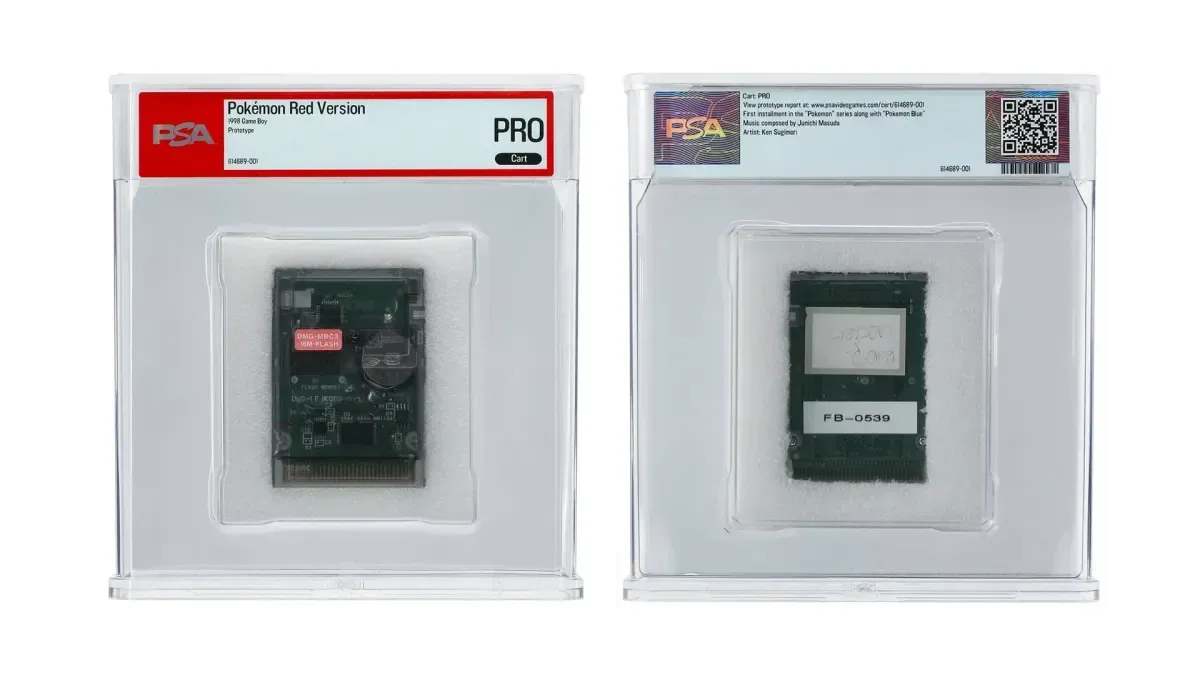
A Pokémon Red development cartridge dating to 1998 is up for auction with an opening bid of $25,000, putting a rare piece of Game Boy-era hardware in the spotlight. But the strongest reason to pay attention is not necessarily the possibility of a lost version of Pokémon Red hiding inside it. The available authentication notes instead point toward something subtler: a development-format cartridge whose readable game data matches the final U.S. release, while its technical header contains two unusual, linked values.
That distinction matters. Prototype and development hardware can be prized for its production history even when it does not contain unseen Pokémon, cut maps, alternate dialogue, or a playable build that differs from the game people remember. In this case, the object’s unusual board, its physical form, and its relationship to the game’s development process appear to be the central appeal.
What is being auctioned
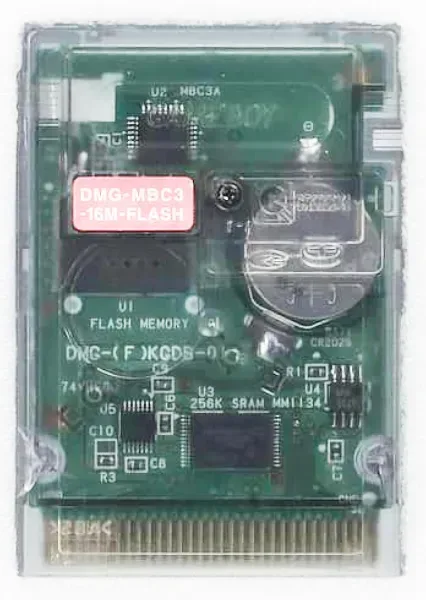
The item is described as a Pokémon Red development cartridge made in 1998. It is visibly different from an ordinary retail Game Boy cartridge: the cartridge is longer, and its front sticker reads “DMB-MBC-16M-FLASH.” It also carries the part number DMG-(F)KGDB-01, identified as an undocumented development board.
Those physical details are important to collectors because a development cartridge is not simply a normal consumer cartridge with a different label. Development hardware exists to support work before, during, or around a game’s release process. The unusually sized shell and board designation are therefore part of the item’s case as specialist hardware rather than a standard store-bought copy.
The listing had one bid at the $25,000 opening level when reported. The auction is scheduled to close on October 26, 2026, at 2:00 a.m. GMT+1. Its ultimate value will depend on bidder interest, the confidence collectors place in its authentication, and how they weigh a piece of development hardware against a cartridge that does not presently offer a distinct playable version of Pokémon Red.
The readable data is not an alternate build
The technical examination is where the story becomes more nuanced. The cartridge was authenticated, but the examining equipment could not complete a full data read. The first 32KB was captured, and that captured portion is described as technically unique because of two header-data changes. Crucially, the readable game data is reported to be completely identical to the final U.S. release of Pokémon Red.
That means the current evidence does not support presenting this as a rediscovered early build filled with different content. There is a meaningful difference between a cartridge being rare and a cartridge containing rare game material. This one is rare physical hardware, while the portion of the game that could be read appears to be final-release content.
The authentication notes express confidence that, if the rest of the data could be captured, it would follow the same pattern. That is a reasoned technical assessment, not a completed full dump. Collectors and preservation-minded fans should keep those two statements separate: the complete contents have not been read, while the available examination found no game-data difference and indicates that more of the same is expected.
Related coverage includes Pokémon Red Development Cartridge Auction Opens at $25,000.
Header data, explained
A cartridge header is a small area of technical information associated with a game’s data. It is not the same thing as the game’s maps, Pokémon encounters, battle systems, text, sprites, or story. Header values help identify or validate aspects of the ROM, the software data stored on the cartridge.
Here, the reported difference occurs at offset 0x014C, the location that denotes the Mask ROM version. It is set to 55 rather than 00. An offset is simply a numbered position within a block of data; the hexadecimal-style notation is a standard technical way to label that position.
That variation has a direct knock-on effect at offset 0x014D, the header checksum. A checksum is a calculated value used to check whether related data corresponds as expected. Because the Mask ROM version field is set differently, the resulting checksum is CB rather than 20. In plain English, these are two connected technical deviations in the cartridge’s identifying and validation information, not two confirmed changes to Pokémon Red’s actual game content.
Why a final-data development cartridge can still be significant
It may initially sound contradictory for a development cartridge to contain final-release game data. It is not. The term “development cartridge” describes the hardware’s role or format; it does not automatically guarantee that every byte of software on it is an unfinished build. A developer could use specialized hardware at different points in a project’s life, including when software was close to or matched its retail form.
That is why the board itself is so central here. The longer form factor, the DMB-MBC-16M-FLASH label, and the undocumented DMG-(F)KGDB-01 part number establish a hardware story that differs from a consumer Pokémon Red cartridge. The item may offer evidence of the tools or formats used around the game’s creation and handling, even if the readable program itself is not materially different from the version released to players.
For gaming-history collectors, provenance and technical identity often matter as much as hidden content. An authenticated, non-retail piece of hardware connected to one of the defining handheld games of its era can stand on its own as a collectible. Its appeal is likely to be especially narrow, however. A buyer hoping to boot it up and find a radically different Pokémon adventure has no support for that expectation in the available examination.
Prototype, early version, and first print are not interchangeable
Collectors often use terms such as “prototype,” “development unit,” “early version,” and “first print” loosely, but they describe different ideas. This is particularly relevant for an item like this one, where the hardware appears unusual but the readable game data aligns with the final U.S. release.
- Prototype: broadly, an item made before normal commercial production, or hardware used in a development context. It does not inherently mean that its software differs from retail.
- Development cartridge: a cartridge intended for development-related use rather than ordinary consumer sale. Its board and shell can be the key point of difference.
- Early version: generally implies software from an earlier stage, with potentially different content or behavior. The available read does not establish that here.
- First print: usually refers to an early retail production run. A non-retail development board is a different category of object, even when it is associated with the same game.
On the information currently available, “development cartridge” is the most precise and useful description. Calling it a first print would blur the line between a specialized board and a retail manufacturing run. Calling it an early software version would go further than the readable evidence permits. The distinction is not pedantry: it helps buyers understand exactly what is known, what is inferred, and what remains unverified.
The preservation question remains open
The incomplete read is arguably the most important unresolved aspect of the sale. A full dump is a complete extraction of the ROM data, allowing specialists to compare the whole cartridge with a known retail version. That has not happened here because the examination equipment prevented a complete data read.
There are two reasonable responses to that limitation. One is excitement: uncommon development hardware can be historically meaningful, and the captured header differences already document something technically distinct. The other is restraint: a partial read cannot prove the entirety of the cartridge’s contents, and there is no basis to promise unreleased material.
Both can be true at once. The object can be a compelling artifact without being a secret alternate Pokémon Red. If a future owner pursues further non-destructive examination, a complete data capture could clarify whether the authentication assessment holds across the rest of the cartridge. Until then, the known facts are more modest and more interesting than a simple “prototype equals hidden content” narrative.
What the bidding will really measure
The $25,000 opening bid tests demand for a very particular kind of Pokémon collectible: not a sealed retail game, not a trading card, and not a conventional piece of gameplay nostalgia, but a development-board artifact with an authentication record and incomplete technical access.
Its value proposition rests on scarcity and specificity. The board’s unusual dimensions and undocumented part number separate it from the mass-market cartridge. The captured 32KB provides a documented technical signature, even though that signature lies in header fields rather than game content. And Pokémon Red remains a landmark Game Boy title, making any credible development-related object associated with it inherently attention-grabbing.
At the same time, the existing evidence defines the boundaries of the claim. There is no confirmed alternate game build, no completed full read, and no reason to reclassify the item as a retail first print. The cartridge’s intrigue comes from being an unusual surviving tool of game development—one that happened to preserve final-release game data in the portion that has been examined.
For more retro-game context, see our coverage of Digimon World Forge and its PS1-style approach. Pokémon Red’s development cartridge belongs to a different conversation: the tangible, technical artifacts that can survive long after a game’s original production work is over.