
The vocabulary trap: “memory” is not one market
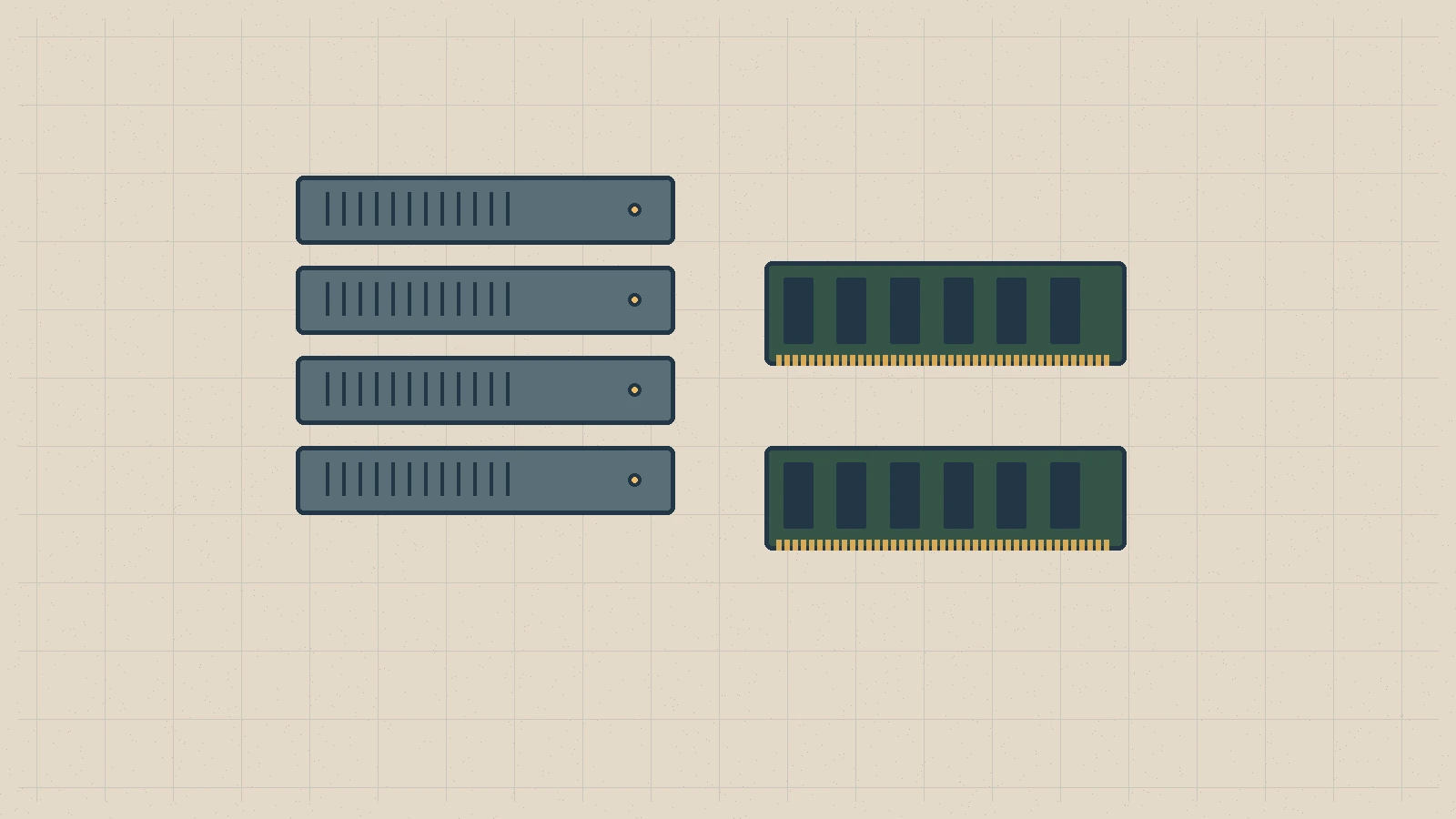
“Memory” is a useful word in an engineering diagram and a dangerous one in a price story. It can mean volatile working memory inside a computer, nonvolatile flash used for storage, a finished desktop module, a server component, or a specialized package attached to an accelerator. Those products do not share one capacity metric, one supply chain, one customer base, or one price. Any serious discussion of AI infrastructure and prices must therefore separate DRAM from NAND before asking whether either has become more expensive.
DRAM is volatile memory. It stores data while a system has power and is used for active computation: operating-system processes, application data, model weights being worked on, and intermediate results. Its advantages are relatively low access latency and the ability to deliver data quickly to a processor. Its limitation is that it does not preserve information after power is removed. System main memory is generally DRAM in desktop DIMMs, server RDIMMs, or laptop packages; HBM is accelerator-attached DRAM serving a distinct local-memory role.
NAND flash is nonvolatile. It retains data without continuous power and is the basic storage medium in solid-state drives, phones, memory cards, and many embedded devices. NAND is arranged and managed differently from DRAM. A finished storage product normally includes a controller, error correction, firmware, spare capacity, and an interface that presents usable storage to the host system. A 2TB SSD is therefore not “2TB of RAM.” It is a persistent storage device built around flash and supporting electronics, designed for a different job and normally accessed through a different protocol.
Capacity alone hides these differences. A gigabyte of raw NAND output, a gigabyte of usable capacity in a consumer SSD, and a gigabyte of protected capacity in an enterprise drive are not economically identical. Nor is a gigabyte of DRAM in a bare component equivalent to a gigabyte in a tested desktop kit or a gigabyte of HBM integrated into an accelerator package. Packaging, testing, firmware, reliability requirements, and the customer’s workload all affect the price.
HBM, or high-bandwidth memory, belongs to the DRAM family. It is not NAND and it is not an interchangeable desktop module. In general technical descriptions, HBM consists of multiple DRAM dies assembled in a stacked package and connected through package-level interconnects. The resulting memory product is designed to work with a graphics or compute die. Its short, wide connection is intended to provide very high bandwidth to an accelerator rather than to serve as a user-replaceable system-memory stick. General editorial taxonomy; the supplied product sources are used here for product-specific capacities and bandwidth, not as a universal process specification.
The physical configuration explains why HBM cannot be placed on the same price chart as ordinary desktop DDR5 without qualification. Micron describes HBM3E products in configurations including 24GB in an eight-high stack and 36GB in a 12-high stack, with bandwidth above 1.2TB per second per placement. Those figures describe package-level products selected for particular accelerator designs. A desktop buyer cannot purchase one as a DIMM, insert it into a motherboard, and use it as a substitute for a conventional memory kit.
DDR5 is a conventional DRAM standard used in desktops, servers, and other systems. A finished desktop kit may contain multiple modules and may be sold with programmed configuration information and an advertised speed and timing profile. Its retail price reflects more than the underlying DRAM chips: module assembly, testing, binning, packaging, branding, distribution, warranty handling, and retail margin also contribute. Product-category description; the supplied sources do not independently document every profile or interface detail.
RDIMMs, or registered DIMMs, are server-oriented memory modules with platform requirements different from typical unbuffered desktop designs. In general product taxonomy, the registered design places a control element between the host memory controller and the module’s DRAM devices, but exact implementation details depend on the standard and product. Server buyers also care about capacity per module, error-management behavior, thermal limits, lifecycle availability, and support for a defined system configuration. A server DDR5 RDIMM and a consumer DDR5 kit may contain related generations of DRAM, but they are different products with different validation and purchasing requirements. General technical background and editorial comparison; no product-specific register design is asserted.
LPDDR means low-power DRAM and is commonly used in mobile devices and thin computers. It is often integrated into a compact device design rather than sold as a user-replaceable desktop module. Its power, packaging, and upgrade characteristics therefore differ from those of desktop DDR5. LPDDR is not a direct substitute for a desktop DIMM simply because both are volatile DRAM. Product-category description.
Storage has a similarly varied vocabulary. An enterprise SSD is designed for data-center workloads that may involve sustained writes, defined endurance, high availability, predictable performance, power-loss protection, telemetry, or long qualification cycles. A consumer SSD may prioritize capacity, burst performance, price, and compatibility with personal computers. Both may use NAND flash, but their controllers, firmware, overprovisioning, endurance targets, warranties, and validation can differ substantially.
Phones also use embedded-storage categories such as UFS and eMMC. These labels describe storage products or interfaces intended for integration into mobile and embedded devices, not removable desktop SSDs or raw NAND. The relevant package, controller, interface, and device design shape procurement and performance. Product-category distinction; no claim is made here about a universal performance ranking.
Even within NAND, technology and product form matter. TLC and QLC are commonly used cell-density labels: in the usual taxonomy, TLC represents three bits per cell and QLC four. Those labels alone do not determine price, endurance, or suitability. A high-capacity QLC data-center SSD, a TLC client drive, and raw flash sold into a mobile product may move through different commercial channels and require different controllers, firmware, testing, and endurance targets. A statement about “NAND prices” is incomplete unless it identifies the type of NAND, its form, capacity, region, and customer. General editorial taxonomy rather than a source-derived product specification.
That is why this feature keeps HBM, server DDR5, consumer DDR5, LPDDR, enterprise SSDs, and consumer SSDs as separate lines of inquiry. Manufacturer documents distinguish HBM, DDR, NAND, and SSD businesses for a reason. The products all store bits, but they do so with different physical designs and economic purposes. A single “memory price” chart would conceal those differences rather than clarify them.
What an AI data center actually buys
An AI server is not a box containing one large pool of interchangeable memory. It is a layered system in which different technologies serve different distances from the processor, different latency targets, and different types of data. The accelerator’s HBM is one layer. The host CPU’s ordinary memory is another. Local solid-state storage, shared file systems, object stores, and backup tiers sit farther away, generally offering more capacity but different access characteristics.
At the center of an AI computation is the accelerator. Its HBM provides high-bandwidth memory for the accelerator’s active workload. NVIDIA’s HGX component table specifies 80GB of HBM3 per H100, 141GB of HBM3e per H200, and 180GB of HBM3e per B200, with corresponding eight-GPU node totals of 640GB, about 1.1TB, and 1.44TB. AMD’s MI350-series documentation lists up to 288GB of HBM3E per accelerator and describes 2.3TB across an eight-GPU platform. These are manufacturer specifications for named products, not measurements of a complete data center.
HBM is optimized for feeding the accelerator, not for replacing every other memory layer. An accelerator can contain hundreds of gigabytes of HBM and still require a host system with ordinary DRAM. The host CPU runs the operating system, orchestration software, data-loading tasks, networking services, storage drivers, and other processes. It may also stage data before transfers to the accelerator. The amount of host memory depends on the server design and workload, but substantial HBM does not eliminate the need for DDR5 or server RDIMMs.
The host-memory layer is therefore a conventional server-memory market even inside an advanced AI machine. A platform may use high-capacity RDIMMs because the CPU, operating system, control-plane software, databases, and service processes need more memory than a small desktop-style configuration can provide. Those modules must be qualified for the server motherboard and processor. They may also be purchased under supply arrangements different from those used for consumer PCs. An AI server can create demand for specialized HBM and conventional server DRAM at the same time.
Networking adds another layer, but its exact memory technology should not be inferred from accelerator specifications alone. NVIDIA’s HGX documentation identifies BlueField-3 DPUs, high-speed adapters, system DDR5 memory, and local NVMe as components of the reference architecture. The documented point is that networking and data movement are part of the platform. The supplied platform material does not establish a universal design for every network buffer, so no general claim about the precise memory technology used in those buffers is made here. Manufacturer specification plus editorial limitation.
Local NVMe storage sits farther from the accelerator and CPU. It may hold operating-system images, container layers, temporary datasets, cached training data, preprocessing results, model files, or checkpoint files. NVMe describes a storage protocol and device ecosystem used with flash drives; it does not make an SSD equivalent to DRAM. Local drives offer much more persistent capacity than HBM or system memory, but their access path and latency are fundamentally different from those of working memory.
Whether a server needs a large local SSD pool depends on its architecture. Some systems stream data from shared storage and keep only a working set locally. Others use local NVMe to reduce repeated reads, stage files close to accelerators, or write checkpoint data before transferring it elsewhere. NVIDIA documentation describes deployment patterns in which local NVMe caches data or temporarily accelerates checkpointing before data is flushed to shared storage. That is a documented architecture, not evidence that every training system uses the same arrangement.
Shared enterprise storage provides a broader capacity layer. Parallel storage systems can distribute datasets across many devices and serve multiple compute nodes concurrently. They are designed around throughput, concurrent access, metadata behavior, and failure handling rather than the characteristics of a single consumer SSD. Enterprise drives may be selected where product-specific endurance, power-loss protection, telemetry, or defined performance behavior matter. The exact feature set varies by product and is not a universal definition of every enterprise SSD. Editorial synthesis grounded in product-category distinctions.
Object and file-storage tiers serve different roles again. A file system may present shared directories and support application behaviors that object storage does not directly provide. Object storage can hold large collections of datasets, model versions, logs, and other files that do not all require the lowest possible latency. AI-factory documentation describes using faster storage for hot data and object storage for colder data. Such a tiered architecture improves flexibility, but it does not imply that every deployment buys the same capacity or uses identical storage products.
Capacity, bandwidth, and latency should therefore be kept separate. HBM’s defining advantage is very high bandwidth close to the accelerator. Host DRAM provides fast working space for the CPU and system software. NVMe supplies persistent local capacity with a different latency profile. Shared systems provide scale and coordinated access across servers. Object and archive tiers provide still more capacity, often with slower retrieval. Comparing them solely by dollars per gigabyte ignores the service each layer performs.
The layers can also interact without becoming interchangeable. A dataset may begin in object storage, move to a shared file system for active work, be cached on local NVMe, and then be transferred into host DRAM or HBM for a computation. Each movement creates a performance and capacity decision. A storage expansion may reduce repeated transfers without adding accelerator memory. More HBM may allow a larger active model or working set without changing the size of the underlying dataset. These are complementary investments.
A deployment estimate must state its unit of calculation. If a platform has eight accelerators, the manufacturer’s platform specification can describe the HBM available across those eight devices. But a claim about the memory or storage purchased by a data center requires the number of servers, the configuration of each server, the shared-storage design, spare capacity, and any separate object-storage systems. Multiplying one accelerator’s HBM figure by an unstated number of machines creates a precise-looking result without establishing what was bought.
The same caution applies to claims about total AI storage demand. A manufacturer can report that AI and cloud growth are increasing demand for data-center SSDs and NAND. That supports a broad demand claim. It does not reveal how much data resides on local drives, how much is held in shared storage, or how much capacity is reserved for backup and recovery. Those figures depend on workload, retention policy, software, and deployment architecture.
The practical consequence is straightforward: AI infrastructure directly purchases several memory and storage products, not one generic commodity called memory. HBM serves accelerator bandwidth. DDR5 and RDIMMs support host systems. Local NVMe provides persistent working capacity. Enterprise and shared storage support datasets, checkpoints, logs, and recovery. Their prices can be influenced by related supply conditions, but their functions, specifications, and purchasing channels remain distinct.
HBM: the premium DRAM lane
HBM belongs within DRAM because its storage cells are DRAM cells. It deserves separate analysis because it is manufactured, packaged, tested, and sold through a specialized path. Conventional desktop memory is assembled as a module that a system builder or consumer can install. HBM is a package-level component designed around a particular accelerator. Its value comes not only from the memory dies but also from the connection between those dies and the compute device.
In general technical descriptions, HBM uses vertically assembled DRAM dies and a very wide package-level connection to the accelerator. Micron describes HBM3E products in an eight-high, 24GB configuration and a 12-high, 36GB configuration. It also describes bandwidth above 1.2TB per second per placement. The stacking and interconnect language is general editorial background; the capacities and bandwidth are manufacturer specifications.
Those specifications describe a specialized design target, not a general-purpose memory module. HBM products are specified as components of particular accelerator-package and platform designs. The supplied sources establish that product-specific integration, but they do not document a universal qualification process for every vendor combination. It is therefore safer to say that HBM products are designed and validated for specific accelerator-package architectures. Manufacturer specification plus editorial qualification.
Advanced packaging is central to the economics. Producing the DRAM dies is only one step: the dies must be stacked, connected, tested, and integrated into a package designed to work with the accelerator. A defect at a die, connection, stack, or package stage can affect usable output. The resulting manufacturing path differs from assembling ordinary desktop DIMMs. Manufacturer-supported supply explanation and editorial synthesis; the paragraph does not quantify stage-specific yields.
Packaging capacity can become a constraint even when wafer capacity exists. HBM requires specialized assembly and advanced packaging steps, and the accelerator package must meet its electrical and thermal requirements. A supplier expanding HBM output may therefore need more than additional DRAM wafers. It may need cleanroom space, packaging equipment, process engineering, testing capacity, and coordination with the accelerator platform. These requirements help explain why HBM supply cannot be increased simply by relabeling ordinary desktop modules.
Power and bandwidth also change the design trade-off. HBM’s short, wide connection is intended to deliver large data flows efficiently to the accelerator. That does not make it a universal substitute for slower or more flexible memory elsewhere in a system. A desktop motherboard is designed around removable modules and a conventional memory interface. An accelerator package is designed around its own memory placements and interconnect. The two products may both be measured in gigabytes, but they are not interchangeable at the system level.
Platform design creates another boundary between markets. An accelerator vendor specifies a supported memory configuration and package arrangement for a particular product and operating environment. The complete platform may then be evaluated with its power delivery, cooling, networking, system memory, and software. A surplus of desktop DIMM modules would not automatically solve a shortage of HBM products designed for a different accelerator package. Editorial inference from the named manufacturer platform specifications.
AI demand has made this distinction commercially important. Accelerators use HBM because their workloads can require very high memory bandwidth. As accelerator shipments grow, demand for the specialized HBM package grows with them. The memory supplier is not merely selling more of the same modules used in home computers. It is allocating manufacturing, packaging, testing, and engineering resources to a product with different requirements and, often, a different value per unit of capacity.
Micron’s filings support a narrower explanation for current supply pressure. The company attributes pressure to AI-driven demand, constrained industry supply, advanced-packaging capacity, cleanroom expansion, product-mix decisions, and allocation choices. Those statements support the existence of supply constraints around a rapidly growing market. They do not, by themselves, quantify how much non-HBM DRAM capacity was displaced by HBM or establish a precise “trade ratio” in the company’s annual filing. Manufacturer statement, with editorial qualification.
That distinction matters. It is reasonable to say that HBM growth can put pressure on conventional DRAM through shared manufacturing resources, product allocation, and capacity planning. It is not reasonable to turn that possibility into a claim that every HBM gigabyte directly removes one desktop-memory gigabyte from the market. The effect may be mediated by wafer allocation, packaging bottlenecks, customer commitments, yield, and a supplier’s decision about which products to prioritize.
HBM demand and desktop-DIMM demand therefore coexist rather than collapse into one market. A data-center accelerator may require multiple HBM stacks, while the same server also uses host DDR5 or RDIMMs. A consumer PC may use a desktop DDR5 kit and no HBM at all. The two markets can compete indirectly for manufacturing resources while remaining technically separate in the products delivered to customers.
Conventional DRAM: server demand versus consumer modules
Conventional DRAM is itself a collection of markets. Server DDR5, desktop DDR5, laptop LPDDR, legacy DDR4, and graphics memory all store data temporarily, but they are delivered in different forms and sold to different customers. Their prices can diverge even when they share broad manufacturing technology because the components are binned, packaged, qualified, and allocated for different uses.
Server DDR5 and RDIMMs are purchased for systems that may operate continuously and support large memory configurations. The module design is a server-oriented registered format and is validated for a specific platform; exact implementation details vary by standard and product. Buyers care about capacity per module, error-management behavior, thermal limits, lifecycle support, and predictable supply. A server operator may negotiate directly with a supplier or system maker, so the relevant price may be a contract or configuration price rather than a public checkout price. General product taxonomy and editorial comparison.
Desktop DDR5 kits are different finished products. A kit may contain two 16GB modules for a nominal 32GB total, a heat spreader, a particular speed rating, and programmed profiles for enthusiast motherboards. The advertised data rate, timings, voltage, and profile support influence the product’s position in the retail market. Manufacturers may select or “bin” chips for particular performance levels, while module assembly, packaging, warranty, marketing, distribution, and retailer margins add costs beyond the underlying DRAM components.
Two kits with the same total capacity can therefore have different prices. One may use a more aggressive speed and timing combination, a different memory organization, or an enthusiast-oriented heat spreader. Another may be a basic kit sold during a promotion. A retailer may also have bought inventory at a different time from a distributor. None of these prices should be read as a direct quotation for a bare DRAM die.
Module compatibility adds another layer. A desktop kit’s rated speed may depend on the motherboard, processor, firmware, and the selected performance profile. That does not mean the product has the same validation requirements as a server RDIMM. It means that the advertised specification is part of a finished consumer product whose value includes ease of installation and a defined performance target. A comparison based only on the number of gigabytes misses those characteristics.
LPDDR is commonly used in laptops and mobile devices where power efficiency and compact packaging are important. It is often soldered rather than installed as a user-replaceable module. Its design priorities differ from those of an upgradeable desktop kit. A data-center supplier can report sales involving LPDDR, DDR5, HBM, and high-capacity DIMMs in the same period, but that does not mean the products are interchangeable or that they experience identical price movements.
Legacy DDR4 adds another complication. Older standards may remain in demand because of installed systems, industrial equipment, lower-cost computers, or replacement needs. Suppliers may reduce or reshape production as newer generations gain share, while buyers may continue needing the older part. A newer-generation shortage does not automatically imply the same shortage for DDR4, and a low price for remaining DDR4 inventory does not disprove tightness in DDR5.
Graphics memory is also distinct from ordinary desktop system memory. It is designed for graphics processors and related architectures, with its own interfaces, bandwidth targets, package arrangements, and qualification requirements. It should not be combined with desktop DDR5 in a single consumer-RAM average merely because both are used by a computer.
Server demand can still affect consumer availability indirectly. Suppliers allocate wafer capacity, packaging resources, testing capacity, and production lines among products. If data-center customers commit to large volumes of server DDR5, HBM, or high-capacity modules, the supplier’s product mix may change. Within its data-center product portfolio, Micron identifies DDR5, HBM, LPDDR, and high-capacity DIMMs. SK hynix reported third-quarter 2026 DRAM growth driven by server DDR5 and HBM4 shipments. These statements support strong server demand, but they do not quantify the effect on every retail module or show that all four categories moved in the same way.
Allocation also operates through time. A large customer may receive supply under a commitment, while distributors and retailers sell from inventory acquired earlier. A consumer price can remain low while old stock is cleared, then rise sharply when replacement inventory reflects tighter component conditions. Conversely, a retailer can discount a product even when supplier commentary describes a firm market. The retail tag is a downstream observation, not a transparent window into every upstream transaction.
Retail products can also carry pricing signals that are unrelated to the underlying memory die. A branded kit may have a premium for its speed rating, timings, heat spreader, warranty, or visual design. The seller may be responding to limited stock, expected replacement cost, or a temporary promotional strategy. These factors can make a single checkout price look extreme without demonstrating that every 32GB kit, every retailer, or every region has experienced the same movement.
Retail observation: On November 14, 2026, the Newegg U.S. page for a Corsair Vengeance CMK32GX5M2B6000C30 32GB DDR5-6000 desktop-memory kit displayed a $599.99 asking price and a displayed comparison price of $644.99, with a displayed savings amount of $45. The page identified Newegg as both seller and shipper and showed a purchase limit of two per customer. It also displayed the message “Save even more w/ promo code BNWF2438, limited offer.” The $599.99 figure is the displayed price before applying that code; the page did not show a code-applied checkout total. Promotion status is therefore “limited-offer promo code displayed; price quoted before code.” The item was presented as a standard retail listing, with no refurbished designation shown. This is a model-specific U.S. retail asking-price observation accessed on November 14, 2026, not a contract-price measure, verified historical comparison price, market average, or universal price for 32GB of DDR5. Retail observation.
The careful conclusion is limited. Server DDR5 and HBM demand can tighten parts of the DRAM supply chain and influence supplier allocation. Consumer DDR5 prices can reflect those conditions, but they also reflect binning, module design, inventory, promotions, seller margins, and platform-specific demand. The named listing shows a high asking price for one kit; it does not establish a universal price of RAM or an independently measured percentage of consumer inflation caused by AI data centers.
NAND is a different crisis, if it is a crisis
NAND flash belongs to a different market from DRAM. It is nonvolatile storage: data remains present when power is removed. DRAM is volatile working memory, used to hold information that processors need quickly. The two technologies can both be described in gigabytes, and both can be found inside an AI data center, but that shared unit does not make their prices interchangeable.
Even “NAND pricing” is too broad to be useful without further description. The relevant product might be raw flash on a wafer, a packaged NAND component, an assembled client SSD, an enterprise drive, embedded storage for a mobile device, or a finished retail product. It might use TLC or QLC cells, have a particular controller and firmware, and be sold under a contract, through distribution, or at a retail checkout. Each stage has its own supply, inventory, and margin structure.
TLC NAND commonly denotes three bits per cell, while QLC commonly denotes four. Those labels affect nominal density, but they do not by themselves determine the price or suitability of a drive. A finished product also depends on controller capability, error correction, firmware, overprovisioning, endurance targets, interface speed, testing, warranty, and the workload for which it is designed. Two drives with the same capacity can therefore have substantially different economics. General editorial taxonomy; not a claim about a specific product implementation.
NAND is manufactured on wafers and divided into dies, which are then packaged and combined into storage products. Wafer supply is an important upstream variable, but it is only one part of the chain. Suppliers can change wafer starts, allocate output between TLC and QLC, alter the mix of client and data-center products, and adjust inventory in response to demand. A change in wafer availability may take time to reach finished drives if manufacturers or distributors already hold stock.
The reverse can also happen. A supplier may report stronger demand while retailers are still discounting older inventory. A retailer may raise an asking price for a scarce model before the broader NAND market has changed. A distributor may have bought drives at an earlier cost and continue selling them below the replacement cost of new inventory. These timing differences make it dangerous to infer an upstream trend from a single checkout page.
A finished SSD contains much more than flash. It requires a controller, firmware, circuit board, power-management components, error-correction functions, testing, packaging, and a support or warranty program. The controller manages host commands, wear, bad blocks, garbage collection, error correction, and the movement of data among NAND cells. Firmware influences behavior when the drive is nearly full, receives sustained writes, loses power, or encounters difficult error conditions.
Enterprise SSDs add product-specific requirements. A data-center model may include power-loss protection, endurance ratings, telemetry or SMART monitoring, data-path protection, firmware-management features, and defined latency or workload behavior. The exact feature set varies by product. These characteristics are not a universal definition of every enterprise SSD, but they illustrate why a data-center drive cannot be treated as a quantity of raw flash in a different box.
Qualification is another distinction. A storage operator may evaluate a drive’s performance, firmware behavior, failure recovery, endurance, and compatibility with a particular platform before deploying it at scale. That process can limit substitution. A client SSD cannot automatically become an enterprise product simply because both contain NAND. The customer is purchasing a tested storage component with specified behavior, not merely a number of terabytes.
Micron’s reported products illustrate the range. The company has described G9 NAND, PCIe Gen6 data-center SSD production, and a 245TB QLC data-center SSD. Those disclosures establish product development and manufacturing activity in high-capacity and high-performance storage. They do not establish that all NAND categories are short, that every consumer SSD has followed the same price path, or that the launch of one high-capacity drive measures global flash consumption.
A 245TB enterprise QLC drive and a retail 2TB client SSD should not be compared by dividing the price of each by its capacity and treating the results as equivalent. The enterprise product may reflect density, controller design, firmware, endurance, power-loss protection, validation, support, and a different sales agreement. The client product may be optimized for a broader retail market, a different write workload, and a shorter replacement cycle. Dollars per terabyte can be calculated, but the result does not erase those differences.
The same caution applies to technology labels. TLC and QLC are not complete product descriptions. A QLC drive may be attractive for dense capacity, while a TLC model may be positioned for a workload requiring a different endurance or sustained-write profile. Neither technology is universally “better” or “cheaper” once controller design, overprovisioning, firmware, packaging, and channel conditions are included.
Counterpoint’s third-quarter 2026 tracker separates PC NAND, mobile NAND, and server NAND. That division is essential. PC NAND commonly enters client SSDs, mobile NAND can be integrated into devices using standards such as UFS, and server NAND enters enterprise storage products with different qualification and reliability requirements. A movement in one category cannot automatically be applied to the others.
The tracker’s visible figures also show why category labels matter. It reports a 29.5 percent quarter-over-quarter increase for a 1TB NVMe DRAM-less client SSD and a 19.8 percent increase for a 3.84TB NVMe enterprise SSD as third-quarter 2026 average contract-price estimates. Those figures describe different products and commercial categories. They are not retail prices, and they should not be averaged into a single NAND number.
AI data centers can add demand for NAND through local NVMe drives, shared enterprise storage, datasets, checkpoints, logs, and model artifacts. Micron places data-center SSDs and NAND within its Core Data Center business and links AI and cloud growth with higher memory and storage demand. That supports a plausible demand channel. It does not demonstrate that every consumer SSD increase came directly from AI deployments.
The effect is mediated by architecture and inventory. A cloud operator might purchase shared storage rather than equip every accelerator server with the same local capacity. A system could use high-performance flash for active data and a larger, less expensive tier for retention. Existing inventory may delay the effect of higher component costs, while a shortage of a particular controller or qualified drive can raise one product’s price independently of the broad NAND balance.
The most defensible description is therefore segmented. NAND may be firm in one category and promotional in another. Enterprise contracts may tighten while client-channel stock remains plentiful. A high-capacity QLC product may show where a supplier sees demand without proving a universal price trend. Raw flash, assembled drives, enterprise products, and retail listings must be tracked separately before anyone can responsibly describe a “NAND crisis.”
AI storage demand: training data, checkpoints, and inference
AI workloads can increase storage demand, but they do not impose one standard storage configuration on every data center. A training cluster, an inference service, a data-preparation system, and a model archive have different requirements. Some prioritize bandwidth, some prioritize latency, and others prioritize capacity, durability, or cost. The resulting infrastructure is usually a hierarchy of storage layers rather than a server filled with one kind of SSD.
Training begins before an accelerator processes a batch. Source material may include text, images, video, audio, code, sensor records, or synthetic data. It may be cleaned, filtered, deduplicated, transformed, and divided into training shards. These steps can create temporary files and intermediate datasets. Depending on the design, workers may read from local NVMe, a shared high-performance file system, object storage, or a combination of those systems.
Local NVMe is the storage layer physically close to the compute server. It can hold operating-system images, container layers, caches, temporary shards, preprocessing output, model files, or checkpoint fragments. Its value is not simply its capacity. Local drives can reduce repeated network reads and provide high aggregate throughput when many workers access their own devices. They remain separate from host DRAM and accelerator HBM, however. A local SSD does not become working memory merely because it is close to a GPU.
Some designs use local drives heavily; others minimize local copies. A cluster may rely on a parallel file system that stripes data across many enterprise SSDs and serves it to numerous nodes. Such a system is organized around aggregate throughput, concurrent access, metadata behavior, redundancy, and recovery. In that arrangement, the storage purchased for the training environment is not the simple sum of the local capacity in every server.
Object storage serves another role. It can retain large datasets, model versions, checkpoints, logs, and other files that do not all require the lowest possible access latency. A frequently used dataset can be copied into a hot file system or local cache for a job, while older material remains in a more economical tier. The architecture can therefore combine high-performance flash with larger capacity pools rather than treating every stored byte as a request for premium local NVMe.
NVIDIA documentation describes deployment patterns that combine local NVMe, shared high-performance storage, object storage, and checkpoint workflows. In one documented DGX architecture, local NVMe can cache data and temporarily accelerate checkpointing before data is flushed to shared storage. NVIDIA’s AI-factory material also describes hot data on NVMe and colder data on object storage. These are documented design examples, not evidence that every AI system uses the same arrangement.
Checkpoints show why storage capacity and performance must be considered together. A training job periodically saves enough state to resume after an interruption or preserve a model version. The exact contents depend on the training framework and deployment design; this feature does not treat optimizer state, scheduler data, or metadata as universal checkpoint contents. Frequent checkpoint writes require a storage path that can absorb the workload without unduly stalling workers, while longer retention increases capacity requirements. Editorial qualification based on documented checkpoint workflows.
Checkpoint policy varies. An organization may retain only the latest few versions, or it may keep many intermediate states for experimentation, rollback, auditing, or reproducibility. A model’s parameter count therefore cannot be converted directly into a universal SSD requirement. A meaningful estimate would need checkpoint frequency, retained versions, optimizer data, compression, replication, the number of concurrent jobs, and the division between local and shared storage.
Inference has a different profile. A serving system may keep frequently used model weights in accelerator HBM or host memory and may use local NVMe for model loading, caches, or several model versions. A retrieval-based application may also use an index or vector database, but that is an application-specific example rather than a universal feature of AI deployments. The balance depends on query rate, update frequency, index structure, and the latency target. Editorial inference and conditional architecture example.
Logs and observability data create another stream. A service can generate request records, performance metrics, traces, error reports, safety events, and usage information. Some material is retained for short-term diagnosis; some is kept for compliance, analysis, or model improvement. Hot logs may remain on fast storage, while older data is compressed or moved to object or archive tiers. This can create persistent storage demand without requiring every byte to reside on an enterprise NVMe drive.
Backup and archive layers are farther from the accelerator. Organizations may retain source datasets, model artifacts, checkpoints, logs, and configuration records for recovery or governance. These tiers may emphasize durability, geographic redundancy, retention, and cost per usable terabyte over maximum I/O performance. Flash can be part of the pathway, but the final archive does not necessarily require the same product used for active training.
Micron’s filings place data-center SSDs and NAND within its Core Data Center business and associate AI and cloud growth with increased memory and storage demand. Its reported PCIe Gen6 and high-capacity QLC products show suppliers targeting both performance and density. PCIe Gen6 addresses a higher-performance data path, while a 245TB QLC drive emphasizes capacity. These are manufacturer product disclosures, not an independent measurement of worldwide NAND consumption.
The demand mechanism is nevertheless credible. More accelerators can support more training and inference activity. More activity can generate more datasets, caches, checkpoints, model versions, indexes, and logs. Storage may need higher throughput to keep compute supplied, greater capacity to retain artifacts, or both. The amount of NAND purchased per accelerator is not fixed because it depends on local caching, shared storage, object storage, compression, deduplication, replication, and retention policy.
Timing also differs between memory and storage. HBM and host memory are incorporated into the accelerator or server configuration. Storage can be expanded separately, pooled across many nodes, or purchased as a service. A cloud operator could add a shared storage system without changing every AI server. A model developer could rent storage instead of purchasing drives. An inference provider could maintain a small hot tier alongside a much larger object store.
These choices weaken any simple “one accelerator equals a fixed number of SSDs” argument. A deployment with heavy local caching will have a different client-device profile from one built around shared storage. A training environment that frequently saves and retains checkpoints will have different capacity needs from an inference service that loads a small number of stable models. A data center’s storage bill can grow even when the number of local SSDs per server does not.
The careful conclusion is that AI is a credible source of additional demand for data-center SSDs and high-capacity storage systems. Manufacturer disclosures support that broad direction. They do not establish a universal architecture, a fixed SSD-per-GPU ratio, or a direct explanation for every consumer drive price. The useful question is which storage layer is being purchased, by whom, for what workload, and under what performance and retention requirements.
The price evidence: contract, spot, channel, and checkout
Price reporting becomes unreliable when numbers from different commercial layers are placed on one chart without labels. A contract-price estimate, a spot quotation, a distributor price, and a retail asking price answer different questions. They can all be valid observations while remaining unsuitable for direct substitution. Any comparison must preserve the product category, transaction type, measurement period, region, and condition.
Contract prices describe negotiated arrangements between suppliers and customers. They may cover specified products, volumes, delivery schedules, pricing bands, or commitments. Counterpoint’s memory tracker separates PC DRAM, server DRAM, consumer DRAM, PC NAND, mobile NAND, and server NAND. Its visible third-quarter 2026 figures are average contract-price estimates, not retail transactions.
Several estimates illustrate the required separation. Counterpoint reports a 24.3 percent quarter-over-quarter increase for 16GB DDR5 SoDIMM, an 18.3 percent increase for 64GB DDR5 RDIMM, and a 34.2 percent increase for 1GB DDR4 consumer DRAM in Q3 2026. The dashboard was last updated November 6, 2026, and identifies the figures as average contract-price estimates subject to revision; prices and forecasts require a Counterpoint account. These are different categories and form factors. They do not establish a single “DRAM price,” and they cannot be read as the percentage increase for every desktop kit. Industry contract-price estimate.
The same tracker reports a 29.5 percent quarter-over-quarter increase for a 1TB NVMe DRAM-less client SSD and a 19.8 percent increase for a 3.84TB NVMe enterprise SSD in Q3 2026. The dashboard identifies both as average contract-price estimates subject to revision, not retail prices. The client and enterprise products have different capacities, use cases, qualification requirements, and commercial customers. Neither percentage should be averaged into a single NAND figure. Industry contract-price estimates.
Contract estimates may conceal variation among customers. A large customer with volume commitments, a systems company, and a smaller buyer can receive different terms because their quantities, delivery requirements, credit arrangements, and qualification status differ. A quarterly average can indicate direction without revealing the exact price of each transaction or the margin later added by distributors and retailers.
Spot prices refer to more immediate quotations or transactions, often involving components, wafers, or available inventory. They may react faster to shortages, excess stock, urgent demand, or production changes. But a spot quotation still applies to a defined product, grade, quantity, region, and delivery condition. A quote for one NAND type cannot represent all NAND, and a bare component quote cannot represent the price of a finished SSD.
Distributor and channel prices sit closer to finished products. A distributor can hold inventory and sell to system builders, retailers, or other businesses. Its price may reflect replacement cost, inventory age, freight, financing, allocation, and expected demand. A distributor-facing condition report can describe channel pressure, but it does not become a consumer checkout price merely because the product is closer to retail.
Retail asking prices are observations of specific offers. They identify a product, seller, listed price, and sometimes fulfillment terms. A page may also display a promotion, comparison price, marketplace offer, membership price, purchase limit, or delivery condition. The asking price is not necessarily the final amount paid, and it does not reveal the retailer’s cost or the supplier’s contract terms.
| Product | Technology | Capacity | Region | Seller | Condition | Price or movement | Measurement period | Access or source-update date | Promotion status | Source type and URL | Caveats |
|---|---|---|---|---|---|---|---|---|---|---|---|
| 16GB DDR5 SoDIMM | DDR5 | 16GB | Not applicable: industry estimate | Not applicable: industry estimate | Not applicable: industry estimate | +24.3% QoQ | Q3 2026 | Source updated November 6, 2026 | Not applicable | Counterpoint Memory Price Tracker; industry contract-price estimate | Quarterly average contract-price estimate subject to revision; not a retail price. |
| 64GB DDR5 RDIMM | DDR5 server DRAM | 64GB | Not applicable: industry estimate | Not applicable: industry estimate | Not applicable: industry estimate | +18.3% QoQ | Q3 2026 | Source updated November 6, 2026 | Not applicable | Counterpoint Memory Price Tracker; industry contract-price estimate | Server module; not interchangeable with desktop DDR5; estimate subject to revision. |
| 1GB DDR4 consumer DRAM | DDR4 consumer DRAM | 1GB | Not applicable: industry estimate | Not applicable: industry estimate | Not applicable: industry estimate | +34.2% QoQ | Q3 2026 | Source updated November 6, 2026 | Not applicable | Counterpoint Memory Price Tracker; industry contract-price estimate | Does not state the change for a finished DDR4 or DDR5 kit; estimate subject to revision. |
| 1TB NVMe DRAM-less client SSD | Client NAND storage | 1TB | Not applicable: industry estimate | Not applicable: industry estimate | Not applicable: industry estimate | +29.5% QoQ | Q3 2026 | Source updated November 6, 2026 | Not applicable | Counterpoint Memory Price Tracker; industry contract-price estimate | Not a retail price and not an enterprise-SSD measure; estimate subject to revision. |
| 3.84TB NVMe enterprise SSD | Enterprise NAND storage | 3.84TB | Not applicable: industry estimate | Not applicable: industry estimate | Not applicable: industry estimate | +19.8% QoQ | Q3 2026 | Source updated November 6, 2026 | Not applicable | Counterpoint Memory Price Tracker; industry contract-price estimate | Different capacity and qualification profile from client storage; estimate subject to revision. |
The product must remain identifiable at every stage. A DRAM die, an RDIMM, and a desktop kit may all be described in gigabytes, but they include different packaging, module construction, validation, firmware information, and distribution costs. A NAND wafer, flash package, assembled drive, and retail box are successive stages in a chain. Capacity alone does not make them comparable.
Promotion status is particularly important in the channel. A retailer may show a reduced price, a displayed comparison price, a marketplace offer, or a limited-time discount. A drive can be discounted to clear old inventory even while upstream contract prices rise. A scarce replacement product can have an elevated asking price before the broader market changes. Recording seller and fulfillment status is therefore part of the price observation, not optional background.
A defensible record should include the product, technology, capacity, region, seller, condition, price or movement, measurement period, access date or source-update date, promotion status, source type and URL, and caveats. It should state whether the number is an estimate, observation, quotation, manufacturer specification, or calculated result. For contract-price estimates, seller, region, condition, and promotion are not applicable and should be recorded explicitly rather than left blank. For retail observations, the record should identify whether the item is new, refurbished, marketplace-sold, or directly sold by the retailer, together with shipping and purchase-limit information when displayed.
A U.S. retail observation, not a global price index
A reproducible retail snapshot requires preserved pages or captures showing the exact product, seller, fulfillment status, price, and access time. The available evidence does not support the previously suggested two-kit, two-SSD comparison. The unnamed category range does not preserve enough model and seller information, the Best Buy Crucial P310 price was not independently verified from a product-specific archived page, and the historical Samsung 990 Pro price cannot be retained without a capture recording the exact offer. This section therefore narrows its scope to two currently retrievable Newegg product-page observations and does not present a complete November 14 historical market snapshot.
Retail observation: Accessed on November 14, 2026, the Newegg U.S. page for the Corsair Vengeance CMK32GX5M2B6000C30, a 32GB DDR5-6000 desktop-memory kit, displayed a $599.99 asking price and $644.99 displayed comparison price. The page showed a $45 savings display, identified Newegg as both seller and shipper, and showed a limit of two per customer. Promotion status was explicit: the page displayed “Save even more w/ promo code BNWF2438, limited offer.” The quoted $599.99 was the displayed pre-code price; the page did not show the price after applying the code. No refurbished designation was shown. This is a model-specific U.S. retail observation recorded on the audit access date, not a universal DDR5 price, verified historical comparison price, contract-price measure, or market benchmark. Retail observation.
The SSD observations require the same discipline. The earlier claim that a Crucial P310 2TB drive appeared at approximately $309.99 on Best Buy should remain excluded unless an archived, product-specific capture establishes the exact model, seller, fulfillment status, price, promotion status, and access time. A search page that cannot be independently retrieved does not provide enough evidence for a precise retail claim. The currently retrieved Newegg page for the Samsung 990 Pro 2TB, accessed on November 14, 2026, displayed a $389.99 offer from Newegg, with Newegg as seller and shipper. The page displayed a $639.99 comparison price and a $250 savings display; no separate promo code was shown. Separate marketplace offers appeared at $404.50 and higher and are excluded from the primary retail observation. This current observation must not be presented as the historical price on November 14 unless the capture itself establishes that date and time.
| Product or record | Technology and capacity | Region | Access date | Seller and shipper | Condition | Displayed price | Displayed comparison or savings | Promotion status | Marketplace treatment | Source type | What can responsibly be concluded |
|---|---|---|---|---|---|---|---|---|---|---|---|
| Corsair Vengeance CMK32GX5M2B6000C30 | DDR5-6000 desktop kit, 32GB | United States | November 14, 2026 | Newegg; sold and shipped by Newegg | Retail listing; no refurbished designation shown | $599.99 before code | $644.99 displayed comparison price; $45 displayed savings | Limited-offer promo code BNWF2438 displayed; code-applied price not shown | Primary Newegg offer; marketplace exclusion not material to the quoted offer | Retail asking-price observation | A named U.S. retail observation for one model and seller; not a universal DDR5 price, verified historical comparison price, or market benchmark. |
| Crucial P310 claim | 2TB client NVMe SSD | United States | Not established | Best Buy seller and fulfillment not independently verified | Not established | Previously reported near $309.99 | Not established | Not established | Search-page result not independently archived; exclude | Unreproducible retail claim | Exclude unless a product-specific capture verifies model, seller, fulfillment, price, promotion, and access time. |
| Samsung 990 Pro current page | 2TB client NVMe SSD | United States | November 14, 2026 | Newegg; sold and shipped by Newegg | Retail listing; no refurbished designation shown | $389.99 | $639.99 displayed comparison price; $250 displayed savings | No separate promo code shown; displayed savings/comparison pricing | Primary Newegg offer excludes separate marketplace offers at $404.50 and higher | Retail asking-price observation | Current Newegg offer only; not proof of a separate historical price or a national SSD average. |
The current Samsung page illustrates why a live page is not a historical archive. On the November 14, 2026 audit access, it displayed a Newegg offer at $389.99, with Newegg as seller and shipper, a displayed $639.99 comparison price, and a $250 savings display. Separate marketplace offers appeared at $404.50 and higher and were excluded from the quoted offer. No separate promo code was shown. This observation records the page as accessed; it does not prove an earlier or later price, and it should not be substituted for a separately captured historical offer. Retail observation.
What manufacturers say caused the squeeze
The explanations from Micron, SK hynix, and Samsung overlap, but that overlap should not be mistaken for independent proof of every link in the price chain. Each company describes artificial-intelligence infrastructure as an important source of demand for memory and storage. Their disclosures mention HBM, server DDR5, high-capacity modules, enterprise SSDs, advanced packaging, and expansion of data-center capacity. These statements are valuable manufacturer statements about what the suppliers are seeing and prioritizing. They are not, by themselves, a complete calculation of why a particular consumer product became expensive at retail.
Micron’s fiscal-2026 filing says that AI-driven demand growth exceeded industry supply growth and contributed to pricing improvement. That is a manufacturer statement about the company’s assessment of market conditions. Micron also describes competition for advanced-packaging capacity and other inputs, supply-allocation decisions, and a shift in part of its DRAM supply toward data-center and hyperscale-cloud markets. The filing supports a broad supply-and-demand explanation: more data-center systems are being built, the products used in those systems are not all ordinary commodity modules, and available capacity cannot be redirected instantly.
The filing does not, however, quantify the effect of each mechanism. It does not establish a precise “HBM trade ratio” or state that a defined number of desktop-DIMM wafers were converted into HBM. It also does not calculate the percentage of a consumer price increase caused by AI infrastructure. The careful formulation is narrower: Micron attributes 2026 pressure to AI-driven demand, constrained industry supply, advanced-packaging capacity, and allocation decisions. Those factors may affect non-HBM DRAM availability, but the filing does not measure the contribution of each one.
Within its data-center product portfolio, Micron identifies DDR5, HBM, LPDDR, and high-capacity DIMMs. That list matters because an AI server can require more than one kind of DRAM. Accelerators use HBM for high-bandwidth access to model and intermediate data. Host processors use ordinary system memory, often in server-oriented module formats. A product portfolio that grows across both categories can tighten more than one DRAM lane at once. It still does not follow that every category experiences the same shortage or price movement.
SK hynix’s third-quarter 2026 business results emphasize server DDR5 growth and HBM4 shipments. The disclosure is consistent with an AI build-out that increases demand for host memory as well as accelerator memory. It also reflects the company’s own product mix and performance, not a neutral inventory survey covering every manufacturer, region, or retail channel. The results material includes an explicit limitation that the information has not undergone separate independent verification. These are therefore company-reported results and outlook, not an independently established market total.
Samsung’s third-quarter results similarly connect AI-infrastructure investment with memory demand. The company discusses HBM, server DRAM, and SSD expansion as part of its strategy. Its account is useful because it spans both volatile memory and storage. A large AI installation needs HBM inside accelerators, host memory around those accelerators, and storage for data and system operation. Samsung’s product emphasis shows that it considers AI a major commercial driver. It does not demonstrate that every consumer DRAM or NAND product is being pulled upward by the same force.
The shared explanation has several layers. The first is direct demand: more accelerators and servers require more memory and storage. The second is product mix: suppliers may devote a greater share of output to HBM, server DDR5, high-capacity modules, or enterprise SSDs. The third is packaging: HBM is not finished when the DRAM dies leave the wafer; it requires stacking and integration with an accelerator package. The fourth is manufacturing capacity, including cleanroom space, process tools, testing, and packaging. The fifth is allocation: a supplier may reserve output for customers with commitments or for products with stronger strategic value. The sixth is time. New capacity and new products take months or years to ramp.
There is a further reason to distinguish observation from explanation. Manufacturers have an interest in describing a strong pricing environment in terms of demand, product leadership, and constrained supply. That does not make the account false. It means the account is a company’s interpretation of conditions that affect its revenue, margins, investment plans, and customer negotiations. A filing can contain historical results, management explanations, forward-looking statements, and planned capacity in the same discussion. Those categories should not be silently merged.
The strongest defensible conclusion is therefore bounded. Micron, SK hynix, and Samsung each attribute at least part of current memory-market strength or supply pressure to AI-related demand and data-center investment. Their disclosures identify HBM, server DDR5, storage, advanced packaging, and allocation as important parts of the story. They do not establish a precise AI share of consumer inflation, a universal shortage across NAND, or a one-to-one relationship between HBM shipments and desktop RAM prices. Editorial inference from multiple manufacturer statements, not an independently quantified causal decomposition.
Supply cannot appear overnight
Technical synthesis: Semiconductor supply is slow to change because “capacity” is not a single switch. A company can announce a fab, approve capital spending, or describe a packaging expansion without producing saleable components immediately. The path generally runs through construction, utilities, cleanroom qualification, tool installation, process integration, wafer starts, yield learning, testing, packaging, customer approval, and a gradual ramp. This is a generalized technical explanation, not a complete sequence documented by Micron for every product. A delay at any stage can prevent an investment from becoming usable supply.
A wafer fab first needs a building and an environment capable of controlling particles, temperature, humidity, vibration, and chemical conditions. The cleanroom must be commissioned before production equipment can operate at the necessary standard. Lithography, deposition, etching, cleaning, inspection, and metrology tools then have to be installed and brought under process control. A room containing tools is not automatically a source of reliable memory dies. The tools must work together across many process steps, and the results must be repeatable over time.
Process transitions add another source of delay. A memory supplier may move to a newer node, introduce a denser NAND generation, or change the design of a DRAM product while continuing to support older products. The new process may eventually improve density or cost, but early wafers require yield learning. Yield is the proportion of dies that meet the required specification. A rise in wafer starts can therefore produce less finished output than a simple capacity calculation suggests while engineers identify defects, adjust recipes, and improve uniformity.
The product mix also matters. A fab configured for a particular DRAM generation, density, or die design cannot necessarily make every other DRAM product at the same efficiency. HBM, server memory, mobile memory, and desktop modules may draw on related manufacturing resources while requiring different design, test, assembly, and commercial decisions. A new DRAM facility does not automatically increase NAND supply, and a NAND investment does not solve a shortage of desktop memory. Total bit capacity is not the same as availability of the product a buyer wants.
HBM has a further step after the DRAM dies are produced. The dies must be stacked and connected through specialized processes, then integrated into an accelerator package. The package must meet electrical, thermal, mechanical, and bandwidth requirements. Micron describes HBM3E configurations of 24GB in an 8-high stack and 36GB in a 12-high stack, with bandwidth above 1.2TB/s per placement. Those specifications describe the finished product, not merely the output of a wafer fab. Additional packaging capacity can relieve one bottleneck while wafer supply, testing, or accelerator integration remains limiting.
Micron has described a planned expansion of HBM advanced-packaging capacity in Singapore beginning in early calendar 2027. That timing is important. It indicates expected future capacity, not meaningful output already available on November 14, 2026. Packaging expansion must still be equipped, qualified, and ramped. It also cannot create additional DRAM dies by itself. Wafer production and packaging must grow together if the result is to be shipped HBM.
Micron’s U.S. projects show the same distinction between a plan and present supply. The company projects initial wafer output from its Boise expansion in calendar 2027, from a second Idaho fab in late calendar 2028, and from its first New York fab in calendar 2030. These are projected initial wafer-output dates. Initial wafer output is not the same as qualified, packaged, shipped, or retail-available product. The dates describe planned milestones, not a promise that every announced product category will become abundant on those dates. Manufacturer forecast; the surrounding manufacturing discussion is technical synthesis.
A shortage observed in November 2026 therefore cannot be assumed to disappear after a capital-spending announcement. Construction may already be under way, but tool installation and process qualification still take time. Early production may be reserved for development, yield improvement, or customers with existing commitments. Even after a facility reaches initial wafer output, the ramp toward designed capacity is gradual. The first wafers can be evidence that a project has begun producing, not evidence that the market has received its full planned supply.
Customer qualification creates another gap between physical production and usable supply. A server manufacturer or storage customer may evaluate a memory module, SSD, controller, firmware revision, or package before deploying it at scale. The evaluation can involve compatibility, error handling, power behavior, thermal performance, endurance, sustained performance, and failure recovery. A part that exists physically may not yet be approved for a particular platform. The qualification path can differ by customer and product, so a supplier may have output that is not interchangeable across all deployments.
New production can also be directed toward a different category from the one under pressure. A supplier might use additional capacity for HBM, high-capacity server modules, mobile memory, or a newer node rather than increasing the supply of legacy DDR4 or a specific consumer DDR5 kit. Similarly, a data-center SSD ramp may not produce more inexpensive client drives. Capacity decisions follow product economics, contracts, technical readiness, and customer demand. “More semiconductor output” is not a sufficient description of what reaches a particular channel.
These constraints do not mean that prices must remain high indefinitely. As yields improve, packaging expands, more suppliers qualify, and inventory accumulates, pressure can ease. But the timing depends on the bottleneck and the product. A wafer expansion may help one DRAM generation while leaving HBM packaging constrained. A NAND recovery may lower client-SSD prices while enterprise contracts remain firm. Planned capacity is meaningful evidence of future supply, but it is not present supply and cannot be used as proof of immediate price relief.
Who pays: cloud operators, OEMs, builders, and players
Memory costs do not pass through the supply chain as one fixed percentage. Buyers negotiate different products, volumes, delivery schedules, qualification requirements, and service terms. A data-center customer may purchase a qualified server configuration under a supply arrangement that is invisible at checkout. An OEM may alter the memory included in a finished computer. A system builder may buy through a distributor. A retailer may price a remaining batch according to replacement cost and competition. The final consumer sees only the last offer in that chain.
Micron discloses strategic customer agreements involving contracted volumes, take-or-pay commitments, pricing bands, and customer deposits. It also describes supply relationships across data-center, consumer, automotive, and industrial markets, along with distribution through direct sales, distributors, retailers, and representatives. Those disclosures demonstrate that allocation can be structured and customer-specific. They do not identify every strategic customer as a cloud operator or establish that every large cloud company buys through the same arrangement.
It is reasonable to use cloud deployment as an illustrative example, but it should remain an inference rather than a universal rule. A large operator planning a server installation may seek predictable supply of accelerators, HBM-equipped platforms, host memory, and storage. It may qualify configurations and arrange deliveries in advance. The exact commercial terms, however, depend on the customer, supplier, product, volume, and schedule. Public filings support the existence of strategic agreements; they do not reveal the price paid by every hyperscaler. Editorial inference, not a disclosed universal purchasing practice.
OEMs filter the pressure differently. A laptop or desktop maker may adjust the amount of included memory, change the selected module configuration, delay a refresh, or use another qualified supplier. A computer’s advertised price may remain stable while included capacity or upgrade flexibility changes. An OEM may also hold inventory purchased earlier at a different cost. Its product pricing reflects a blend of component cost, inventory, product planning, competition, and the timing of the next manufacturing cycle.
System builders operate with smaller inventories and shorter quoting horizons. A builder may quote a machine before every component is secured. If memory or storage becomes more expensive before assembly, the builder can absorb part of the increase, revise the configuration, delay delivery, or pass through a surcharge. Substitution is possible but not always frictionless. A replacement module or SSD may require checks for speed, capacity, physical clearance, firmware behavior, thermal characteristics, and warranty compatibility.
Distributors and retailers introduce another timing difference. A distributor may still hold stock purchased when prices were lower while its next shipment costs more. It can sell the older stock at a discount, protect its margin, or raise the price in anticipation of replacement cost. Retailers may list their own inventory beside marketplace offers. Two apparently similar products can therefore have very different prices because they entered the channel at different times or are being sold under different fulfillment arrangements.
This explains how an expensive gaming kit can coexist with cheaper legacy inventory. A high-priced kit may be a scarce DDR5-6000 configuration with a particular timing profile, bin, brand, or seller. Older DDR4 may be discounted because demand is weaker, because a distributor has excess stock, or because the product is being phased out. Even within DDR5, one kit may have been replenished at a higher cost while another remains from an earlier shipment. The visible prices describe product and inventory conditions, not one universal DRAM rate.
Storage follows a similar pattern. A consumer SSD can be discounted because a retailer is clearing a previous batch, even while an enterprise SSD supplier negotiates firmer terms for a qualified data-center product. A newer performance-oriented drive may remain expensive while a client QLC model is promoted. Controller availability, firmware, endurance, warranty, heatsinks, generation, and seller competition influence the finished price. NAND content is important, but it is not the whole drive and does not determine every retail offer.
Upgrade timing can soften or delay transmission. A consumer buying today faces the current channel offer. An OEM may have purchased components months earlier and revise its product only at the next manufacturing cycle. A system builder may postpone an upgrade if the quote becomes unattractive. A data-center operator may reserve supply in advance and deploy it later. These decisions can make an upstream change appear gradually in one market and abruptly in another.
Corrections, forecasts, and what the evidence does not establish
“HBM is taking all consumer RAM.” Status: partly supported as a supply concern, unsupported as stated. HBM is a form of DRAM, and manufacturers describe its growth, packaging requirements, and demand as contributors to a tighter supply environment. AI servers also consume ordinary host memory, so demand can rise in more than one DRAM category. That supports a mechanism by which HBM and server demand can influence the broader product mix. It does not show that all consumer RAM has been diverted, that HBM can be converted directly into desktop DIMMs, or that every consumer price increase has the same cause.
“HBM directly determines desktop DDR5 prices.” Status: unsupported. HBM and desktop DDR5 belong to the same broad DRAM family but differ in packaging, assembly, bandwidth, integration, testing, and use case. Desktop kits also include module construction, binning, SPD programming, optional performance profiles, distribution, and retail margin. A shared constraint in cleanroom space or manufacturing resources can affect both categories, but the relationship is not one-to-one. A costly desktop kit does not reveal how much of its price came from HBM demand.
“Micron’s 10-K proves an HBM trade-ratio mechanism.” Status: unsupported in that form. Micron’s fiscal-2026 filing supports claims about AI-driven demand, constrained supply, advanced-packaging capacity, allocation pressure, and a shift toward data-center products. It does not contain the phrase “HBM trade ratio” or quantify the displacement of non-HBM DRAM. A trade-ratio explanation should be attributed only to specific earnings material that actually contains it. Otherwise the article should say that Micron does not quantify how much conventional capacity was displaced by HBM.
“AI caused every SSD increase.” Status: unsupported. AI data centers are a credible source of demand for enterprise SSDs, local NVMe, high-capacity storage, and related infrastructure. Manufacturers connect AI and cloud growth with higher memory and storage demand. But NAND is divided among PC, mobile, server, and other applications, while finished SSD prices also reflect controllers, firmware, qualification, endurance, inventory, promotions, and seller margins. A consumer SSD can rise for channel reasons while another is discounted. The evidence does not support assigning every increase to AI.
“NAND and DRAM are interchangeable.” Status: unsupported. DRAM is volatile working memory; NAND is nonvolatile storage. HBM, DDR5, LPDDR, and RDIMMs are different DRAM products. TLC and QLC NAND become usable storage products only after integration with controllers, firmware, boards, testing, and packaging. The markets have different manufacturing paths, product designs, inventory cycles, and customers. A movement in one market cannot serve as a substitute measurement for the other.
“A new fab will fix prices next month.” Status: unsupported. Micron’s projected initial wafer-output dates for the Boise expansion in 2027, the second Idaho fab in late 2028, and the first New York fab in 2030 are future milestones. The company has also described HBM packaging expansion in Singapore beginning in early 2027. None of those plans equals immediate, qualified, packaged, shipped, or retail-available product. Construction, tool installation, process learning, yield improvement, packaging, testing, and customer qualification remain between an announcement and usable supply.
“New capacity automatically means more consumer memory.” Status: unsupported. A facility may be configured for a particular generation, density, die type, or product family. Additional output may be directed toward HBM, server modules, mobile memory, or strategic customer commitments. A DRAM fab does not create NAND, and a data-center SSD ramp does not necessarily create inexpensive client drives. Total semiconductor capacity and availability of a specific consumer part are different measurements.
“One retailer listing proves a national shortage.” Status: unsupported. On the November 14, 2026 audit access, a Newegg page for the Corsair Vengeance CMK32GX5M2B6000C30 32GB DDR5-6000 kit displayed an asking price of $599.99, a displayed comparison price of $644.99, Newegg seller and shipper status, and a purchase limit of two. The page also displayed the limited-offer promo code BNWF2438; the quoted $599.99 was before applying that code, and no code-applied total was shown. This is evidence about one named product, seller, and access date, not a national average or proof that every DDR5 kit was similarly priced.
“A high-priced gaming kit shows what hyperscalers pay.” Status: unsupported. Retail listings and strategic supply agreements describe different transactions. Contract customers may buy qualified server memory at volume under terms that include delivery schedules, support, and pricing bands. A consumer asking price includes channel costs and seller decisions that do not apply in the same way to a large data-center order. The reverse is also true: a contract estimate cannot be used as the expected price of a finished retail kit.
“A discounted SSD disproves storage tightness.” Status: partly supported only as a channel observation. A discounted client SSD can show that inventory, promotions, or competition are holding down that product’s retail price. It does not disprove firmer enterprise contracts or stronger demand for another NAND category. An expensive consumer SSD likewise does not establish uniform NAND scarcity. Product generation, NAND type, controller, firmware, capacity, seller, and inventory age must be known before the observation is generalized.
“Manufacturer agreement proves the whole causal chain.” Status: partly supported. Micron, SK hynix, and Samsung each identify AI-related demand or data-center investment as an important market driver. Their statements converge on a broad explanation involving HBM, server memory, storage, packaging, allocation, and supply growth. That convergence is meaningful, but the companies remain interested parties. Their disclosures do not independently calculate the exact share of consumer inflation caused by AI or prove that every product category moved for the same reason.
Current observations versus forecasts. The Corsair page was audited on November 14, 2026 and records a model-specific U.S. retail asking price of $599.99 before the displayed limited-offer code BNWF2438, together with seller, shipper, comparison-price, purchase-limit, and promotion-status fields. Counterpoint’s Q3 2026 figures are average contract-price estimates, not retail transactions; its dashboard was updated November 6, 2026 and identifies the estimates as subject to revision. The Samsung page was also audited on November 14, 2026 and displayed a $389.99 Newegg offer, while separate marketplace offers appeared at $404.50 and higher; that current observation is not a substitute for a separately captured historical price. Manufacturer comments about demand and constrained supply are company-reported assessments. Micron’s 2027, 2028, and 2030 milestones are projections of planned output, not current inventory. These categories should remain separate. A forecast can be credible without being a present fact, and a retail observation can be reproducible without representing a market average.
The evidence supports a narrower final assessment. AI data-center demand is a major driver identified by multiple manufacturers. HBM, server DDR5, desktop memory, enterprise SSDs, and consumer SSDs remain distinct products and markets. Manufacturer filings describe constrained 2026 supply and allocation pressure. The November 14, 2026 retail audit records selected U.S. asking prices for named products with explicit seller, fulfillment, comparison-price, promotion, condition, and access-date fields: Corsair DDR5 at $599.99 before the displayed BNWF2438 code, and Samsung 990 Pro 2TB at $389.99 from Newegg, excluding separate marketplace offers at $404.50 and higher. These observations do not produce a single universal “memory price” or a precise percentage of consumer inflation caused by AI.
Several questions remain open. How much of non-HBM pressure reflects packaging, cleanroom limits, node transitions, product mix, or deliberate allocation? How quickly will announced capacity become qualified output in each product category? How much channel inventory was acquired at older costs? Are enterprise NAND contracts tightening while client-SSD promotions continue? What portion of a retail increase reflects component cost, replacement inventory, seller margin, or scarcity pricing? The available evidence identifies the mechanisms and their limits. It does not justify a sweeping numerical conclusion.