Most older consoles are familiar objects: gray Nintendo 64s, black original Xboxes, white Dreamcasts and the first PlayStation in its unmistakable pale shell. Yet a small number of factory variants turned those everyday machines into highly specialized collectibles. They were prize items, regional exclusives, short-run commemorative releases, game bundles or systems distributed internally rather than sold at retail.
The important distinction is that a rare console is not automatically an expensive console, and an expensive listing is not proof of a market price. Condition, original packaging, controllers, included game bundles, documentation and the number of confirmed sales can radically change the result. A complete, sealed, professionally graded set may sell for many multiples of a loose working console—even when both are the same underlying hardware.
That makes identification the first job for anyone clearing out a closet or assessing a retro collection. Look for the exact shell color, a special center jewel or numbered plaque, region-specific accessories, bundle contents and any model or edition information. Do not assume that a translucent console is a particular variant just because it resembles one. In several cases below, closely related bundles are distinct releases with their own production histories.
It is also worth separating documented sale prices from price-guide estimates. A completed sale shows what one buyer paid for one specific item at a specific time. A guide is an estimate built from available market information. Neither guarantees what another console will command. The thinner the sales record, the more cautiously a buyer or seller should treat any proposed value.
Nintendo 64 Toys “R” Us Gold Edition
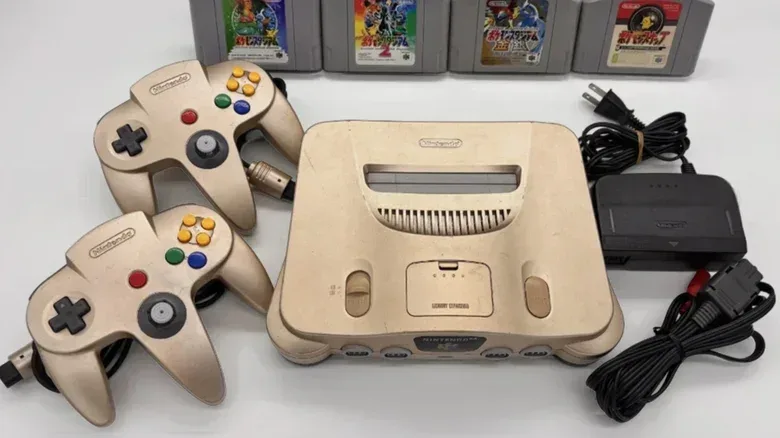
The metallic-gold Nintendo 64 and matching controllers are far less ordinary than the standard gray-and-black configuration. This was a Toys “R” Us-exclusive edition, and a December 2025 census from Video Game Authority, commonly abbreviated as VGA, listed only nine examples. A census is a count of examples recorded by a grading service, not a definitive total of every unit that exists.
That small census helps explain why premium examples can climb sharply. A VGA 80 near-mint gold system with two matching controllers sold for $3,250 in January 2026. The broader market is much less dramatic: documented ungraded loose-system sales in 2026 ranged roughly from $140 to $425, while boxed examples reached around $1,750 to $3,000. The practical lesson is clear: the gold shell alone is not enough to compare a loose console with a graded, accessory-complete presentation piece.
Nintendo 64 Pikachu Edition
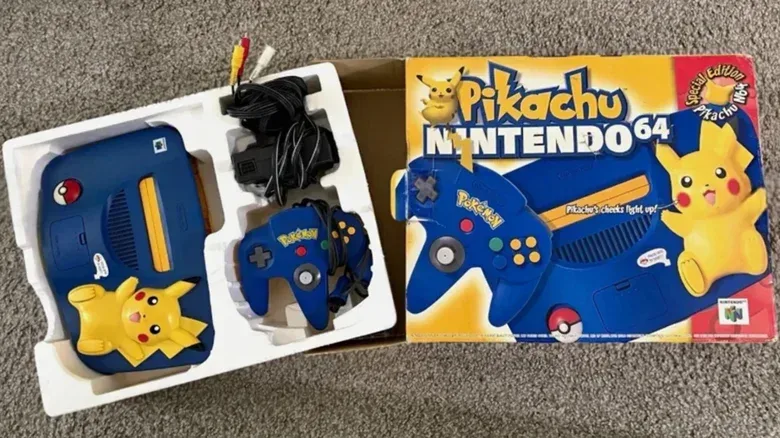
The North American Toys “R” Us-exclusive Pikachu Nintendo 64 is recognizable by its blue-and-yellow body, raised Pikachu decoration, Poké Ball-style power button and matching controller. Its original set also included Hey You, Pikachu! and the Voice Recognition Unit used to play it. Those bundle-specific pieces matter when determining whether a console is truly complete.
Sealed VGA 80+ collector sets sold for $10,000 in May 2025 and $16,250 in August 2026. Those figures should not be used as shorthand for the value of a played system. Estimates for a loose console sit near $390, while a complete set is estimated around $1,567. A VGA census reported 22 sealed examples in April, with only one receiving a grade higher than the sealed console sold in May 2025. Here, the visual appeal of Pokémon hardware meets a major divide between used, complete and sealed condition.
Related coverage includes 10 Rare Game Console Editions That Became Collector Legends.
PlayStation 10 Million Midnight Blue Edition
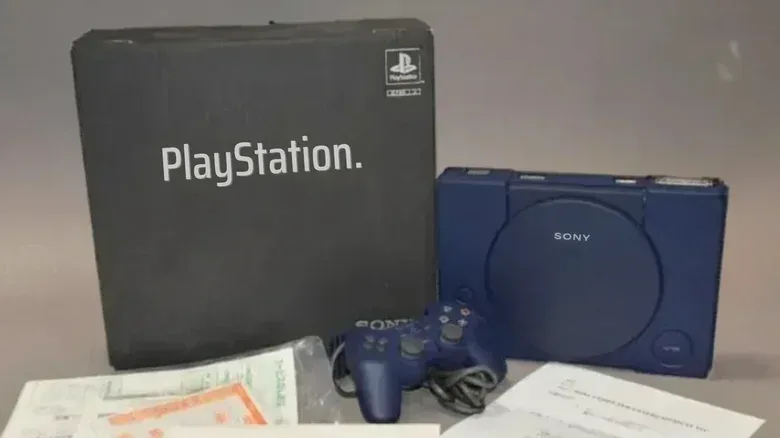
In 2000, Sony used the Midnight Blue original PlayStation as a prize rather than an ordinary store release. North America had 100 consoles in a sweepstakes and 1,000 matching DualShock controllers. A separate Japanese contest offered another 100 consoles tied to the anticipated domestic milestone of 10 million PlayStation units sold. The reported total is therefore 200 consoles across the two promotions.
Extremely limited prize hardware is difficult to price precisely because it appears so infrequently. One 10 Million model sold for $10,326.32 in October 2024; reported private sales were $9,000 in 2021 and $3,000 in 2017. A current complete-in-box estimate is about $9,663, while estimates for new and graded-new systems exceed $25,000. The wide variation is not a contradiction so much as a warning: sparse sales history leaves plenty of room for condition, provenance and buyer enthusiasm to affect a result.
Panasonic Q: GameCube Meets DVD Player
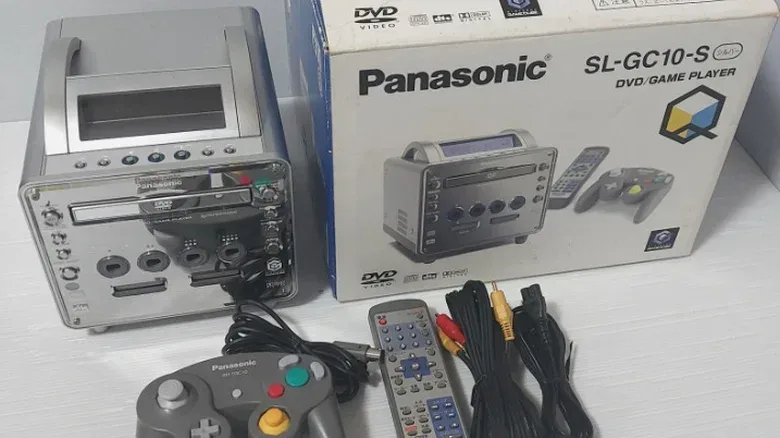
The Panasonic Q is unusual because it was more than a new colorway. Released only in Japan on December 14, 2001, it combined GameCube hardware with DVD playback, answering a capability the standard GameCube did not have. Its silver enclosure, front-panel LCD and hybrid purpose made it a conspicuously different machine. It launched at ¥39,800, approximately $325 at the time.
Production ended by December 2003. At that point the Q cost ¥34,800, compared with ¥13,800 for a regular GameCube. That price gap helps explain why the system occupies a special place among GameCube variants. Working examples recorded in 2026 have sold between $800 and $2,200 depending on condition, accessories and modifications. Estimates put a loose unit around $1,645, a complete boxed set about $2,200 and a sealed ungraded example about $4,569. A sealed VGA 80 example sold for $7,512 in December 2024.
Modifications deserve special attention with hardware such as the Q. They may be useful to a player, but they mean a seller should describe changes plainly rather than present a modified unit as untouched collector stock. The same careful approach applies to imported hardware generally: establish what is included and what has been altered before comparing it against a completed sale.
Sega Saturn Skeleton Edition
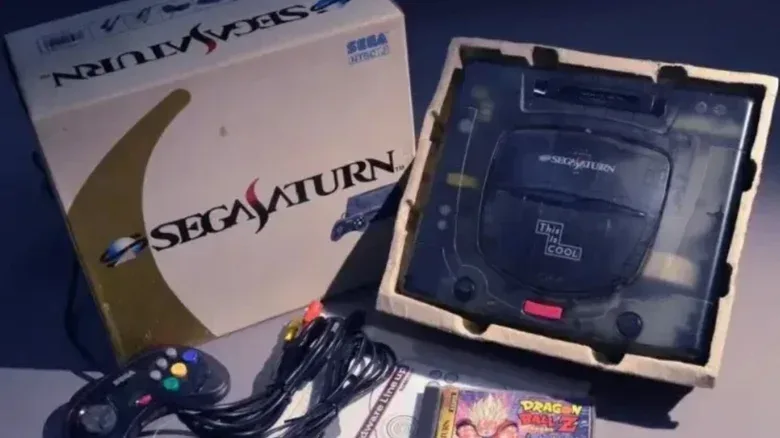
Sega’s Japan-only Skeleton Edition Saturn arrived on April 4, 1998, with a translucent gray body and matching clear controller. Its run was limited to 30,000 units, a number that is substantial beside contest prizes but still makes it distinct from an everyday standard system. It originally sold for ¥20,000.
Collectors must avoid mixing it up with the separate Skeleton Saturn and Derby Stallion bundle released in March 1999. Similar names and translucent styling do not make two packages interchangeable. Current estimates place a loose Skeleton Edition around $430, a complete boxed set about $573 and a new one near $900. Recorded 2026 sales include a tested console at $439, a boxed unit at $530 and another tested system with controller, cables and box at $429.99. This is a useful example of a variant whose market is more active and legible than that of some lower-production machines.
Dreamcast Maziora Edition
The Japan-exclusive Dreamcast Maziora Edition changes between green and purple with the viewing angle and light. It is named for a popular Japanese paint. Collector databases report 500 consoles, with about 200 signed by Japanese racing driver Tadahiko Taira, but that production figure is not confirmed by Sega.
This is exactly where restraint matters. There are not enough completed sales to support a reliable current price guide, and visible listings cannot tell us what buyers actually paid. A rare-looking console with an asking price is not the same thing as a demonstrated market value. For Maziora, authenticity, the reported signing detail and careful documentation are more useful starting points than trying to force a number from too little evidence.
Resident Evil — Code: Veronica S.T.A.R.S. Dreamcast
Japan received this Biohazard Code: Veronica Dreamcast bundle in February 2000. The package included the console, matching controller, Visual Memory Unit and game. It was distributed through a raffle, with 2,000 total bundles produced. Just 200 had the blue S.T.A.R.S. console; the remaining 1,800 were translucent pink and inspired by Claire Redfield.
The original package sold for ¥34,800, roughly $340 at the time. A blue system’s scarcity is real within the bundle run, but a reliable current value cannot be established from documented sales. One is listed for $18,000, which is an asking price, not evidence that a buyer has paid that amount. For collectors, the raffle structure and the blue-versus-pink split are crucial details to preserve when cataloging one of these sets.
Original Xbox Pure White Limited Edition
Microsoft made 1,000 Pure White Limited Edition original Xbox consoles for the platform’s second anniversary in Japan. They were not sold through regular shops. Customers ordered through the official Xbox Japan website during a one-week period in early 2004. The white-and-silver machine came with a white controller, DVD playback kit, Xbox Live starter kit, one-year Xbox Live membership and voice communicator. Buyers could also have a short name or message engraved on the casing.
It launched for ¥19,800, around $186 at the time. Complete examples have produced meaningful documented sales: $2,651.11 in March 2026, $1,599 in May 2026 and $1,999.99 for a near-mint complete set in January 2026. Current estimates sit near $2,100 for complete and $2,551 for new. Personal engraving is a distinctive part of the release, so it should be documented rather than treated automatically as damage or ignored as irrelevant.
PS4 Pro 500 Million Limited Edition
Sony’s 2018 PS4 Pro 500 Million Limited Edition commemorated 500 million PlayStation systems sold across all PlayStation models. The system has a translucent dark-blue shell, copper-colored detailing, matching controller, individually numbered copper plate and a 2TB hard drive. Sony made 50,000 worldwide, making it more widely available than prize hardware but still limited on a global console scale. It launched in the United States on August 24, 2018 for $499.99.
Its resale record is comparatively active, which makes the distinction between conditions easier to see. Completed 2026 sales include $500 in March and $750 in September. Current estimates are around $550 loose, $750 complete and $1,325 new. It remains a clear reminder that limited production does not always create an inaccessible market; a system with enough recorded transactions can offer more realistic comparison points than a much rarer item with almost no sales.
Original Xbox Launch Team Edition
The translucent-green Original Xbox Launch Team Edition was an internal thank-you for people who worked on the original Xbox in 2001, not a retail product. It bears Bill Gates’ signature on the center jewel, the words “Great Work!” and a “Special Edition” label. Two matching translucent-green Duke controllers came with it and were not separately sold.
The exact production number is unresolved. One auction estimate places it around 1,000 consoles, while collector databases suggest between 1,000 and 5,000. That uncertainty should remain part of the item’s description rather than being replaced with a confident but unsupported total. A signed example sold for $967.20 in August 2025, while another console sale reached $3,000 in March 2026; a complete-set estimate is $6,999.99. Inclusion of both original controllers and the signature-bearing jewel can make a major difference in how an individual unit is assessed.
How to assess an uncommon console without guessing
- Identify the exact release. Check edition names, regional release status, bundle contents and model details. A related bundle may be a different product.
- Photograph everything. Capture the console, controllers, labels, special plates, packaging, inserts and any engraving or signatures before cleaning or selling.
- Describe condition narrowly. “Working,” “loose,” “complete,” “boxed,” “sealed” and “graded” are not interchangeable terms. Say exactly what is present.
- Use completed transactions carefully. Compare like with like: a loose unit should not be valued from a sealed, graded example with every accessory.
- Treat listings as requests, not proof. An ambitious asking price says what a seller wants, not what the market has confirmed.
- Disclose modifications. Changed hardware, replacement parts or altered packaging affect comparisons and should be plainly stated.
Old gaming hardware can remain useful even when its original ecosystem has moved on; as with other aging technology, compatibility and original accessories can determine whether it feels obsolete or still functions as intended. That broader issue is explored in this look at why old hardware can become difficult to use. For console collecting, however, utility is only one part of the story. The specific edition, its distribution method and the evidence behind its condition are what turn familiar plastic boxes into unusual artifacts.
Shop the products
Check current price, model and availability at the retailer.