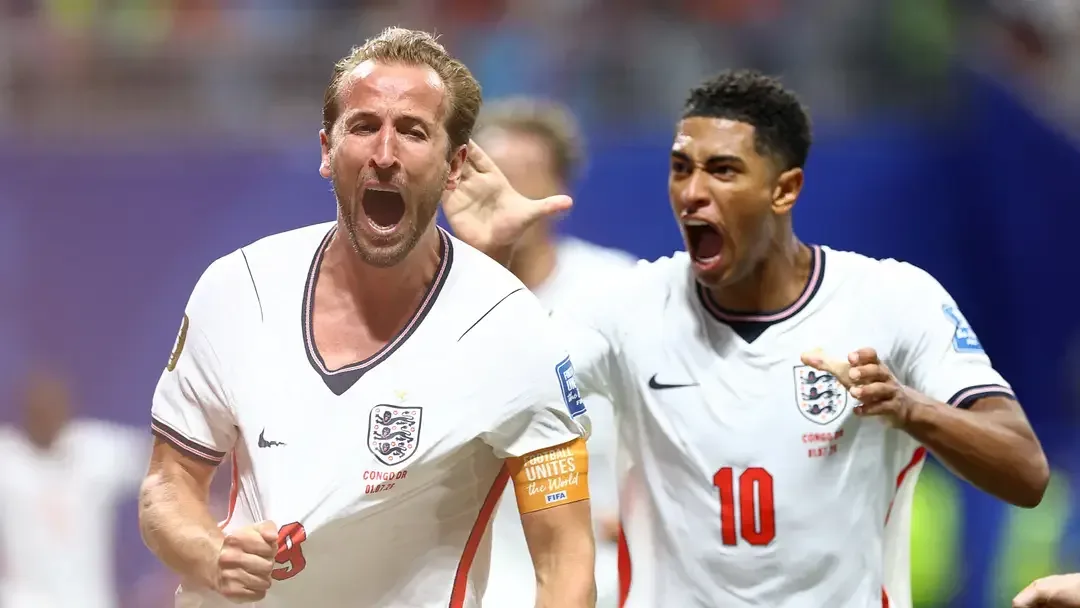
Harry Kane’s reported ankle injury, sustained in Bayern Munich’s Bundesliga match against FC Köln, creates an abrupt change in the football story surrounding one of 2026’s biggest sports-card names. The injury is expected to keep the striker out for months and end his calendar-year campaign, although the precise recovery timetable remains uncertain.
For collectors, the important distinction is between a player’s long-term standing and the short-term attention cycle around active performance. Kane entered this interruption with unusually strong momentum: 10 goals and 11 assists in 16 Bayern appearances this season, following a year in which he won the Ballon d’Or, helped Bayern complete a domestic treble, and contributed to England’s third-place World Cup finish. His 73 goals in 65 club and international matches supplied the kind of sustained on-pitch case that collectors often want behind a high-end card.
An injury does not erase that résumé. It can, however, reduce the immediate stream of match-winning moments, highlights and big-game narratives that keep a veteran star at the center of weekly hobby conversation. At Bayern, it also opens a very different question: which players receive a larger opportunity while the established focal point is unavailable, and which of those players have card markets small enough to react if that opportunity turns into production?
Kane’s market has recent high-end support
Kane’s most notable recorded card sales have all come in 2026, a sign that collectors had already reassessed his place in the modern soccer-card hierarchy before this injury. His three highest documented sales are all one-of-one cards, meaning each is a uniquely scarce version rather than a broadly available card with a large number of comparable sales.
For more context, explore Molly Santana Says a Headlining Tour Is Coming After Kimokawaii Plans Were Shelved.
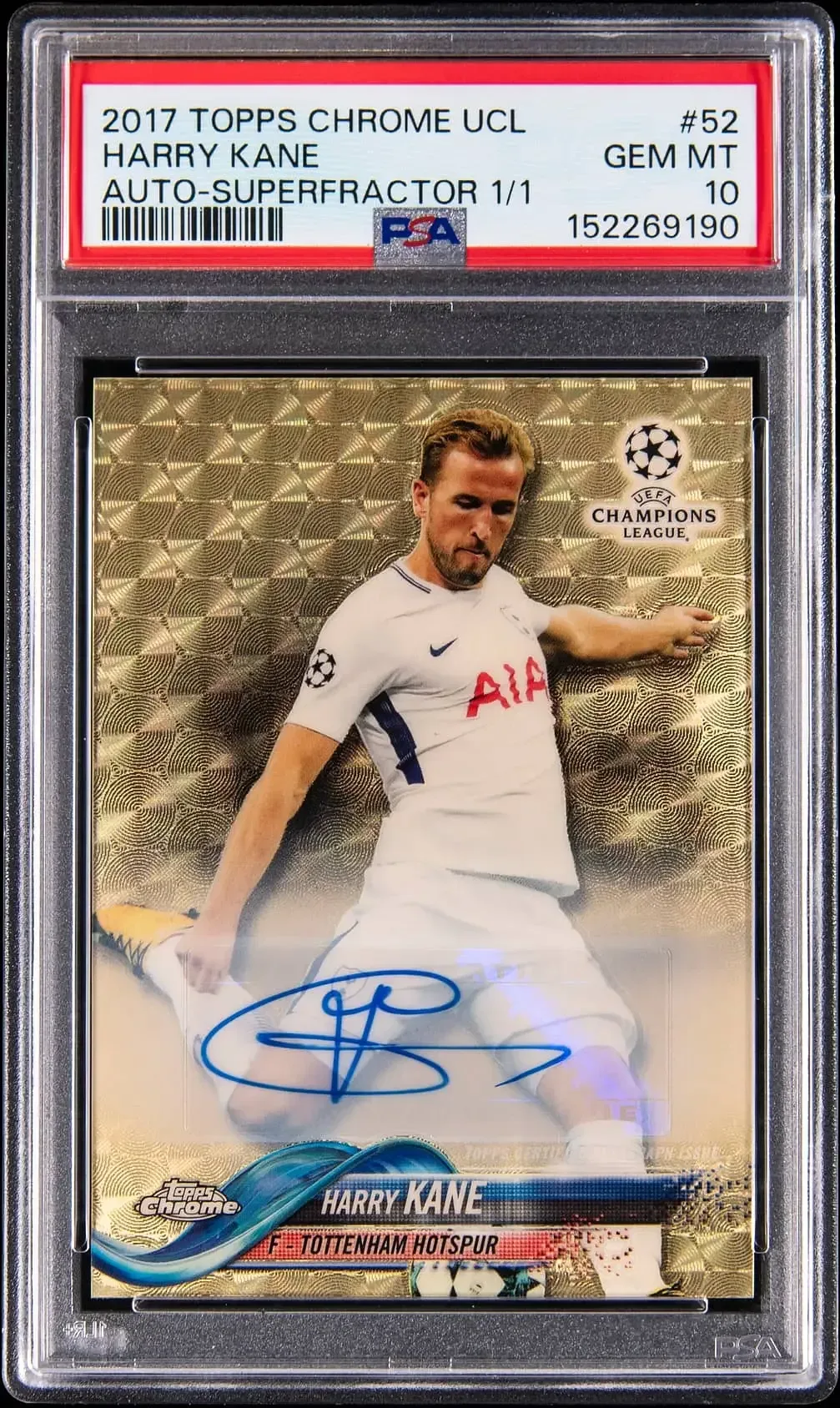
- 2017-18 Topps Chrome UCL Harry Kane Superfractor Auto 1/1, PSA 10: $53,070
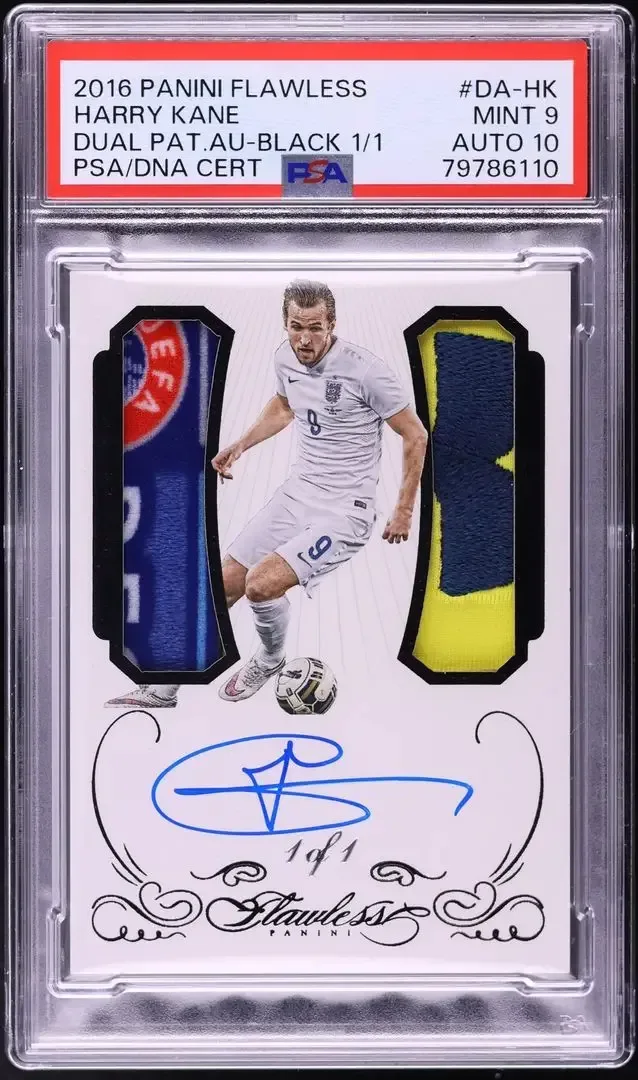
- 2015-16 Panini Flawless Harry Kane Dual Patch Auto Black 1/1, PSA 9 with Auto 10: $50,400
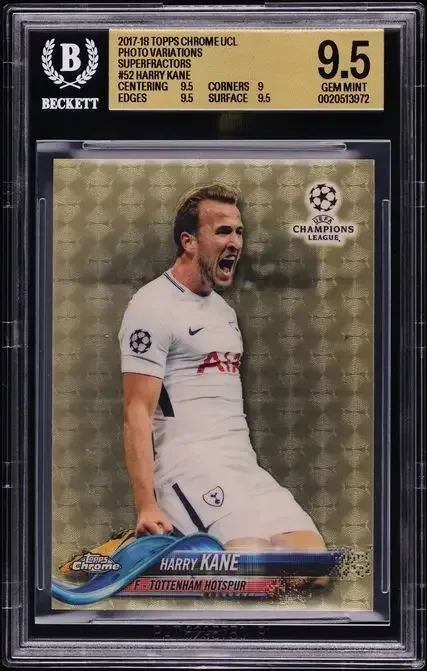
- 2017 Topps Chrome UEFA Harry Kane Photo Variation Superfractor 1/1, BGS 9.5: $49,200
Those results matter, but they should be interpreted carefully. A one-of-one is the only copy of a particular parallel or configuration, so it is not a direct price guide for another Kane card. A Superfractor is Topps’ one-of-one gold parallel, while a patch auto combines an autograph with a piece of memorabilia. Both formats create a scarcity and premium-material story beyond the player’s name alone.
The grades also form part of the result. PSA and BGS are third-party grading companies; the numerical grade refers to condition, while an autograph grade evaluates the signature. A PSA 10 or BGS 9.5 can materially separate a card from lower-graded copies. Consequently, the $53,070, $50,400 and $49,200 figures demonstrate demand for exceptional Kane examples, not a universal floor for his entire checklist.
That nuance is especially relevant during an injury absence. Sales of rare cards are often sporadic because there are few or no exact copies changing hands. Collectors watching Kane should resist treating one auction result—or one quiet stretch—as definitive proof of a whole-market direction. The more practical question is whether demand continues for comparable cards when they surface, and whether buyers differentiate between high-grade rookies, key early issues, autographs, memorabilia cards and ultra-rare parallels.
Related coverage includes Harry Kane’s Injury Could Shift Attention to Bayern’s Young Card Markets.
Why Bayern’s lineup matters to collectors
Performance opportunity is a major ingredient in prospect and emerging-player markets. It is not a guarantee of card growth, but greater responsibility can generate the measurable events that create collector attention: starts, goals, assists, decisive performances and sustained visibility.
Bayern’s situation is complicated by injuries elsewhere in attack. Ismael Saibari has made five appearances this season and is also injured. Serge Gnabry and Luis Diaz are injured as well, though Diaz is expected back soon. Michael Olise left the Köln match injured but is expected to return next week. Jamal Musiala had only just returned, playing 20 minutes after a two-month layoff caused by a thigh injury.
That context matters because Kane’s absence should not automatically be read as a simple “next striker up” scenario. Bayern could distribute duties, alter positions or gradually reintegrate returning players. Collectors who assume every available attacker will receive the same benefit are treating a fluid squad issue as a fixed depth-chart transaction.
Tom Bischof and Nathaniel Brown have a clearer immediate narrative
Tom Bischof, 21, directly replaced Kane in the match against Köln and supplied an assist for Nathaniel Brown. Brown is listed primarily as a left back but has been used farther forward amid Bayern’s injury issues. That one sequence does not establish either player as a permanent attacking solution. It does show, however, why their cards may receive more attention in the near term: both are connected to a visible, current Bayern storyline rather than a theoretical future role.
Neither Bischof nor Brown has a confirmed individual card sale above $1,200. That leaves a wide gap between their documented ceilings and the prices attached to more established Bayern names. A low prior high sale is not, by itself, evidence that a card is undervalued. It simply means the market has not yet recorded a more expensive confirmed transaction for that player.
For collectors, the sensible takeaway is to separate attention potential from proven demand. If Bischof or Brown earns repeated minutes and turns them into production, new buyers may begin seeking rookie cards, autographs, low-numbered parallels or high-grade examples. If their roles shrink as teammates return, the initial burst of discussion may fade just as quickly. Their market case is therefore contingent on usage and output, not merely on Kane’s medical status.
Lennart Karl remains the high-variance name
Lennart Karl is the most striking example of how prospect enthusiasm and established production can diverge. The 18-year-old made his senior Bayern debut last season and has played 15 times this season. His current output includes two Bundesliga goals and one Champions League goal, largely while operating as an attacking midfielder.
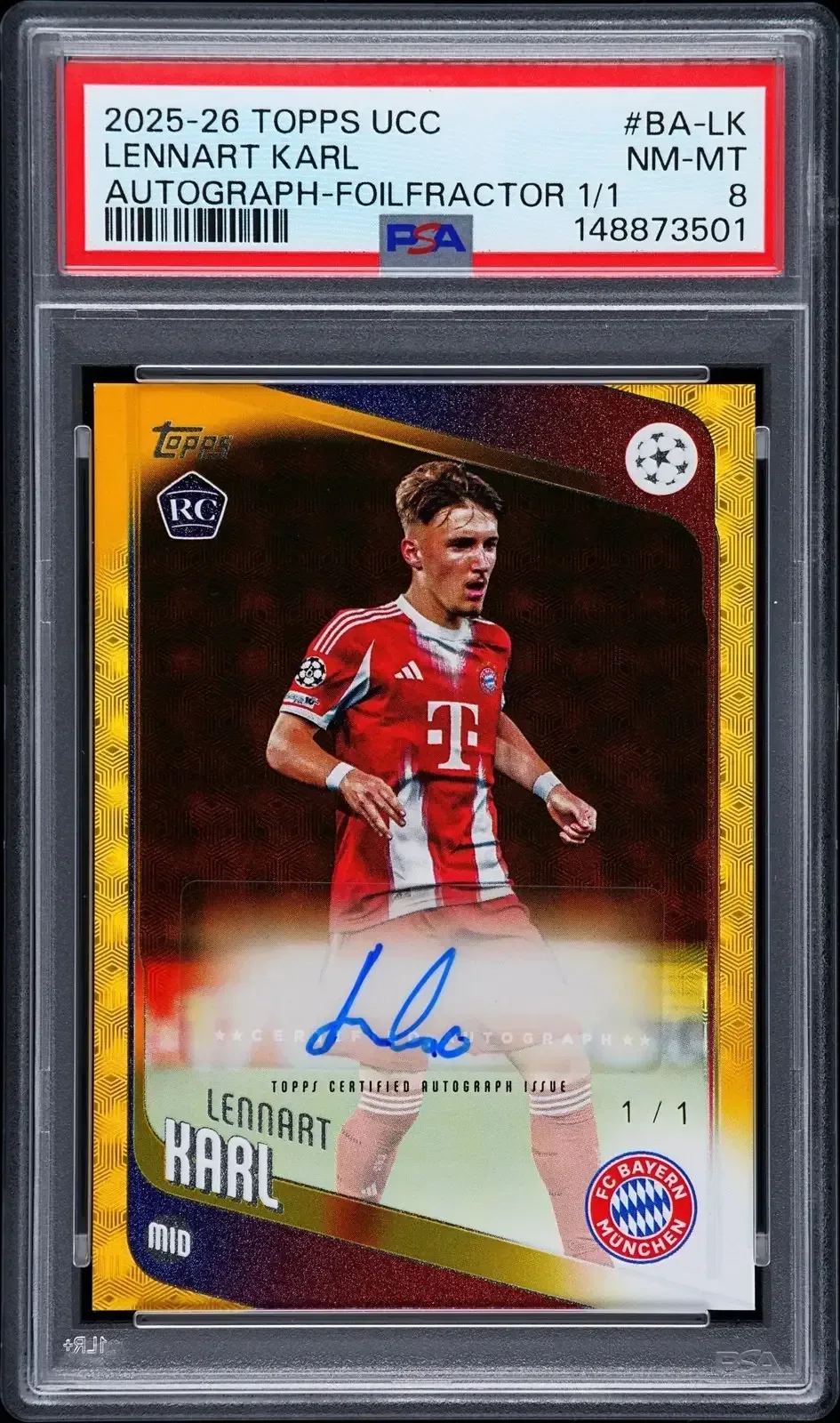
Yet Karl already has an extraordinary headline sale: a 2025-26 Topps UEFA Club Competitions FoilFractor Auto graded PSA 8 sold for $140,000 in March 2026. A FoilFractor is a premium Topps parallel, and an autographed example pairs that scarcity with a signature. The price illustrates how strongly collectors can value a young player’s perceived ceiling, especially when the card itself is rare and visually distinctive.
It does not establish that every Karl card should trade at a lofty level, nor does it settle whether he is ready for a leading role at Bayern. His possible opportunity during Kane’s absence is intriguing precisely because the expectations are already considerable. Greater involvement could create powerful new evidence for believers; limited minutes or a modest attacking return would underline the difference between a promising young talent and a player ready to carry a major side.
That is the central risk in prospect markets. They can move ahead of a player’s current statistical profile because collectors are purchasing a possible future. The same dynamic can reverse when the next visible stretch of matches fails to confirm that projection. Karl’s March sale makes him a name to watch, but it also calls for extra care when using a single elite card to assess wider demand.
Musiala and Olise offer a different kind of case
Musiala and Olise are not the same type of speculative play as Bischof, Brown or Karl. Both are more established attackers, and each enters the conversation with a health caveat. Olise is expected back next week after leaving the Köln match injured, while Musiala is still building fitness after his thigh issue.
That makes a dramatic immediate market reaction less straightforward. A player returning from injury may receive opportunity, but workload management can limit the number of minutes he plays. In collecting terms, that means the story is less about an unknown player suddenly appearing and more about whether an established talent can regain rhythm and assume a larger share of Bayern’s attacking burden.
What collectors can watch without overreacting
The clearest practical approach is to watch the next run of team selections and performances rather than trying to declare a winner on the day an injury is reported. Relevant signals include:
- Starts and position: Is Bischof actually used as Kane’s replacement, or does Bayern change its structure?
- Repeat involvement: A goal contribution can draw attention; a sequence of meaningful appearances carries more weight.
- Returning-player fitness: Diaz, Olise and Musiala could each reduce the available role for younger options as their situations improve.
- Specific-card supply: Scarce autographs and numbered parallels can behave very differently from base cards or common inserts.
- Comparable sales: Look for more than one confirmed transaction before treating a price movement as a stable market shift.
Kane’s injury may cool the weekly performance catalyst around his cards in the immediate term, but his 2026 accomplishments and record-setting high-end sales give collectors substantial established context. The more volatile story lies behind him. Bayern’s injury list has created room for Bischof, Brown and perhaps Karl to command attention, while Musiala and Olise could take on more importance as they return to fitness.
For now, that is opportunity rather than certainty. In a sports-card market, the difference is everything: opportunity produces watchlists; sustained performances are what can turn those watchlists into lasting demand.