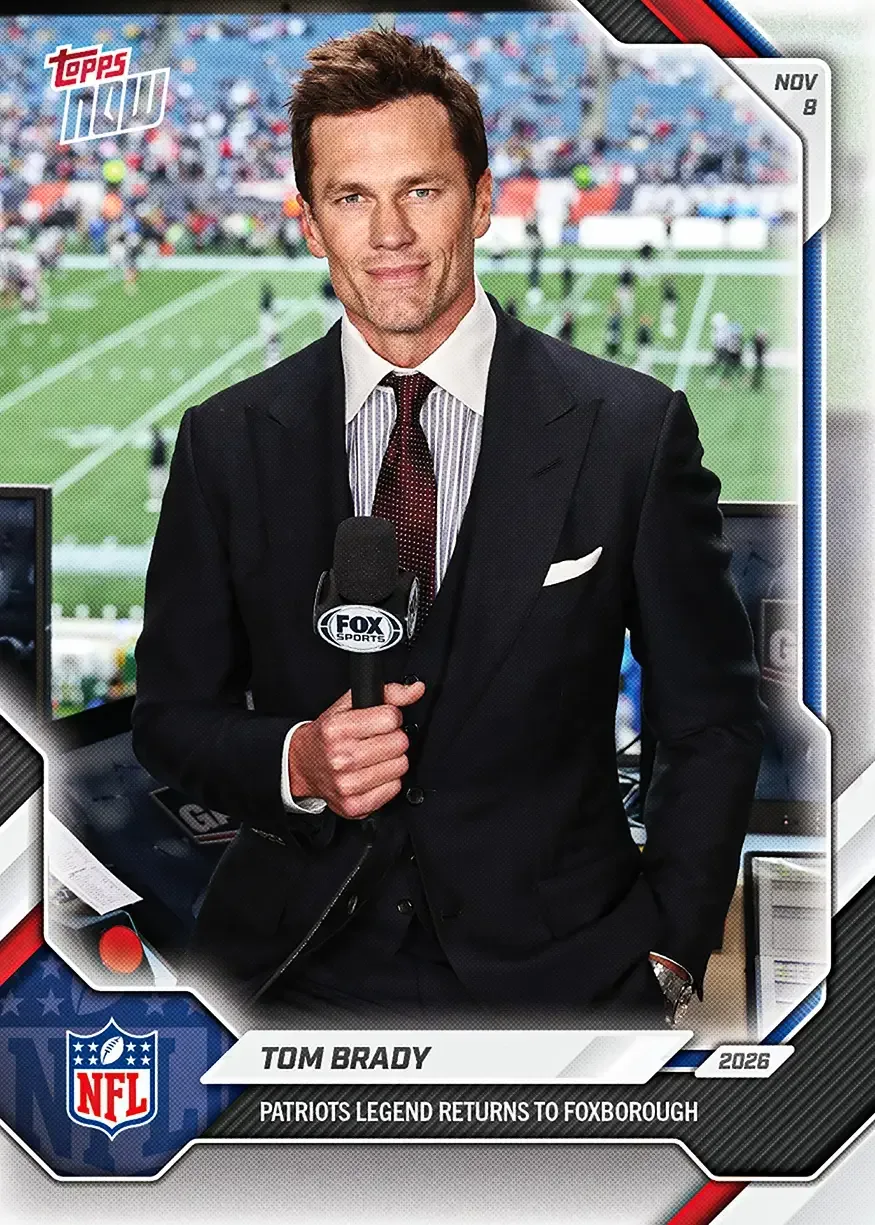
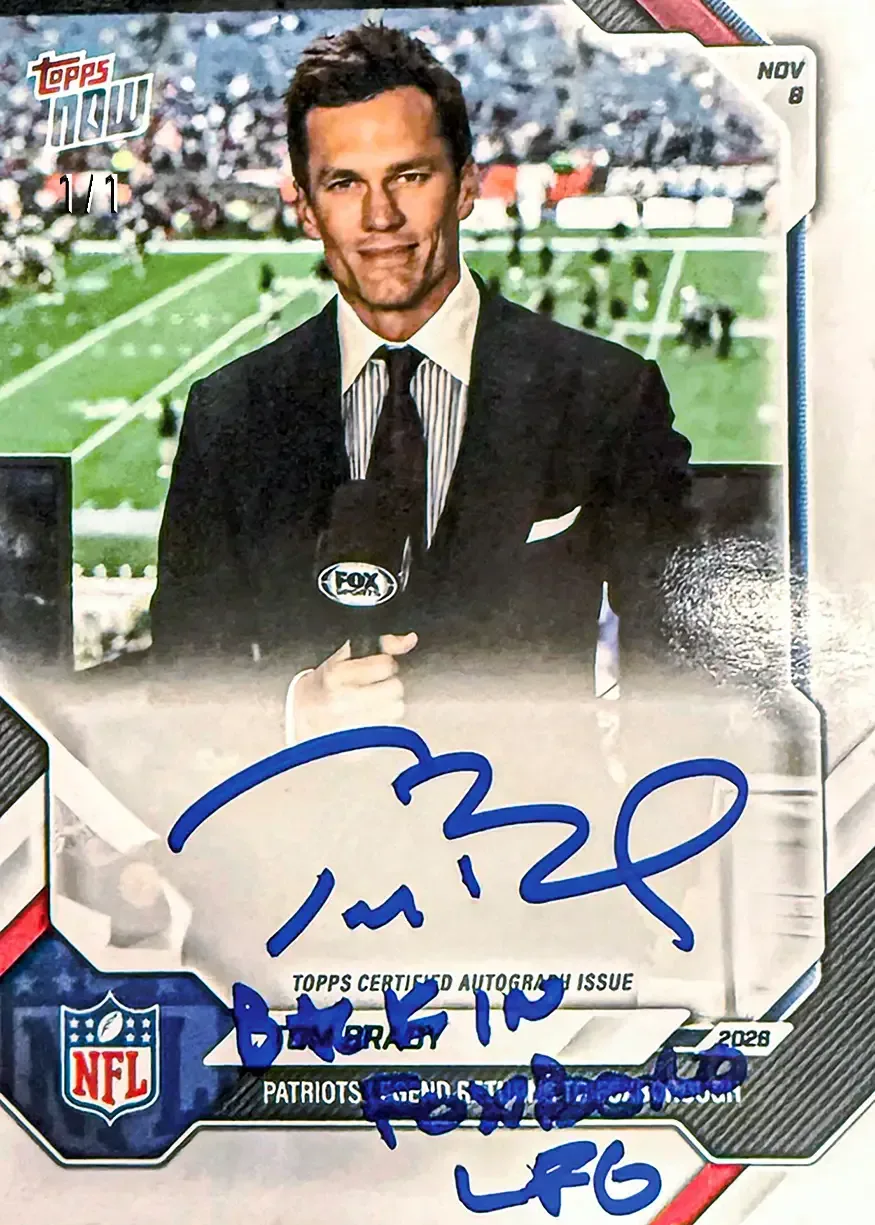
Tom Brady’s return to Foxborough as a broadcaster produced an unusually literal piece of sports-card immediacy: a photograph taken of him in the booth during the first quarter of the Packers-Patriots game was turned into a Topps NOW card, delivered to him in the second quarter, and signed live on the broadcast.
Brady added the inscription “Back in Foxboro LFG” before showing the card to viewers. The moment tied a current role in the booth to the place most closely identified with his playing career, while making the item itself part of the broadcast rather than simply a product released after the game.
The standard commemorative cards are printed to order and available for a 72-hour ordering window ending November 11, 2026. One purchaser will receive the specific card Brady held and signed at Gillette Stadium. That distinction is central to the release: most orders are for the same commemorative issue, while the on-air original is a one-card chase within the promotion.
A card made while the game was still unfolding
Topps NOW releases are event-driven cards. Rather than being distributed as a conventional preassembled trading-card set, an individual card is created around a recent sports moment and offered for a limited period. Here, the underlying moment was not a touchdown, a record, or an on-field highlight. It was Brady’s own appearance as an announcer at Foxborough.
The compressed sequence is what makes this release unusual. A booth photo from the first quarter became a physical card by the second, then Brady signed it during the same telecast. In practical terms, the card documents three connected events: his return to the Patriots’ home venue, his first time calling a Patriots game there, and an on-air signature that turned the card into a piece of broadcast-used memorabilia.
Kevin Burkhardt presented Brady with the card. Brady used the occasion for a joke: “I'm glad there’s no statistics on the back that tell you how many times I’ve cursed on-air this year.” It is a small but important element of the card’s appeal. The release is not only a photo of Brady; its defining context is an unplanned-feeling television exchange built around a rapidly made collectible.
What buyers can chase—and what that means
Collectors ordering the Topps NOW card can receive foil parallels numbered to 50, 25, 10, 5, and 1. A parallel is a version of a card that differs from the standard edition—here through foil treatment—and is limited to a stated production number. A card numbered /50 has 50 copies, while a /1 denotes a single copy.
Those numbered parallels should be considered separate from the live-signed card shown on air. The latter is the actual physical card Brady handled and inscribed at Gillette Stadium, and it will go to one buyer. The source material identifies it as a giveaway among purchasers, not as a separately sold card with a disclosed price.
Related coverage includes Tom Brady’s Live-Signed Topps NOW Card Turns Foxborough Return Into a 72-Hour Chase.
There is also a key limitation for anyone considering an order: the base-card print run will be determined by demand during the 72-hour ordering period. “Printed to order” means the eventual quantity of standard copies is based on orders placed before the cutoff. It does not mean that every base copy carries the same scarcity as one of the numbered foil parallels, nor does it establish a future market value.
For collectors, the sensible way to read the offer is straightforward:
- The base card is the broad commemorative edition created from the broadcast-booth image.
- Foil parallels add specifically numbered scarcity tiers, from /50 down to /1.
- The live-signed, held-on-air original is a distinct prize card going to one purchaser.
- Orders must be made before the stated November 11, 2026 deadline.
Nothing in the release guarantees a parallel, the signed original, or a particular resale outcome. The clearest reason to buy is an interest in the moment itself: Brady returning to Foxborough in a new capacity and signing a card that had just been made from that appearance.
Why Foxborough matters to this particular release
The setting carries weight because Brady spent 20 of his 23 NFL seasons with the New England Patriots. He won six Super Bowls with the franchise, then played three seasons for the Tampa Bay Buccaneers and won another. His seven Super Bowl victories are the most by any player; Charles Haley is next with five.
Brady’s career record also supplies the scale behind a card that could otherwise look like a lighthearted booth novelty. He finished with 89,214 passing yards and 649 passing touchdowns, figures identified as quarterback records, plus a 251-82 regular-season record and a 35-13 playoff record. His path began with a sixth-round selection, No. 199 overall, in the 2000 NFL Draft.
That history helps explain why a broadcasting appearance could merit a rapid card release. For many athletes, a first broadcast at a former home stadium would be a neat footnote. In Brady’s case, Foxborough is inseparable from the two decades in which he became the NFL’s most decorated Super Bowl winner.
November 8, 2026 also contained another Patriots occasion. Rob Gronkowski was recognized at halftime following his induction as the 38th member of the New England Patriots Hall of Fame. Brady’s first Patriots broadcast from Foxborough therefore arrived during a ceremony centered on another major figure from the franchise’s recent era.
Brady’s growing connection to the card hobby
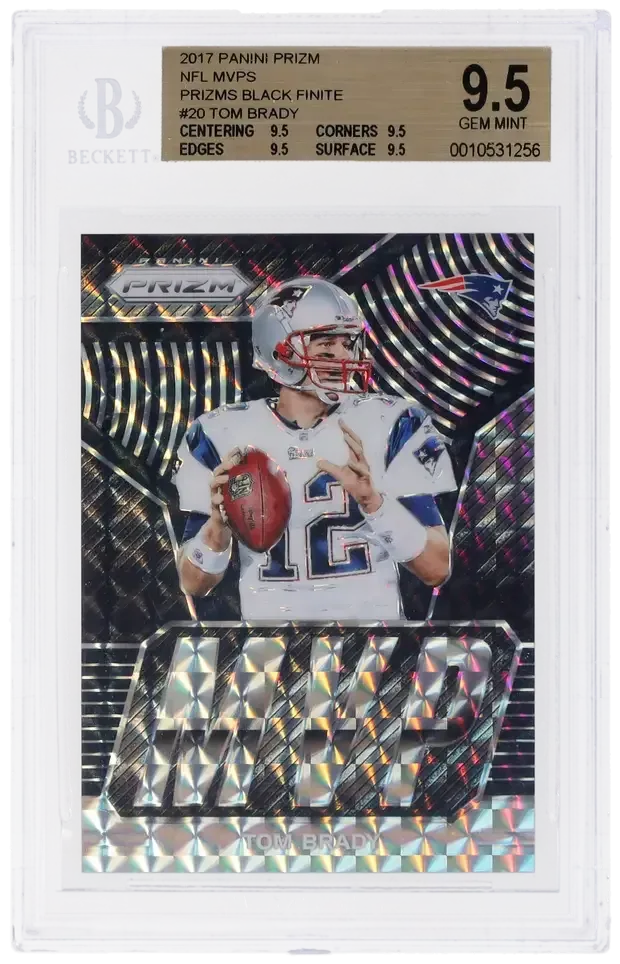
The broadcast moment did not arrive in a vacuum. Brady is a co-owner of CardVault by Tom Brady, a sports-card shop franchise with 20 locations in the United States. Its latest location opened in Pittsburgh. His card interest was also part of the pregame discussion around the Packers-Patriots telecast.
He additionally owns the first card of Las Vegas Raiders quarterback Fernando Mendoza, made after Mendoza was selected first overall in the 2026 NFL Draft. That detail places Brady in the hobby both as a participant around retail and as a high-profile owner of a modern player’s first card.
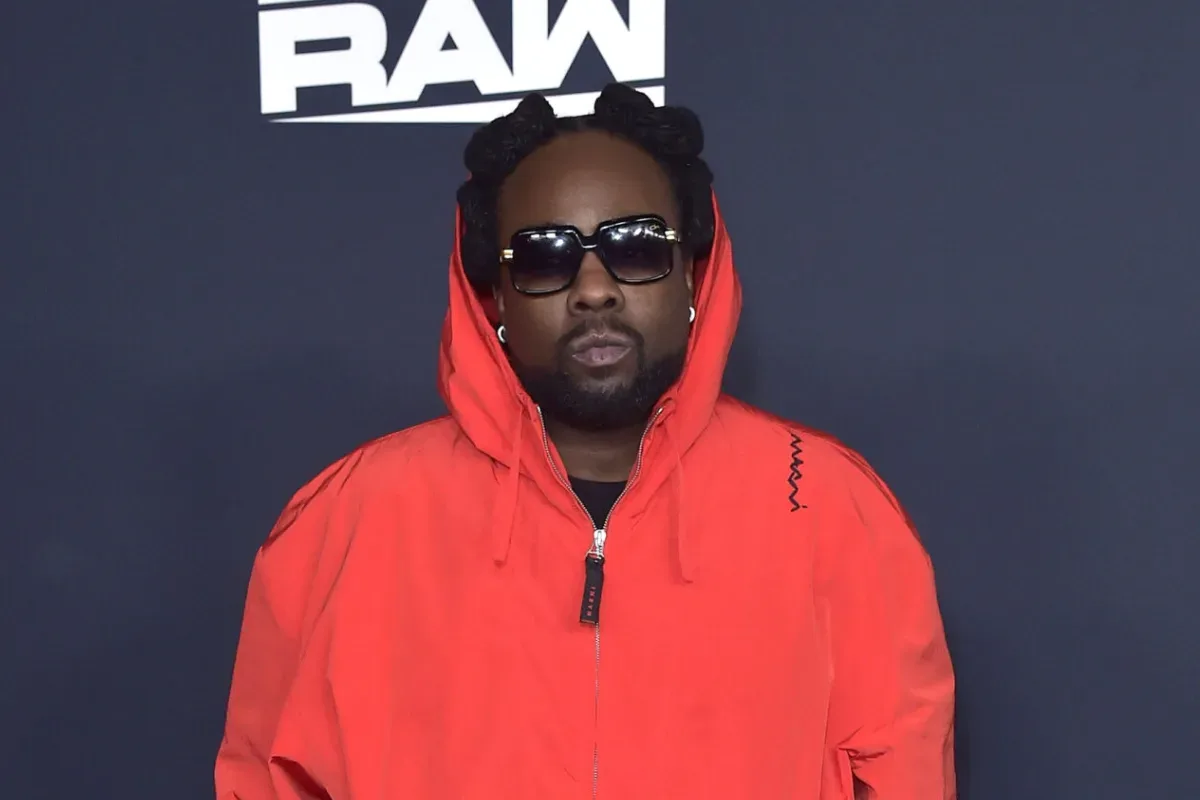
There is a broader cultural overlap at work as sports figures become increasingly visible around collecting, community events, and fan-facing projects. For another current example of sports-oriented community programming, see this look at Wale’s Gifted Week sports career panel and youth clinic. Brady’s Topps NOW appearance is more narrowly focused, but it similarly puts a well-known sports name directly into an experience designed for fans.
A collectible whose provenance is the attraction
In collecting, provenance refers to an item’s documented history: where it came from, who handled it, and why that journey matters. The Brady card’s appeal is built around unusually visible provenance. Viewers saw the image’s setting, watched the card arrive, saw Brady sign and inscribe it, and watched him hold it up on air.
That is meaningfully different from an autograph that exists without a shared public moment around it. The inscription roots the specific card in Brady’s Foxborough return, while the live segment gives the signed original a clear narrative. The regular print-to-order cards preserve the same occasion in commemorative form, but they are not presented as the card Brady held.
It also makes the release a reminder to read card descriptions precisely. “Autograph chase” can describe the pursuit of autograph-related cards, but collectors should separate a potential numbered parallel from the single live-signed original. Similarly, a limited sales window restricts the time to order; it does not by itself reveal the final base print run until ordering has ended.
For Brady fans, Patriots collectors, and people who follow broadcast-era memorabilia, the card is a compact record of an uncommon crossover: a legendary former quarterback, back at Foxborough as an announcer, signing a card produced from the very broadcast in progress. The order window closes November 11, 2026, while the particular signed card seen on screen will ultimately belong to one fortunate buyer.