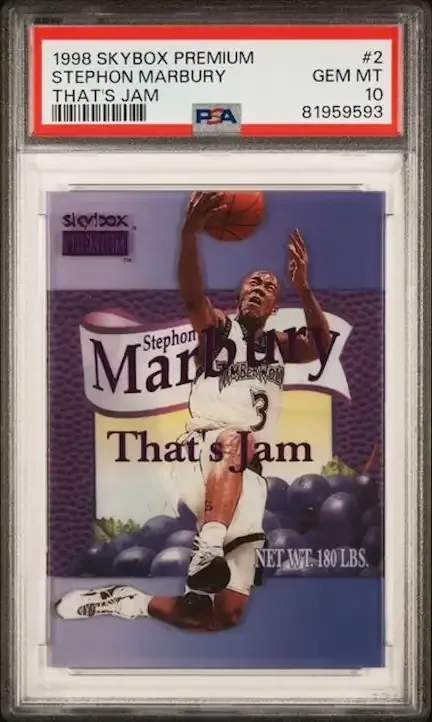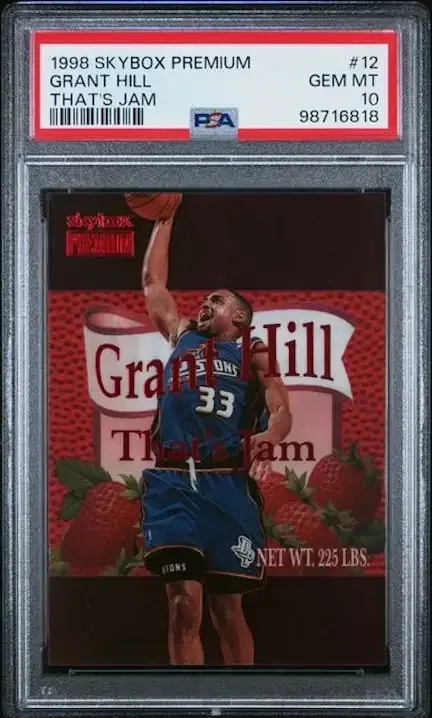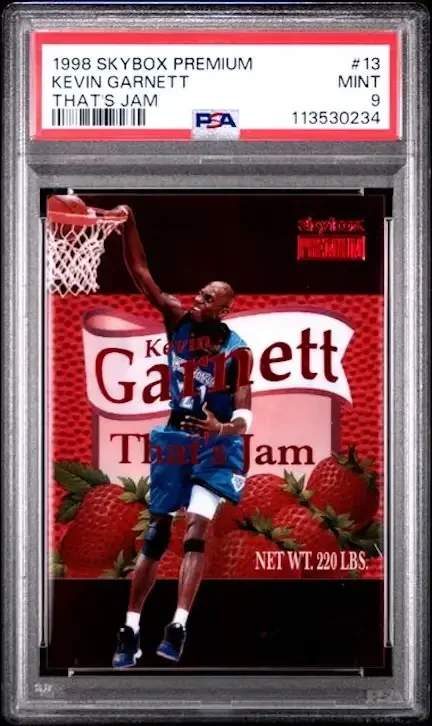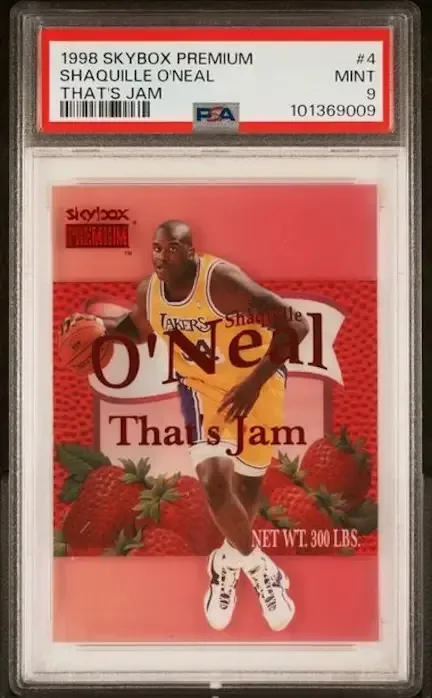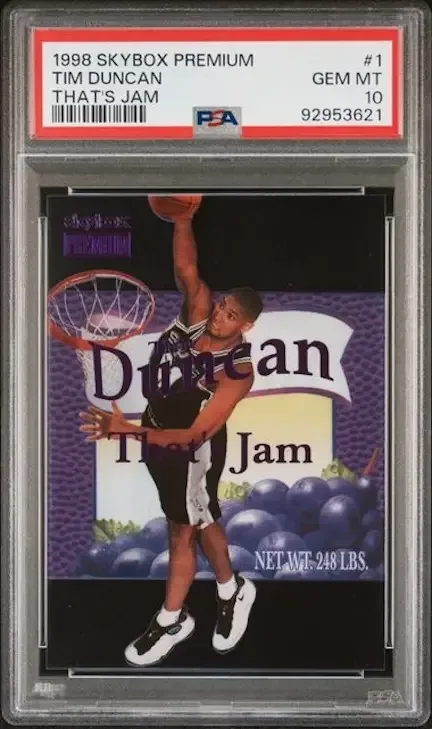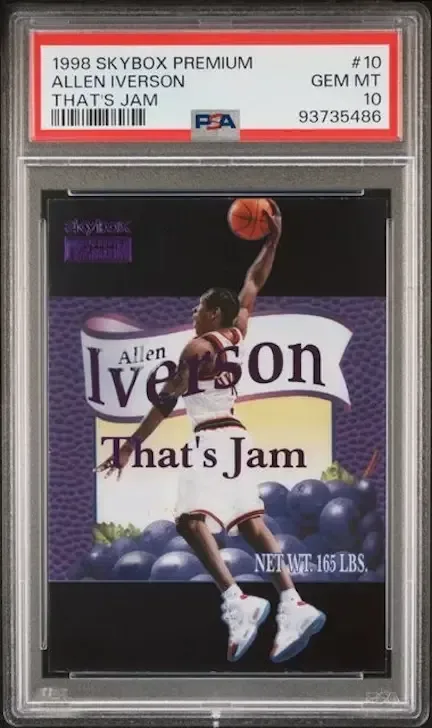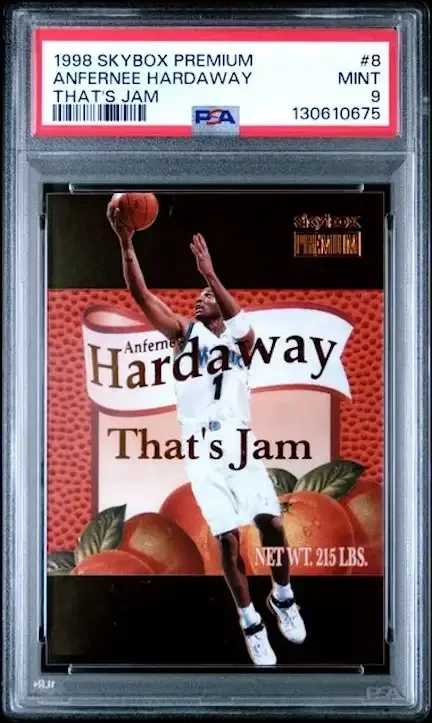
The 1998-99 SkyBox Premium That’s Jam insert set has a simple premise and a very complicated modern market: it combines a notoriously difficult pull rate with an era packed with basketball icons. The cards do not include rookies, yet the player list includes Kobe Bryant, Shaquille O’Neal, Tim Duncan, Allen Iverson, Kevin Garnett, Grant Hill, Penny Hardaway and Stephon Marbury. For collectors who came up during the late 1990s, that is a concentrated dose of memorable NBA talent wrapped in a scarce insert chase.
The reported pull odds were one That’s Jam card per 96 packs. In card-collecting terms, an insert is a card intentionally seeded into packs at a lower frequency than the standard base-card checklist. That distinction matters. A player can have many cards from a season, but a specific scarce insert has a separate supply story—and a collector looking for it today may be competing with both player collectors and fans of 1990s card design.
Recent reported sales show a wide range. Raw, or ungraded, examples of certain players have been available in the roughly $50-to-$300 range. At the other end, top-condition graded examples tied to the biggest names have sold for substantially more, culminating in a reported $42,000 high sale for Kobe Bryant’s Strawberry Jam version. That gap is not a contradiction. It is a reminder that player demand, scarcity, condition and third-party grading can all change the value proposition of what is ostensibly the same card.
Why this insert is getting attention
The 1998-99 SkyBox Premium checklist has an unusually strong connection to the current hobby. Its rookie group includes Dirk Nowitzki, Paul Pierce and Vince Carter, while established stars in the product include Michael Jordan, Bryant, O’Neal, Duncan and Iverson. The That’s Jam subset does not contain those rookies, but it benefits from being part of a release identified with a loaded generation of players.
More specifically, the insert hits several collector preferences at once:
- Era appeal: It comes from the 1990s, a period associated with bold insert designs and star-driven basketball collecting.
- Chase scarcity: One-in-96-pack insertion odds make the card meaningfully harder to encounter than a typical base card from the same product.
- Star power: Its featured players include multiple MVPs, champions, Hall of Famers and enduring fan favorites.
- Condition sensitivity: High-grade copies can sit in a very different price tier from raw cards.
It is worth separating the facts from the market interpretation. The documented sales demonstrate that individual high-grade copies have commanded strong prices. They do not, by themselves, establish a universal price for every card in the set or guarantee future appreciation. A card’s realized price is what one buyer paid for one particular copy at a particular time; it is useful evidence, not a permanent price tag.
Grades are doing real work in the price spread
Several of the reported standout transactions involved PSA 10 examples. PSA 10 is a top grade assigned by Professional Sports Authenticator, a third-party grading company. In practical terms, grading is an evaluation of a card’s condition, with collectors commonly watching details such as centering, corners, edges and surface. A grade does not change which player is on the card, but it can sharply affect how scarce and desirable that exact copy is perceived to be.
That is particularly important with an insert that can trade from double or low-triple digits in raw form while elite graded examples reach into the thousands—or, in Bryant’s case, tens of thousands. Buyers should not assume an asking price for a slabbed gem-mint example translates directly to an ungraded card. Likewise, “raw” does not necessarily mean poor condition; it means the card has not been encapsulated and assigned a numerical grade by a grading company.
Related coverage includes 1998-99 SkyBox Premium That's Jam Inserts Are Heating Up Again in the Basketball Card Market.
For collectors weighing a purchase, the useful question is not merely, “What did the last one sell for?” It is, “Was that sale for the same player, the same color designation, and a comparable grade?” Comparing like with like is especially important here. A raw copy, a lower-grade copy and a PSA 10 can represent dramatically different collecting targets.
The broader principle extends beyond sports cards. In any market where authenticity, rarity and condition converge, collectors need to distinguish the object from the particular version of the object being offered. That same tension is explored in this look at rarity, authentication and market value in high-end collecting.
The cards and their reported high sales
Kobe Bryant — Strawberry Jam
Bryant’s card is the clear headliner in the available sale figures. His reported high sale reached $42,000. Bryant spent 20 years with the Los Angeles Lakers, won one MVP award and finished in the top five of MVP voting 11 times. Those career credentials, combined with his enduring importance to collectors, put a scarce 1990s PSA 10 insert in a category far removed from an ordinary raw card.
The number should be read carefully: it is a reported highest sale, not a claim that every Bryant That’s Jam card is worth that amount. But it does establish the scale that exceptional examples can reach when a major player, a difficult insert and premium condition converge.
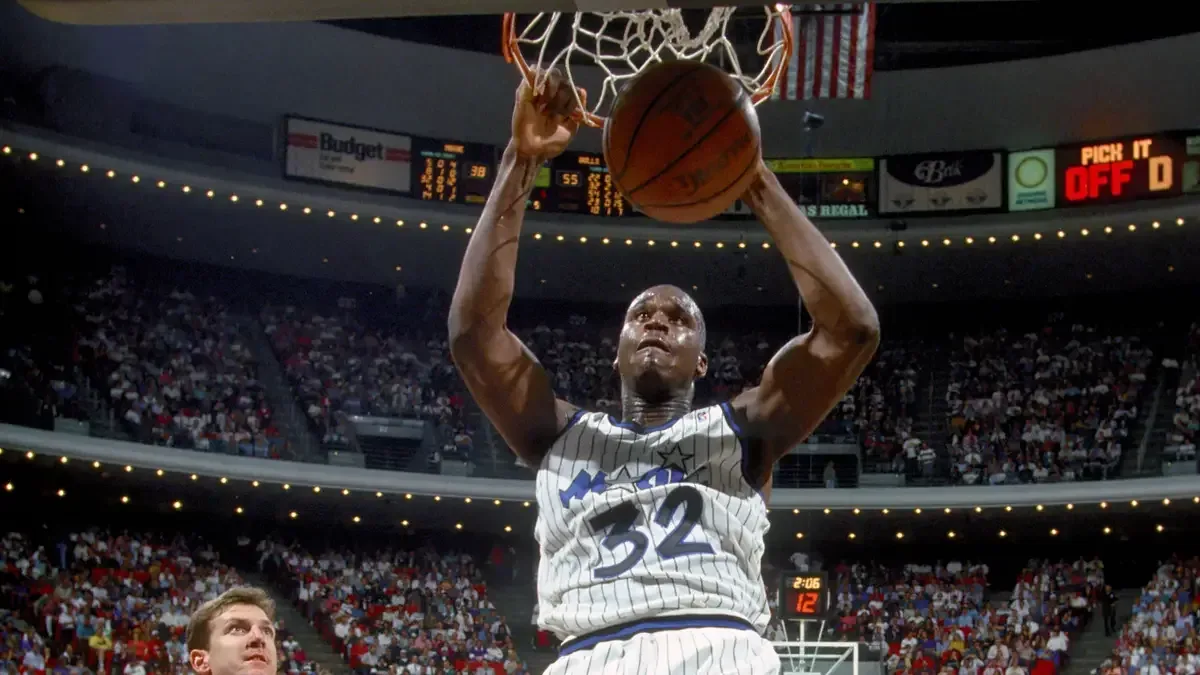
Shaquille O’Neal — Strawberry Jam
O’Neal’s reported high sale was $14,600. He entered the league with the Orlando Magic, won Rookie of the Year and completed a 19-year career averaging 23.7 points and 10.9 rebounds per game. As one of basketball’s defining dominant centers, O’Neal brings a different kind of collector appeal: a towering on-court legacy and recognition that extends far beyond a single franchise or era.
That reported result places Shaq second among the listed cards, ahead of Iverson, Duncan and the other stars discussed here. It also illustrates that the market is not solely built around guards, wings or rookie cards; a sought-after insert can elevate established stars with enormous name recognition.
Allen Iverson — Grape Jam
Iverson’s Grape Jam card has a reported high sale of $11,700. He won both Rookie of the Year and MVP, and finished his career averaging 26.7 points per game. His explosive style and crossover dribble helped create an unmistakable basketball identity, which remains part of why he resonates with collectors of the period.
For the set, Iverson offers a strong example of an established star whose appeal is rooted in more than accolades. His game, persona and place in 1990s basketball culture are all part of the card’s context. None of that eliminates the need to assess the specific card’s condition, but it helps explain why a premium graded copy can land well into five figures.
Tim Duncan — Grape Jam
Duncan’s reported high sale was $5,250. Selected first overall by the San Antonio Spurs after a season in which David Robinson was sidelined by injury, Duncan became central to five championships. He also won the MVP award twice and finished his career averaging a double-double.
His card represents a compelling contrast within the set. Duncan’s legacy was built on sustained excellence and team success rather than flash, yet his hobby relevance remains substantial. A five-figure-adjacent ceiling is not required for a card to be significant: the $5,250 reported high sale still reflects strong demand for a high-end version of a scarce late-1990s insert.
Penny Hardaway — Orange Jam
Hardaway’s reported high sale was $4,000 in October 2026 for a PSA 10. His career is frequently framed through the question of what might have been after a knee injury in the 1996 Eastern Conference Championship, as well as the possibility of a different Orlando trajectory had O’Neal not left for Los Angeles. Still, Hardaway retains a committed collector following.
That following matters because card demand is not a simple career-stat leaderboard. Championships, awards and longevity are important, but nostalgia and an individual player’s cultural footprint can also make a card desirable. Hardaway’s result is a useful reminder that collector affection can sustain strong prices for stars whose careers did not unfold exactly as early expectations suggested.
Kevin Garnett — Strawberry Jam
Garnett’s Strawberry Jam card reportedly sold for $3,350 on October 1, 2026. Chosen fifth overall by the Minnesota Timberwolves out of high school, Garnett became an MVP and later won a championship after moving to Boston. His reputation as a talented, intense competitor gives his cards a durable connection to collectors who value the high-energy basketball of the era.
The reported sale places Garnett closely alongside other notable names in the subset’s middle-to-upper tier. It also shows that the set is not merely a Bryant-and-Shaq story. There are several players whose best graded examples have crossed $3,000.
Grant Hill — Strawberry Jam
Hill’s reported highest sale came in at $3,120 in October 2026. He won Rookie of the Year in 1994-95 after being drafted by the Detroit Pistons and played 18 seasons, averaging 16.7 points per game. Injuries affected the arc of his career, but the longevity and early promise remain central to his appeal.
Hill and Hardaway offer parallel reminders of how collecting can preserve interest in players associated with extraordinary potential as well as completed résumés. Their cards draw meaning from the era itself, not just from a final tally of titles and awards.
Stephon Marbury — Grape Jam
Marbury’s PSA 10 card reportedly sold for $3,050 in June 2026. Drafted fourth overall by the Milwaukee Bucks and then traded to the Timberwolves for Ray Allen, Marbury played 13 years and averaged 19.3 points per game. He was part of the 1996 draft class that also included Bryant and Iverson.
For set collectors, the Marbury sale adds useful perspective. The highest prices naturally cluster around the most widely collected legends, but a difficult-to-pull, top-grade card of a recognizable All-Star-level player can still command a serious premium. The difference between Marbury’s result and Bryant’s is sizable, but both figures reinforce the importance of scarcity and condition in this insert.
What collectors should take from the numbers
The That’s Jam market is a good case study in avoiding shortcuts. The set has no rookies, so its appeal does not depend on the usual rookie-card thesis. Instead, its desirability comes from the combination of scarce pack odds, a distinct late-1990s insert identity and a roster full of players who have remained relevant to the hobby.
Collectors considering one should identify the exact player and color variant first—Orange Jam for Hardaway, Grape Jam for Marbury, Duncan and Iverson, and Strawberry Jam for Hill, Garnett, O’Neal and Bryant among the examples above. Then they should distinguish raw examples from graded ones and treat the reported high sale as a ceiling for a specific comparable card, not a universal benchmark.
The available results suggest that this is a set where the best copies of the biggest stars have become marquee collectibles. At the same time, the stated raw range of roughly $50 to $300 for some players leaves room for collectors who appreciate the design and era without pursuing gem-mint trophy cards. That split may be the set’s most appealing feature: That’s Jam can be a high-end chase, a focused player collection, or simply a vivid piece of 1990s basketball-card history.