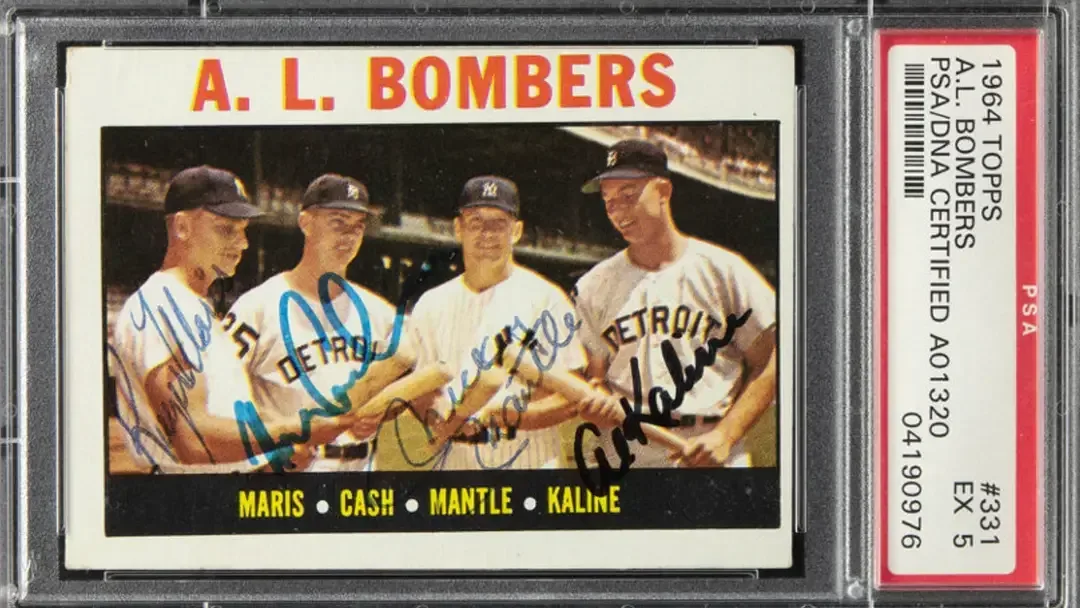
The 1970s gave baseball-card collectors a new visual language, a new generation of stars and a more connected hobby. Mickey Mantle’s final Topps card from his playing career had arrived in 1969, ending a long-running annual presence that defined packs for many collectors in the 1950s and 1960s. The decade that followed did not simply replace one familiar superstar. It created fresh reasons to chase cards: historic milestones happening in real time, memorable rookie issues, bold designs and photographs that increasingly made a card feel like a captured moment rather than a posed portrait.
The hobby’s infrastructure was changing, too. Small collector meetings in 1969 helped point toward a bigger public card convention in Detroit in 1970. Card shows spread opportunities to trade and purchase beyond a collector’s immediate neighborhood. That social side still matters: sports fandom creates communities in many forms, from card tables to major-game entertainment such as the WNBA Finals halftime-show spotlight.
Topps’ release model also changed the practical experience of building a set. Through 1973, its annual baseball cards arrived in multiple series during the season. The later cards, often called high numbers, came later in the release cycle and could be more difficult to locate. In 1974, Topps issued its 660-card main set at once, ending a serial approach that had been in place since 1952. That makes the 1973 set especially notable in collecting history: it contains important cards in the final high-number run before the format changed.
Meanwhile, Hank Aaron’s pursuit of Babe Ruth’s home-run record helped bring the idea of the “first card” into sharper focus. The hobby increasingly settled on the language of the rookie card: generally, a player’s first card in a major annual issue. The term is useful, but it does not decide a card’s importance by itself. Some of the decade’s most resonant cards are tributes or second-year issues. Condition, visual identity, player legacy, historical circumstances and the exact place of a card within a set can all matter.
Here are seven cards that best capture those overlapping forces. This is an editorial ranking based on their hobby recognition, imagery, player significance, design and lasting cultural footprint—not a guarantee of value or a buying guide. The cited price and population figures are snapshots, while individual cards can vary dramatically in appeal and condition.
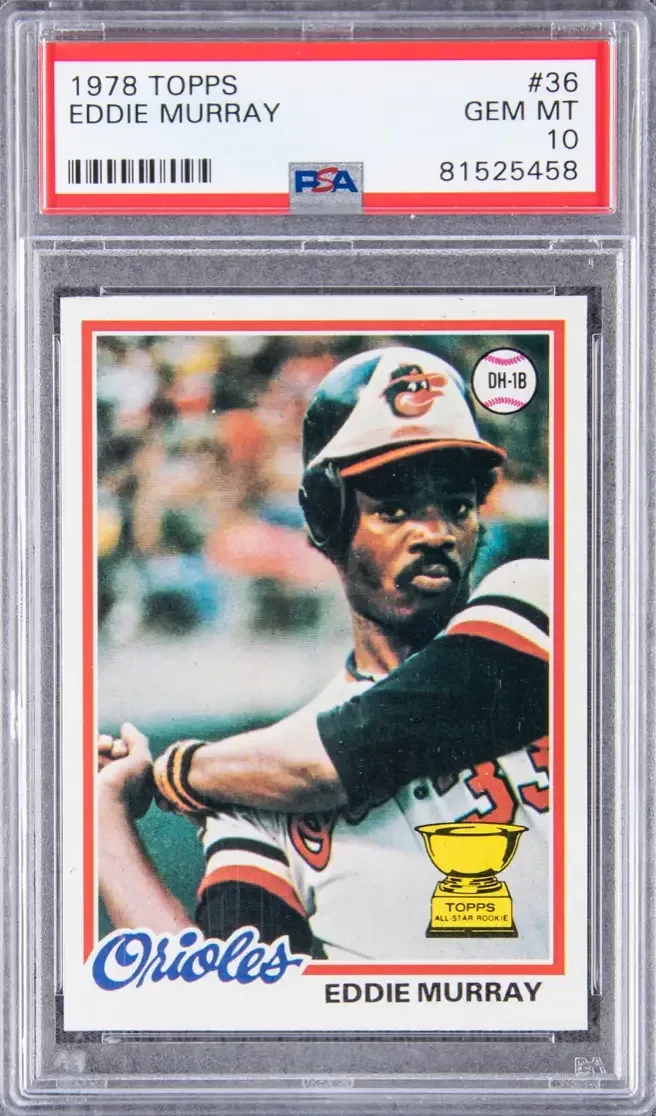
7. 1978 Topps Eddie Murray #36
Eddie Murray’s 1978 Topps rookie is immediately recognizable for the gold Topps All-Star Rookie trophy at the lower right. That emblem gives the card a particular kind of period charm: it frames Murray as a promising young player while later career accomplishments turn the image into a retrospective landmark.
Murray ultimately joined the extremely short list of players with both 500 home runs and 3,000 hits, alongside Hank Aaron, Albert Pujols, Willie Mays, Miguel Cabrera, Alex Rodriguez and Rafael Palmeiro. That statistical company explains why this is far more than a pleasing rookie card with a familiar logo.
The reported PSA population is 17,309 cards, including 18 PSA 10s. PSA is a third-party grading service; its 10 designation is its top numerical grade. Reported recent figures place PSA 9 examples at $1,508 and PSA 8 examples at $225, while a PSA 10 sold for $59,040 on March 8, 2021. Those gaps are a direct lesson in vintage grading: a card may be relatively available overall, yet pristine copies can remain exceptionally difficult to find.
Related coverage includes The 7 Most Iconic Baseball Cards of the 1970s and Why Collectors Still Chase Them.
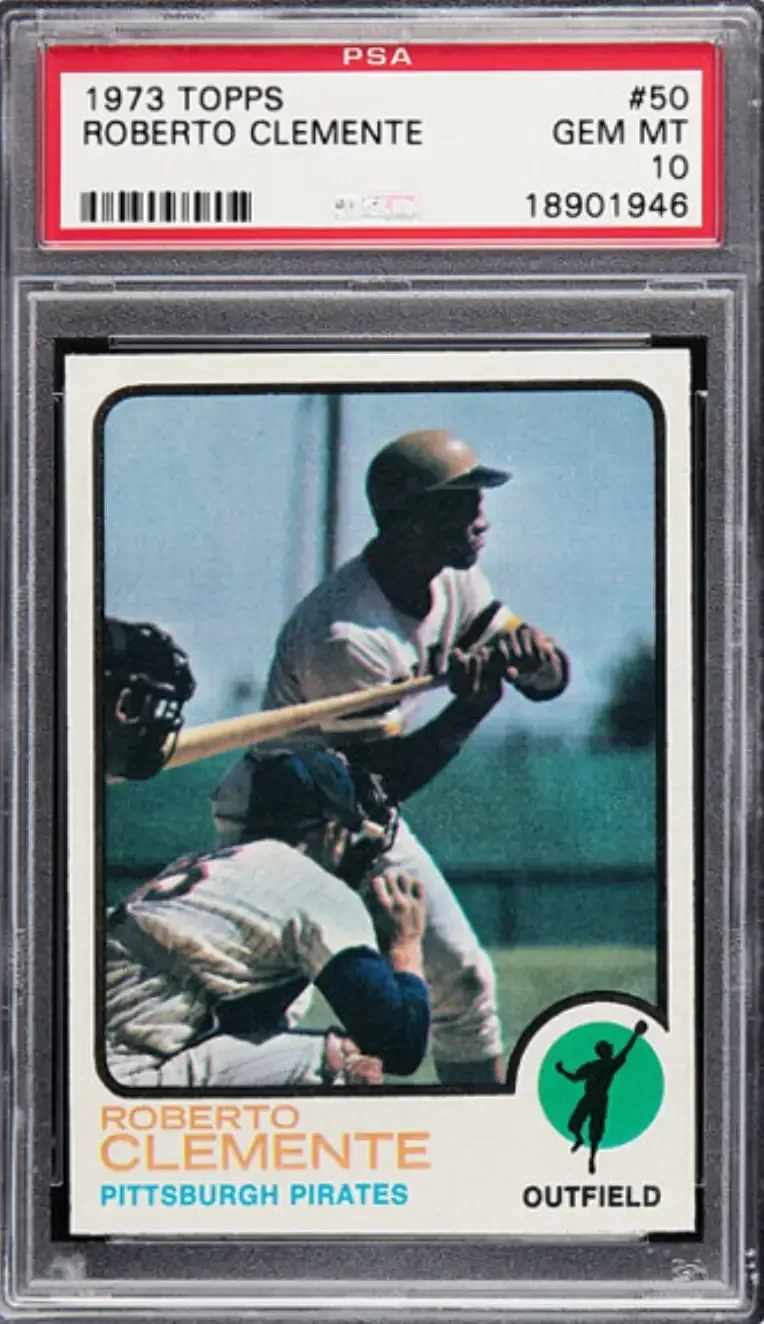
6. 1973 Topps Roberto Clemente #50
Roberto Clemente’s 1973 Topps #50 carries an emotional weight that no checklist position or statistical milestone could manufacture. Clemente died in a plane crash on December 31, 1972, while delivering aid to victims of the Nicaragua earthquake. The card had already been designed and scheduled for production, and Topps released it as planned.
The result is widely regarded as a poignant farewell. Its softly lit “sunset shot” does not need additional text on the front to communicate the passage of an era; subsequent knowledge of Clemente’s death transforms the image. It is an example of how a standard base card—meaning a regular card in a set, rather than a special insert—can become historically inseparable from the circumstances around it.
The reported population is 10,064, with eight PSA 10s. Reported recent values were $3,295 for a PSA 9 and $340 for a PSA 8. A PSA 10 brought $105,000 on January 27, 2023. As with every historical sale, that figure records one transaction for one exceptionally graded copy, not a universal price for the card.
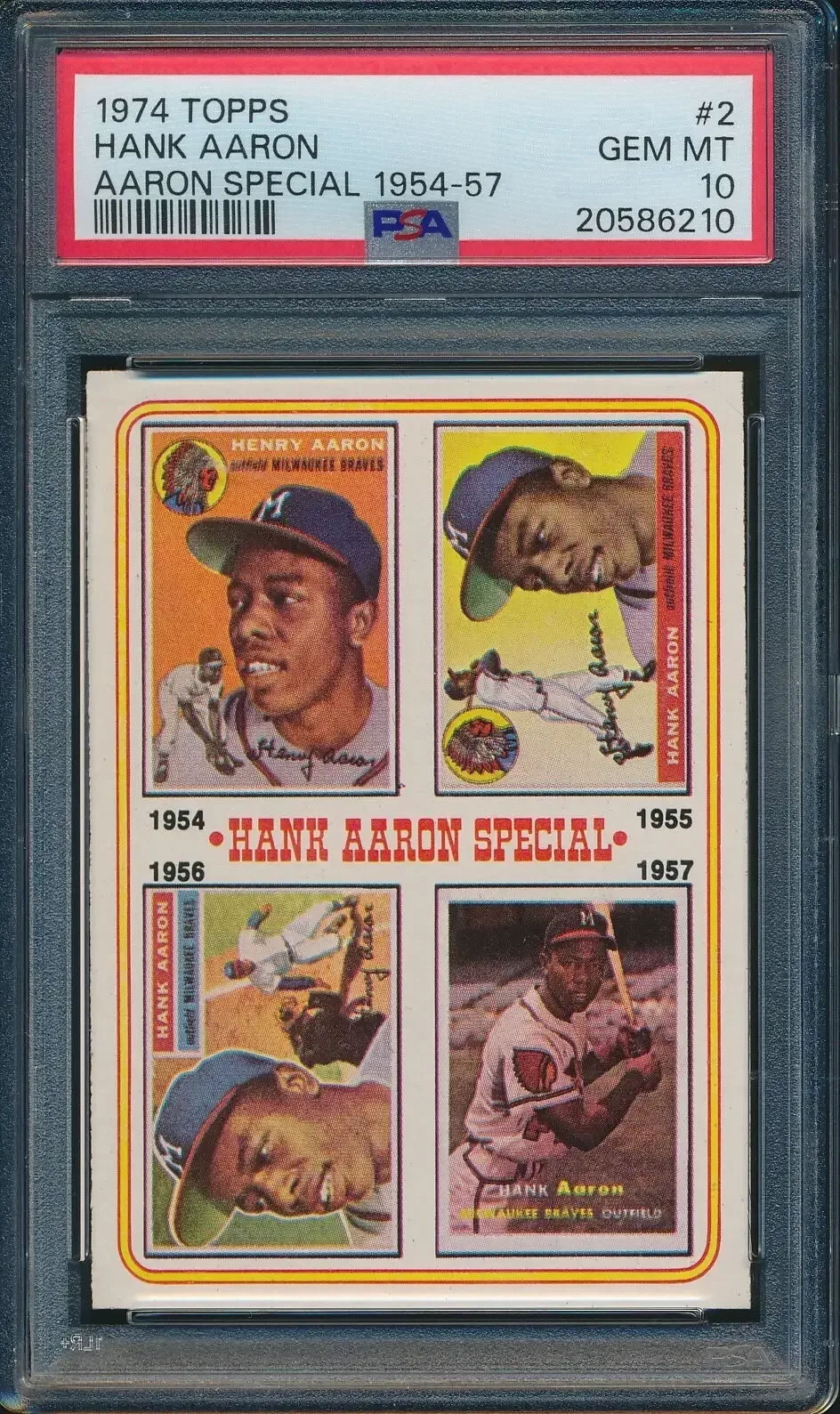
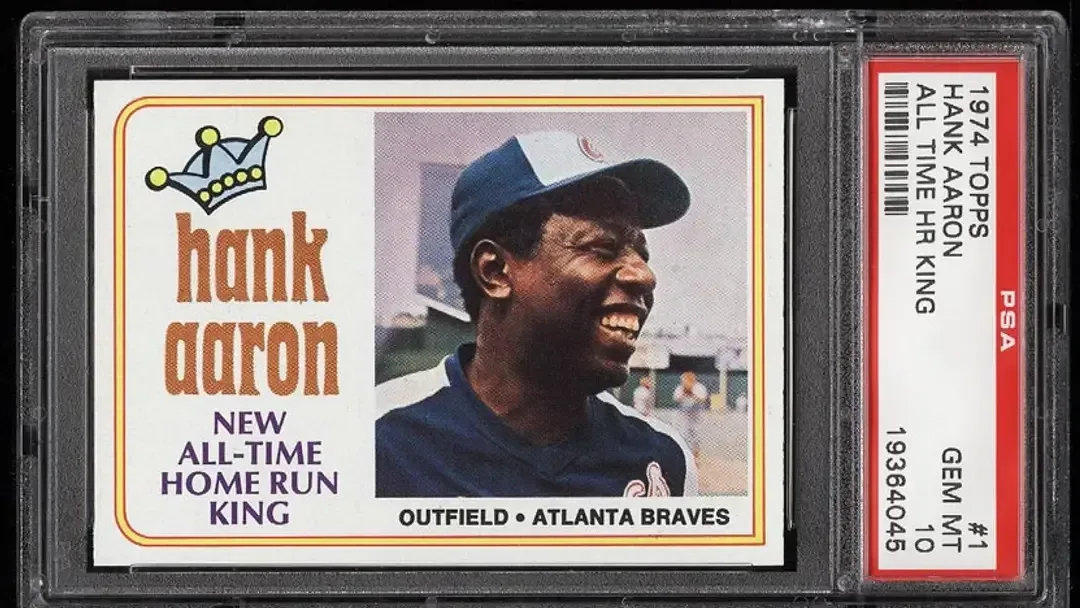
5. 1974 Topps Hank Aaron #1 All-Time Home Run King
Hank Aaron’s 1974 Topps #1 is a remarkable artifact of a record chase still underway. When the set went into production and reached collectors in January 1974, Aaron had 713 career home runs—one shy of tying Ruth’s 714. Nevertheless, the card’s front identified him as the new all-time home-run king before the record had actually fallen.
That apparent timing mismatch is precisely why the card endures. It reflects the certainty surrounding Aaron’s approach to the record, while also freezing the anticipation of that moment. The chase was a defining sports story of the decade, and it came amid racism, hate mail and death threats directed at Aaron. The card consequently represents not just an eventual athletic achievement, but the immense pressure around it.
Topps devoted the first six cards of its 1974 set to Aaron, underscoring the scale of the occasion. For #1 itself, the reported population is 5,460, including just one PSA 10. Reported recent figures were $8,235 for PSA 9 and $510 for PSA 8; the top reported sale was $23,299 for a PSA 10 on July 19, 2016. The enormous difference between an 8 and a 9 also shows why collectors should learn the distinction between a card’s identity and its grade: both influence demand, but they are not the same thing.
4. 1971 Topps Thurman Munson #5 All-Star Rookie
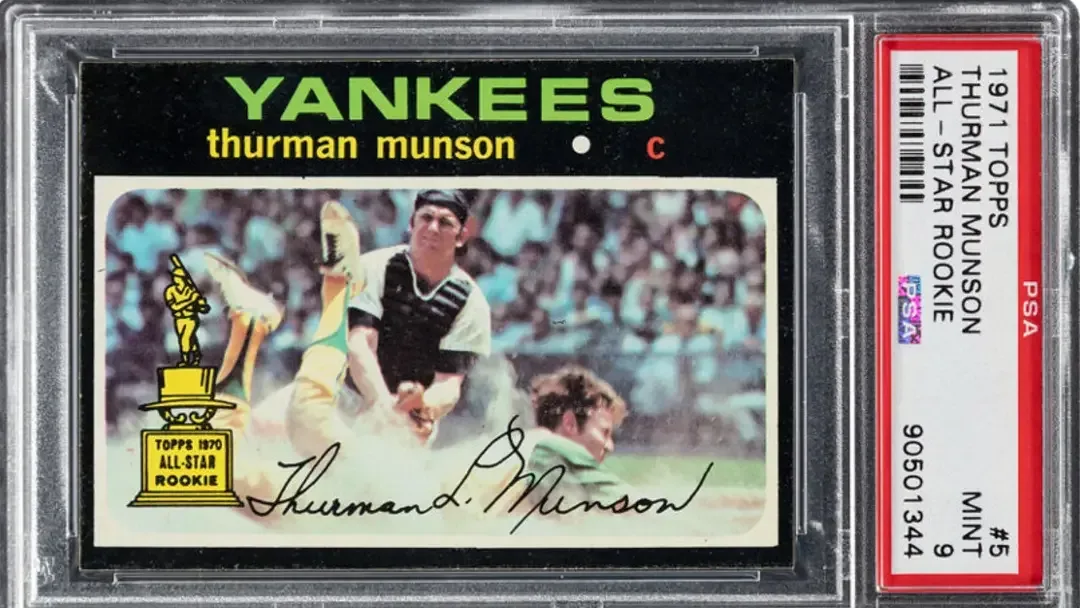
Thurman Munson’s 1971 Topps #5 earns its reputation through photography and fragility. The image catches Munson making a tag at home plate amid flying dirt, one of the early in-game action photographs used on a Topps base card. Rather than presenting a player as a cleanly framed subject, it places him in the violence and motion of the play.
This is not Munson’s rookie card, but it is his first solo Topps card and celebrates his 1970 American League Rookie of the Year season. That distinction is important. A rookie card may attract the most attention in a player’s catalog, yet a later card can become equally or more iconic because it has a stronger photograph, a more compelling set design or a clearer connection to a career milestone.
The black borders create a major condition challenge. Dark edges readily reveal chipping, meaning even small flaws can be conspicuous and grading-sensitive. No PSA 10s are recorded in the reported population of 6,140. Reported recent prices were $192,000 for PSA 9 and $7,200 for PSA 8, with a PSA 9 reaching $199,999 on May 13, 2022. For collectors, it is an unusually clear reminder that a design choice can shape a card’s high-grade scarcity for decades.
3. 1979 Topps Ozzie Smith #116
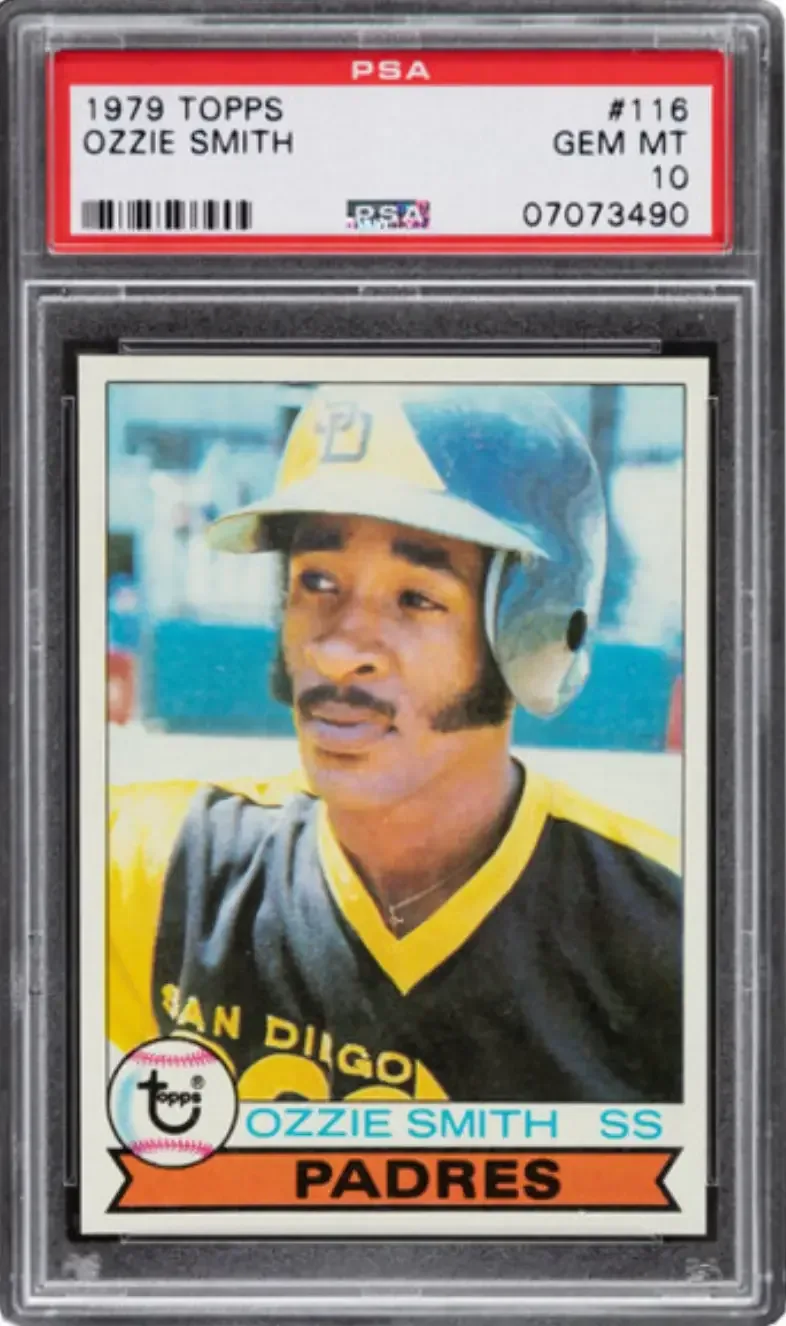
Ozzie Smith’s 1979 Topps rookie has the unusual advantage of representing a player whose hobby stature rests heavily on defense. Smith won 13 consecutive Gold Gloves and is broadly regarded as baseball’s greatest defensive shortstop. The card shows “The Wizard” as a San Diego Padre, before the stretch that made him a Cardinals legend.
It is easy for collecting conversations to prioritize home-run totals, batting milestones and pitchers’ wins. Smith’s card pushes back against that instinct. It demonstrates that a career defined by fielding brilliance can generate one of the decade’s most recognizable rookie cards. Its visual familiarity and Smith’s singular reputation have kept it central to 1970s discussions.
The reported PSA population is 18,267, including five PSA 10s. Reported recent prices were $5,033 for PSA 9 and $441 for PSA 8; the highest reported sale was $222,000 for a PSA 10 on February 26, 2021. Its population is higher than some entries here, but the tiny count at the top grade illustrates a core grading reality: population totals tell one story, while the distribution across grades tells another.
2. 1973 Topps Mike Schmidt Rookie Third Basemen #615
Mike Schmidt’s 1973 Topps rookie does not give him the card to himself. The “Rookie Third Basemen” card also includes Ron Cey and John Hilton. That shared-card format is part of its character, but it also makes Schmidt’s later stature all the more striking. He finished his career with three MVP awards, 10 Gold Gloves and 548 home runs, and is frequently viewed as baseball’s greatest third baseman.
Its placement at #615 gives it an additional historical appeal. Schmidt’s rookie appeared in the 1973 high series, the final late-season Topps series before the company switched to a one-time 660-card release in 1974. A high-number card can have special collecting cachet because of that release structure, though scarcity and condition should never be assumed solely from a card number.
The reported population stands at 13,302, with five PSA 10s. Reported recent prices list PSA 9 at $13,700 and PSA 8 at $3,225. A PSA 10 sold for $353,800 on December 19, 2025, the largest top sale among these seven cards. Schmidt’s entry proves that iconic does not always mean visually solitary; historical format, player legacy and premium-grade difficulty can turn a multiplayer rookie into a defining card.
1. 1975 Topps George Brett #228
George Brett’s 1975 Topps rookie is the decade’s visual shorthand. Its green and purple borders are unapologetically of their time, and that is its strength. When collectors picture a 1970s baseball card, this is often the design language they picture first: bright color, a bold border and an immediately identifiable layout.
Brett’s on-field record gives the design staying power. He is one of only five players with a .300 career batting average, 3,000 hits and 300 home runs, while his pursuit of a .400 average in 1980 remains a celebrated batting feat. Schmidt’s rookie is scarcer in top condition and has recorded a higher peak sale, but Brett’s card has an argument for first place on pure recognizability.
The reported population is 20,534, with 11 PSA 10s. Reported recent values were $10,200 for PSA 9 and $1,010 for PSA 8, while a PSA 10 sold for $158,600 on December 19, 2025. Its place at the top is not a claim that it must be the most expensive 1970s card. It is a recognition that card design can become as durable as the player pictured on it.
More essential 1970s cards to know
A seven-card list necessarily leaves out serious contenders. The 1974 Topps Dave Winfield rookie, 1975 Topps Robin Yount #223, 1972 Topps Carlton Fisk #79, 1978 Topps Paul Molitor/Alan Trammell #707 and 1971 Topps Nolan Ryan #513 all merit attention in any broader decade discussion. Winfield’s 1974 PSA 10, for example, reportedly sold for $106,750 on February 28, 2026.
Together, the core seven show why 1970s baseball remains such a rich collecting lane. There are rookie cards that became monuments to Hall of Fame careers, an action image whose black border makes elite condition a substantial challenge, a tribute that acquired profound meaning after tragedy, and a record-chase card that was printed in anticipation of history. The decade did not have Mantle in current packs. It did, however, produce a new gallery of cards collectors still instantly recognize.