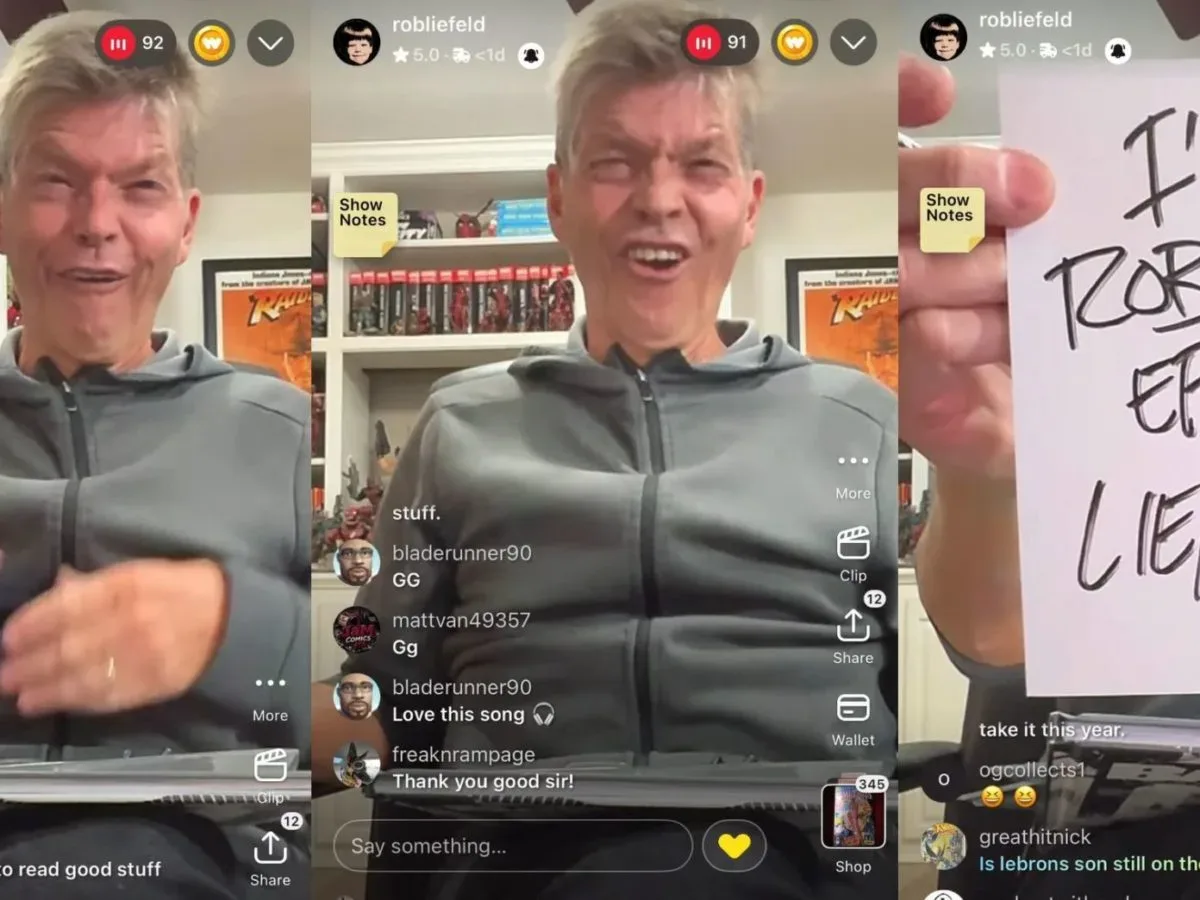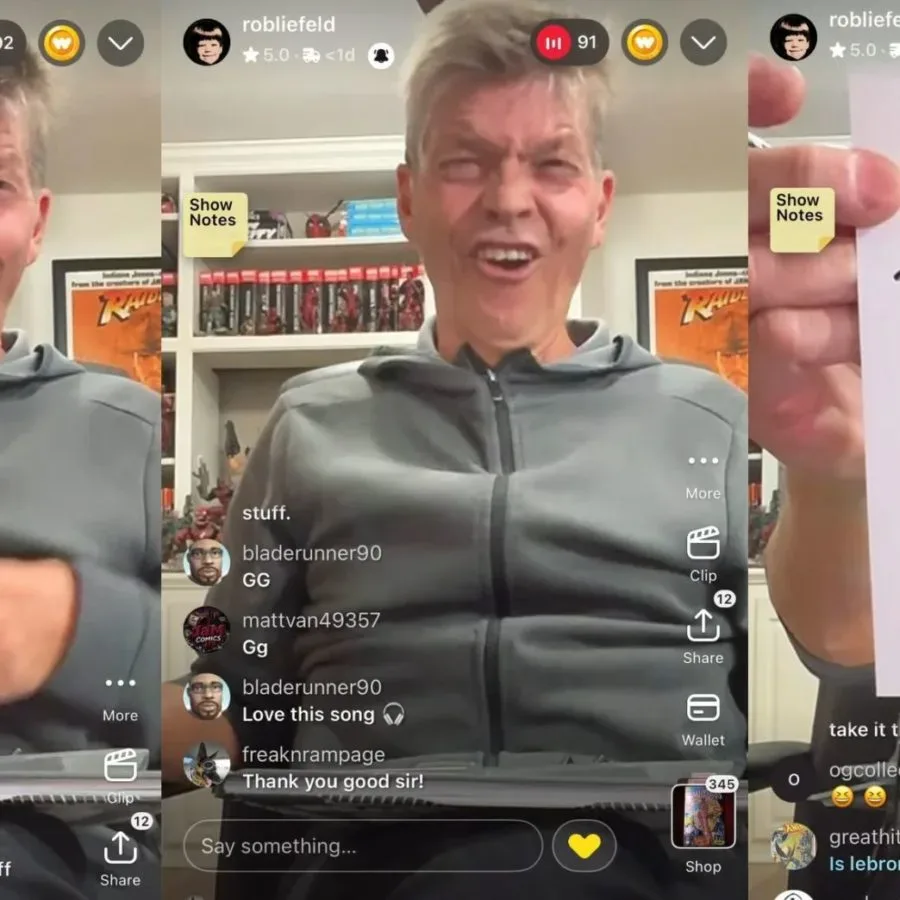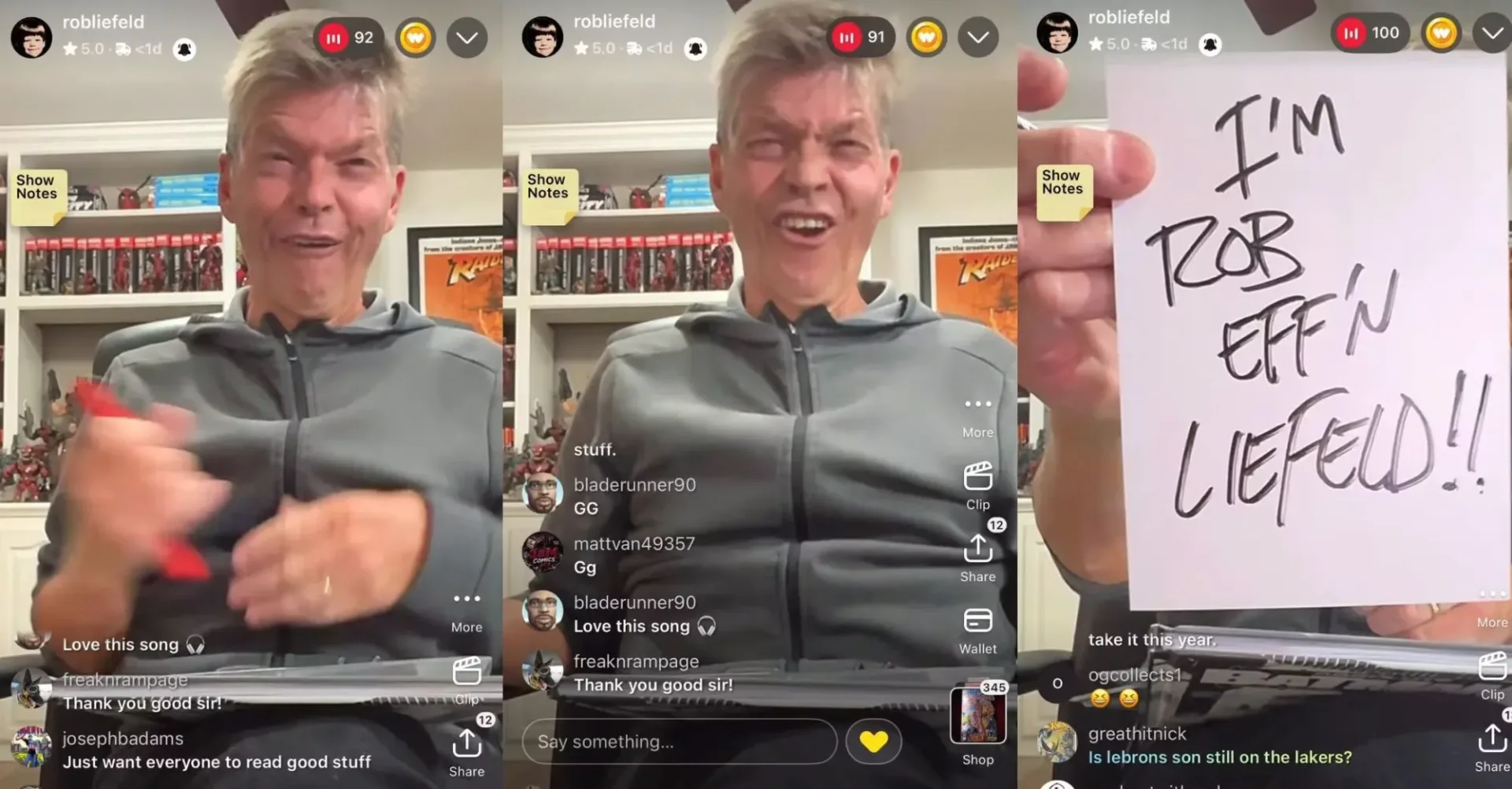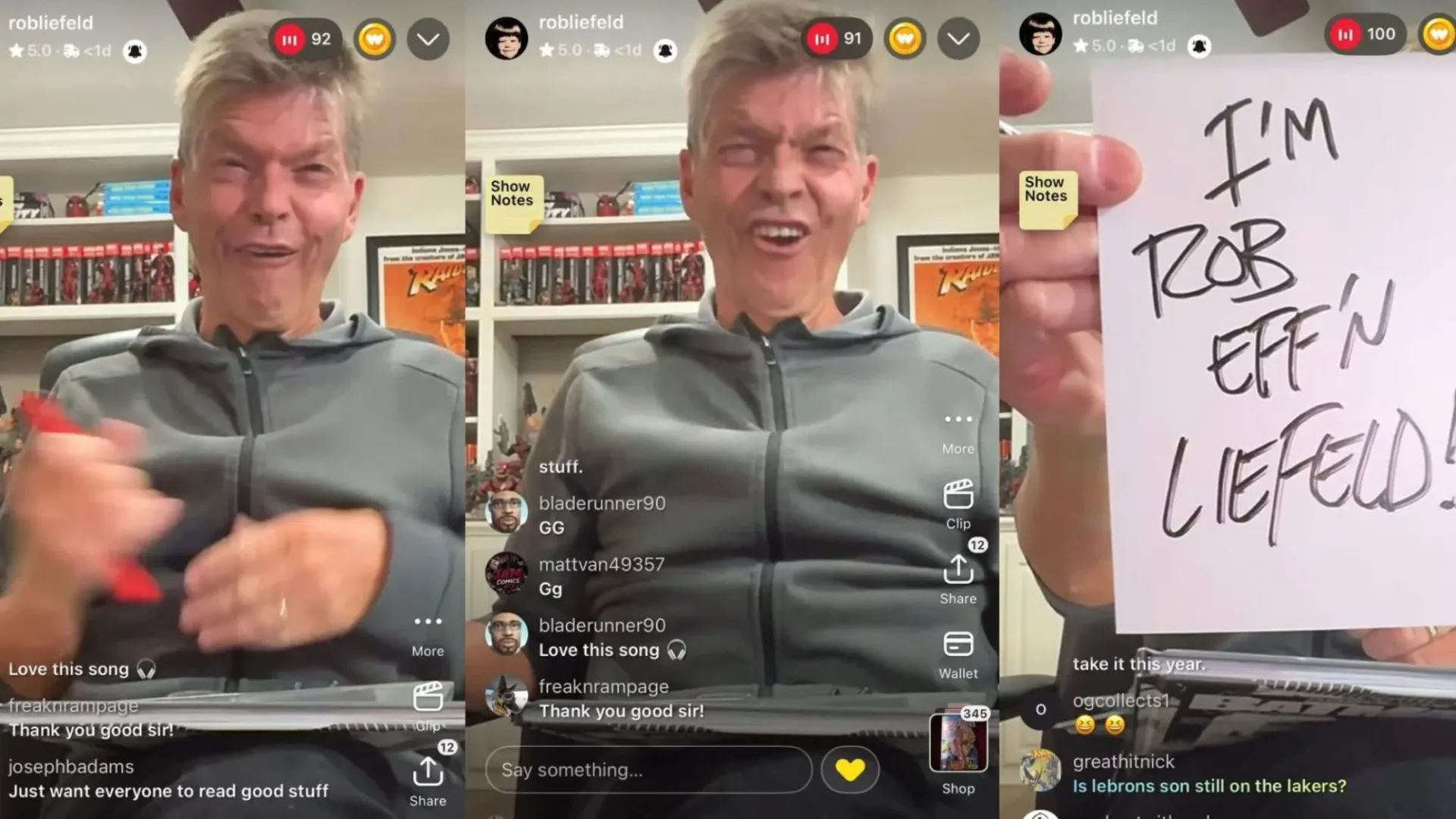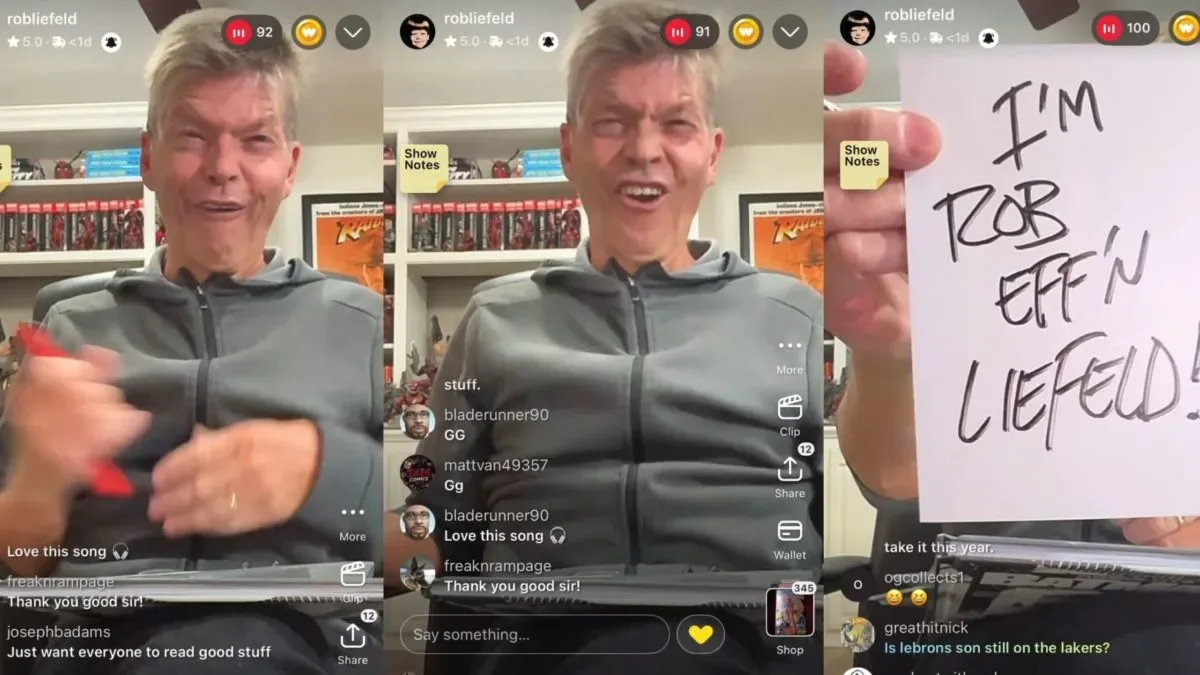
Rob Liefeld is not attempting to make his livestream presence smaller, quieter or more diplomatic. The comic creator has leaned into a combative, knowingly theatrical refrain—“I’m Rob Effin Liefeld”—during Whatnot broadcasts, then encouraged people clipping those moments to share them further.
It is a direct approach that fits the public image Liefeld has built over decades: conspicuous, energetic and acutely aware that his name and his characters provoke strong reactions. The recent clips appear to be landing as entertainment for many of the fans watching, while others online have been less taken with the routine. That split is hardly mysterious. A creator who makes the act of self-promotion part of the show is inviting both enthusiastic participation and scrutiny.
But the streams are not merely a venue for a running catchphrase. They are part of Liefeld’s continuing effort to sell work directly to readers while keeping attention on a catalog that includes Youngblood, Avengelyne and Badrock. They also arrive as he turns his attention back toward the Extreme Universe, alongside mentions of projects including Heirborne, Blood Brothers II and Last Blood.
A creator’s personality becomes part of the product
Livestream selling is a format in which the host is not just displaying an item. They are answering viewers in real time, maintaining momentum and providing a reason to stay in the room rather than simply checking a product listing and leaving. For a comics creator with an unusually recognizable public persona, that makes the stream a natural extension of the work rather than a detached storefront.
Liefeld’s response to people recording him underscores that point. Rather than treating every circulating clip as something to shut down, he has invited wider sharing even while ribbing the people doing it. That stance turns a potential annoyance into promotion. The resulting footage can reach people who did not watch a full broadcast, including viewers who may know the creator principally through characters such as Deadpool and Cable rather than through his current direct-sales activity.
There is also a calculated bluntness to the performance. The “I’m Rob Effin Liefeld” line functions as a declaration of identity, but it is also a joke about celebrity, comic-book discourse and the long-running tendency for Liefeld conversations to become debates about Liefeld himself. In that sense, the persona is doing several jobs at once: it reassures committed fans that the host is unfiltered, gives critics something to react to and creates a concise clip-friendly moment for social platforms.
That does not require universal approval to work. An audience can enjoy a creator’s work, find the performance amusing, dislike it, or hold a mix of all three views. The available reaction suggests precisely that kind of divide. The more useful takeaway is that Liefeld is choosing visibility over neutrality. For a seller operating live and directly, a strong reaction can be more functional than being forgettable.
Why the Whatnot presence matters
Whatnot is a livestream marketplace, meaning sales are connected to live video rather than only to conventional online catalog pages. In practical terms, it lets a creator present comics to viewers while speaking with them, taking questions and making the act of purchasing part of a communal event. That is different from a traditional retail model in which a reader encounters a book on a shelf or in a static web store without direct access to the person behind it.
For fans, the appeal is access and immediacy. They can see what is being offered and watch the creator discuss the material as it is sold. For the creator, the format creates a direct path to readers and makes personality a core part of the sales experience. The stream can also keep multiple properties in circulation at once, which matters for a creator whose body of work spans famous superhero contributions and creator-associated independent characters.
Liefeld co-created Deadpool, Cable, Domino and X-Force, and he co-founded Image Comics, launching it with Youngblood. Those credits give the present-day livestreams an unusually broad reference point. A viewer may come in because of Deadpool or X-Force, then see Youngblood, Avengelyne or Badrock being foregrounded. The stream is therefore both a sales channel and a way of reconnecting a large legacy with material currently being promoted.
That distinction matters. A direct sale is not automatically a replacement for every other way comics reach readers, and there is no basis here to treat it as one. Rather, it is a complementary route that allows a creator to speak to an established audience without reducing the interaction to a transaction alone. Liefeld’s loud on-camera manner is a feature of that route, not an accidental distraction from it.
The Extreme Universe is back in the frame
The broader business and creative backdrop is Liefeld’s renewed focus on the Extreme Universe. The name refers to the shared collection of characters and concepts associated with his comics work, including properties such as Youngblood and Supreme. A “shared universe” in comics is a setting in which distinct series and characters can occupy the same continuity, potentially enabling crossovers or connected storylines. It is a useful framework for building attention around more than one title at a time.
Liefeld has reconciled with former investor Scott Rosenberg, who owns much of Liefeld’s back catalog of intellectual property, including Youngblood and Supreme. Intellectual property, often shortened to IP, refers here to the rights and commercially valuable identity attached to characters and comic concepts. Ownership and rights arrangements can shape who is able to publish, license or otherwise use a property, so that reconciliation is a meaningful part of the context behind the revived emphasis on the Extreme Universe.
The catalog under discussion is not limited to familiar names. Liefeld has also teased Heirborne, Blood Brothers II and Last Blood. Teasing a project signals an intention or future creative direction, not a guaranteed release timetable, and readers should keep that difference in mind. The same caution applies to the long-discussed Brigade Kickstarter, which remains unfinished.
That uncertainty is especially relevant in comics, where the excitement of a character name, a cover reveal or a livestream mention can run ahead of completed and released pages. The responsible way to read these streams is to separate what is available for sale now from what is being talked about as forthcoming. Liefeld’s broadcasts can generate visibility for both, but the two categories are not interchangeable.
After Marvel, the spotlight shifts inward
The current focus also follows Liefeld’s declaration that he was ending his Marvel work after Deadpool Team-Up. That makes his renewed emphasis on the Extreme Universe more than a side project alongside ongoing Marvel assignments. It places his creator-associated catalog and direct reader engagement at the center of his current public activity.
There is a clear practical logic to that transition. Characters like Deadpool and Cable remain central to Liefeld’s name recognition, while the Extreme Universe gives him a collection of properties around which to organize fresh attention. The livestream format lets him connect those two facts without pretending they are the same thing: his Marvel-associated legacy can bring viewers to the broadcast, while Youngblood, Avengelyne and Badrock can be the books and brands receiving the immediate push.
It also reinforces a recurring truth of creator-driven comics: readers often follow not only a specific character but also the voice, art and personal mythology of the person making the work. Liefeld’s streams are unusually explicit about that relationship. He is not presenting himself as an invisible intermediary between a product and its buyers. He is presenting Rob Liefeld as the reason to tune in, react, share a clip and, potentially, purchase a comic.
What fans should take from the clips
The immediate entertainment value is obvious: an established creator is treating his own notoriety as material for the broadcast. Yet the clips also reveal the modern practical side of fandom. Discussion is not confined to a convention appearance, a letter column or a retailer visit. It can happen in real time around a sale, then move outward through short recordings and social feeds.
For collectors and readers interested in the books being shown, the useful approach is straightforward:
- Distinguish items currently offered in a livestream from projects merely mentioned as future work.
- Pay attention to the specific comic or property being discussed, rather than assuming a famous creator credit means every title is connected in the same way.
- Remember that strong online reactions to a clip are reactions to a performance, not necessarily a guide to the content or status of a comic.
- Follow rights and publishing developments around the Extreme Universe carefully, since ownership context can matter to how legacy properties are used.
For a wider comics context, readers can also see how another ongoing series frames competing magical agendas in this look at Zatanna #7.
Liefeld’s message on stream is ultimately uncomplicated: he wants the clips out there, he wants the attention, and he is willing to make himself the punchline as well as the pitchman. Whether viewers embrace or reject the swagger, it is serving a recognizable purpose—keeping his name and the Extreme Universe’s familiar titles in active conversation while direct sales continue.