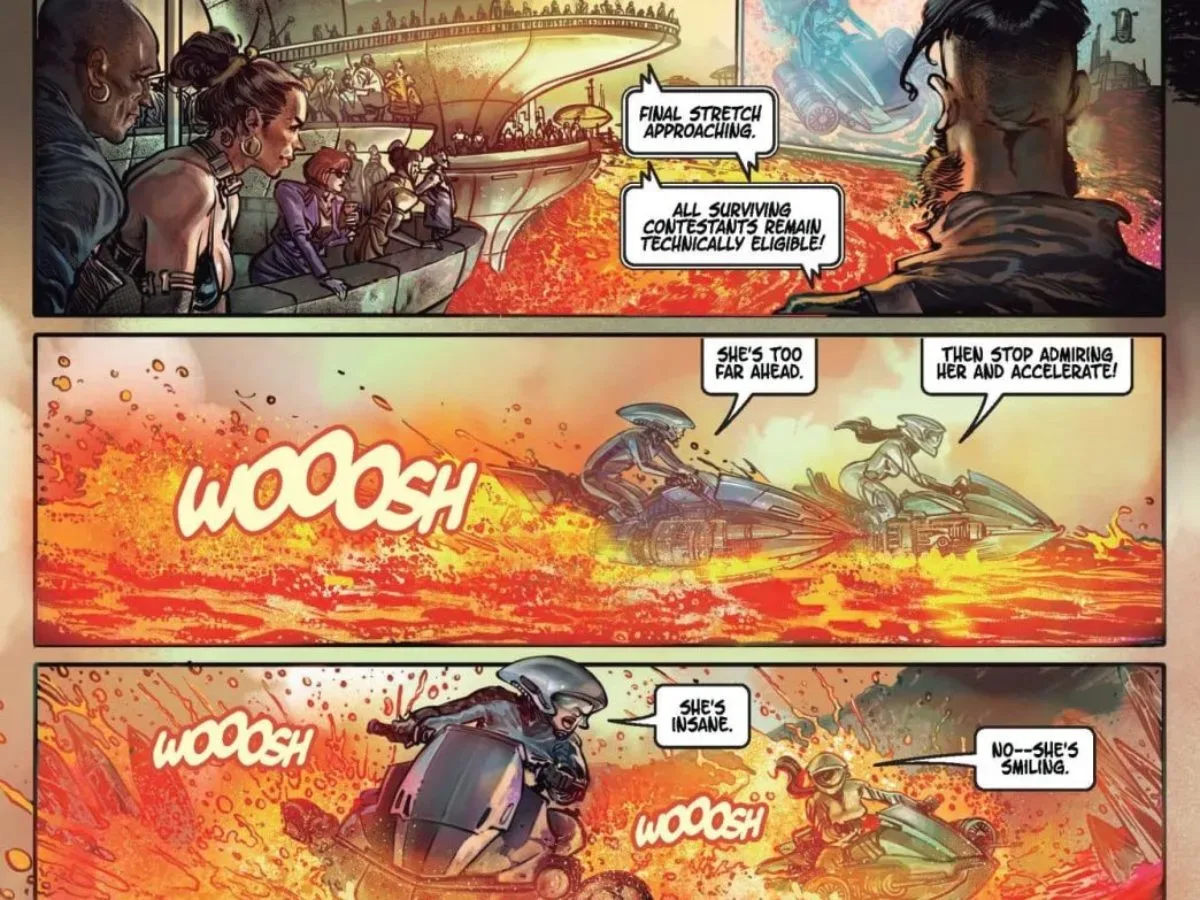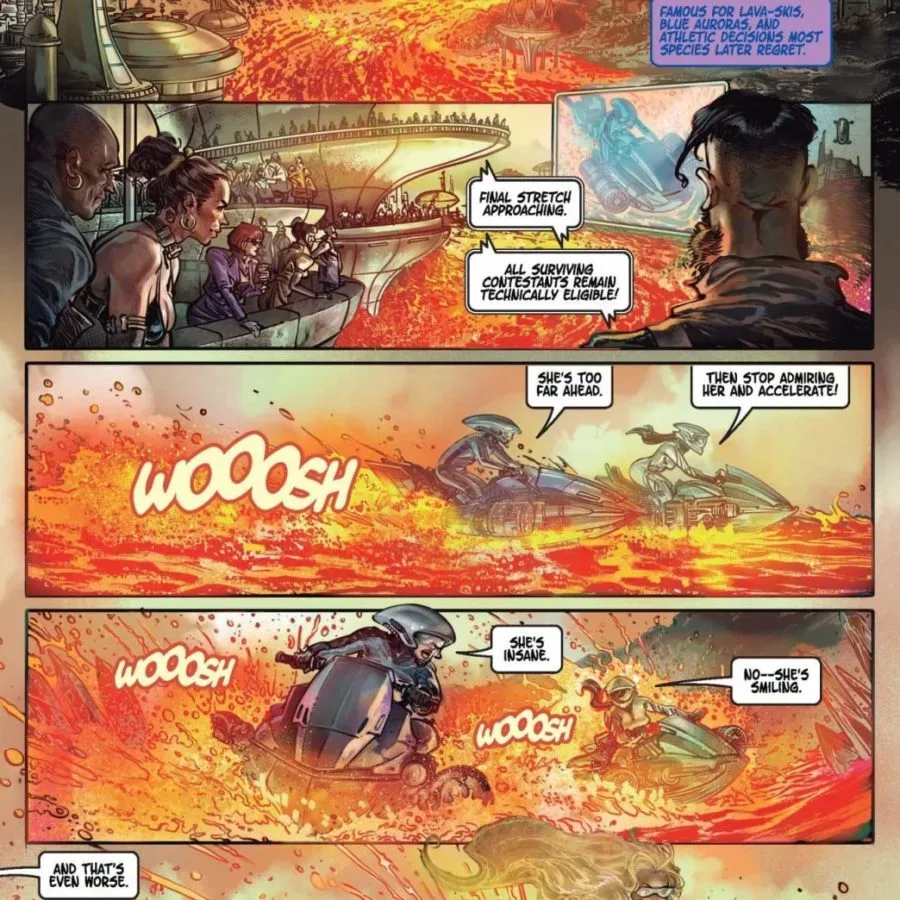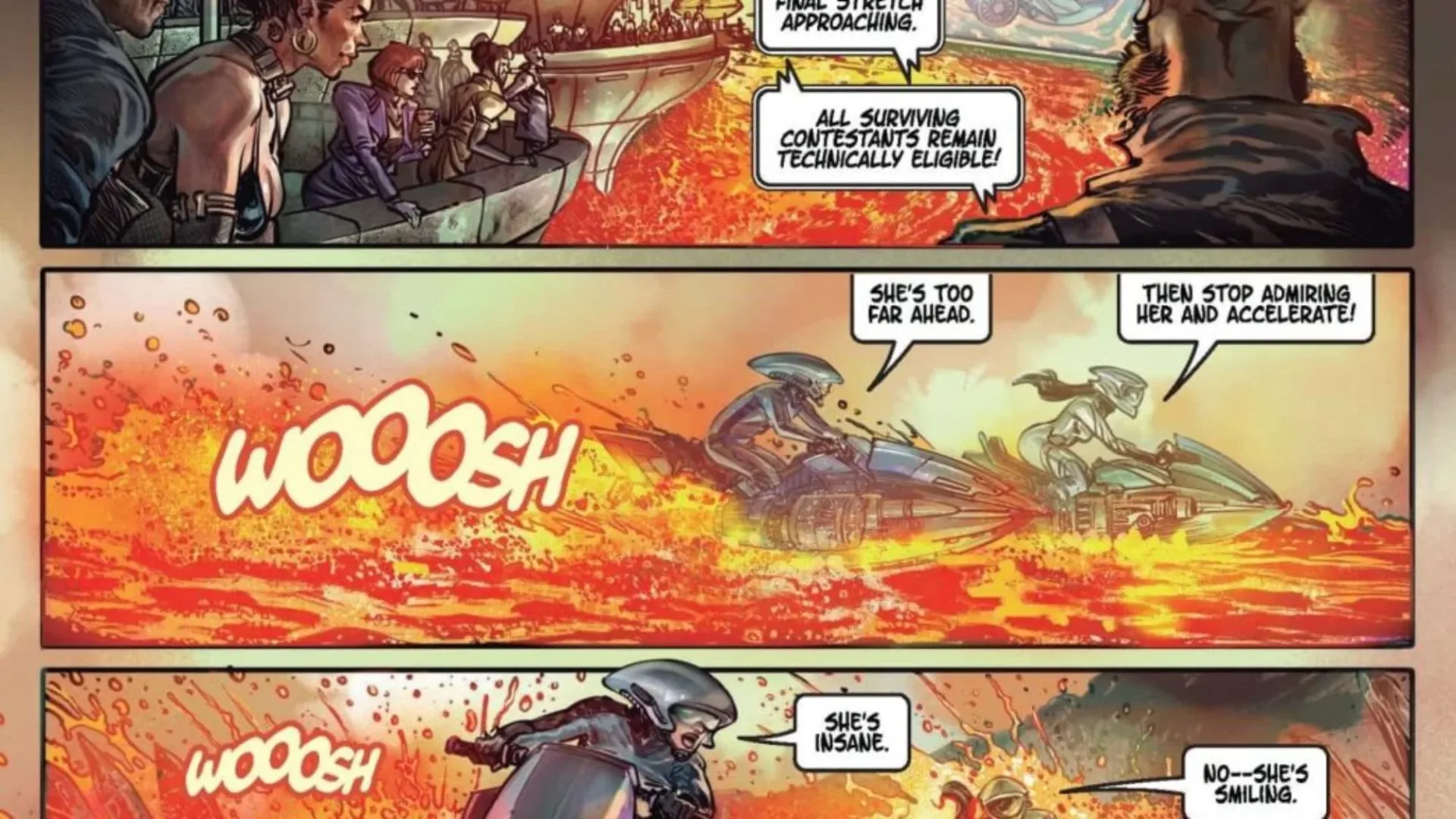
Red Sonja/Barbarella #1 will bring two heroines from dramatically different corners of fantastical fiction into the same mystery when it reaches comic shops on November 4, 2026. The new Dynamite Entertainment one-shot-style launch, written by Homero Rios with art by Diego Yapur, positions Barbarella’s science-fiction world beside Red Sonja’s blood-soaked sword-and-sorcery terrain.
The central setup is deliberately split between the characters before it joins them. Barbarella is pursuing an Obsidian Mirror connected to a past she only partly remembers. Elsewhere, beneath a blood-red sky, Red Sonja rides toward danger in an attempt to rescue an Oracle whose future appears destined for violence. Neither protagonist knows that the other exists, but an unknown force is drawing both toward the same threat.
That is a strong basic framework for a crossover because it does more than put two recognizable names on a cover. The story’s stated concerns—memory, destiny, desire, survival and debts paid in blood—give each heroine an individual problem while leaving room for the worlds to collide. The Obsidian Mirror is framed as more than a simple object to retrieve: it may provide access to a life that Barbarella can barely recall. For Sonja, the Oracle’s prophecy establishes a more immediate rescue mission, with the implication that knowing a violent fate does not necessarily make it easier to prevent.
A collision of genres, not just characters
The solicitation calls the book a meeting of science fiction and savage fantasy. In practical terms, that means its crossover premise has to accommodate two different storytelling languages. Barbarella’s thread begins with a mysterious artifact and lost memories, ideas often associated with science-fiction adventure. Red Sonja’s side begins with a ride toward an Oracle, a blood-red sky, prophecy and violence—elements that sit comfortably in sword-and-sorcery.
Sword-and-sorcery is a fantasy mode generally centered on perilous journeys, warriors, magic and intimate stakes rather than the grand political structures of an epic quest. The details supplied for this issue fit that approach: Sonja is headed into personal danger to save a specific figure, and the Oracle’s fate is presented as an urgent, potentially bloody problem. Science fiction, as deployed in the book’s setup, provides the counterweight through Barbarella’s connection to an “impossible” world and a mystery concerning identity and memory.
The crossover’s most important narrative question, then, is not which heroine is stronger. It is why a mirror tied to Barbarella’s obscured history has any connection to Sonja’s prophetic crisis. The solicitation does not answer that question, and that restraint is useful. It tells readers what is at stake without defining the force bringing the characters together or explaining what form the larger threat takes.
The Obsidian Mirror and the Oracle
Two story devices anchor the first issue. The first is the Obsidian Mirror. Obsidian is volcanic glass, and a mirror in fiction commonly suggests reflection, concealed truths or a pathway into another reality. None of those specific functions have been confirmed here, but the book does establish one concrete role: Barbarella believes the object may hold the key to understanding a past she scarcely remembers. That makes her search fundamentally personal. She is not merely recovering an artifact for its own sake; she is looking for information about herself.
The second device is the Oracle. An oracle is a person or authority associated with prophecy, and the solicited premise says this one has a fate seemingly already written in violence. That wording introduces a classic tension between foreknowledge and agency. If Sonja can see the threat or at least understand its inevitability, can she change anything? The issue appears poised to make that question part of its action, rather than treating the prophecy as decorative fantasy language.
These two threads also complement each other. Barbarella is confronting an uncertain past; Sonja is confronting an apparently fixed future. One heroine is looking backward for missing knowledge, while the other races forward to challenge a foretold outcome. Their eventual convergence gives the series a clean thematic bridge even before readers know the mechanics of how their worlds meet.
Creative team and release details
Homero Rios is credited as writer, while Diego Yapur provides the interior art. Joseph Michael Linsner is credited for cover art on the primary solicitation listing. The release is scheduled for November 4, 2026, with a standard suggested retail price of $4.99.
Dynamite’s listed edition lineup includes several choices for readers who want the issue itself without stepping up to higher-priced cover editions, as well as premium-priced Linsner options. The solicit lists the following:
- Red Sonja/Barbarella #1 — $4.99
- Collette Turner cover — $4.99
- Cosplay Ivy Red Sonja cover — $4.99
- Cosplay Ivy Barbarella cover — $4.99
- Blank Authentix cover — $4.99
- Joseph Michael Linsner cover edition — $11.99
- Joseph Michael Linsner cover edition — $29.99
The supplied listing does not explain the distinction between the two differently priced Linsner entries, so buyers should not assume that the price alone identifies the format, print treatment or scarcity of either edition. Likewise, a blank cover is simply listed as a Blank Authentix Cover; no additional signing or sketch details are specified.
What readers can reasonably expect from issue #1
The available information supports a few clear expectations. This first chapter should introduce the Obsidian Mirror as the engine behind Barbarella’s storyline, establish the Oracle’s predicament as Sonja’s immediate objective, and begin revealing the force connecting the two women. The solicitation explicitly says neither knows the other exists at the outset, so their first contact—or the circumstances that make it unavoidable—should be a major dramatic beat.
Readers should be cautious about expecting more than that from the initial description. There are no confirmed details about the number of issues, the exact nature of the antagonist, whether the mirror enables travel between worlds, or how long either heroine spends outside her usual setting. The imagery and language promise a collision between science fiction and fantasy, but the precise rules of that collision remain part of the mystery.
That uncertainty is arguably the book’s best selling point. Crossover stories can sometimes reveal their main attraction immediately, but this setup treats the meeting itself as something to be earned. It gives Barbarella and Red Sonja separate motivations first: one needs the truth about her own past, and one is trying to save someone from a future marked by violence. A shared danger can then test whether those motivations align, conflict or demand sacrifice.
Why the premise has room to work
On paper, the pairing offers contrast at nearly every level. Barbarella’s mission is tied to memory, an inward-looking mystery about identity. Sonja’s mission is tied to prophecy, an outward crisis with a target to save. Barbarella follows an artifact; Sonja rides into imminent danger. The story can use that contrast to make their eventual partnership feel less like coincidence and more like a response to a problem too large for either character’s original path.
The repeated emphasis on a price for memory, destiny, desire and survival is also notable. It suggests that the crossover is not framing its central mystery as a consequence-free adventure. The phrase “debts are paid in blood” signals violence and sacrifice, although it does not identify who will pay that cost or how literal the debt will be. For a first issue, that is a concise way to give the larger plot some menace without spoiling its outcome.
Fans interested in another comic built around a mysterious magical book can also read about Sunder #2 and Zeek’s pursuit of a mysterious magic book.
Red Sonja/Barbarella #1 is due in shops November 4, 2026. With Rios and Yapur leading the story, and an assortment of $4.99 standard and specialty cover choices alongside two higher-priced Linsner editions, the debut sets out to make its central mystery—not simply its character pairing—the reason to follow the collision of its two impossible worlds.