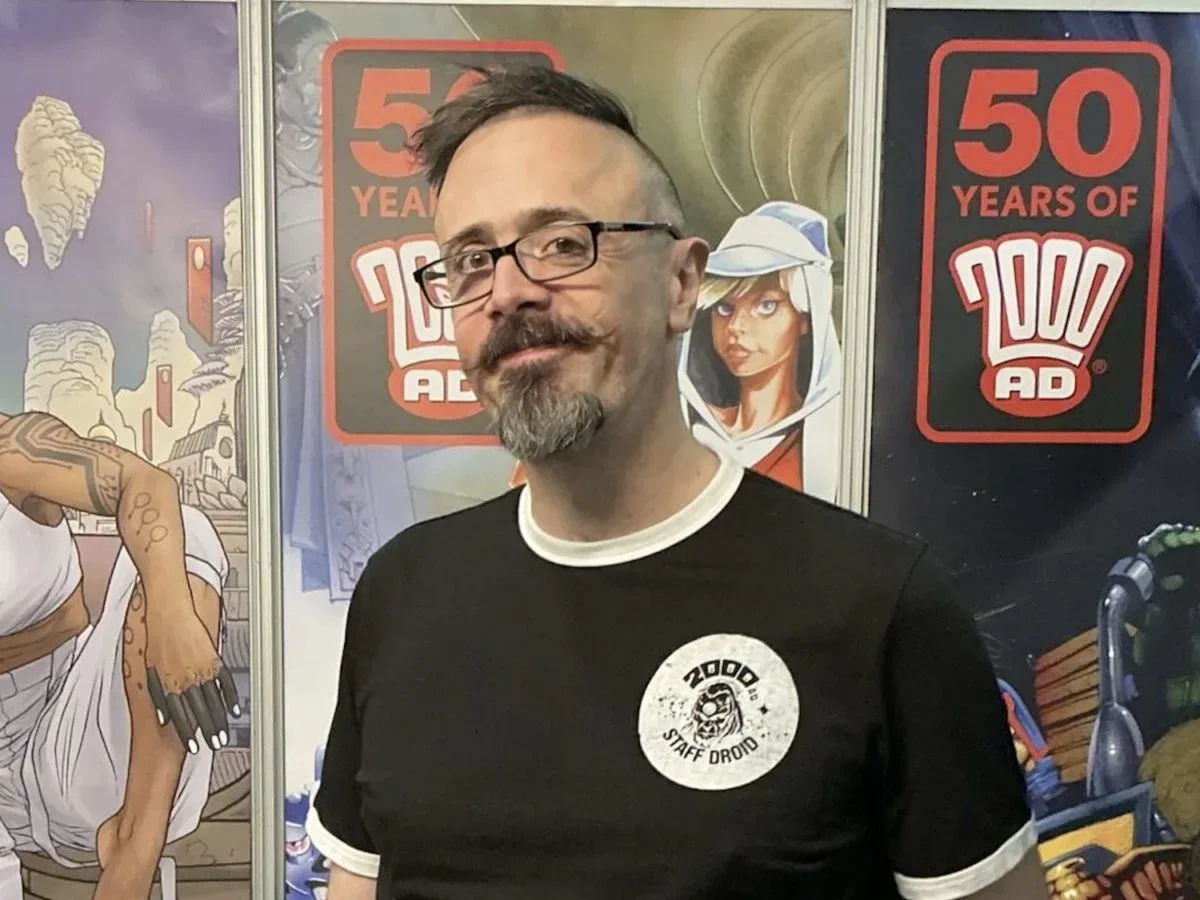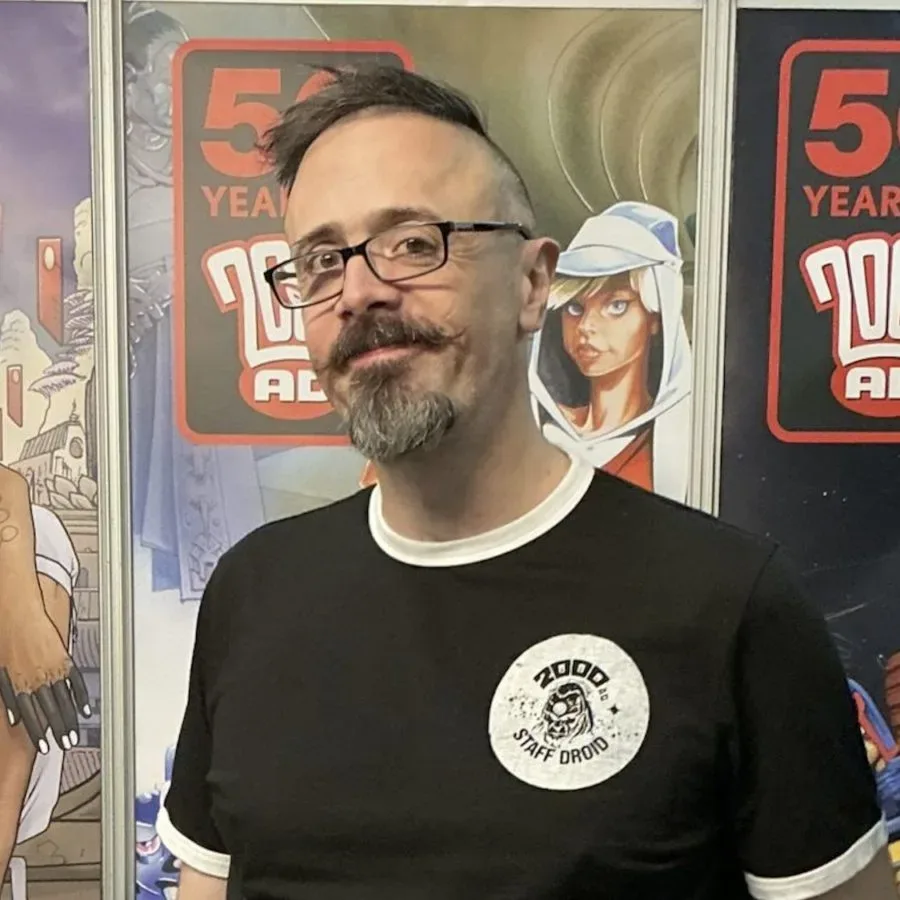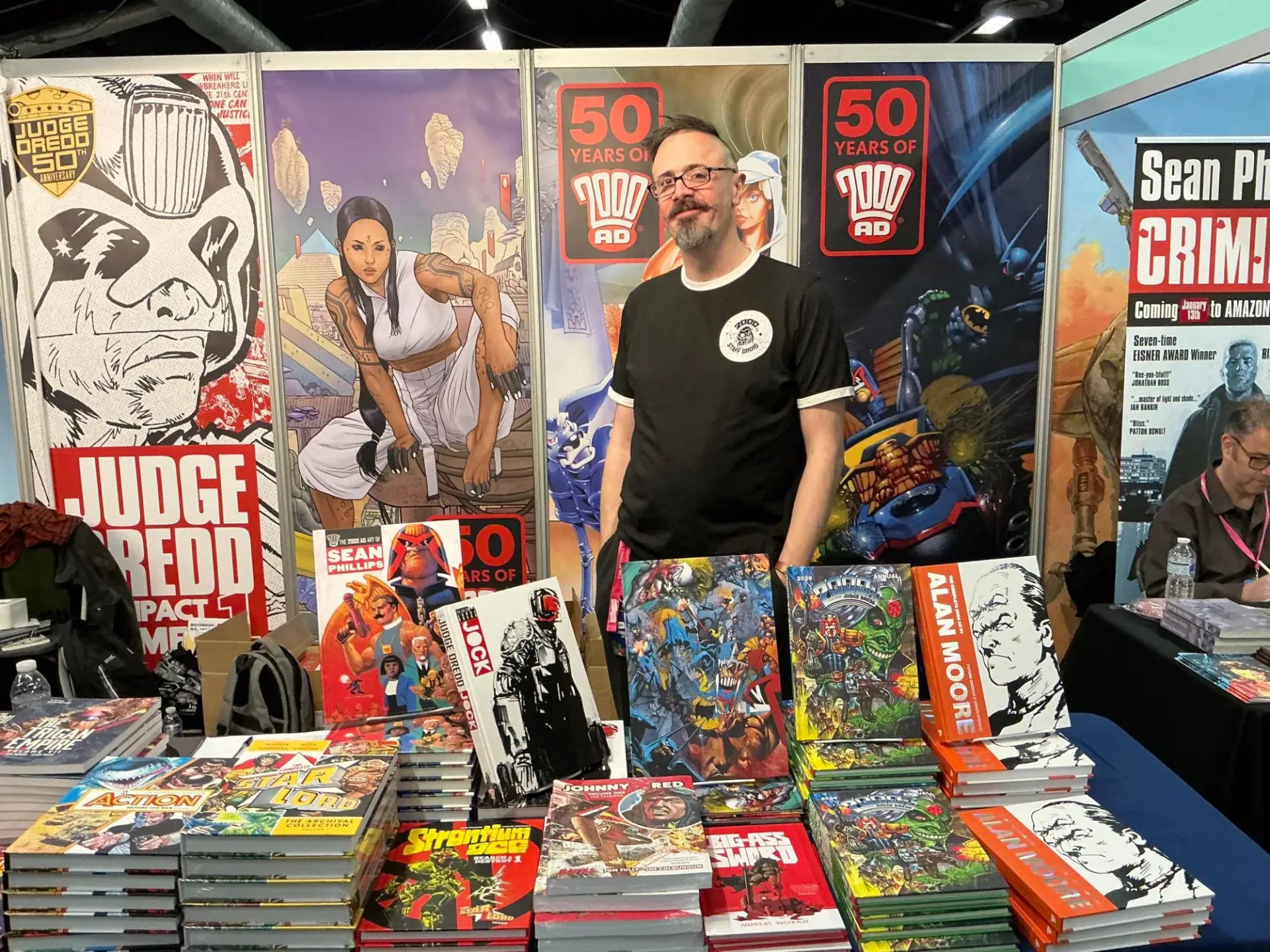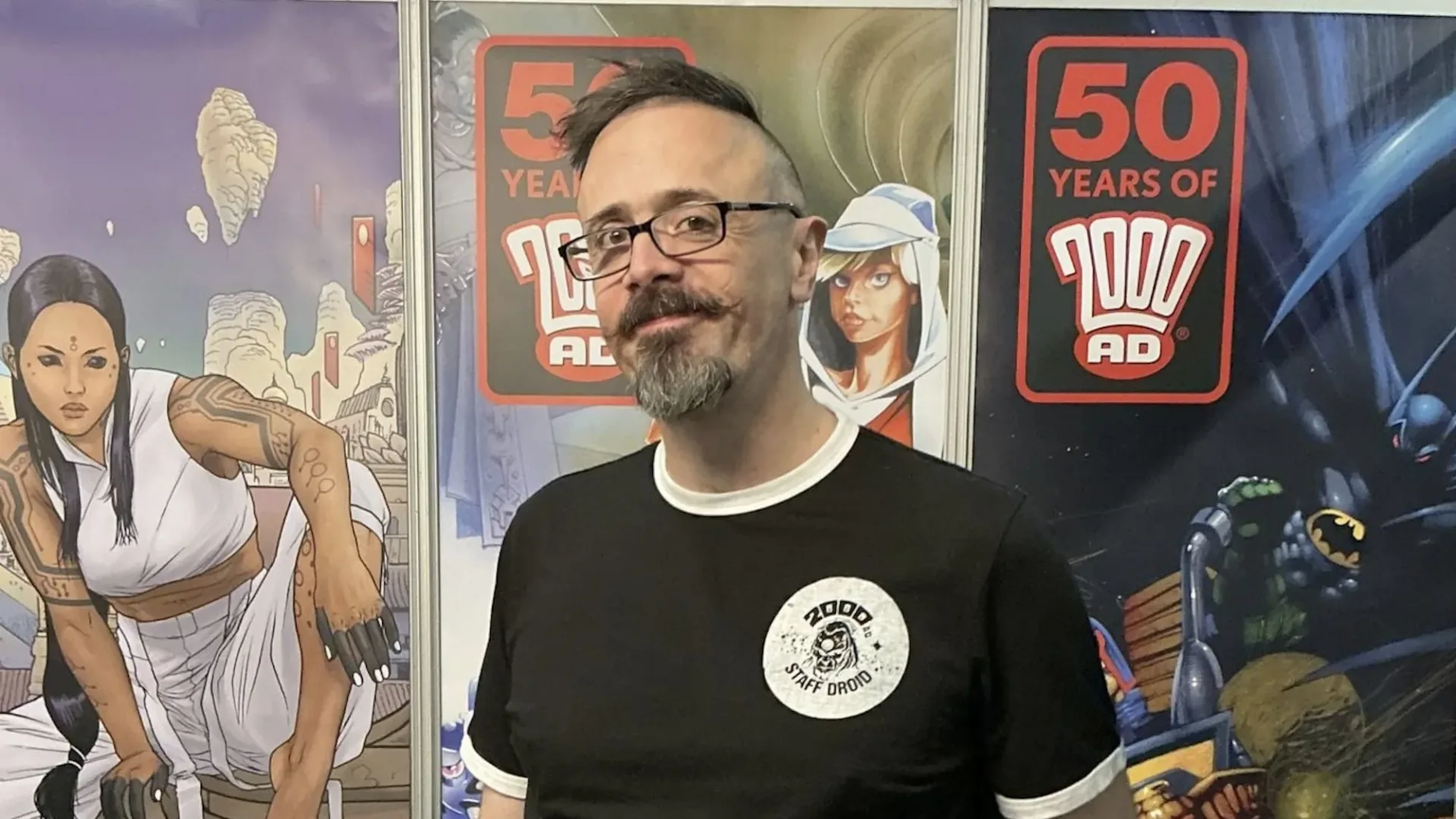
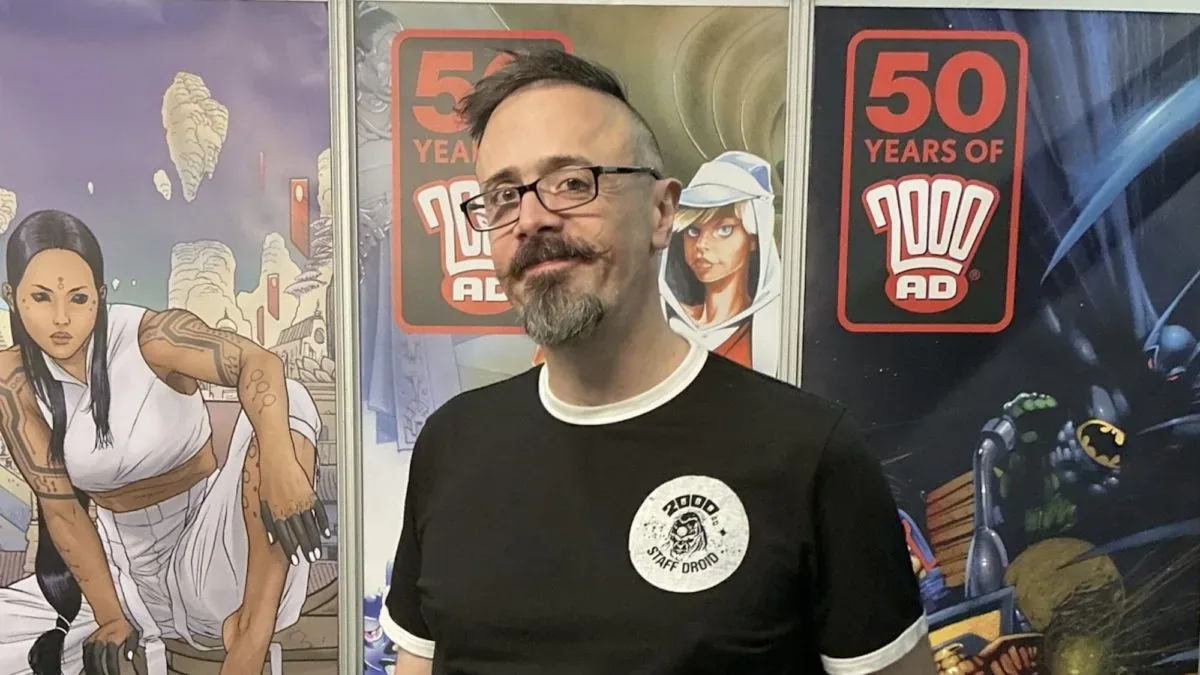
Mike Molcher is set to leave Rebellion, the owner of 2000 AD and publisher of Judge Dredd, on December 23, 2026. After almost 16 years with the company, the longtime Brand Manager plans to move into full-time writing.
The timing is notable: Molcher’s final day is only days ahead of the 50th anniversary of both 2000 AD and Judge Dredd. For readers who have encountered the publisher not simply through its weekly comics but through interviews, convention appearances, podcasts and livestreams, the departure marks a change for one of its most recognisable fan-facing figures.
Molcher’s role extended beyond the usual idea of brand management. He hosted the official 2000 AD Thrill-Cast from 2015, appeared at events, interviewed creators, and helped present the publisher’s work to established readers and newcomers alike. More recently, he launched the weekly In Orbit Every Wednesday show with co-host Chloe Maveal.
From comics interviewer to 2000 AD representative
Molcher’s relationship with 2000 AD began as a reader. Raised in Leeds, West Yorkshire, he reportedly discovered the comic around the age of 10 through inexpensive Best of 2000 AD Monthly reprints. That route matters because reprint editions can be an entry point into long-running comics: they offer a sampling of material without asking a new reader to immediately understand every decade of continuity.
After studying theatre and media at the University of Huddersfield, Molcher worked in local journalism. His career included posts at the Rochdale Observer and the Harrogate Advertiser, where he became chief reporter, followed by five years as a press officer for Leeds City Council.
In 2005, he began interviewing major comics creators, initially for his self-published small-press title The End is Nigh. Those conversations later appeared in the Judge Dredd Megazine and were collected in the multi-volume 2000 AD: The Creator Interviews series. His interview subjects included Alan Moore, Pat Mills, Dave Gibbons, Carlos Ezquerra, Kevin O’Neill and Mick McMahon.
That body of work reflects an important part of comics culture that can sit outside the comics themselves: documenting how creators describe their work, their characters and the business around them. For a long-running anthology with a deep creator history, interviews can function as an accessible record of its development, particularly when the original stories span many years and formats.
Molcher also wrote feature material for the 90-volume Judge Dredd: The Mega Collection, a Hachette partwork series that began in 2015. A partwork is a collection issued in regular instalments, usually designed to build into a larger library over time. In this case, the format created room for supporting editorial alongside the Judge Dredd material itself.
Nearly 16 years at Rebellion
Molcher joined Oxford-based Rebellion in early 2011 as PR Coordinator. Rebellion operates across video games, comics and fiction publishing, placing its comics work within a company whose interests reach beyond one medium. Readers interested in the wider overlap between older gaming communities and genre publishing can also see that long-tail enthusiasm in this look at a Commodore 64 release.
His later position as Brand Manager made him a prominent public ambassador for 2000 AD. Brand management in this context is not just a matter of logos or advertising. It can involve making a publisher’s characters, history and current releases understandable across conventions, interviews, social channels and recurring video or audio programming. The job becomes especially visible when the property has a dedicated audience spread across generations of readers.
Molcher’s convention presence was part of that visibility. He was still working at the 2000 AD stand at Thought Bubble in Harrogate, conducting livestreamed creator interviews during the event. His connection to Judge Dredd’s iconography also became a running point of recognition after he dressed as the character at San Diego Comic-Con, using his height to fill out Dredd’s unmistakable uniform and helmet.
Those appearances should not obscure the writing credentials behind the public role. Molcher’s move to full-time writing follows a career that has repeatedly connected comics reporting, editorial work and critical nonfiction.
An Eisner-winning study of Judge Dredd’s politics
His most prominent recent book, I Am the Law: How Judge Dredd Predicted Our Future, won the 2024 Eisner Award for Best Comics-Related Book. The Eisner Awards are comics-industry honors, and the Best Comics-Related Book category recognises work about comics rather than a comic story itself.
I Am the Law examines decades of Judge Dredd stories through criminology and political theory. Its subject is not simply the fictional lawman’s history, but the satirical ideas embedded in the character and his setting. The book considers parallels between the series and real-world issues including the militarisation of policing, zero-tolerance policy, the suppression of protest and state surveillance.
That framing is central to understanding why Judge Dredd remains more than a durable action character. Dredd is a judge, jury and executioner in the future city of Mega-City One; the premise can create spectacle, but it also gives the strip a mechanism for interrogating power. Political satire uses exaggeration, irony or invented scenarios to criticise social and political conditions. In Judge Dredd’s case, an all-powerful police authority and an immense, unstable city can turn questions about security, punishment and civil liberty into science-fiction stories.
Molcher’s book positions those themes as a serious critical subject rather than background decoration. The Eisner recognition suggests that this approach resonated within comics scholarship and commentary, especially as discussion around policing and surveillance continues to shape how older dystopian fiction is revisited.
What changes, and what does not
The confirmed change is Molcher’s departure from Rebellion and his stated intention to write full time. The supplied details do not identify a successor, outline a new communications structure, or specify future projects. It would therefore be premature to treat the move as evidence of editorial changes to 2000 AD, the Judge Dredd Megazine, the Thrill-Cast or In Orbit Every Wednesday.
What is clearer is the scale of the transition for Molcher personally. His path has moved from local reporting and public relations into comics interviewing, publishing work, cultural criticism and public-facing stewardship of a landmark British comics brand. Leaving shortly before the anniversary of the comic and its best-known character puts a neat date on a long association, but it also points toward a new phase built around the work he has already been recognised for: writing about comics with attention to their creators, ideas and political consequences.