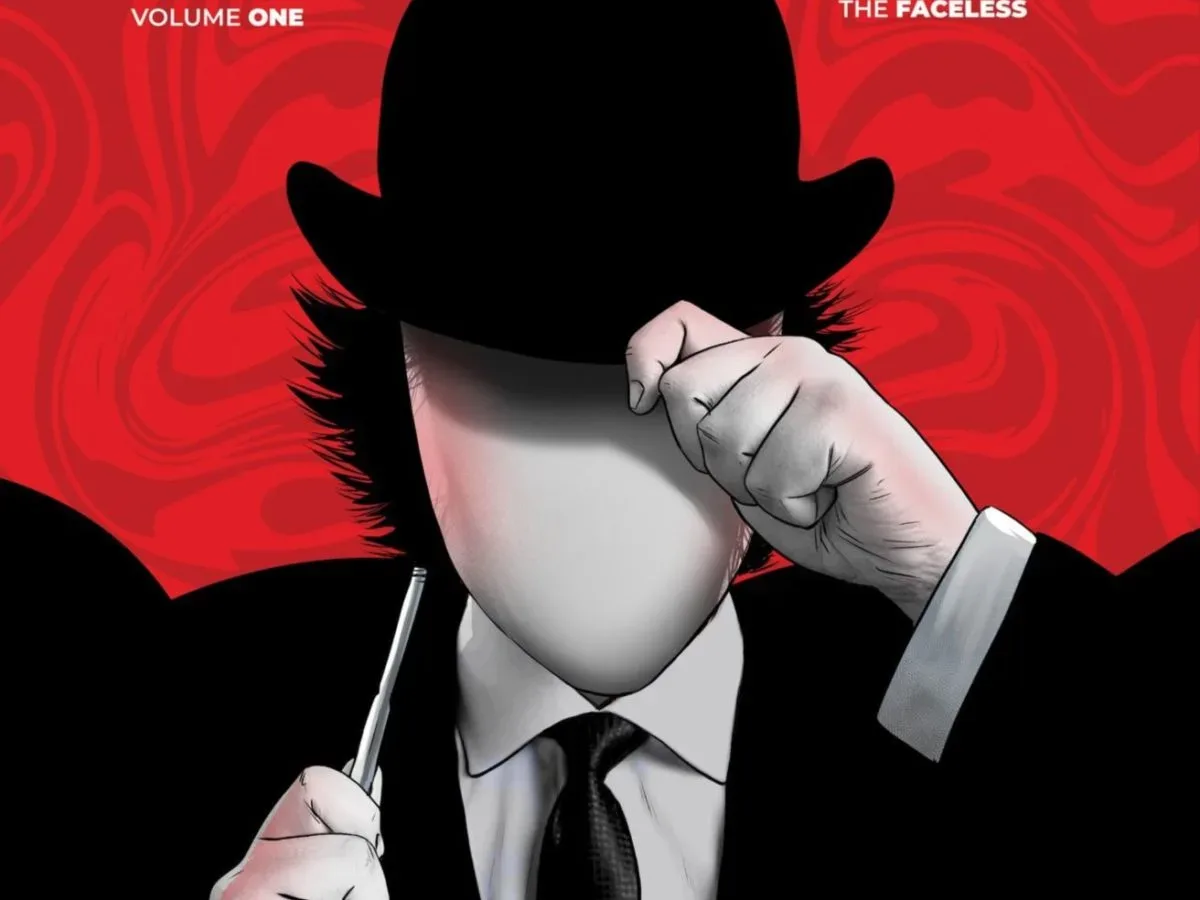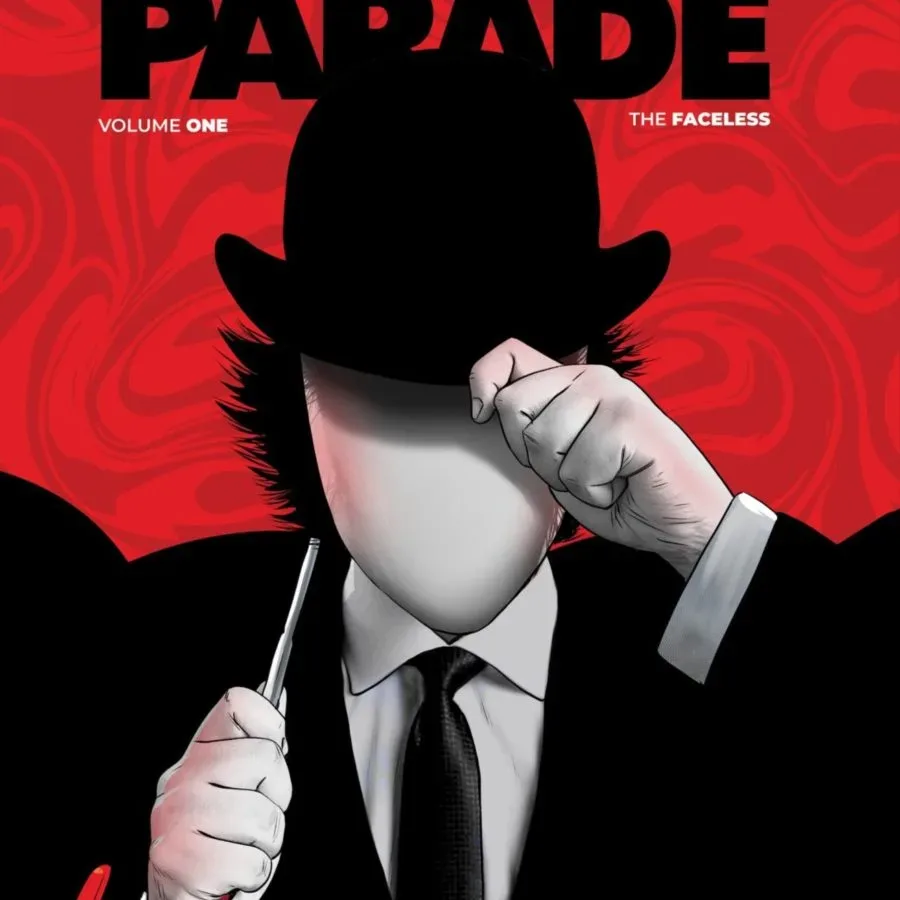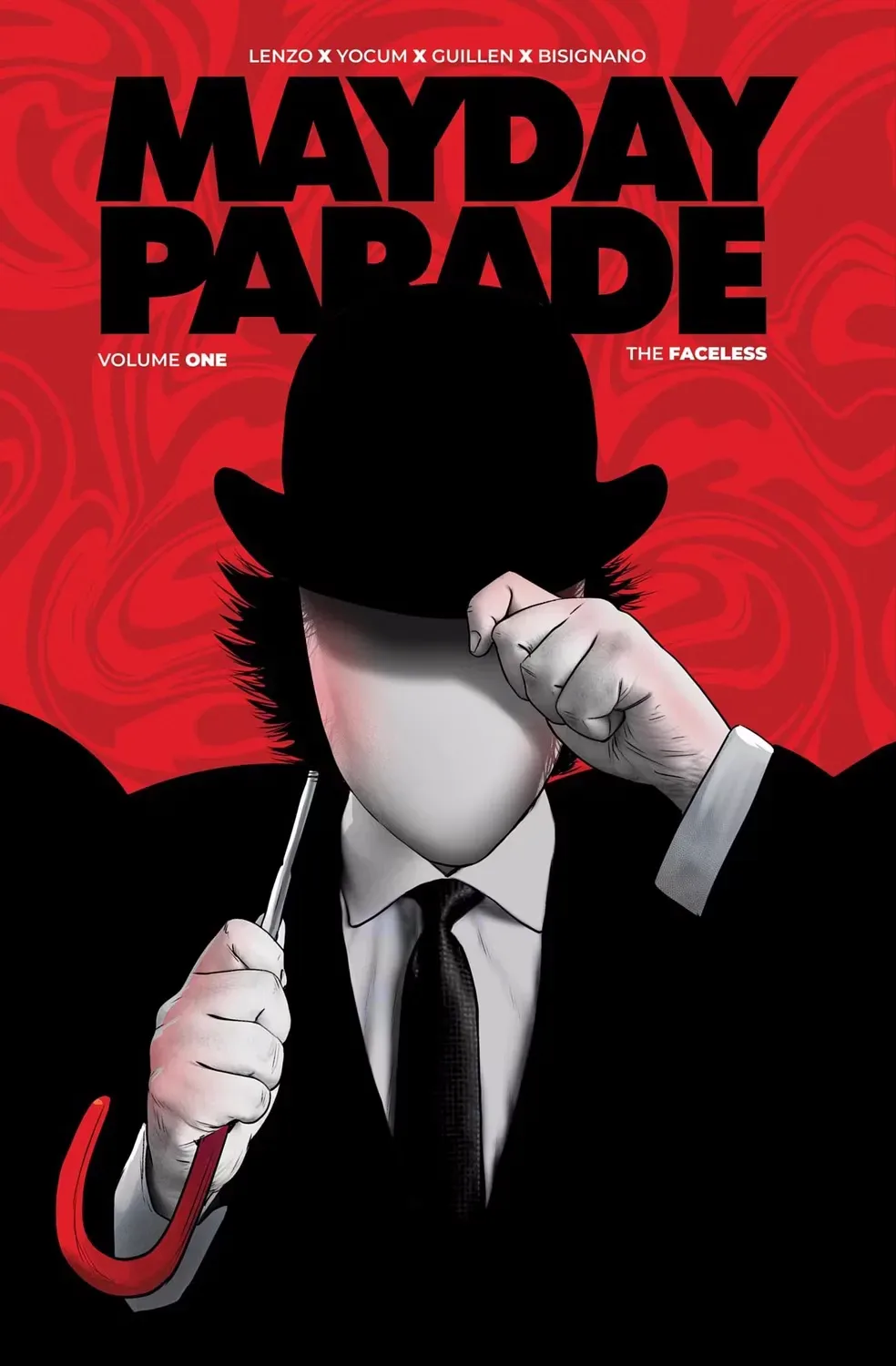
Mayday Parade’s faceless “umbrella man” imagery is moving into a new medium with Mayday Parade: The Faceless, a psychological-horror graphic novel scheduled for December 9, 2026. The 96-page hardcover is co-created by Mayday Parade member Jeremy Lenzo and Adriana Yocum, and it turns the band-associated visual mythology into a narrative built around recurring sleep paralysis, unreliable perceptions and a presence that may not stay inside a nightmare.
The book is listed at $24.99 and will arrive in a 7.25-by-11-inch full-color hardcover edition with a dust cover. Santi Guillen provides the interior art, Elisa Bisignano handles colors and Micah Myers letters the project. Kiko Mauriz is credited on the cover.
For a band whose music and visuals have helped cultivate a recognizable fan-facing identity, the premise is notable because it does not merely attach a familiar name to an unrelated comic story. The solicited setup explicitly draws on the faceless figure, umbrella iconography and music-video lore connected to Mayday Parade. That gives the graphic novel a defined creative lane: it is designed as an expansion of a pre-existing atmosphere rather than a straightforward biography of the group.
A familiar face—deliberately absent
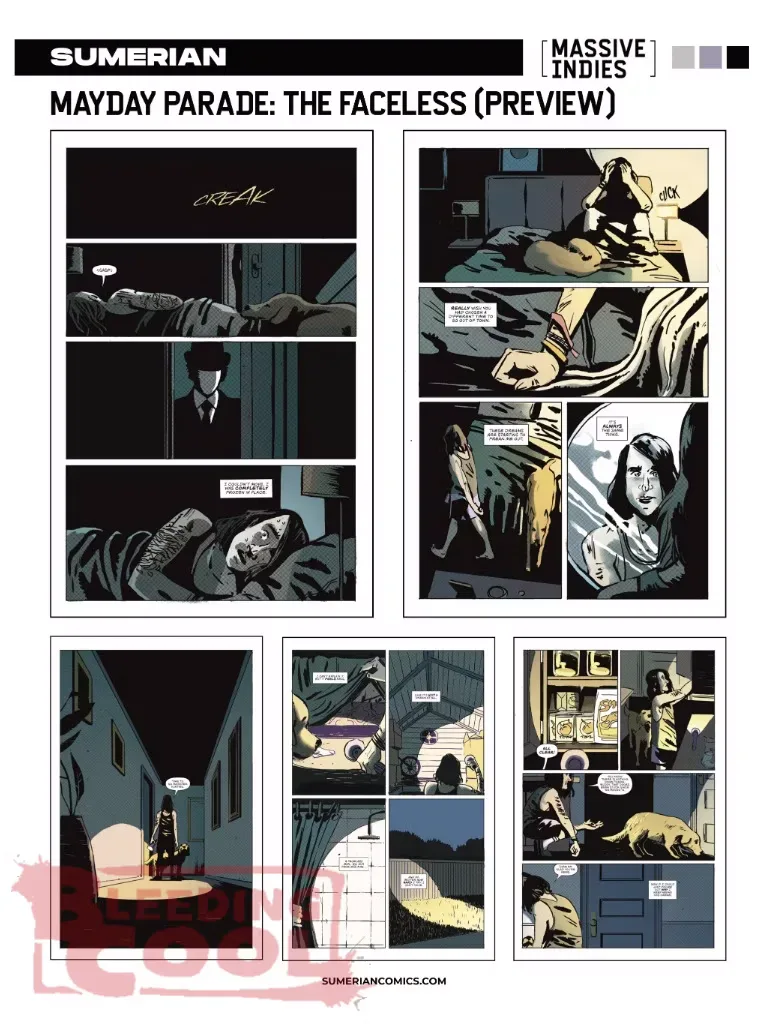
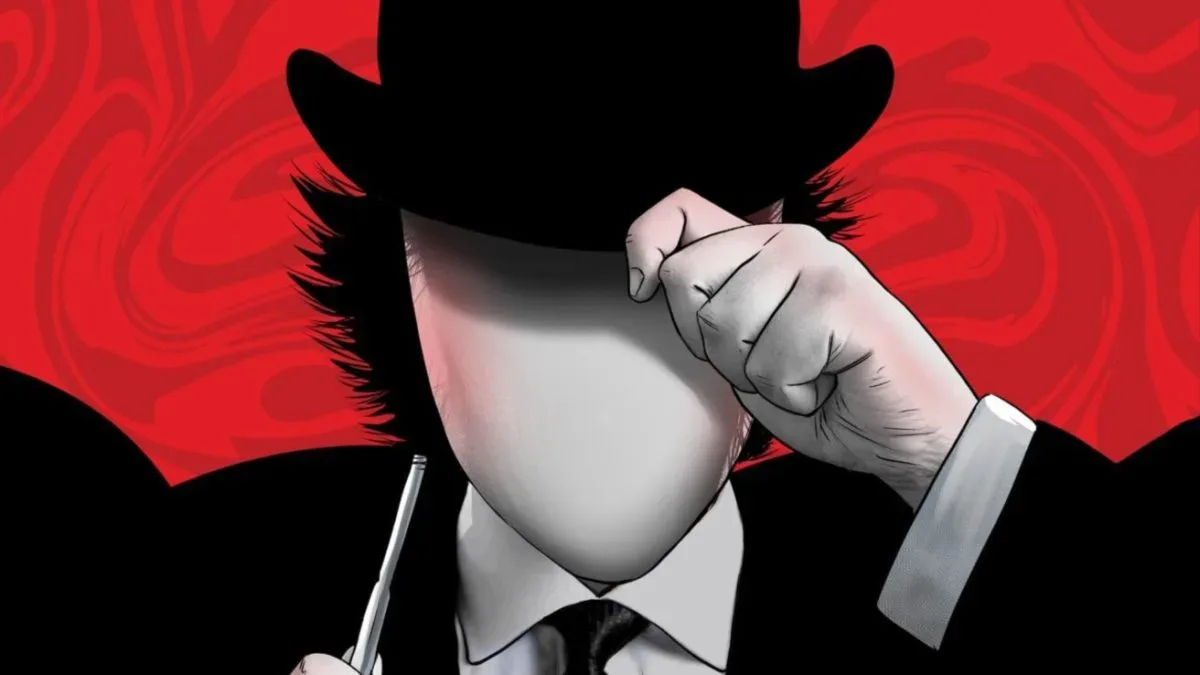
The Faceless centers on Derek Sanders after he moves into a new home and begins waking from episodes of sleep paralysis to find a faceless man in a wide-brimmed hat standing in the hallway. The visitor’s appearance is unnerving in its simplicity. A face is ordinarily one of the first things people use to read intent or emotion; stripping it away leaves the character difficult to interpret and, in horror terms, much harder to rationalize.
Sleep paralysis is a state in which a person becomes conscious while still unable to move or speak normally. In horror fiction, it is especially useful because it narrows the gap between an internal experience and an external threat. The person experiencing it can see their surroundings, but cannot easily act on what they see. That ambiguity is central to the book’s premise: Derek has reason to wonder whether stress is creating the visions, while the story steadily introduces details that suggest another explanation.
Those details include strange odors, objects turning up out of place and red-umbrella symbolism appearing during Derek’s waking hours. The escalation matters. A scary image in a bedroom can be attributed to a dream or exhausted mind; evidence that appears in daylight turns the question toward whether the danger has crossed into ordinary life. The synopsis does not resolve that question, and that uncertainty is likely the engine of its psychological-horror approach.
Psychological horror generally places fear in perception, dread and uncertainty as much as in visible threats. It differs from a premise that immediately explains its monster, rules or supernatural mechanics. Here, the faceless observer is frightening not only because it watches Derek, but because Derek cannot initially determine what it is, why it is there or whether anyone else can verify it. The red umbrella functions as a repeated visual signal, turning an otherwise ordinary object into an omen.
Bandmates, folklore and the widening mystery
Desperate to understand what is happening, Derek seeks help from his bandmates and investigates online folklore concerning the “Umbrella Man.” That plot choice creates two avenues for the story. The band relationship can give Derek people he knows well enough to confide in, while the internet-search component opens the possibility that the figure has a history beyond his house.
Neither route guarantees an answer. Folklore can preserve clues, exaggerate them or muddy them; friends can provide support but may also be unable to distinguish a serious paranormal event from a stress-driven crisis. The central situation is therefore more complicated than a character seeing a monster and setting out to defeat it. Derek needs to establish what kind of problem he is facing before he can know what a solution would even look like.
The premise also uses a practical horror advantage: domestic spaces are supposed to feel predictable. A hallway, bedroom or familiar object gains force when it stops behaving like part of a dependable home. Strange smells and misplaced belongings are modest disturbances on their own, but they can make the setting feel compromised before the story has fully explained why. By having the activity progress beyond the bedroom, The Faceless makes Derek’s home—and eventually the daytime world—part of the threat.
That structure is a natural fit for comics. The visual team can control when readers see the umbrella, the silhouette or an altered room, while lettering can guide the pacing of a silent hallway, an interrupted thought or an anxious online search. Color is especially relevant to a story using a red umbrella as a recurring motif. The solicitation does not describe the book’s palette or panel design, but Bisignano’s color credit establishes that the material will be presented in full color, giving that repeated red image a clear opportunity to stand apart.
What the format tells readers
The first volume is solicited as a 96-page hardcover with a dust cover, rather than as a standard monthly comic issue. That format suggests a self-contained, substantial reading package even though the labeling leaves room for additional volumes. Importantly, the available details do not confirm how many volumes are planned, whether the narrative will continue, or whether the book is intended to adapt a specific song or video. Readers should treat those as open questions rather than assumptions.
It is also worth separating the project’s confirmed credits from its premise. Lenzo and Yocum are credited for the story, while Guillen, Bisignano and Myers take the art, color and lettering roles respectively. A comic’s finished storytelling is collaborative: writing determines the scenario and structure; penciled and drawn art establishes expressions, environments and action; color shapes mood and emphasis; lettering controls the readability of dialogue, captions and sound effects. In a work about a wordless, faceless observer, each of those contributions can be particularly consequential, because the atmosphere cannot depend on conventional facial acting from its central menace.
The project sits in an increasingly legible space between music identity and long-form visual storytelling. A song, video or recurring symbol can imply a world without fully mapping it. A graphic novel can spend more time in that world, introduce a plot with its own logic and turn recognizable imagery into a sustained source of tension. For fans, the appeal may be seeing the umbrella-man idea interpreted through sequential art; for horror readers unfamiliar with the band, the hook is a contained supernatural-or-psychological mystery built around sleep paralysis and an invading presence.
Music remains a potent way for artists to extend an ongoing creative identity, whether through a new collaboration or another narrative form. For a different recent example of a shared music release, see Quavo and Offset’s preview of “AWAY”. The Faceless, however, is not presented as a music release: its stated ambition is to make Mayday Parade-associated visual lore carry a horror story on the comics page.
The Crow returns in the same December lineup
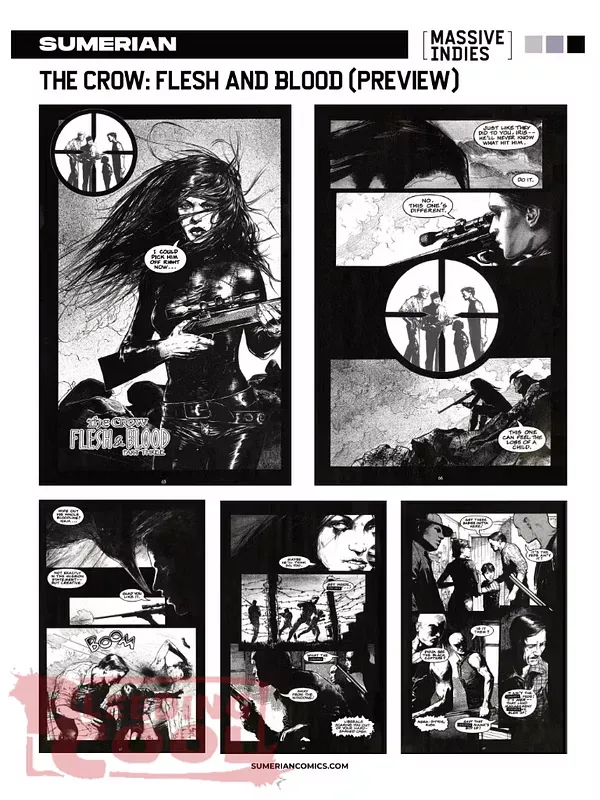
The December listings also include The Crow: Flesh & Blood #3, which is returning to print in comic-book format for the first time since 1996. It is written by James Vance, illustrated by Alexander Maleev and features a cover by Eduardo Schaal. The issue is listed for December 9, 2026 at $4.99.
Flesh & Blood follows Iris Shaw, a federal conservation officer murdered when right-wing extremists destroy her office. She is also pregnant at the time of her death. The Crow resurrects Iris, setting her on a supernatural revenge mission against those responsible. That is a very different kind of horror-adjacent comic from The Faceless: its protagonist’s death and return are overtly supernatural from the outset, and its premise is propelled by vengeance rather than uncertainty over whether a threat is real.
Together, the two books show two distinct uses of dark genre material in the same release window. The Crow: Flesh & Blood foregrounds tragic loss and retribution, while Mayday Parade: The Faceless starts from dread, recurring images and the destabilizing possibility that a nightmare has followed its victim into the day. The latter’s key unanswered question is not simply who the Umbrella Man is, but how far its presence can reach once Derek begins looking for it.
Release details at a glance
- Title: Mayday Parade: The Faceless Vol. 01
- Story: Jeremy Lenzo and Adriana Yocum
- Art: Santi Guillen
- Colors: Elisa Bisignano
- Letters: Micah Myers
- Cover: Kiko Mauriz
- Format: 96-page, full-color hardcover with dust cover
- Size: 7.25 by 11 inches
- Listed price: $24.99
- Listed date: December 9, 2026
For now, the solicitation establishes the essentials: Mayday Parade’s umbrella-man imagery will anchor a new graphic-novel horror story, Derek Sanders will be the character at the center of its haunting, and the book’s tension will depend on whether the faceless figure is a symptom, a legend or something far worse.