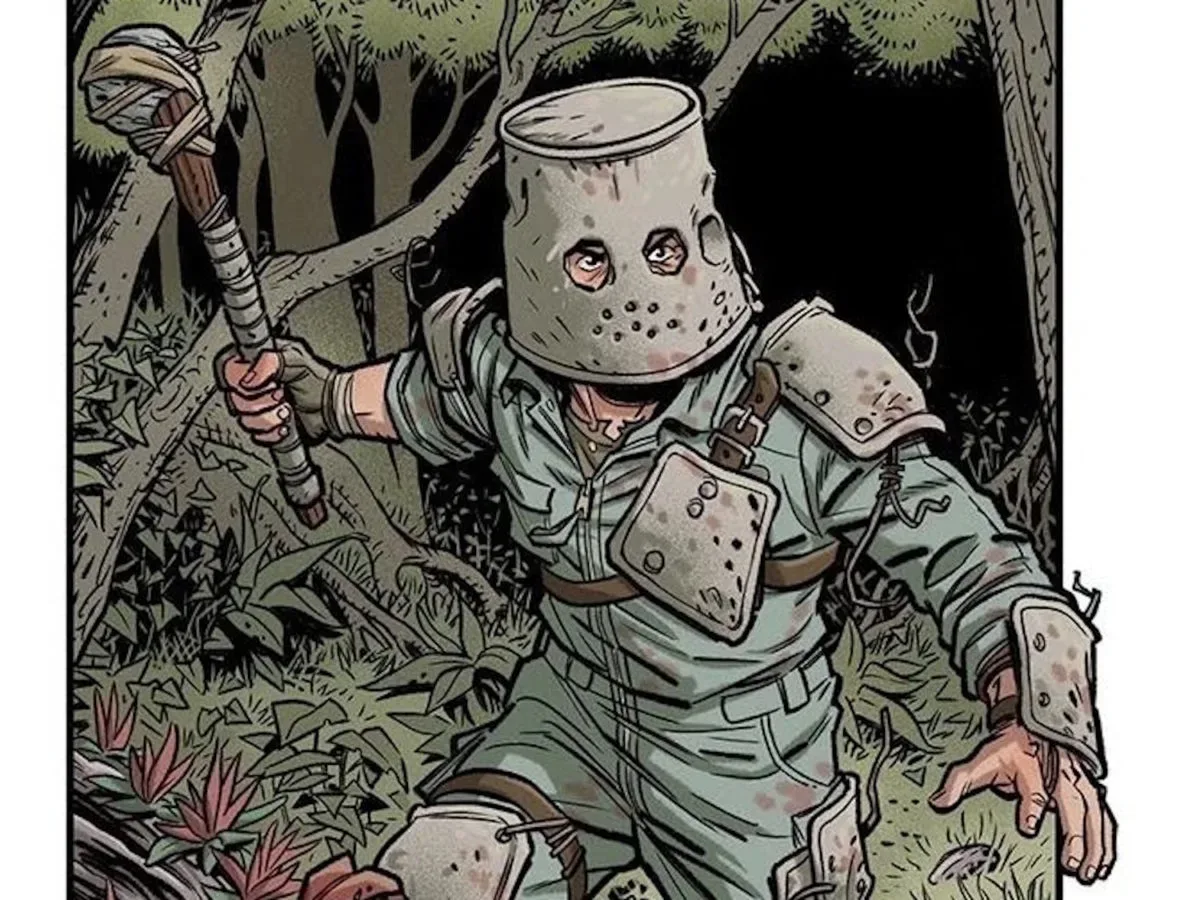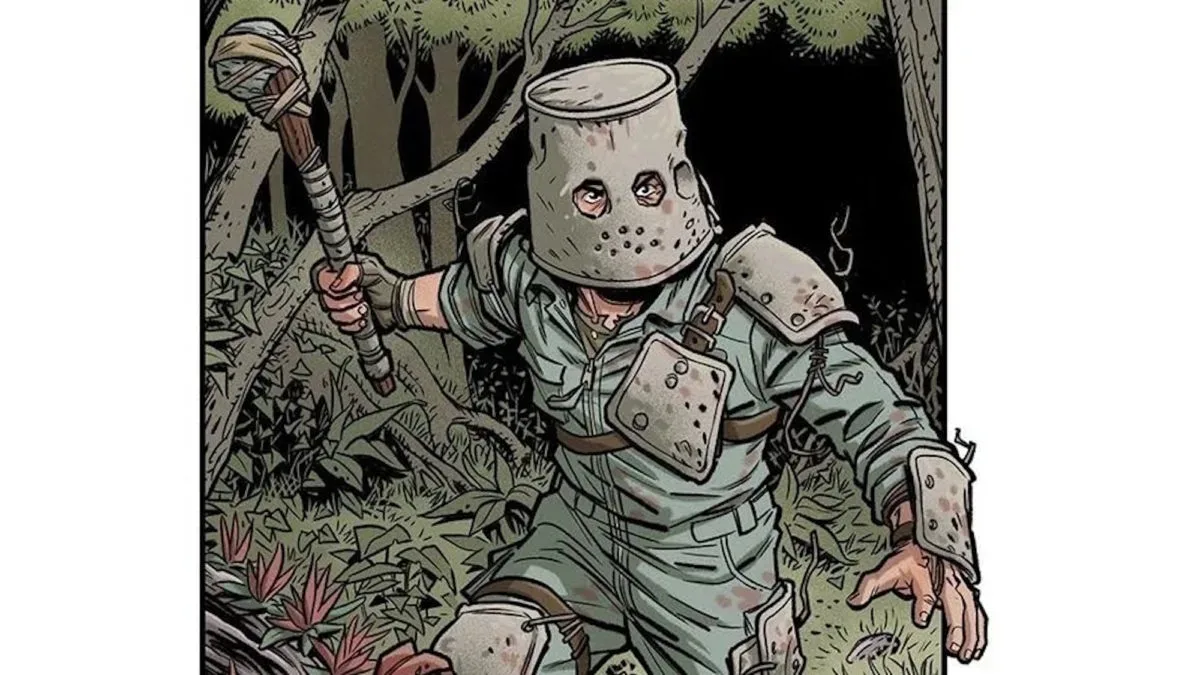
A new one-shot from writer Mark Russell and artist Alain Mauricet is headed to Ahoy Comics in 2027, and its premise is already doing a remarkable amount of heavy lifting. Kindergarten Gulag concerns a man who wakes up imprisoned on an island run by 5-year-olds. Russell has framed the setup as a loose metaphor for artificial intelligence: specifically, the uneasy assumption that people will be able to contain a force they have created.
That is the core of what has been revealed so far. There is no stated release date beyond 2027, no format detail beyond its status as a one-shot, and no broader plot outline. A small look at Mauricet’s artwork has been shown, while a fuller reveal could still arrive around New York Comic Con. For now, the project is best understood as an intentionally strange satirical concept rather than a comic with its full rules, cast, or stakes publicly defined.
An island prison with a deliberately unstable chain of command
The image at the center of Kindergarten Gulag is simple: an adult is trapped, but the authorities holding him are children. That reversal has obvious comic potential, yet the stated AI angle gives it a more pointed purpose than a basic role-reversal gag.
In this case, the children are not necessarily meant as literal stand-ins for every feature of AI technology. Russell described the idea as a loose metaphor, an important qualifier. It leaves room for the comic to pursue absurdity, dread, or both without presenting the island’s rulers as a one-to-one technical allegory. The useful connection is the imbalance between assumed control and actual power. The prisoner may expect that adults should be in charge; the premise promptly demonstrates that expectation is worthless once the system around him has decided otherwise.
Artificial intelligence is a particularly fitting target for that kind of satire because public discussion often swings between confidence and anxiety. People talk about managing, aligning, limiting, or containing AI systems, while simultaneously pushing them into more tasks and spaces. In plain language, containment means keeping a system within limits set by the people who built or operate it. The comic’s prison-island scenario turns that abstract concern into a physical situation: a person finds himself subject to rulers he did not expect to have the authority—or maturity—to rule him.
That does not mean readers should assume the one-shot will be a technical story about machine learning, robots, or software. None of those details have been confirmed. The announced premise supports a broader satirical reading: institutions can be powerful without being wise, and a creator’s faith in being able to direct a creation can collapse very quickly. The fact that the rulers are 5-year-olds makes the idea sharper and sillier at the same time. Their age signals unpredictability and an immature sense of power, while their control of the island means the captive cannot simply dismiss them.
For readers interested in the broader cultural conversation around compact, consumer-facing AI, the premise also lands at a moment when AI is being imagined in increasingly personal forms. One recent example is a proposed talking AI avatar designed for a keychain. That is not evidence of any connection to Kindergarten Gulag, but it illustrates why a story about proximity, trust, and presumed control can feel timely without needing to be a literal forecast.
A one-shot built to stand on its own
Kindergarten Gulag is part of a continuing preference for unusual, self-contained projects. Russell has discussed making what he called “odd-length” one-shots, with the practical advantage that each book begins at issue No. 1. Unlike a serialized comic, a one-shot does not require a new reader to track down previous chapters before trying the concept.
That accessibility matters for a premise this left-field. An island dictatorship of kindergartners does not need months of preamble to make its elevator pitch. A one-shot is a complete comic story told in a single issue rather than across a numbered ongoing series or a limited sequence of multiple issues. The format can give a satirical idea room to establish a bizarre world, escalate one central conflict, and arrive at a punchline or an unsettling resolution without asking readers for a long commitment.
Of course, a one-shot is not automatically shallow. It simply concentrates its storytelling. For Kindergarten Gulag, that could be an asset. The announced hook is already an exaggerated situation with a clear pressure point: how does an adult navigate imprisonment under rules made and enforced by children? If the AI metaphor remains central, the story may use that pressure to examine confidence in control rather than attempting to explain a whole fictional technological ecosystem.
Russell cited an earlier Thanksgiving-themed one-shot as part of this run of standalone work. Its premise involved a family Thanksgiving meal disrupted by the realization that one attendee was a serial killer. Both concepts start with a recognizable social arrangement—a family dinner, an authority structure—and fracture it with an unnerving intrusion. The connection is tonal rather than proof that the books share a setting or continuity; no shared universe has been announced.
What Mauricet brings to the announced pairing
The 2027 book pairs Russell with Alain Mauricet, and the early panels offer the first visual indication that the concept is moving beyond a logline. Art matters enormously to a story based on mismatched authority. The island’s young rulers need to register as credible enough within the comic’s reality to make the prisoner’s situation matter, while preserving the absurdity inherent in their age.
At this early stage, readers should resist filling in the blanks. There is no confirmed account of how the island functions, whether the children are supernatural, technologically empowered, politically organized, or simply accepted as rulers by the world of the story. There is likewise no announced supporting cast, page count, release month, or explanation of the central character’s identity. The revealed premise establishes the conflict, but it does not settle the mechanics behind it.
That uncertainty is part of the appeal of an early tease. It invites readers to engage with the provocative image while leaving the creative team room to reveal the actual shape of the book. A prison story can focus on escape; a political satire can focus on the nonsense of arbitrary systems; a science-fiction allegory can focus on creators losing influence over what they have made. Kindergarten Gulag may overlap with some or all of those modes, but only the basic setup and AI comparison are currently established.
Why the title and premise demand care
The title is deliberately severe, placing an image of early childhood beside language associated with imprisonment and coercion. That collision is not subtle, and it suggests a work prepared to use discomfort as part of its comic engine. But a provocative title does not itself reveal how far the satire goes, what subjects it targets beyond the stated AI metaphor, or whether the book’s tone will lean predominantly toward farce, menace, or a balance of the two.
It is useful to separate the announced facts from interpretation. The facts are that a man wakes up imprisoned on an island controlled by 5-year-olds; the book is a one-shot planned for 2027; Mauricet is the artist; Russell has connected the premise loosely to AI containment. Interpretation begins when considering what the setup could say about authority, accountability, or technology. Those are reasonable themes to watch for, not promises about the finished comic.
That distinction is especially important with satire. Satire uses exaggeration, reversal, and ridicule to expose tensions in an idea or institution. A scenario does not need to be realistic in its literal details to comment on a real concern. Here, the exaggerated premise gives an intangible fear—losing control over something meant to be controlled—a human-scale form. One person wakes up in a situation where normal assumptions about who makes rules no longer apply.
Other 2027 work remains on the horizon
The publisher’s 2027 slate also includes Memory Hole, another Russell project, this time with Steve Pugh. That series has been described as the story of two robots who fall in love while exploring the void of space. Pugh previously collaborated with Russell on The Flintstones and Billionaire Island.
The two announced projects are markedly different at the level of their pitches: one places a human prisoner under child rule on an island, while the other follows robots through space. Their shared presence on the 2027 schedule nonetheless points to a continued interest in high-concept stories that use genre situations for more than straightforward adventure. No schedule or additional creative details for Memory Hole have been specified here beyond its planned 2027 timing and core premise.
What may surface at New York Comic Con
More information on Kindergarten Gulag could emerge at New York Comic Con, although that remains a possibility rather than a confirmed dedicated announcement. The publisher is scheduled to hold a Toxic Avenger signing at Forbidden Planet New York on Saturday, October 10, from 4 p.m. to 7 p.m. Participants listed for that event are Matt Bors, Felipe Sobreiro, Fred Harper, Lee Loughridge, and Lloyd Kaufman.
That signing is separate from Kindergarten Gulag, and it should not be treated as confirmation that Russell or Mauricet will appear there, nor as confirmation of a release date. It does, however, place the publisher at a major comics gathering where new details about future work could plausibly be shared.
Ahoy Comics, based in Syracuse, New York, began in 2018 and has positioned itself around witty, satirical, humorous, dark, and irreverent work across genres including superheroes, science fiction, horror, fantasy, and social commentary. Its internal shorthand for that mix is “Funny Vertigo.” The company was founded by Hart Seely, with Tom Peyer as editor-in-chief, Stuart Moore as editor, and Frank Cammuso as chief creative officer.
For now, Kindergarten Gulag remains a concise but memorable proposition: a standalone comic in which an adult prisoner learns that the people supposedly too young to run anything have already taken charge. Whether the final book makes that situation primarily hilarious, horrifying, or both is still to be revealed.
Shop the products
Check current price, model and availability at the retailer.