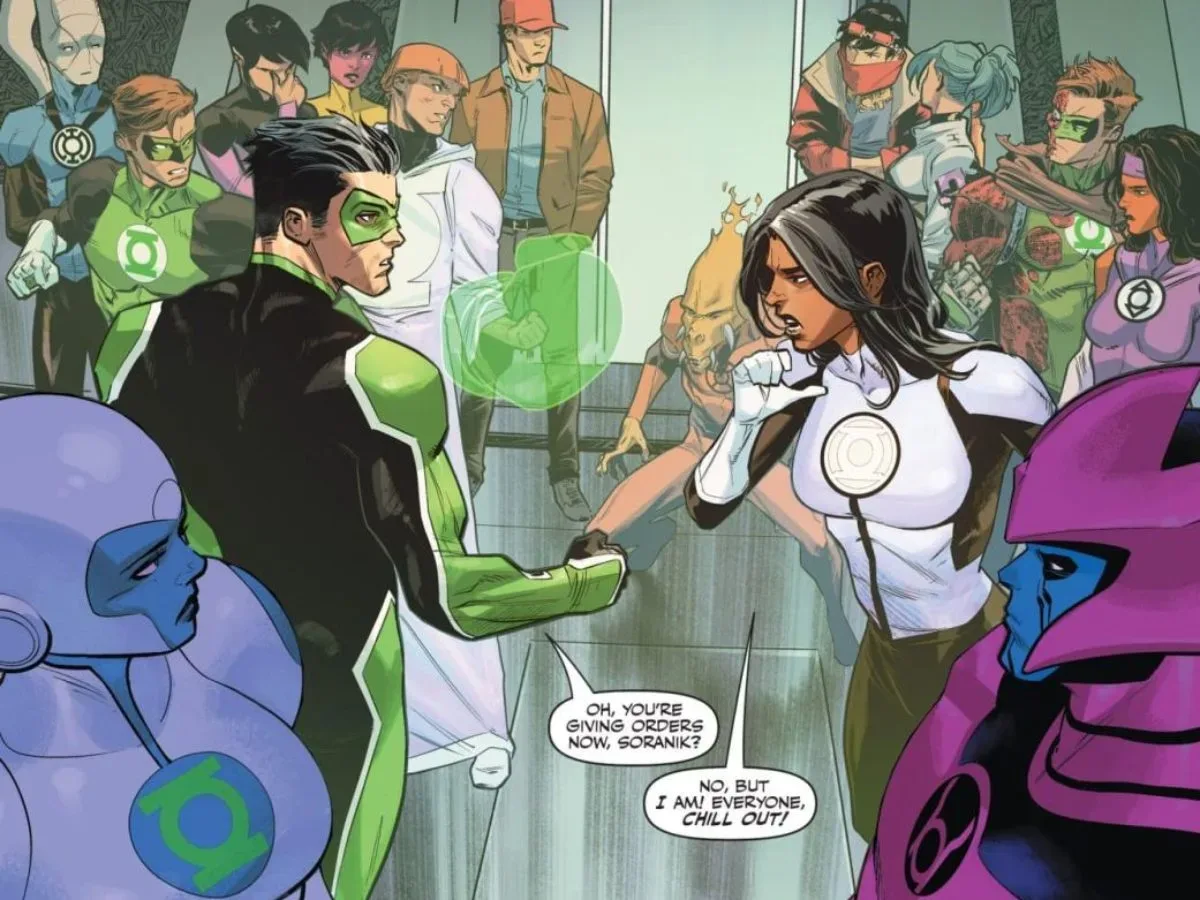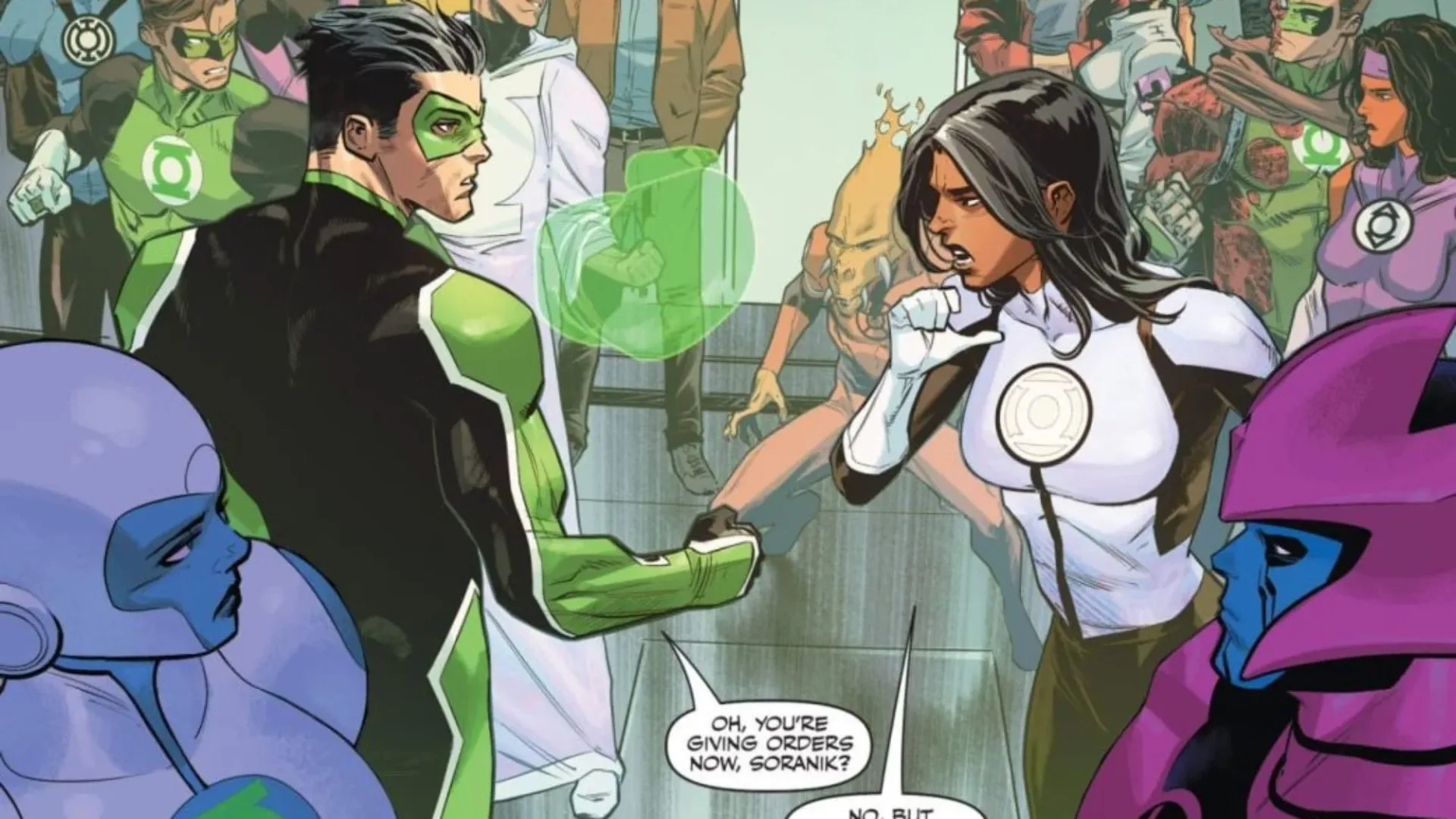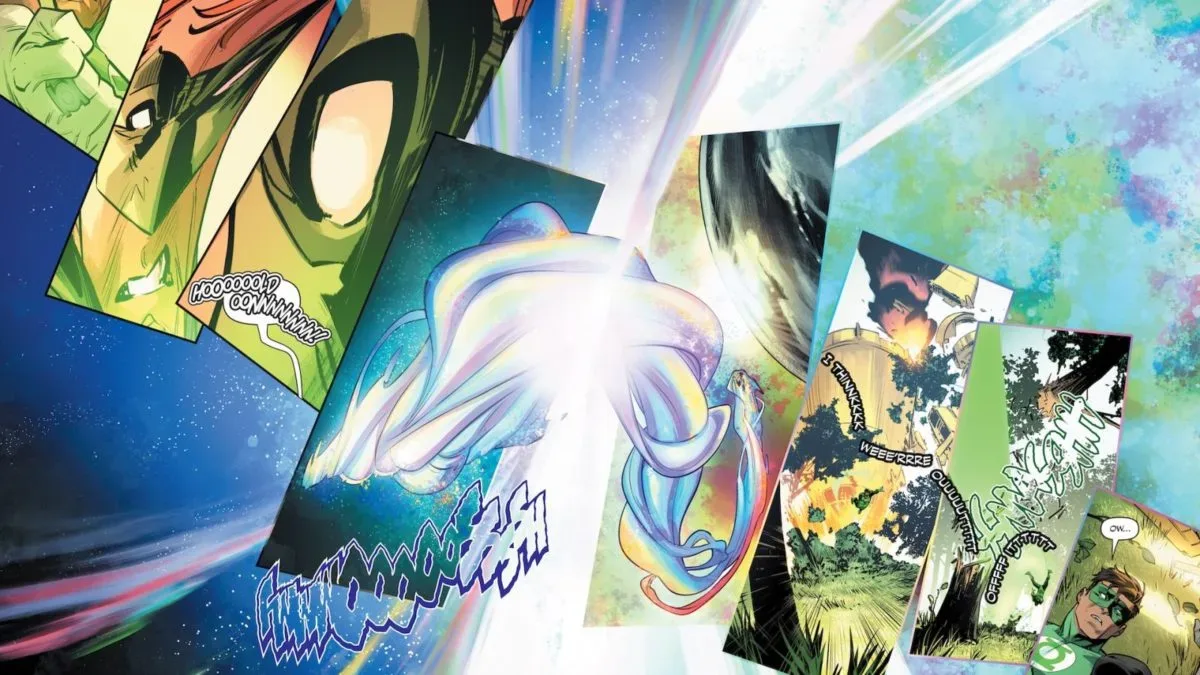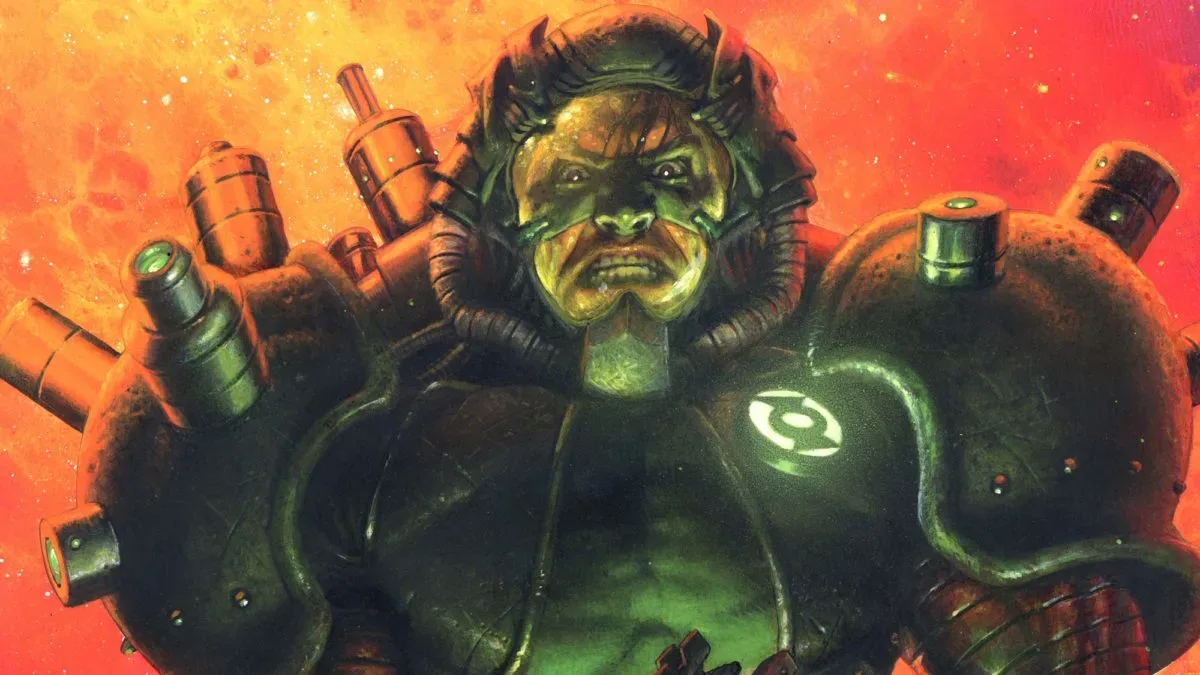
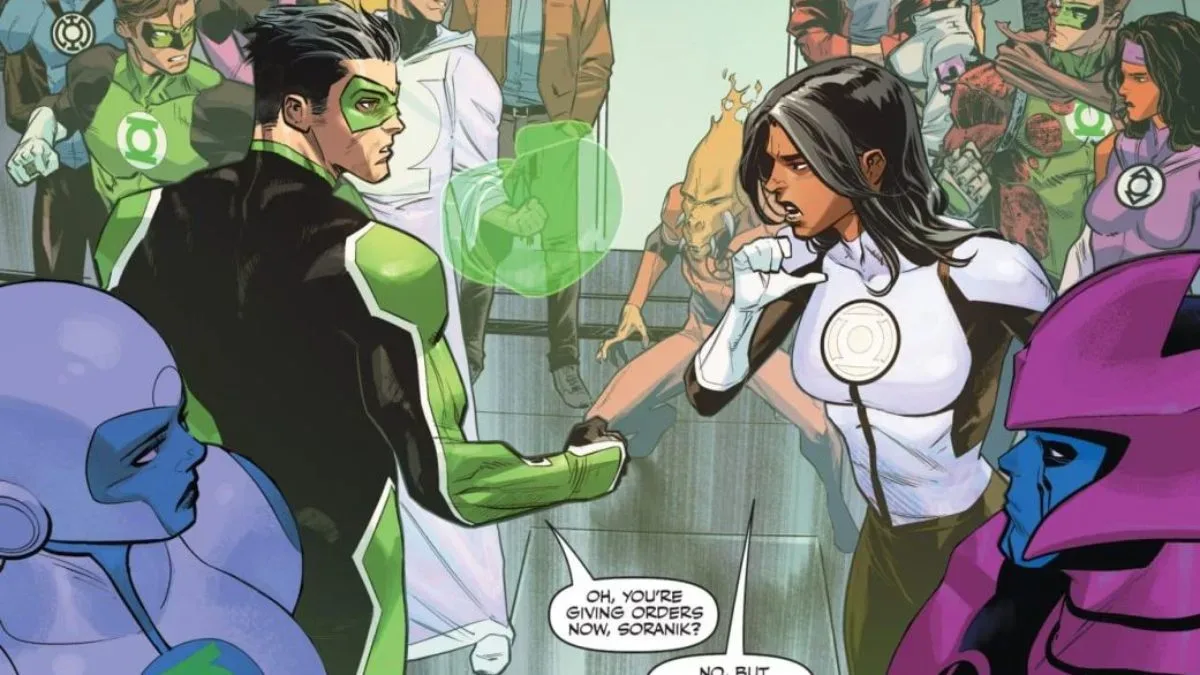
Green Lantern #41 is scheduled to reach comic shops on Wednesday, November 25, 2026, and its central question is admirably direct: who is calling Hal Jordan? The issue is billed as Green Lantern: First Light Part 3, with the solicitation promising the reveal of the voice that has drawn Hal toward “the end of the emotional electromagnetic spectrum.”
That phrase gives the issue an unusually big arena even by Green Lantern standards. The series has long used light, color, and emotion as the vocabulary for cosmic-scale conflicts. Here, the mystery is not merely an incoming distress call or an enemy issuing a challenge. Something—or someone—is summoning Hal to a boundary within that emotional spectrum, and the stated consequence is that the Lanterns “will never be the same.” That is appropriately dramatic comic-book language, but it also establishes the reveal as the issue’s major narrative event rather than a small clue to be saved for much later.
What Green Lantern #41 says is happening
The official setup indicates that Hal moves into a fight before waiting for backup. Reinforcements do arrive, but not in time to bring the conflict under control: before they can turn the situation around, “the entire ocean flips over.” The wording is surreal enough to leave the exact event unclear. It may describe a literal catastrophe, a vast environmental reversal, or a visual shorthand for how thoroughly the battle escalates. What can be said with confidence is that the scene is framed as a sharp change in the heroes’ fortunes, not a routine rescue.
The core plot points currently established for the issue are:
- Hal Jordan is investigating a mysterious voice.
- The call concerns the outer limit of the emotional electromagnetic spectrum.
- Hal begins fighting without waiting for assistance.
- Backup arrives amid a reversal serious enough to reshape the immediate conflict.
- The source of the call is set to be revealed in this chapter.
Readers should be careful not to turn that last point into a full explanation of the story. The available description confirms a reveal, but it does not identify the speaker, explain the speaker’s motive, or specify how the status quo for the Lanterns will change. Those are precisely the unanswered details that make the issue a meaningful installment for followers of the arc.
Why the “emotional electromagnetic spectrum” matters
The term emotional spectrum is doing important work in the premise. In Green Lantern fiction, the concept links colors of light with emotional forces and the ring-powered groups associated with them. Adding “electromagnetic” emphasizes the science-fiction framing: electromagnetic radiation is the broad family of phenomena that includes visible light. The comic’s mythology uses that familiar language as a springboard for a wider, emotion-driven cosmic system.
So, the “end” of the spectrum should not be read simply as a location at the edge of a map. It suggests a threshold in the series’ own power structure and symbolism. A voice calling Hal there is, on its face, a challenge directed at the foundations of what a Lantern is and how Lantern power is understood. That does not prove a new faction, a revived adversary, or an altered rule set; none of those details have been specified. But it does explain why the solicitation ties a single voice to a claim that all Lanterns could be changed afterward.
There is also a useful character-level implication. Hal is presented as acting first and receiving help later, a choice that places his instincts at the center of the trouble. A mystery involving a summons naturally tests judgment: is the call a warning, bait, a demand, or something Hal feels uniquely compelled to answer? The description keeps the nature of that compulsion under wraps, but the structure places Hal’s decision-making alongside the wider cosmic mystery.
Creative credits and cover options
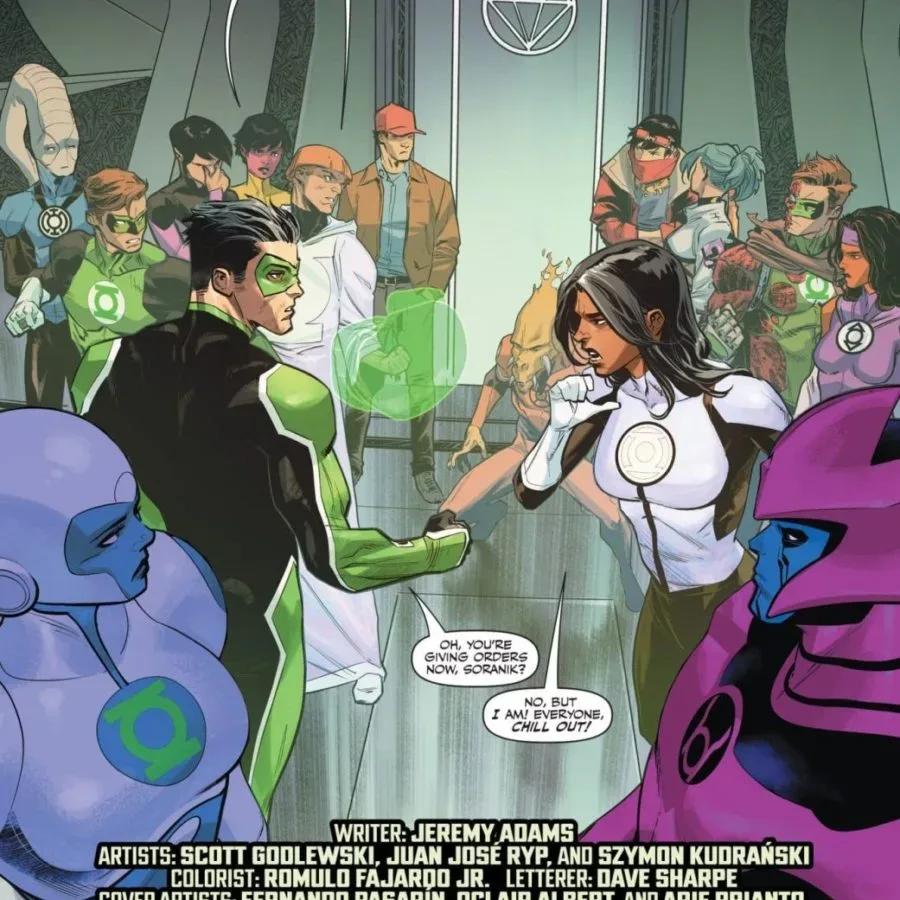
Jeremy Adams is credited as writer. The supplied credits identify Scott Godlewski, Juan Jose Ryp, and Szymon Kudranski with the art, while the standard cover is credited to Fernando Pasarin and Oclair Albert. David Nakayama, Juan Jose Ryp, and Dan Hipp are listed for additional covers.
That lineup offers collectors several clearly identified editions to distinguish when ordering:
- Green Lantern #41 — listed at $4.99.
- David Nakayama cover — listed at $5.99.
- Juan Jose Ryp cover — listed at $5.99.
- Dan Hipp cover — listed at $5.99.
The standard issue is catalogued as 0926DC0156. The listed alternate-cover item numbers are 0926DC0157 for the David Nakayama cover, 0926DC0158 for the Juan Jose Ryp cover, and 0926DC0159 for the Dan Hipp cover. For readers placing an order through a local shop, using both the cover artist and the item number can help avoid ambiguity, particularly where multiple editions share the same issue number and release date.
A mystery issue with a consequential promise
“First Light Part 3” is positioned as the chapter where the premise starts paying off. Comic solicitations routinely promise upheaval, of course, but this one is more specific than a generic warning of danger. It says the source behind the summons will be disclosed. That makes Green Lantern #41 potentially important for readers who prefer answers to arrive on the page rather than only another layer of setup.
The creative setup has an appealing tension between enormous abstraction and a concrete question. “The end of the emotional electromagnetic spectrum” is as expansive as superhero sci-fi gets; “Who is calling Hal Jordan?” is a simple mystery anyone can follow. The issue’s success will likely depend on how convincingly it makes those two scales meet—whether the identity of the caller feels personal to Hal, consequential to the Lanterns, and worthy of the cosmic language surrounding the reveal.
There is a faintly topical resonance in the premise, too. A disembodied voice calling someone toward a life-changing decision has become a familiar modern anxiety, whether it comes from a machine, an institution, or a cosmic stranger. That does not make this story an AI parable, and the announced plot provides no basis to claim that it is. Still, readers interested in the broader conversation around artificial intelligence and creative technology may find related industry context in this look at GPT-6.2 Sol’s ChatGPT rollout.
For the comic itself, the immediate practical takeaway is simpler: readers following First Light will want to note the November 25 date, while cover buyers have four listed editions and prices to compare. The more important question—what waits at the spectrum’s far end, and why it wants Hal Jordan—remains the reason to open the issue.