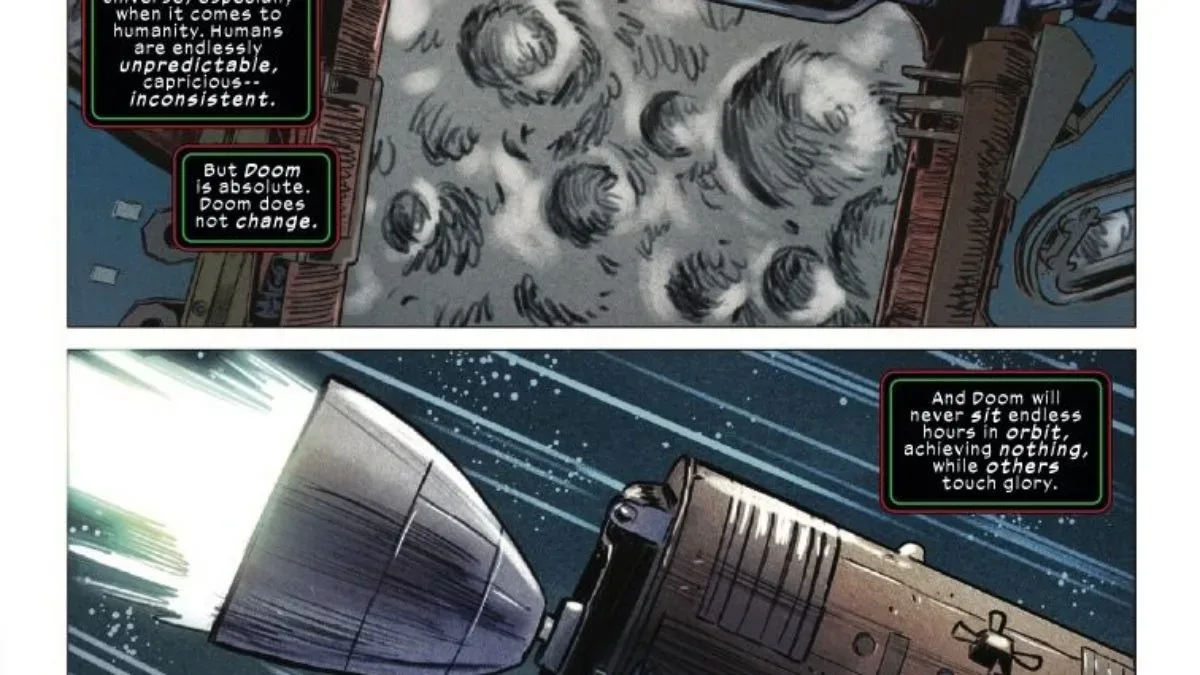
Doctor Doom has confronted gods, geniuses, superheroes and the ordinary logistical indignities of ruling Latveria. In Doomquest #6, he faces perhaps the most personally intolerable crisis of all: other people are about to walk on the Moon while he is stuck in orbit.
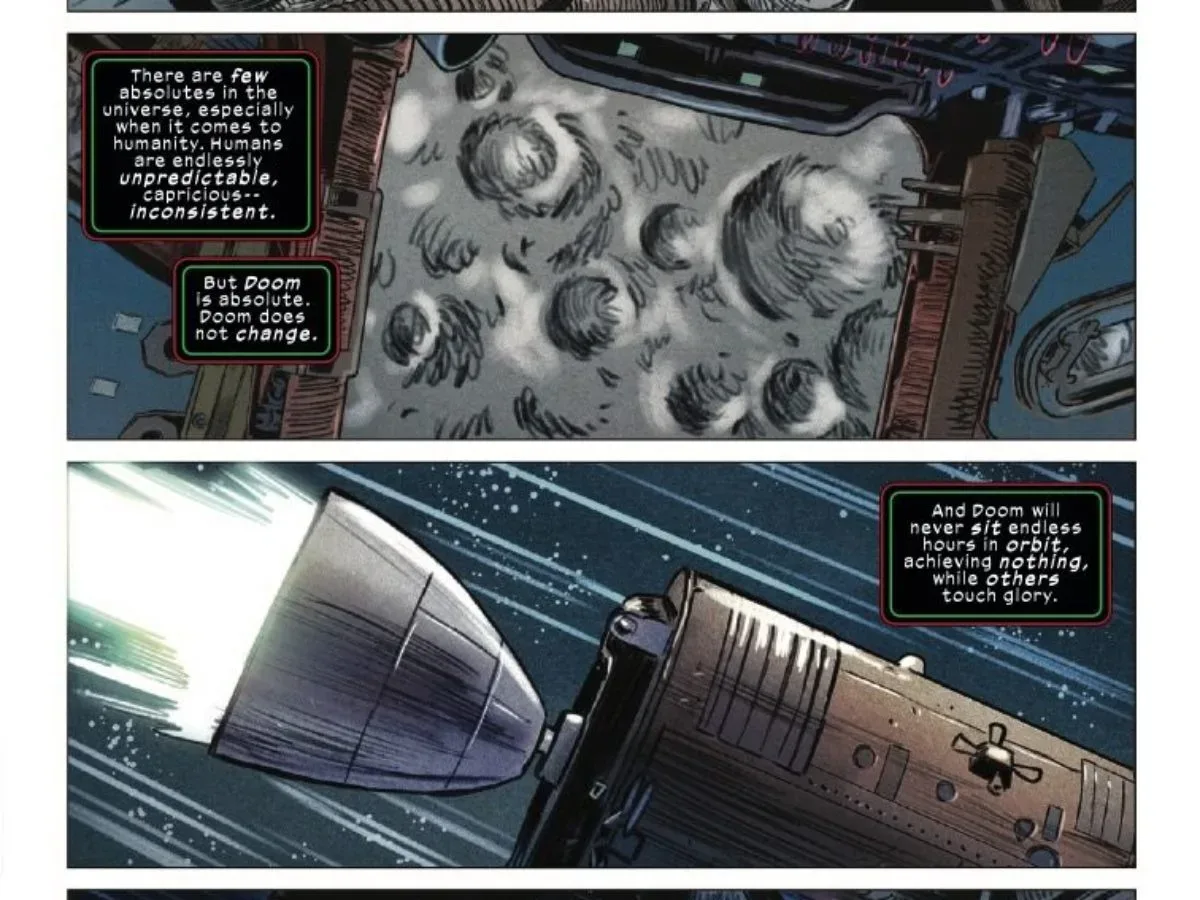
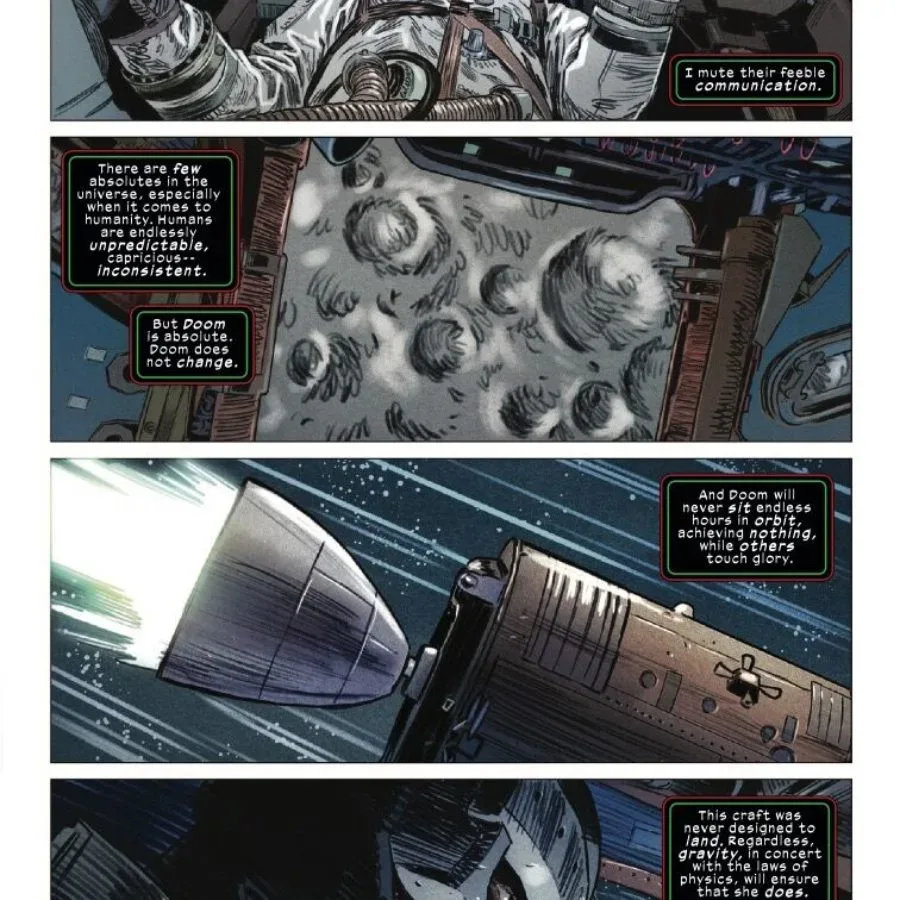
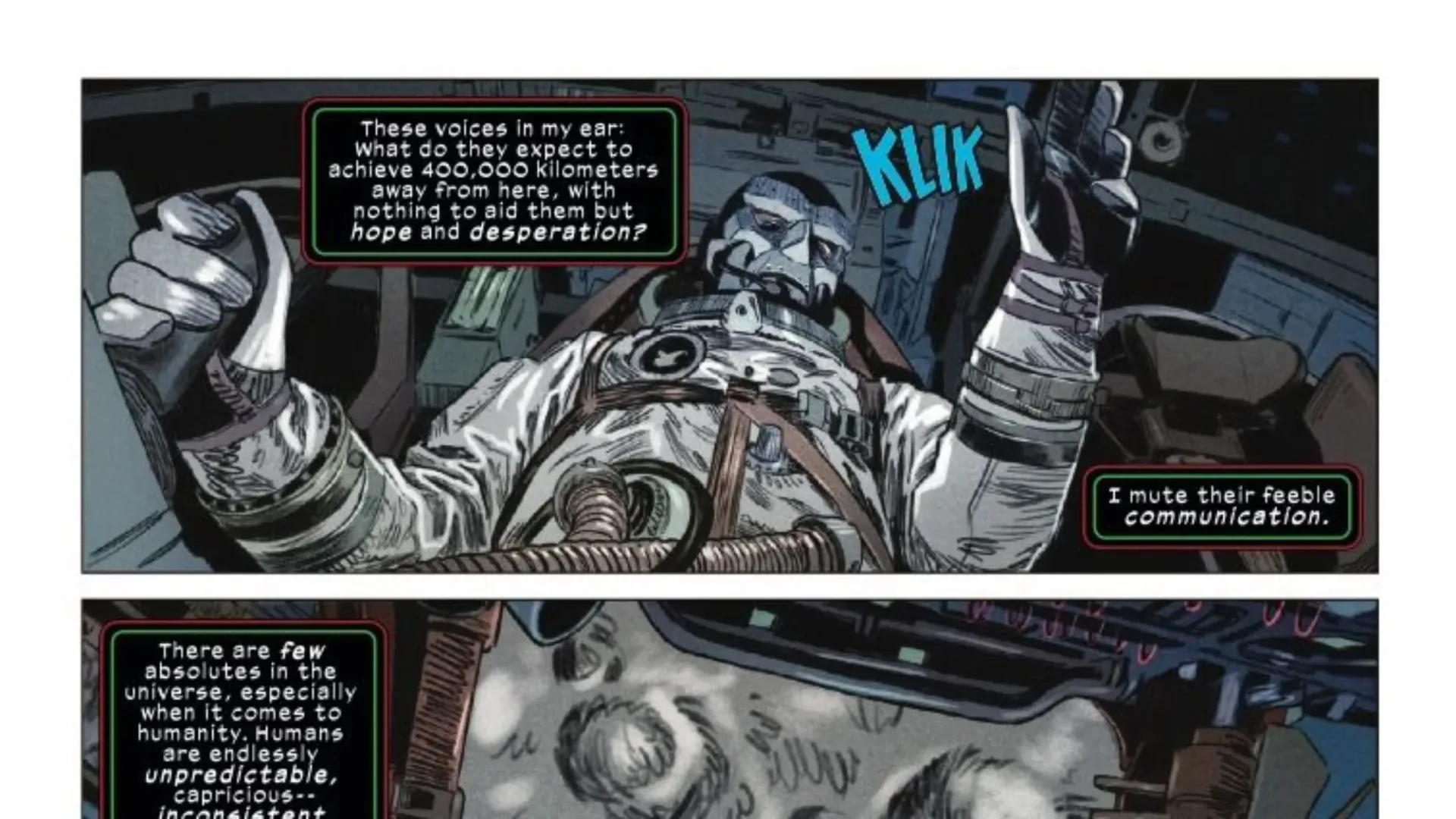
The new issue places Doom in July 1969, possessing the astronaut aboard Apollo 11’s command module Columbia. That is a serious advantage by normal standards. He is in lunar orbit, alone on a spacecraft, at one of history’s most consequential moments. By Doom standards, however, it is a humiliating seating assignment. The people descending to the surface get the history-book moment; he is expected to remain with the vehicle that keeps the mission running.
The premise turns that tension into a specifically Doom-shaped disaster. He is not content to watch the landing from above, and the issue’s setup says he intends to get to the lunar surface first—even though the command module was never made to land there. It is the kind of plan that begins as wounded pride, accelerates through a technical impossibility, and ends somewhere near a revised world history.
A Moon mission becomes a Doom mission
Doomquest #6 is written by Ryan North, with interior art by Francesco Mobili and a main cover by Alex Ross. Marvel lists the issue for sale on December 2, 2026. It is a 32-page, T+ comic with a $4.99 US cover price.
Its central hook is refreshingly direct. Doom is aboard Columbia, safely circling the Moon, but someone else is preparing to claim the first steps on the lunar surface. The distinction matters enormously to him. In practical terms, the command module is a spacecraft designed for orbit, not a lunar lander. In character terms, Doom has been assigned the role of the person who makes the mission possible without receiving its most visible triumph. That is not a role likely to survive contact with Victor von Doom’s ego.
The official setup also frames his move as an attempt to rewrite history. A message from the past reaches the present, prompting heroes from the future to travel back and intervene. They, too, will need to commandeer bodies, setting up a conflict that appears to work on two levels: stopping Doom’s immediate attempt to seize the landing and untangling the broader time-travel consequences of his presence in 1969.
There is a particularly funny escalation built into the premise. Doom is already in an extraordinary position. He has gained access to one of the most important missions in human history, is orbiting the Moon, and is separated from the famous moment by only the inconvenient detail that he is on the wrong spacecraft. For nearly anyone else, that would suggest restraint. For Doom, it is apparently a challenge to engineering, chronology and the basic idea that anyone can have an achievement he did not personally authorize.
Why the command module detail is the whole joke—and the whole threat
A command module is the part of this fictional scenario that gives the issue its immediate stakes. The supplied premise emphasizes that Columbia is in lunar orbit and that Doom is alone aboard it. It also emphasizes that the craft was not designed to land on the Moon. That makes Doom’s objective more than a race for bragging rights. He is trying to force equipment into a role it was never intended to perform.
In storytelling terms, that is a strong pressure point. Doom is often defined by supreme confidence in his own intelligence and will. A spacecraft’s limitations are not merely an obstacle; they are an affront. The issue can therefore use the difference between “being close to the Moon” and “being able to land on it” as a clean expression of his character. He has proximity, authority over his immediate environment and vast ambition. What he lacks is a sensible reason to accept the mission’s actual constraints.
That mismatch is also what distinguishes the premise from a simple alternate-history stunt. The danger is not just that Doom might arrive first. It is that he is prepared to turn an orbital support vehicle into something it is not, apparently because history has committed the unforgivable error of assigning somebody else the spotlight.
There is an obvious comic-book irony to the setup: Doom’s desire to control the story is exactly what risks producing chaos. His fixation on claiming a symbolic victory for Latveria could put a historical event, a spacecraft and the timeline itself at risk. The arrival of future heroes suggests the consequences will reach well beyond one altered photo opportunity.
Possession and time travel raise the stakes
The issue’s other major device is body commandeering. Doom is not simply visiting 1969 in his own armor; he is possessing the astronaut left aboard the command module. The heroes approaching from the future will need to use the same kind of tactic. That detail gives the conflict an unusual structure: the battle is not only about who gets where in time, but who has agency inside a body at a decisive moment.
It also gives the series room for a more crowded kind of confrontation than the lone-Doom-in-space image initially suggests. The description says Doom will soon find himself outnumbered. That does not necessarily mean the problem becomes simple. If multiple people are operating through borrowed bodies across different points in time, numerical superiority can create as many complications as it solves.
“Outnumbered” is especially intriguing when applied to Doom. He tends to treat opposition as a temporary condition rather than a verdict. The issue’s premise positions him against future heroes who already know enough to mount an intervention, while he has the immediate advantage of being in orbit during the event they need to preserve. The result should be a contest between foresight and proximity: the people trying to repair history versus the man currently standing—or floating—where history is about to break.
What readers can expect from this setup
The available information does not spell out how Doom plans to get Columbia to the surface, which is the correct amount of mystery for a premise this reckless. It does establish the ingredients:
- Doctor Doom inhabits the lone astronaut aboard Apollo 11’s command module in lunar orbit.
- He refuses to let the lunar landing’s glory belong to someone else.
- He is attempting to use a craft not designed for a lunar landing.
- A message reaches the present from the past, alerting heroes who then travel back in time.
- The opposing heroes must also commandeer bodies to confront him.
Together, those elements suggest an issue focused on momentum and containment. The immediate question is whether Doom can make his impossible Moon-bound maneuver work. The larger question is what must be undone once he has interfered with a pivotal historical moment. Readers who enjoy Doom at his most grandiose should find the basic appeal easy to identify: no situation is too high-stakes, too technically constrained or too historically sacred to be improved by Doom deciding the glory ought to be his.
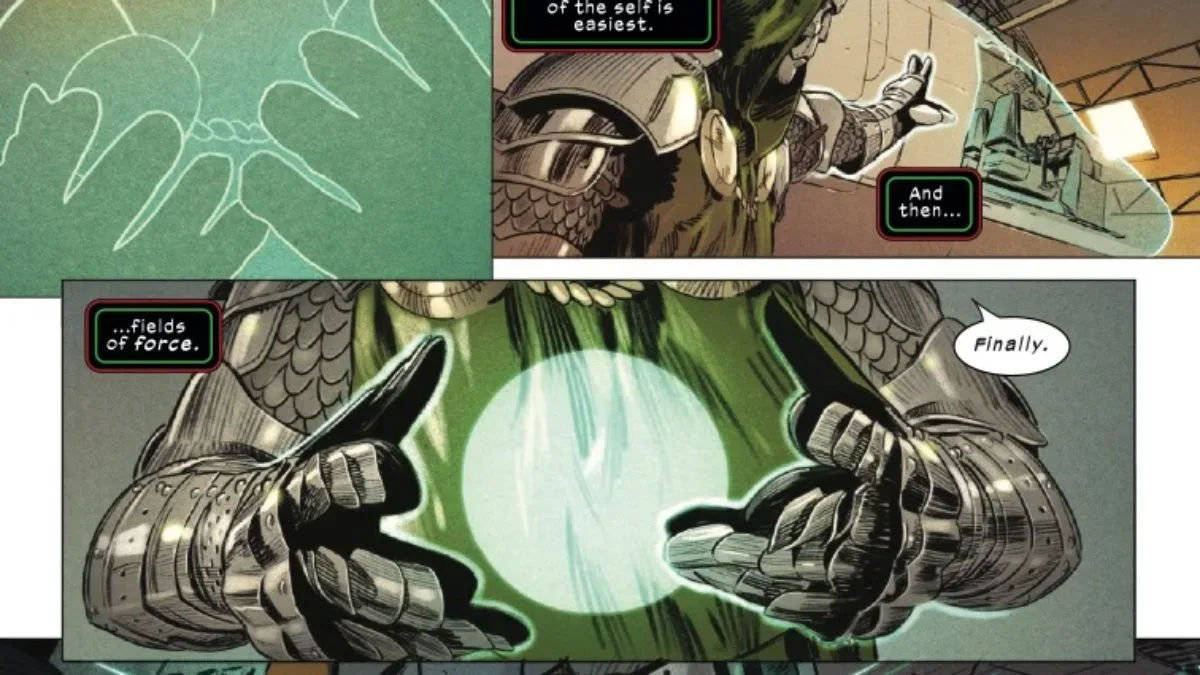
The lunar setting also lets the story play with a sharp visual contrast. Doom’s usual imagery is built around armor, sovereignty and theatrical menace; Apollo-era hardware represents a tightly constrained, highly specific environment. Mobili’s art will be carrying a premise where one of Marvel’s most imposing figures is embedded in a setting defined by limited space, fragile systems and no room for an ego to throw its cape around. Alex Ross handling the main cover adds another strong visual component to the issue’s historic-scale collision of Marvel villainy and space-race iconography.
Variants and release details
Alongside Ross’s main cover, Marvel lists three variants: a 1:25 Phil Noto variant, a C.F. Villa variant and a Guilherme Balbi Marvel Studios Doomsday variant. All are listed at $4.99 US, while the listed Canadian price is $6.25.
That gives readers several cover options without changing the central reason to pick up the issue: Doom, in orbit around the Moon, deciding that the best response to professional jealousy is to pick a fight with spacecraft design and causality. It is a wonderfully compact summary of the character’s operating system.
The story’s attention to orbital systems may also land differently for readers who have followed modern conversations around satellite infrastructure and space-based communications. For related context on contemporary scrutiny of such networks, read this look at Starlink and Starshield scrutiny. Doomquest, of course, takes the more entertainingly unreasonable route: put Doctor Doom near the Moon and trust him to make history everyone else’s problem.
Doomquest #6 arrives December 2, 2026 from Marvel Comics.