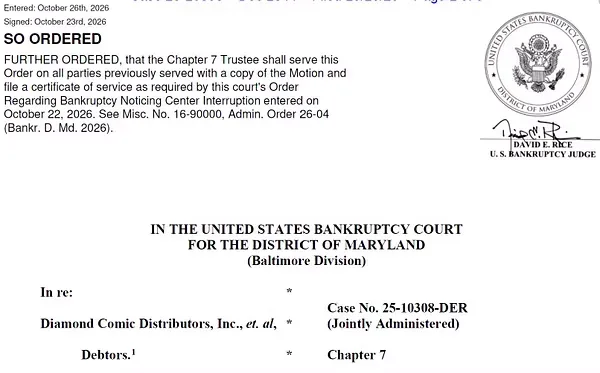
A Maryland bankruptcy court has approved a settlement that gives a group of comic publishers a defined path to recover inventory still held at Diamond Comic Distributors’ former Olive Branch warehouse. The agreement involves Chapter 7 trustee Morgan W. Fisher, Diamond purchaser Sparkle Pop, and a publisher group now identified in legal papers as the Palik Consignment Group.
For Dark Horse Comics, Oni Press, Titan, DSTLRY, Vault, Magnetic, Aspen, Black Mask, Heavy Metal, Massive, Panini UK, Alien Books and Graphic Mundi, the practical result is not an instant truckload of recovered comics. It is a court-approved logistics plan: each publisher must select one of two “Pik&Pak” routes, arrange to collect its books once notified, and meet a firm removal deadline. The group can also elect to have specified stock destroyed without an additional charge, with a certificate of destruction required.
That may sound procedural, but it is a meaningful change in a dispute that has left large quantities of publisher-owned books caught in the aftermath of Diamond’s bankruptcy. The broader consignment inventory remaining in Olive Branch has been valued at nearly $50 million at cost. By the terms described in the settlement, publishers now have an agreed mechanism to move at least part of that inventory out of warehouse limbo.
What the settlement covers
The Palik Consignment Group takes its name from counsel Craig M. Palik, who represents the publishers in the matter. Its approved deal applies to consigned comics held in Olive Branch, rather than serving as a blanket solution for every dispute and every publisher affected by Diamond’s bankruptcy.
Consigned inventory is stock a publisher places with a distributor to sell or manage, while maintaining the position that the publisher owns the physical goods. That distinction sits at the heart of this dispute. A distributor’s collapse is especially fraught when warehouses contain books that publishers regard as their property but which remain physically controlled by a bankrupt estate, a buyer, or an operator handling the site.
The reported inventory figures show why the process matters. Oni’s allocation is listed as 287,011 units with a stated value of $5,466,625. Dark Horse is listed with 108,674 units valued at $2,879,015, while Magnetic has 92,878 units at $1,912,225. Vault has 104,500 units listed at $643,267. The figures are substantial enough that recovery, resale, storage, shipping and eventual disposition are not side issues; they are central business concerns.
Other listed quantities include 58,078 units for Massive, 45,732 for Titan, 43,594 for Aspen, 40,098 for Alien, 40,073 for Black Mask, 16,027 for DSTLRY, 15,577 for Heavy Metal, 14,267 for Graphic Mundi, and 6,483 for Panini UK. The stated values vary widely, reflecting the different books and catalogs involved rather than a simple per-unit benchmark.
The two Pik&Pak choices, explained
The approved agreement offers publishers two primary recovery options. Both are meant to cover the work of identifying, picking, packing and palletising inventory. In warehouse terms, a pallet is a platform on which boxed goods can be stacked and moved by forklift; palletising is the preparation needed for commercial collection or freight shipment.
Option 1: Give up stock equal to 4% of wholesale value
Under the first option, Sparkle Pop retains inventory equal to 4% of the remaining stock’s wholesale value. The agreement defines wholesale as 50% of MSRP, or the manufacturer’s suggested retail price. Sparkle Pop can choose which titles make up that 4% and may sell them. It will pick, pack and palletise the remaining 96% without an extra charge.
Aspen, Black Mask, DSTLRY, Heavy Metal, Massive, Panini UK, Alien Books, Titan, Vault and Dark Horse selected this route. Titan’s arrangement includes a specific exception: roughly 31 pallets already staged for collection are excluded from the additional fees.
The practical trade-off is straightforward. A publisher avoids paying cash for the warehouse work but gives up a portion of stock, and it does not choose precisely which titles Sparkle Pop retains. That title-selection detail could matter when backlist books have unequal demand or when a publisher wants to preserve particular editions, though the settlement itself does not assess any individual publisher’s reasons for its election.
Option 2: Pay 2% of wholesale value in cash
The second route lets a publisher retain all remaining inventory, but it pays Sparkle Pop cash equal to 2% of wholesale value for the picking, packing and palletising work. Magnetic, Oni and Graphic Mundi selected this option.
This choice replaces a stock-based recovery charge with a cash charge. It may be more attractive to a publisher that considers retaining every unit more valuable than surrendering a selected slice of the inventory. But the deal does not eliminate the publisher’s next costs: collection, shipment, receiving, storage and any later effort to sell or redistribute the books remain practical issues after warehouse release.
Pickup deadlines are a major part of the deal
The settlement has a strict timetable. Once Sparkle Pop receives the required payment under the chosen option, it must make the identified inventory available at the warehouse loading dock within 10 business days. Sparkle Pop must send written notice when that happens.
Then the responsibility shifts decisively to the publisher. The inventory must be removed within 30 days of Sparkle Pop’s written notice unless the parties execute another written agreement before the deadline. If it is not removed, the books are deemed abandoned and Sparkle Pop receives sole discretion to dispose of them.
That clause makes this more than a victory on paper. Publishers need a concrete collection plan before the notice arrives: carrier arrangements, a destination warehouse or other receiving location, staff capacity, and a decision about what to do with potentially aging stock. A court-approved right to retrieve books is valuable, but it can be lost if the physical logistics fail.
For retailers and readers, this also means there is no guaranteed immediate flood of discounted back issues, graphic novels or collected editions. A publisher recovering inventory can decide how, when, or whether to send it back through retail channels. Some books may retain commercial potential; others may be less useful after a long delay. The settlement establishes access and process, not a public release calendar or a promised retail destination.
Where the escrow money goes
The agreement also addresses money held from sales during the bankruptcy proceedings, alongside Sparkle Pop’s claims for storage and handling expenses. Two escrow pools are identified: $840,151 held in the court registry, with $48,254 attributed to the Palik group, and $478,490 held by Sparkle Pop, with $105,856 attributed to the group.
Under the settlement, the full court-registry escrow is released to the trustee. The Sparkle Pop escrow is released to Sparkle Pop, which retains the full amount for storage expenses and processing fees. Once the separate Ad Hoc settlement receives approval, the trustee is also to disburse $308,890 from the court-registry escrow to Sparkle Pop.
Escrow is money held by a neutral or designated party while ownership, entitlement or distribution is being worked out. Here, its release does not mean the publishers receive the sums attributed to them. Instead, the settlement resolves how those funds are allocated among the trustee and Sparkle Pop in connection with the warehouse process and related expenses.
The trustee is also assigning Sparkle Pop certain inventory tied to default judgments involving Digital Manga, Netcomics and Valiant Entertainment, as well as inventory covered by the Image Comics settlement and publishers outside both this agreement and the pending Ad Hoc deal. Those assignments underline the fact that Olive Branch is being resolved through several overlapping arrangements rather than a single universal settlement.
Why this is progress, but not the end
The consignment conflict grew out of Diamond’s January 2025 Chapter 11 filing and the subsequent sale of operating assets. The case later moved to Chapter 7, a liquidation process in which a trustee administers the remaining estate. Individual arrangements had already removed some inventory from the warehouse, including a settlement involving Image Comics.
This new agreement narrows the remaining conflict for one major publisher bloc. It does not resolve the separate Ad Hoc settlement, which remains pending after Sparkle Pop objected. A hearing is set for early November, and the filings indicate that the remaining parties may negotiate an amendment resembling the Palik Group framework.
That remaining proceeding matters because it could determine whether another large collection of publishers receives an equally clear route to their stock. Until it is approved or otherwise resolved, the larger Olive Branch inventory dispute is not entirely finished.
There is also an unavoidable commercial reality beneath the legal language. Stock tied up for an extended period can become harder to use. Publishers may have invested in printing, warehousing and distribution expectations long before the books can actually be retrieved. Meanwhile, the value of comics inventory is not static: demand can change, newer editions can arrive, and shelf space is finite. The recovery of goods can be a necessary success even when it does not restore every lost sales opportunity or every dollar of value.
That is part of the broader physical-media pressure visible across entertainment. Discussions around physical releases, including concerns about physical games being left behind, are distinct from this bankruptcy case, but they share a basic lesson: getting a physical product made is only one step. Distribution, inventory control and the ability to move stock where it needs to go can be just as consequential.
What happens next
The immediate next steps are operational. Publishers that chose a Pik&Pak option must satisfy its payment or inventory terms. Sparkle Pop must prepare the goods and notify each publisher when pallets are ready at the loading dock. Publishers then need to move quickly enough to avoid the 30-day abandonment provision.
For Dark Horse, Titan, Vault, DSTLRY and the other Option 1 participants, the cost of recovery comes partly in inventory. For Oni, Magnetic and Graphic Mundi, it comes as a 2% wholesale-value cash payment. Neither option is consequence-free, but both replace uncertainty with defined obligations and deadlines.
The court’s approval therefore marks a significant procedural checkpoint rather than a clean, instant ending. One segment of the publisher group has an enforceable way forward. The remaining questions are whether the books can be extracted smoothly, what condition and commercial usefulness they have after their long stay in Olive Branch, and whether the pending Ad Hoc agreement can bring the rest of the consignment dispute to a similar resolution.