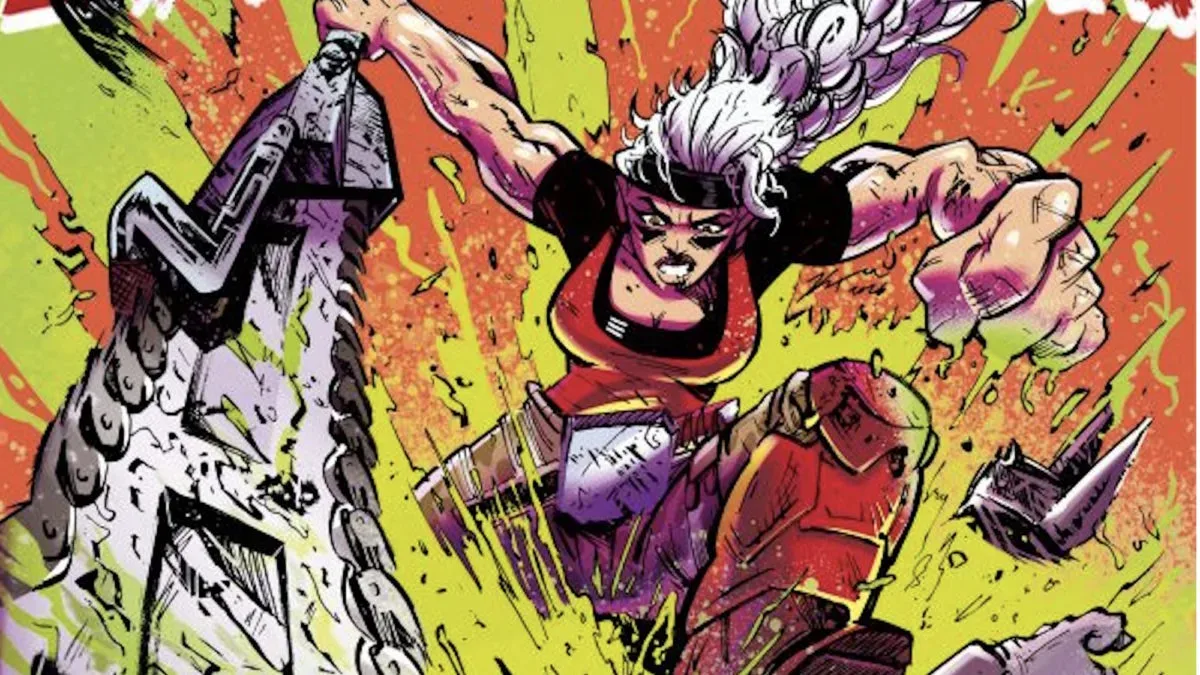
Chainkata #1 is set to arrive in comic shops on November 18, 2026, launching a new Image Comics science-fiction series centered on Luma, a warrior queen whose pursuit of an unknown power takes her into the vastness of space. She is armed with a chainsaw, looking for peace, and apparently unable to escape violence and terror as black holes enter the picture.
That is a compact premise, but it makes the book’s intended identity unusually clear. Chainkata is positioning itself as an aggressive, high-energy space adventure built around a protagonist with an inherently loud visual signature. Luma is not simply a monarch, explorer, or combatant: she is specifically a chainsaw-wielding warrior queen. The contrast between her stated desire for peace and the weapon she carries establishes a central tension before readers know the full shape of the world around her.
A cosmic journey with a volatile lead character
The debut issue sends Luma searching for a power that remains unidentified in the available premise. That uncertainty is significant. Rather than framing the first chapter around a defined artifact, enemy, or rescue target, the setup makes the object of Luma’s search part of the mystery. Her destination is equally immense: deep space, with black holes specifically identified as places where trouble continues to follow her.
In science fiction, a black hole is generally understood as a region of space with gravity strong enough that light cannot escape it. Here, the term also works as vivid genre language. It promises an environment that is hostile, disorienting, and beyond ordinary scale. The story description does not explain how black holes function in the series, whether they are literal travel routes, battlefields, hazards, or something stranger. Readers should therefore treat them as a stated part of the premise, not a confirmed explanation of the book’s fictional cosmology.
What is confirmed is the emotional direction: Luma wants peace, but conflict refuses to leave her alone. That creates room for a character story beneath the spectacle. A protagonist seeking serenity while moving through situations that demand force can produce a meaningful question for a first issue: is violence something Luma chooses, something she is forced into, or something woven into the role she has inherited as a warrior queen?
The comparison points: fantasy feeling and brutal sci-fi scale
The series is being described through two prominent reference points: Princess Mononoke and Warhammer 40,000. Those comparisons should not be read as confirmation that Chainkata shares either property’s exact setting, characters, themes, or mechanics. They are shorthand for tone and scope.
The Princess Mononoke comparison suggests a possible emphasis on a warrior figure confronting violence, nature, power, or spiritual unease. The Warhammer 40,000 side signals a much harsher and more militarized kind of cosmic science fiction, where the sheer size and danger of the setting are part of the appeal. Put together, the pitch points toward a collision of mythic imagery and abrasive spacefaring action rather than a conventional clean-lined superhero adventure.
That makes Luma’s mission to find peace more than a character detail. It could be the hinge that separates the book from pure mayhem. The advertised setup is full of material that suggests chaos—chainsaws, warriors, terror, black holes, and a vast unknown power—but its protagonist’s goal is the opposite. Whether the comic pursues that contrast with tragedy, humor, catharsis, or relentless action remains to be seen.
What readers get in the first issue
Chainkata #1 is listed as a 40-page, ad-free series premiere with a $3.99 suggested retail price for the regular edition. For a new ongoing or limited comic, a first issue is the entry point: it is where the creative team has to establish a lead character, a setting, the initial conflict, and a reason to return. The larger page count gives this premiere more space than a standard short opener to introduce Luma’s search and set its first complications in motion.
The supplied listing identifies Daniel Warren Johnson as writer, artist, and cover artist for the primary edition. It also lists additional covers by Riley Rossmo and Rob Liefeld, alongside other cover editions and a blank sketch cover. Variant covers are alternate front-cover designs sold as separate editions of the same issue; they do not automatically indicate different interior story content. The blank sketch version is listed at $4.99, while the other specified priced cover editions are listed at $3.99.
- Release date: November 18, 2026
- Publisher: Image Comics
- Format: Series premiere
- Interior length: 40 pages, no ads
- Regular-edition SRP: $3.99
- Lead character: Luma, a chainsaw-wielding warrior queen
- Core premise: A quest for an unknown power in deep space while violence and terror pursue her
Why the debut’s presentation matters
A comic’s first issue has to be legible at a glance, especially when it is an unfamiliar property rather than a continuation of a long-running franchise. Chainkata has an immediate title, a protagonist whose weapon conveys action instantly, and a high-concept location in deep space. The pitch does not depend on readers arriving with prior continuity knowledge. Instead, it gives them a single figure—Luma—and a direct contradiction to follow: a person equipped for war who wants peace.
That simplicity does not mean the series premise is small. “Unknown power” gives the narrative an open-ended objective, while “every black hole” implies a travel-heavy cosmic framework rather than one isolated planet or fortress. The initial solicitation also claims a high-octane approach, so readers interested in action-forward independent comics have a clear signal about its intended pace.
For comic readers comparing new single issues in the same release week, cover choice may be the most visible decision. Buyers primarily interested in the story can look for the standard edition, while those drawn to a particular artist can consider the named alternate covers. Collectors should still verify availability with their local shop: a cover’s inclusion in a listing does not establish how many copies any individual store will receive or stock.
The announcement arrives amid a continuing stream of high-stakes comic-book setups, including stories such as a looming judgment in Wonder Woman #39. Chainkata, however, is starting from page one, so its appeal rests on its original lead and the promise of a strange, violent universe still waiting to be defined.
What has not been established yet
Beyond Luma’s identity, her search, the deep-space setting, and the book’s action-oriented tone, many of the most important details have not been disclosed. The available information does not name supporting characters, identify an antagonist, explain the unknown power, or specify what has caused violence and terror to chase Luma. It also does not establish the length of the series or reveal how the black holes operate within the plot.
Those omissions leave the first issue with a useful job: turn a strong visual and tonal pitch into a world readers can understand. On November 18, Chainkata #1 will begin that process with Luma’s search for a quiet life—or at least a moment of peace—in a cosmos that seems determined to give her anything but.