Spoilers for Absolute Green Arrow #6 follow.
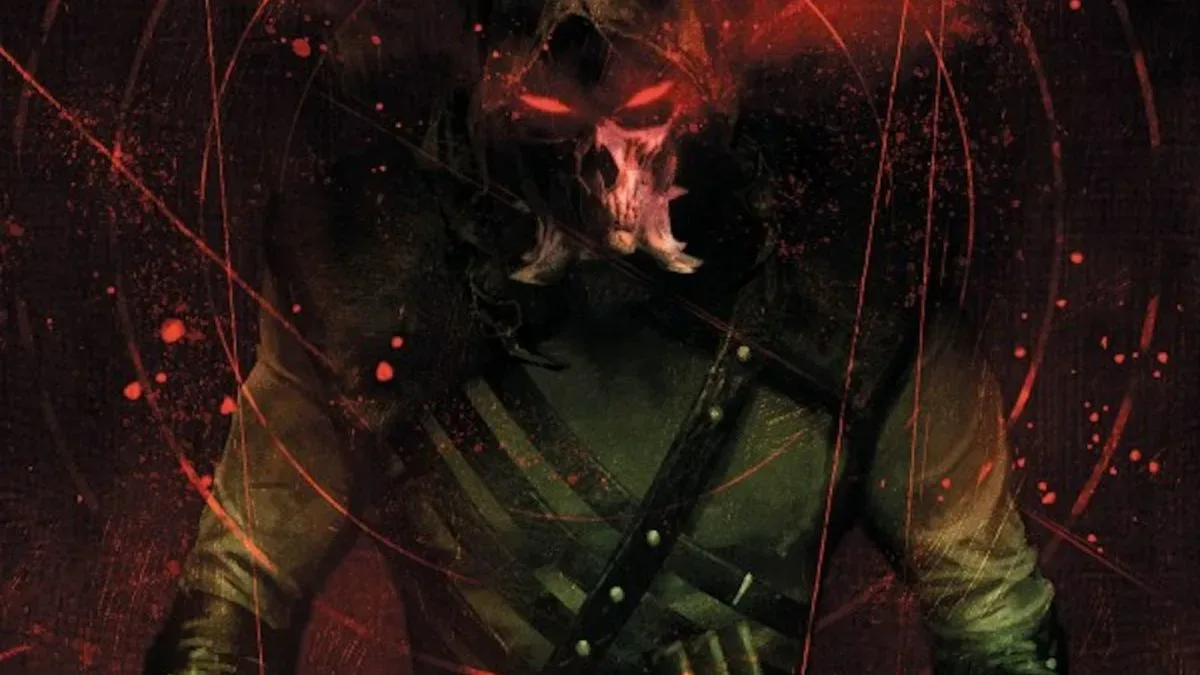
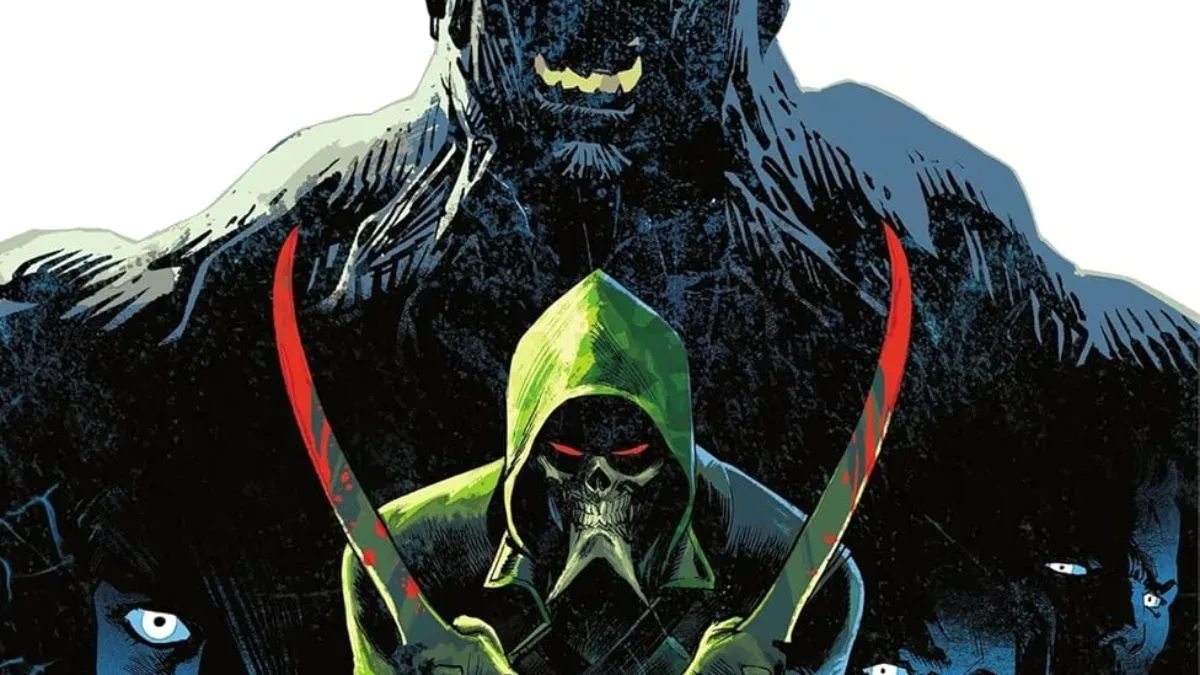
Absolute Green Arrow #6, by Pornsak Pichetshote and Rafael Albuquerque, delivers on the immediate mystery at the center of its story: the character operating as Absolute Green Arrow is Connor Hawke, Oliver Queen’s son. But the issue’s importance goes well beyond a masked-person reveal. Its conflict draws together Hector Hammond’s experiments, a revenge plot, Malcolm Merlyn’s role alongside Connor, and the uncertain standing of major figures connected to Absolute Justice.
That makes the sixth issue less a clean endpoint than a pivot. A hood comes off, one antagonist apparently dies, and several new pieces are placed on the board: the Kobra Cult, an “Arthur” reference that may point toward Arthur Curry, and the implication that Connor’s future may be shaped by obligations rather than freedom. For a book built around trick shots and misdirection, the answer to “who?” is evidently only the entry point to “why?” and “what now?”
Connor Hawke is the Absolute Green Arrow
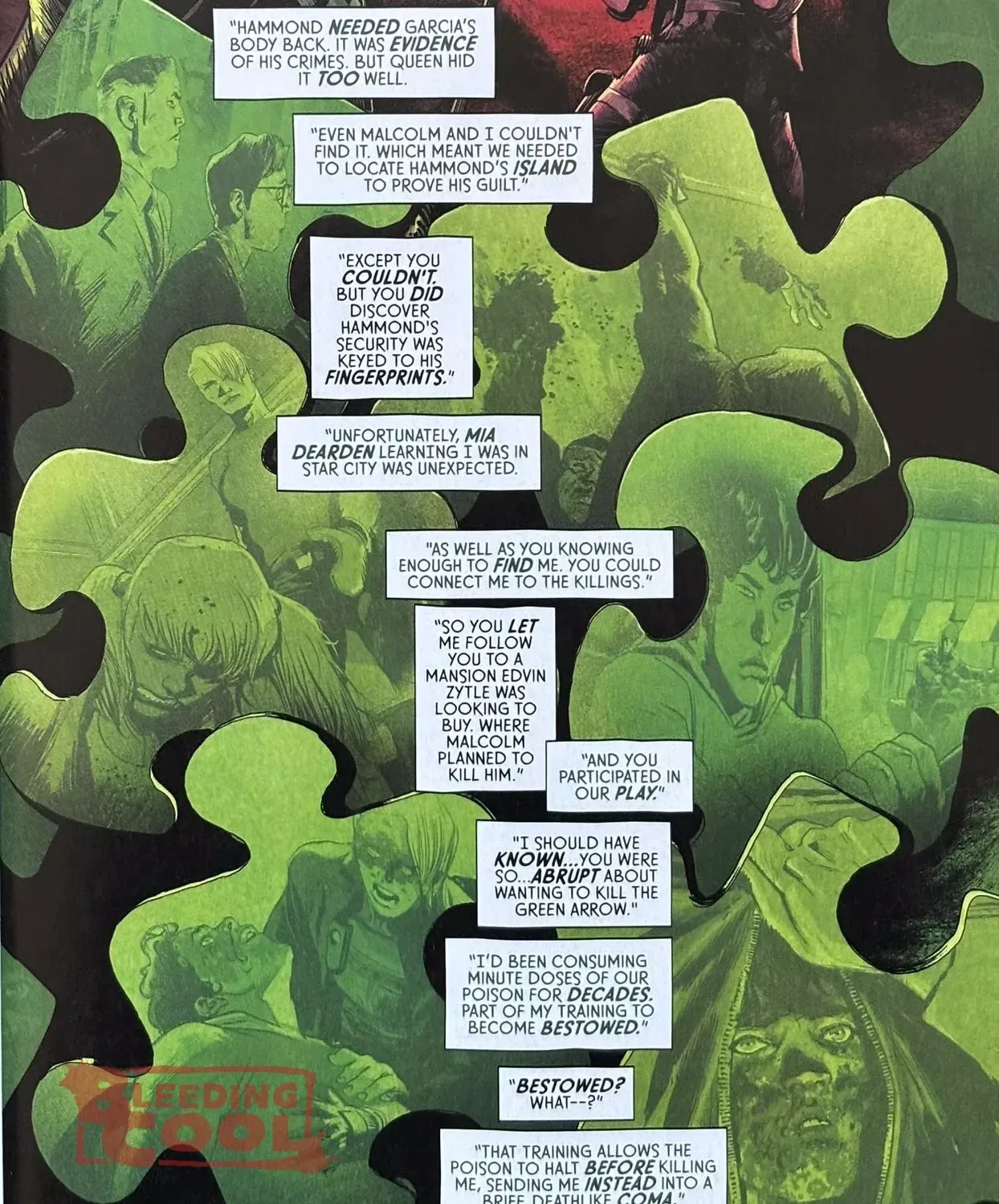
The key reveal is that Connor Hawke takes on the Absolute Green Arrow mantle with Malcolm Merlyn. The account is complicated by the fact that Connor has faked his death, a choice that reframes the prior mystery around the hooded archer. The story’s misdirection was not simply about hiding a face; it depended on readers looking in the wrong direction while a supposedly dead character remained active.
That distinction matters because a secret identity reveal can accomplish very different things in superhero comics. Sometimes it merely restores a familiar character to a recognizable costume. Here, Connor’s false death makes the identity itself part of the conspiracy plot. His survival is not a detached surprise but a mechanism that allows him and Merlyn to act from outside the assumptions of the people pursuing them.
The wording around Connor also suggests that “Absolute Green Arrow” is not a straightforward solo role. Malcolm Merlyn operates alongside him, and the issue is positioned as a story of plotting, targeted revenge and calculated deception rather than a simple succession from Oliver Queen. Connor may now be the remaining Green Arrow, but the status comes with unresolved ties that could prove as important as the bow and hood.
Guillermo Garcia and the cost of Hammond’s experiments
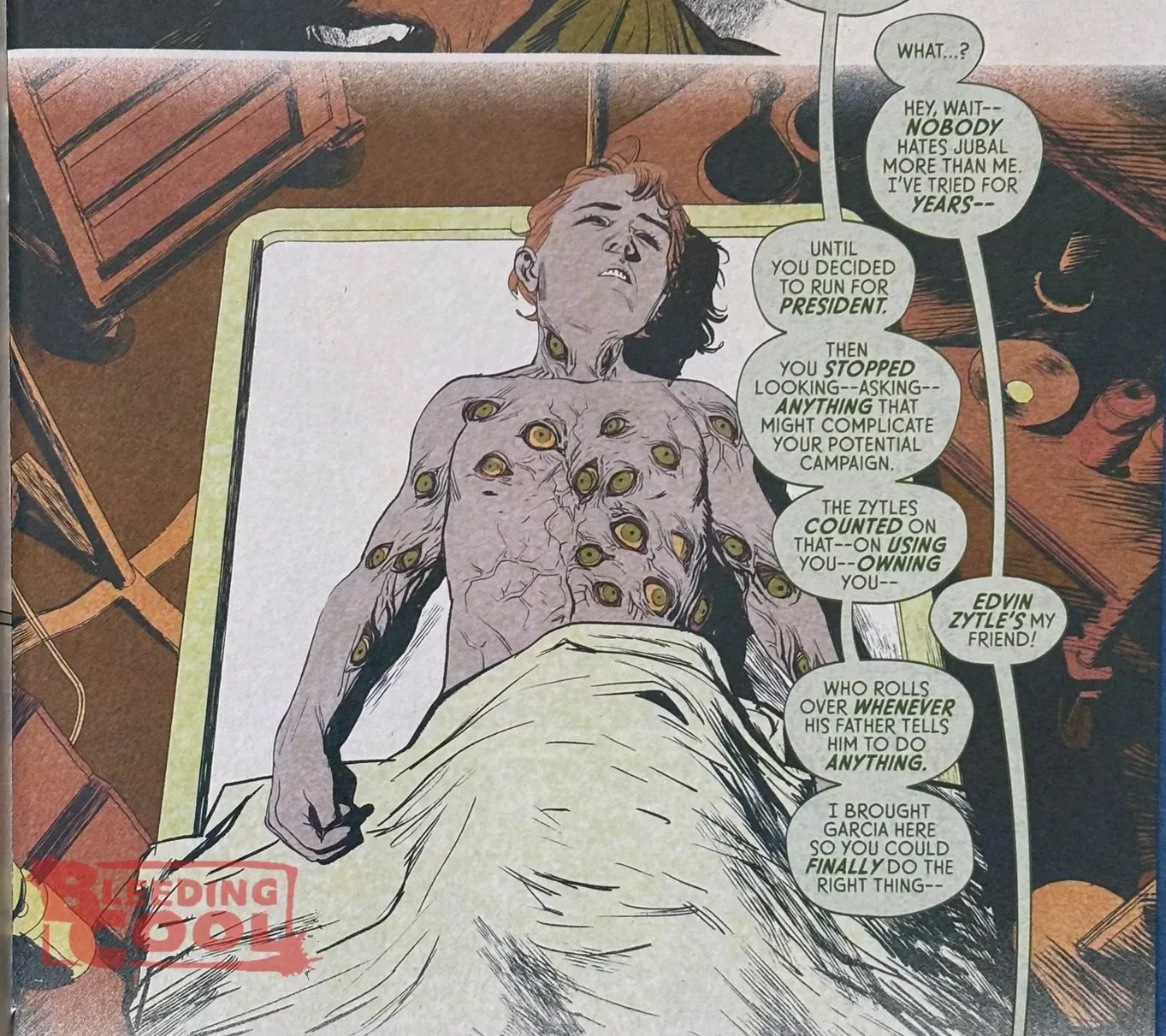
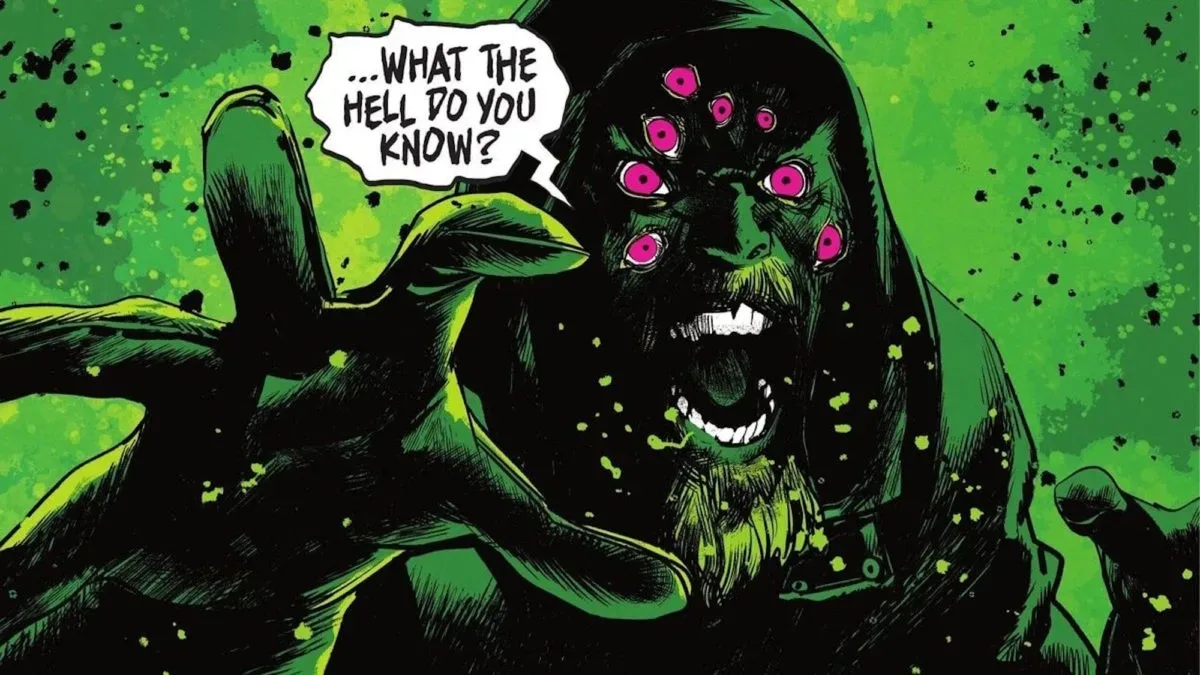
Hector Hammond’s body-horror experiments form a central part of the issue’s larger conspiracy. Guillermo Garcia, described as a fatal subject of those experiments, is not presented merely as an isolated victim in a shocking scene. His fate becomes part of a power play surrounding the people and organizations fighting for control.
Body horror is a genre term for fiction that creates fear or unease through the violation, transformation or exploitation of the human body. In this case, the term is especially useful because it points to more than monster imagery. Hammond’s experimentation turns a person into evidence of institutional cruelty and ambition. That gives the conflict a more disturbing dimension than a conventional grudge match between costumed characters.
The issue connects this horror directly to its political and strategic stakes. Garcia’s suffering sits inside a sequence of conspiracies and misdirection that eventually leads to a carefully arranged act of revenge. The image of an arrow finding its target is therefore doing double duty: it is literal Green Arrow iconography, but it also describes a plan designed to arrive at one specific person.
Hector Hammond apparently falls, but certainty is in short supply
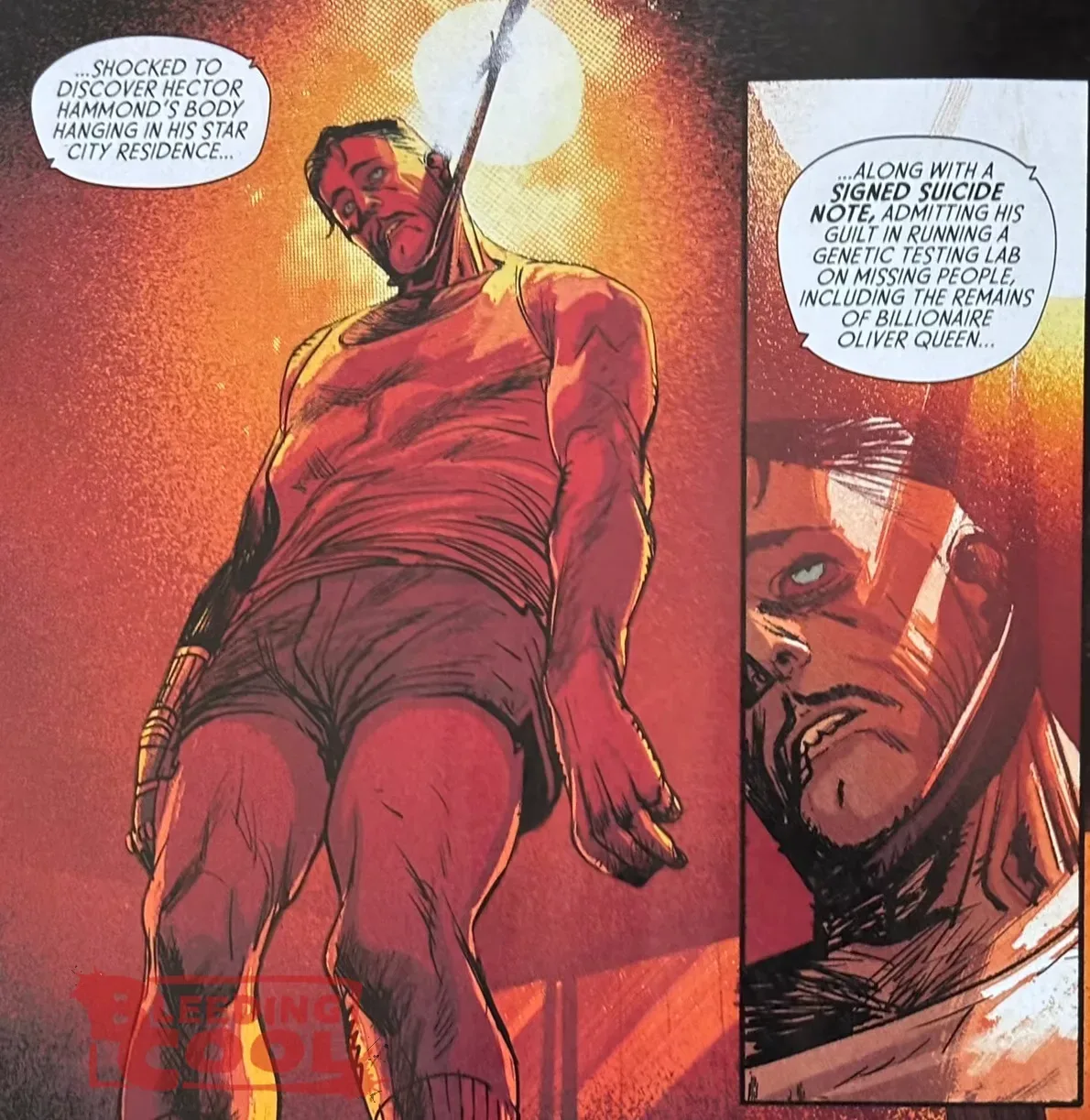
That target is Hector Hammond. The issue depicts Hammond’s death after his role as an antagonist to both Absolute Green Arrow and Absolute Green Lantern, as well as his connection to Absolute Justice. The apparent loss is significant because Hammond has occupied more than one corner of this setting. Removing him would affect Green Arrow’s immediate storyline while potentially changing the dynamics around Green Lantern and the wider Justice group.
Still, “apparently” is the important word. The story raises doubt over whether Hammond is truly gone, and it does so with a specific in-universe rationale: Lazarus Pits and Miraclo exist in the Absolute Universe. The material does not establish that either resource will be used to restore Hammond, nor does it promise his return. It does establish why a fatal outcome should not automatically be treated as final in this world.
Lazarus Pits are a DC concept associated with restoration and renewal, while Miraclo is another established DC element. Their presence leaves narrative room for reversals, recovery or transformations. For readers, that means the issue’s death should be read as a major development with deliberate uncertainty attached—not as a guaranteed permanent exit.
Ra’s al Ghul is also mentioned in connection with the shifting status of Absolute Justice. The available information does not spell out the group’s next lineup or purpose. What it does show is instability: Hammond and Ra’s al Ghul are both framed as figures whose places in the organization may no longer be secure. That uncertainty is precisely why the story feels geared toward a larger next chapter rather than simple closure.
Absolute Justice is becoming the larger frame
At the beginning of an arc, a conspiracy can look like a private problem for one hero. By this point, the ramifications look broader. Hammond’s links to Absolute Green Lantern and Absolute Justice put Green Arrow’s conflict in contact with other parts of the Absolute setting, while the issue also names Black Canary and Solomon Grundy among the characters whose paths collide in its violent finale.
The promised “Absolute Justice” development should be treated as a direction of travel, not a fully explained event. There are no supplied details about its roster, objective, release structure or the exact form the next story will take. Yet the issue clearly uses its revelations to expand the scale of the narrative. A secret archer, an experiment victim and a revenge plot now sit against questions about a larger power structure.
That expansion can be more meaningful than an ordinary crossover tease. A group such as Absolute Justice can connect characters who otherwise have separate enemies and settings. Hammond already serves that connective role because he opposes both Absolute Green Arrow and Absolute Green Lantern. His apparent death may remove one link, but the lingering questions around the group create several new ones.
For readers following the wider line, there is also a broader publishing context around the “Absolute” label. Recent uncertainty has surrounded planned deluxe hardcover editions involving Absolute Batman, Superman and Wonder Woman, as covered in this report on cancelled Absolute Deluxe Hardcover orders. That situation concerns collected editions rather than the events of Absolute Green Arrow #6, but it illustrates how closely readers may be watching developments across this corner of DC storytelling.
Kobra could place Connor under a new kind of pressure
Perhaps the issue’s most consequential unresolved thread is the suggestion that Connor Hawke may owe fealty to the Absolute Kobra Cult. Fealty means a pledge of loyalty or service, so this is potentially much more restrictive than a temporary alliance. If Connor is obligated to Kobra, his role as Green Arrow could be defined by a conflict between personal purpose and an organization’s demands.
Kobra has a long DC history. The organization debuted in Kobra #1 in 1976, created by Martin Pasko, Steve Sherman, Jack Kirby and Pablo Marcos. Its established imagery centers on snakes, and its ideology includes a belief that snakes are superior to humans. Genetic enhancement is also associated with the cult.
Those traits make Kobra a particularly pointed organization to introduce after a storyline involving Hammond’s experimentation. The supplied material does not say that Kobra caused Hammond’s work or controls every piece of the conspiracy. It does, however, place a character potentially beholden to a group associated with genetic enhancement directly after the story has exposed the horrors inflicted on Guillermo Garcia. The thematic connection is hard to miss even where the factual connection remains unconfirmed.
For Connor, the threat is not only physical. A secret identity can protect him from enemies, but it cannot necessarily free him from a debt, oath or cult allegiance. That is a strong setup for the “newly extended” saga signaled by the issue: the main mystery may be solved, while the cost of the solution becomes the next problem.
Does “Arthur” mean Absolute Aquaman?
The issue also includes a reference to “Arthur,” inviting the possibility of Arthur Curry and, by extension, an Absolute Aquaman. It is an intriguing clue, but it remains only that. The available evidence does not confirm the character’s full name, a new series, a costume, an appearance, or even that the Arthur in question is definitely Aquaman.
Still, the implication is easy to understand. Arthur Curry is the name most commonly associated with Aquaman in DC stories, and the Absolute setting is already being discussed in relation to a growing cast and an impending Absolute Justice development. If the mention is intentional setup, it could signal that the setting is continuing to widen beyond the characters currently at its center.
Readers should separate that plausible interpretation from confirmation. A teaser is not an announcement. The value of the reference is that it gives future issues a specific question to answer while leaving the answer open.
What #6 changes going forward
- The Green Arrow mystery has an answer: Connor Hawke is behind the Absolute Green Arrow identity and has used a faked death as part of the plan.
- Hammond’s plot reaches a turning point: the antagonist apparently dies after the consequences of his experiments and conspiracy converge.
- Finality is deliberately questionable: Lazarus Pits and Miraclo leave room for outcomes that may not stay permanent.
- Connor’s independence is uncertain: a possible obligation to the Absolute Kobra Cult could shape the next phase of his story.
- The scope is widening: Absolute Justice, Green Lantern connections and the “Arthur” tease all point beyond a self-contained Green Arrow conflict.
Absolute Green Arrow #6 therefore functions as both payoff and provocation. It resolves the identity question with Connor Hawke, gives Hammond an apparent downfall, and makes its conspiracy feel costly through Guillermo Garcia’s fate. Yet it preserves uncertainty where it counts: Hammond may not be beyond return, Absolute Justice is in flux, Kobra’s hold over Connor is unresolved, and Arthur Curry may be waiting just beyond the edge of the story.
Shop the products
Check current price, model and availability at the retailer.