Disney Lorcana deckbuilding can become an exercise in seeing the same powerful shells across the table. Amber Amethyst lists have been especially visible, while Amber Emerald builds centered on Elinor or Songs have also commanded attention. That does not mean every answer—or every opportunity for experimentation—has to come from the format’s most familiar cards.
In a trading card game, a card being cheap is not automatic proof that it is weak, and a card being overlooked is not automatic proof that it will become expensive. Price, competitive demand, print supply, collector appeal and future card pools can all move independently. Still, low-cost cards with a defined role can be useful to players looking to build away from the crowd, particularly while a metagame is still being worked out.
The current rotation only began on July 24, and the hierarchy of decks shifted during August. That makes broad claims about permanent “best” choices premature. It does, however, make this an interesting point to identify cards whose text may matter more as decklists evolve. The five cards below are not investment guarantees or universal staples. They are budget-friendly pieces with clear purposes: supporting a Floodborn board, rewarding a Toy-heavy strategy, or answering Evasive characters efficiently.
For another concise view of inexpensive Lorcana cards attracting attention, see these low-cost Disney Lorcana picks.
For more context, explore Pokémon Pokopia Part 2 Brings Accessories for Ditto and Its Pokémon Neighbors in Late 2026.
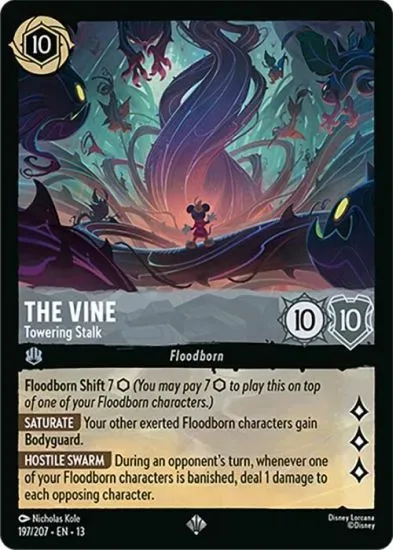
The Vine — Towering Stalk: a late-game Floodborn payoff
The Vine — Towering Stalk has the kind of stat line that immediately changes combat math. It carries 10 Strength and 10 Willpower, quests for three Lore, and costs 10 Ink when played normally. That is an enormous price for a character, so it is plainly not intended to dominate the opening turns. The reason to consider it is the Floodborn Shift option: it can be played for seven Ink atop another Floodborn character.
Even seven Ink is a substantial commitment, but The Vine is more than a large body. Its Saturate ability gives every other exerted Floodborn character Bodyguard. This redirects an opponent’s challenges toward those exerted Floodborn characters before they can go after The Vine. In the right board state, that protection can leave The Vine available to keep questing rather than immediately becoming the opponent’s preferred target.
Then there is Hostile Swarm. Whenever one of its controller’s Floodborn characters is banished, every opposing character takes one damage. Together, the two abilities create a notable tension: the opponent may need to challenge through the Floodborn characters guarding The Vine, but doing so can spread damage across their own board. It is not a standalone solution; it asks for a deck that can establish several Floodborn characters and recover after trades. But it offers a coherent payoff for doing exactly that.
The cited market price was around $0.25. At that level, the card’s appeal is chiefly experimentation rather than financial certainty. Its longer-term relevance could depend on later Floodborn support, as a wider pool may make the surrounding shell more consistent. Players should also remember that a 10-Ink character can be stranded in hand or arrive too late if the deck cannot reliably reach its late game.
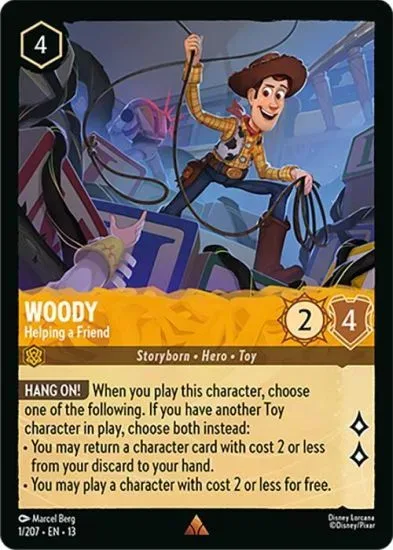
Woody — Helping a Friend: small-cost Toy recursion and deployment
Woody — Helping a Friend works from a different angle. This Amber character costs four Ink and has 2 Strength and 4 Willpower—reasonable numbers, but not the central reason to play it. The important text is Hang On!, which requires at least one other Toy character in play.
Once that condition is satisfied, Woody lets its controller either return a character costing two Ink or less from the discard pile to hand, or play a character of that cost for free. The choice is valuable. Returning a card to hand preserves flexibility for a later turn, while playing it directly can help refill the board immediately. Either line points toward a strategy that wants numerous inexpensive characters, rather than a pile of individually costly threats.
There are limits worth respecting. Woody needs another Toy already present, and its target must cost two or less. It will not retrieve every fallen centerpiece, nor does it turn a Toy deck into an automatic engine. But cards that create extra utility from a discard pile or turn a small character into free deployment can matter greatly in decks attempting to keep a board populated.
Woody’s reported price was about $0.44. That makes it accessible for anyone who wants to test whether a low-curve Toy plan has enough density and payoff. Its eventual standing will be tied to the quality and quantity of eligible Toy characters, but its job is easy to understand: turn a modest board presence into additional resources.
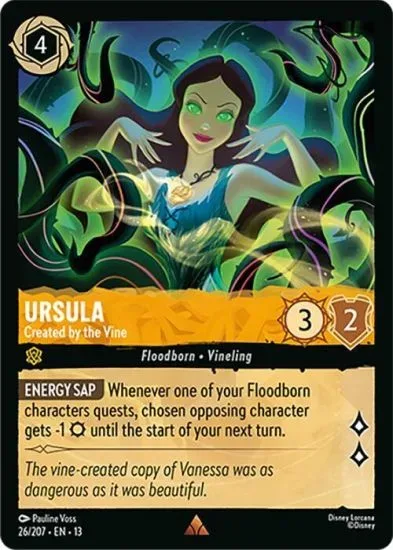
Ursula — Created by the Vine: reducing the opponent’s combat options
Ursula — Created by the Vine is another card that asks players to judge it as part of a Floodborn package instead of by its base numbers alone. It has 3 Strength, 2 Willpower and two Lore. The modest Willpower makes it vulnerable, but Energy Sap gives it a potentially disruptive role.
Whenever a Floodborn character quests, Energy Sap causes a chosen opposing character to lose one Strength until the start of its controller’s next turn. Ursula can trigger that effect when she quests, and other Floodborn questing during the same turn provide further triggers. A single reduction may not decide much; several reductions distributed carefully can reshape which opposing characters are able to challenge effectively.
This is a pressure tool rather than removal in the ordinary sense. It does not banish a chosen character outright, and it relies on having Floodborn characters ready to quest. The card becomes far better when the deck can repeatedly present that type of character and protect the board long enough to profit from multiple quest triggers. It also complements the general Floodborn idea seen in The Vine: make opposing challenges less attractive, then keep accumulating Lore.
At a cited price near $0.10, Ursula is an inexpensive inclusion to examine for that archetype. The low entry point should not be mistaken for a promise of future value, but it does mean the cost of testing the synergy is minimal.
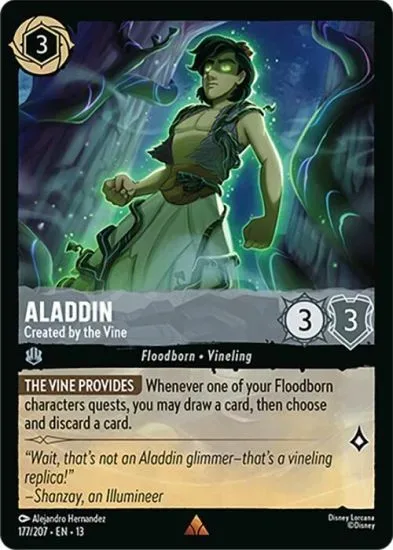
Aladdin — Created by the Vine: filtering through Floodborn questing
Aladdin — Created by the Vine has similarly direct Floodborn-facing text. It costs three Ink and brings 3 Strength and 3 Willpower, making it a more manageable early-game character than The Vine. Its key ability, The Vine Provides, activates whenever a Floodborn character quests: draw a card, then discard a card.
That is card filtering, not pure card advantage. A card is drawn, but one must be discarded afterward. The distinction matters. Aladdin will not simply build an unlimited hand. What it can do is help a Floodborn deck look for relevant pieces, move past cards that are currently unhelpful, and gain more value from each quest when several Floodborn characters are active.
Because the trigger applies each time a Floodborn character quests, a developed board can generate repeated filtering in a turn. That may help locate a needed character, improve hand quality before a later decision, or discard an excess card that does not fit the immediate board state. The cost is that players need to plan around the discard requirement and avoid treating every trigger as free upside.
Aladdin was also listed around $0.10, making it one of the least expensive cards here. For players who want a Floodborn list to function as a connected engine instead of a collection of separate characters, Aladdin offers one of the clearest support effects among these five choices.
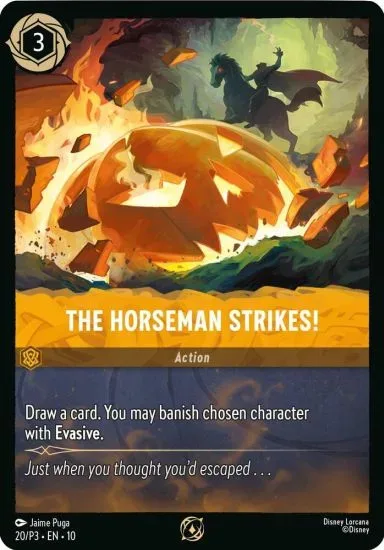
The Horseman Strikes!: a focused answer to Evasive
The Horseman Strikes! is the outlier in this group. It does not need a Toy board or a Floodborn payoff to function. Instead, it is a three-Ink action designed to deal with a particular nuisance: a chosen character with Evasive. The action banishes that chosen Evasive character and lets its controller draw a card.
Evasive can frustrate a board-based plan because characters with the ability cannot be challenged unless the challenger also has Evasive. The Horseman Strikes! provides a targeted answer while replacing itself with a draw. Three Ink is a meaningful cost, especially early, and the card can sit unused if an opponent has no Evasive character. That makes it a metagame call rather than a default inclusion for every deck.
The cited regular version was near $4, with a Promo option around $1.99. It is therefore less of a pure bulk-bin experiment than the other selections, yet its directness gives it a practical purpose. When Evasive characters are a recurring obstacle, paying Ink for removal plus a replacement card may be preferable to waiting for an unlikely combat answer.
What makes these cards worth monitoring
All five choices reward a specific question: what does the rest of the deck do for this card? The Vine, Ursula and Aladdin rise or fall with Floodborn density and a board that can safely quest. Woody needs fellow Toys and a meaningful selection of characters costing two or less. The Horseman Strikes! depends on whether Evasive is common enough to justify a specialized answer.
- The Vine — Towering Stalk: a seven-Ink Shiftable Floodborn payoff with protection and damage-punishment tools.
- Woody — Helping a Friend: Toy-dependent recursion or free deployment for low-cost characters.
- Ursula — Created by the Vine: repeatable Strength reduction attached to Floodborn questing.
- Aladdin — Created by the Vine: repeated draw-and-discard filtering from Floodborn quest triggers.
- The Horseman Strikes!: targeted Evasive removal that also draws a card.
That specificity is exactly why these cards are worth a second look while the format remains unsettled. The strongest deck is not always built by ignoring the metagame; it can also come from identifying the cards the metagame has not yet forced everyone to respect.