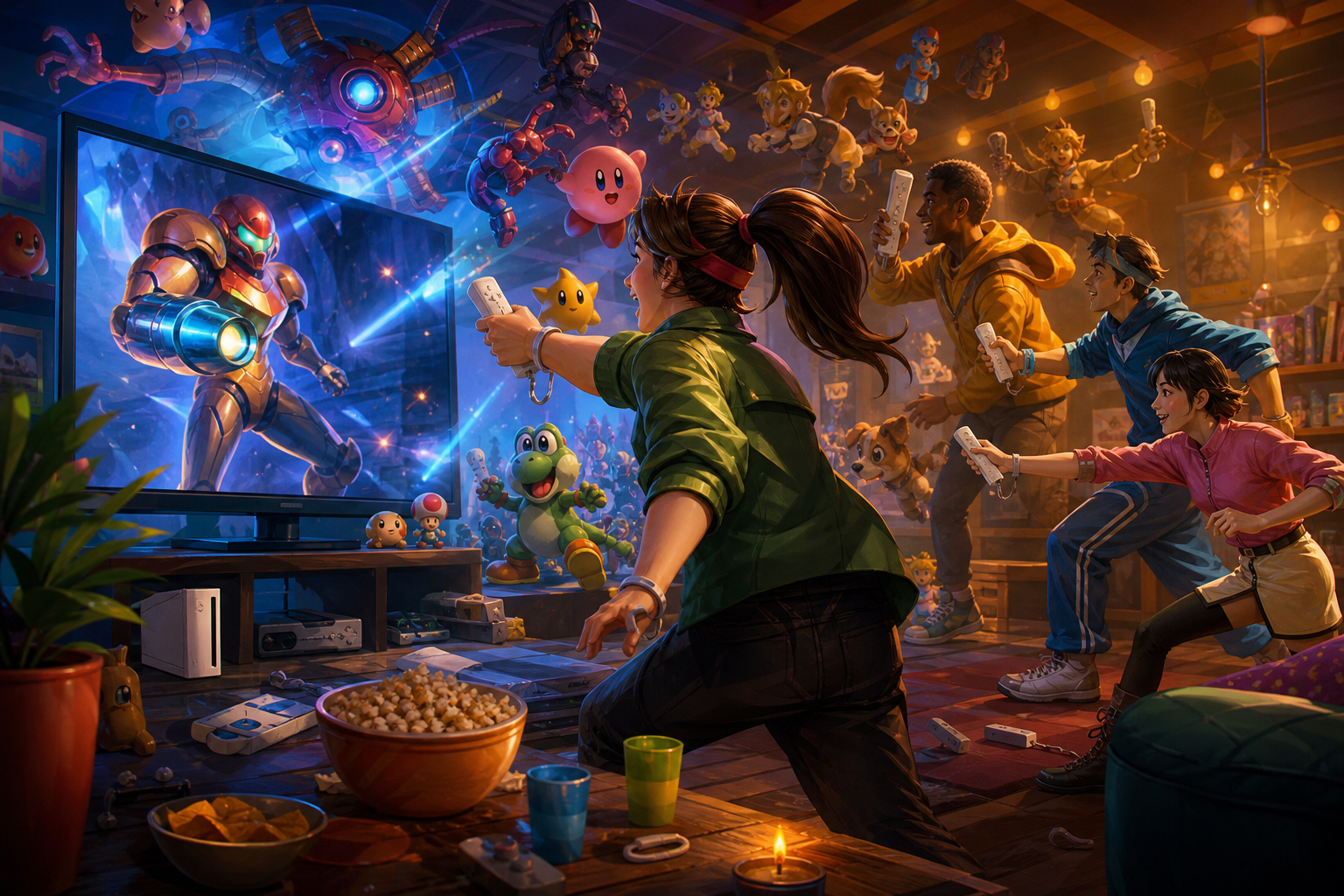
The Nintendo Wii made local multiplayer feel unusually physical. A game could ask players to swing, point, balance, shake, aim or simply hold a Wii Remote in a particular position, turning the controller into part of the social experience. That makes the Wii party category broader than a standard board-game compilation: sports packages, physics challenges and strategy-heavy hybrids can all belong when they work especially well with a group.
This ranking weighs five things. Group variety comes first: a strong choice should serve more than one kind of player or session. Motion-control identity matters because the best Wii party games should feel meaningfully connected to the hardware. Replay value separates a lasting multiplayer game from a funny first demonstration, while accessibility determines how quickly a mixed group can understand the objective. The final factor is distinction: each entry needs to offer a different kind of group play rather than simply repeat the same board-and-minigame formula. The result is an editorial ranking, not a universal scorecard.
10. Mario Sports Mix
Mario Sports Mix is the straightforward choice for a group that wants competition without committing to a long board-game campaign. Its four sports—volleyball, dodgeball, hockey and basketball—share an arcade sensibility, so the package feels unified while still changing the rhythm from match to match. The use of Mario characters, Square Enix guests and Miis gives it a broader identity than a Mii-only collection, and up to four players can take part locally.
Its weakness is that the variety is concentrated inside a single competitive template. Players who want elaborate board events, cooperative puzzles or strange room-based activities will find fewer surprises here. The advantage is clarity: each sport explains itself quickly, and a group can move from a short match to a small tournament without learning an entirely new ruleset. Mario Sports Mix ranks tenth because it is dependable rather than especially deep, but that dependability makes it useful for casual gatherings.
- Best for: groups that want familiar sports with a Mario presentation.
- Tradeoff: less mode variety than the larger minigame collections.
9. Boom Blox Bash Party
Boom Blox Bash Party is the ranking’s physics-based wildcard. Instead of presenting a parade of unrelated minigames, it builds its multiplayer around structures, blocks, projectiles and carefully timed destruction. Local play can turn the same basic interaction into cooperation, competition or a test of accuracy, giving the game a more consistent mechanical identity than many party compilations.
That focus is also its limitation. Boom Blox Bash Party is less immediately legible to a group that expects cartoon quizzes, races or button prompts, and its challenges can demand more patience than a quick party round. Its more than 400 offline levels give it more staying power than a novelty demonstration, while the Wii Remote’s pointing, throwing and motion gestures make the physical simulation feel appropriate to the platform. The original online sharing features should not be treated as a current reason to choose it; its local content is the safer basis for a modern session.
Boom Blox Bash Party places ninth because it serves a narrower audience, not because it lacks ideas. It is the best pick here for players who want a party game with genuine spatial problem-solving.
- Best for: groups that enjoy construction, destruction and physics puzzles.
- Tradeoff: its slower, skill-driven play may not suit a loud, rapidly rotating gathering.
8. Rayman Raving Rabbids: TV Party
Rayman Raving Rabbids: TV Party embraces chaos more openly than most games on this list. Its large collection of minigames draws on television parody, physical comedy and deliberately awkward challenges. The important distinction is player count: some activities support simultaneous play, while others use turn-based participation for larger gatherings. Up to four players can take part simultaneously in supported activities, while certain party formats allow up to eight players to alternate. That makes it more flexible than a game that simply advertises four-player support without explaining what everyone is doing.
The Rabbids’ tone will either make the session memorable or become exhausting, depending on the group. The visual jokes and exaggerated presentation help new players understand that failure is part of the entertainment, but the unevenness between activities can make the package feel less focused than Wii Party or WarioWare. A large gathering can still get substantial mileage from it because spectators remain involved when turns rotate, and the mixture of short challenges prevents one person from monopolizing the session for long.
It ranks eighth as a high-energy social option. Choose it when silliness and audience participation matter more than a carefully balanced competitive structure.
- Best for: large groups that enjoy physical comedy and rotating turns.
- Tradeoff: simultaneous and turn-based modes have different player limits.
7. Fortune Street
Fortune Street is the slow-burn strategy game in this ranking. Its board combines property purchases, investments, stock decisions and wealth accumulation, creating a very different kind of party tension from a reflex minigame. Players do not merely race around a board waiting for the next event; they watch prices, decide when to invest and judge whether an apparent lead is secure. That makes every turn part of a longer argument about risk.
The game supports up to four players and offers simplified rules alongside a more advanced standard format. That distinction is important. Beginners can learn the basic loop without facing the full burden of the financial system, while experienced groups can use the deeper rules to create a more deliberate contest. The pace is its central tradeoff: a session can become a substantial commitment, and players who want instant action may find the negotiation and accumulation too gradual.
Fortune Street earns seventh because it expands the meaning of a Wii party game. It is not the best choice for a five-minute introduction, but it may be the strongest option for a group that enjoys rivalry, comeback stories and arguing over investments. Its original online features are not part of the recommendation; the useful case for the game today is its local multiplayer.
- Best for: players who prefer board-game strategy to rapid minigames.
- Tradeoff: local sessions are longer and less immediately accessible than motion showcases.
6. Mario Party 8
Mario Party 8 is the traditional board-and-minigame choice. As the first Mario Party entry released for Wii, it adapts the established formula to motion controls while retaining the familiar four-player structure. Its six boards and more than 60 minigames provide a clear variety advantage: the group can play a full competitive board, jump into shorter events or use the minigames as the main attraction.
The Wii Remote gives the package some hardware identity, but not every activity feels equally essential to motion control. That unevenness is part of the game’s position here. Mario Party 8 offers a strong general-purpose format, yet later Wii party games make more radical changes to pacing or controller use. It also asks players to accept the usual Mario Party volatility, where luck and sudden reversals can matter as much as careful play.
It ranks sixth because it remains a recognizable social template with enough content to support repeated gatherings. It is the safest choice for players who specifically want a conventional Mario Party board, while players seeking a more distinctive Wii design should look higher on the list.
- Best for: groups that want classic board movement plus minigame rounds.
- Tradeoff: luck and uneven motion-control ideas can matter as much as skill.
5. Wii Play: Motion
Wii Play: Motion is a compact showcase for Wii Remote Plus features. Its 12 minigames are built around motion-sensitive activities, including competitive scoring and cooperative ghost-hunting modes. The package is easier to introduce than a long board game because most activities communicate their basic goal quickly. That makes it particularly useful when players have different levels of gaming experience or when the group wants to sample several ideas without spending an entire evening on one ruleset.
Its size is also the reason it does not rank higher. Twelve activities can feel focused and approachable, but the game cannot match the breadth of Wii Party or the long-term strategic tension of Fortune Street. The special red Wii Remote Plus included with documented editions is another important distinction: bundle contents and regional packaging should not be assumed to be identical, and the required motion technology should be treated as part of the game’s identity.
Wii Play: Motion earns fifth as the best short-session controller demonstration. It is less ambitious than the top four, but its clean objectives and physical variety make it excellent for mixed groups.
- Best for: newcomers who want short, readable motion-control challenges.
- Tradeoff: fewer activities mean less depth once the novelty fades.
4. WarioWare: Smooth Moves
WarioWare: Smooth Moves understands that a party can be entertaining even when only one person is actively holding the controller. Its more than 200 microgames arrive in rapid succession, and many depend on recognizing a physical form for the Wii Remote before reacting. The fun comes from the compressed decision-making: players have barely understood the instruction before they must perform it.
Its alternating multiplayer supports up to 12 players, which gives it an advantage that ordinary four-player games cannot match. A large group can rotate quickly, comment on mistakes and treat each attempt as a performance. The structure also keeps spectators engaged because every challenge is brief and failure is often funny rather than punishing. The compromise is that it is not a simultaneous multiplayer contest for most of its content, so players seeking constant shared control should choose Wii Sports Resort or Mario Sports Mix instead.
WarioWare: Smooth Moves ranks fourth because it turns the Wii Remote into a prop, a puzzle and a source of audience comedy at once. For a crowded room, few Wii games use limited hardware more effectively.
- Best for: large gatherings with one active player at a time.
- Tradeoff: spectators participate socially, but not always through simultaneous control.
3. Mario Party 9
Mario Party 9 changes the series’ familiar rhythm instead of simply adding more motion minigames. All players travel together in one vehicle, and ordinary Stars are replaced by Mini Stars. That shared movement reduces the long stretches in which one player is separated from the others, while the altered scoring system creates a more direct race toward the finish. The result feels faster and more eventful than a traditional board structure.
The game also adds boss battles that temporarily ask players to cooperate before returning them to competition. That shift between teamwork and rivalry gives the session a useful emotional rhythm: players can celebrate a collective success and then immediately start calculating how it affects the standings. Mario Party 9 includes more than 80 minigames, giving the altered board structure enough activity variety to support repeated sessions. Some longtime Mario Party players prefer the older individual movement model, so Mario Party 9 is not a universal improvement. It is, however, a clearly different design rather than a duplicate of Mario Party 8.
It takes third place because it solves a common party-game problem: keeping everyone connected to the same unfolding event. Choose it when your group wants Mario Party’s boards and minigames but dislikes long periods of passive waiting.
- Best for: groups that want faster shared board movement and cooperative interruptions.
- Tradeoff: players who prefer individual board paths may miss the older structure.
2. Wii Party
Wii Party is the broadest all-purpose package in the ranking. It combines board-style modes, minigame rounds, pair activities and House Party games that move some interaction away from the television and into the room. That range matters because a mixed group rarely wants the same type of competition for an entire session. One mode can reward planning, another can test timing and another can create a physical joke that works even for people who do not usually play games.
Nintendo’s catalog description identifies more than 80 minigames across 13 game modes, with simultaneous support for one to four players. Those figures explain its unusual flexibility, but variety alone does not guarantee replay value. The strongest sessions come from changing modes rather than repeatedly choosing one favorite activity. Some players may find the package less strategically substantial than Fortune Street or less mechanically concentrated than Boom Blox Bash Party.
Wii Party places second because it is the easiest recommendation for a household with uncertain tastes. It covers the widest range of social situations, from a serious board contest to a quick room-based activity, without demanding that every player understand the Wii’s motion controls in the same way.
- Best for: families and mixed-skill groups seeking many kinds of local play.
- Tradeoff: breadth sometimes comes at the expense of deep mastery in individual activities.
1. Wii Sports Resort
Wii Sports Resort is the strongest overall Wii party game because its activities are immediately recognizable while still giving the hardware a reason to exist. Nintendo presents the package as a collection of 12 sports and activities, offering more range than a single-sport multiplayer title. Players can move between quick competition and more deliberate challenges without learning a completely unrelated interface each time.
The defining limitation is also the defining feature: Wii Sports Resort expects Wii MotionPlus functionality through a Wii Remote Plus or compatible accessory. Original Wii Remotes should not automatically be treated as interchangeable with the required motion technology, and regional bundles may package the hardware differently. That edition distinction matters more here than it does in many other Wii games because the precision of motion input is central to the experience. Some activities also require a Nunchuk.
The collection wins this ranking through balance. It is easier to explain than Fortune Street, more mechanically coherent than a broad minigame compilation and more accommodating than a four-player-only competitive game. Its sports vocabulary lets newcomers understand the goal quickly, while the range of activities gives experienced groups reasons to return. Wii Sports Resort is the Wii party game to start with when the group includes both enthusiastic players and people who only want to pick up a controller and try something physical.
- Best for: mixed groups that want accessible competition and meaningful motion control.
- Tradeoff: Wii MotionPlus or Wii Remote Plus compatibility is essential to the intended experience.
The best choice depends on the group rather than on a single definition of fun. Wii Sports Resort is the strongest starting point for mixed experience levels, Wii Party offers the widest menu of social formats, and WarioWare: Smooth Moves is ideal when a large crowd must rotate through one controller. Mario Party 9 and Fortune Street suit players who want a longer board-game rivalry, while Boom Blox Bash Party rewards a group that prefers physical problem-solving over luck.
Before planning a session, check the edition and controller requirements. Wii Sports Resort’s MotionPlus requirement is significant, Wii Play: Motion is closely associated with Wii Remote Plus hardware, and player limits can change between simultaneous and turn-based modes in games such as Rayman Raving Rabbids: TV Party. Those details determine whether a promising recommendation actually fits the room.