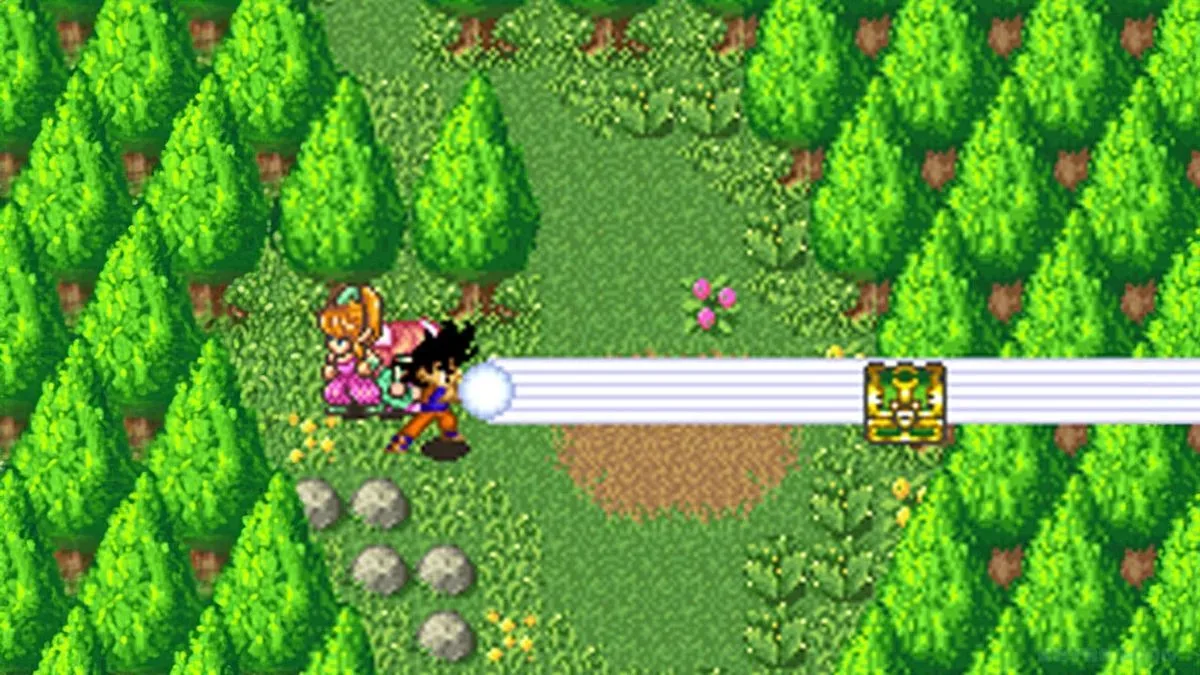
Secret of Goku is a work-in-progress ROM hack that gives the SNES action RPG Secret of Mana an extremely different leading man: Goku. Created by Mikola Lysenko with assistance from Claude, the project reworks the familiar adventure around Dragon Ball-style movement and attacks, including punches, ki blasts, flight, Instant Transmission and Kamehameha.
The premise is gleefully abrupt. Goku’s Saiyan pod lands in Potos at the moment the Mana Sword is removed, crushing the original hero and sending Goku on the journey in his place. It is a crossover setup built for speed rather than solemnity, but it also signals the hack’s more meaningful goal: changing how players move through and interact with an established SNES world.
Secret of Goku can currently be played in a web browser without a download, while a separate SNES cartridge-oriented patch route is also available for people who own the required game data. Its current status matters, though. Large encounters can produce slowdown, and the cartridge version has been tested in emulators rather than on original SNES hardware.
Goku is more than a character-sprite replacement
A simple character swap changes the look of a game. Secret of Goku aims for something broader by giving its new protagonist abilities associated with Dragon Ball. Goku can punch enemies and fire ki blasts, but the project also lets him fly over chasms and break through walls and ceilings. Those actions have direct consequences for traversal, combat and the shape of the game’s spaces.
Ki blasts are energy-based attacks in Dragon Ball terminology. In the hack, they provide a ranged way to deal damage, changing the feel of encounters that would ordinarily be approached using the base game’s weapons and systems. Flight is equally consequential: crossing a chasm removes a conventional barrier and turns terrain into something Goku can bypass rather than navigate around.
Breaking walls and ceilings is a further departure from a normal RPG toolset. Environmental destruction can change the player’s route through a location, potentially making exploration feel less like following fixed corridors and more like exploiting superhero-scale mobility. The supplied details do not establish how broadly these abilities apply across the adventure, so it is best viewed as an ambitious reinterpretation rather than a complete map of every altered area.
The latest update reportedly has Instant Transmission and Kamehameha functioning properly. Instant Transmission is Goku’s teleportation technique, while the Kamehameha is his signature energy-wave attack. Their inclusion is important because crossover projects can often stop at recognizable visuals. Here, the character’s identity is being expressed through mechanics: rapid repositioning, powerful projectile attacks and movement that ignores ordinary level geometry.
A browser route lowers the barrier to curiosity
The browser version is the immediate way to see the project in action. That approach avoids installing a separate application or arranging console hardware, making it easy for curious players to try the hack on an existing device. Browser access has become a useful format for retro-game experiments because it can make a fan project approachable even for someone without a flash cartridge or a dedicated emulation setup.
Related coverage includes Secret of Goku ROM Hack Brings Ki Blasts to Secret of Mana.
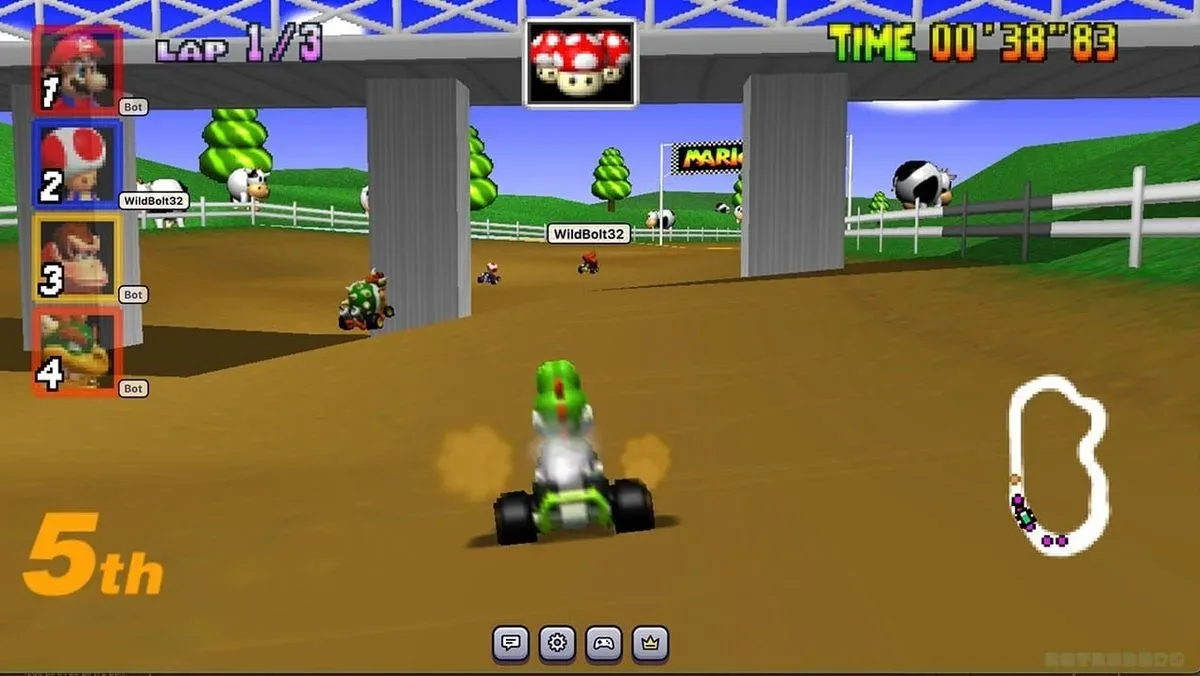
There is a useful parallel in the growing appetite for retro experiences that can be reached with minimal setup. A Mario Kart 64 browser port built around instant online races and private rooms similarly illustrates why the format gets attention: the first hurdle is smaller when the game can be opened rather than installed.
That convenience should not be mistaken for a final technical verdict. Secret of Goku is still being tuned, and the current report notes that big battles may lag. In this context, lag means the game’s action can slow when the system is handling a particularly demanding scene. It is a practical issue for a combat-focused hack, especially one adding flashy attacks and large-scale action to a game originally built around different assumptions.
For players, that makes the browser build a convenient way to follow an evolving project, not necessarily evidence that every situation has reached a finished performance standard. The presence of an openly acknowledged slowdown issue is valuable information: it sets a realistic expectation that further optimization may be required.
What the SNES patch requires
For an SNES-oriented setup, the project requires a legally acquired, unmodified and headerless copy of the U.S. version of Secret of Mana to be patched. The specified file is identified by CRC32 D0176B24.
That string is a checksum identifier. A CRC32 value is a compact code generated from a file’s contents. Matching the requested value helps confirm that a user has the exact expected revision before applying a patch. This is particularly useful for ROM hacks because regional versions, revisions, modifications and extra headers can all result in files that differ from what the patch expects.
A headerless ROM, in this case, means the file does not include an additional header section that may be present in some dumps. The distinction can affect file offsets—the positions where a patch expects to make changes. If a patch is designed for a headerless file but receives one with an extra header, the modified data can land in the wrong place and fail to work as intended.
The supplied instructions are therefore specific: use the legal U.S. game file in its unmodified, headerless form and verify CRC32 D0176B24 before patching. That is not merely administrative detail; it is the compatibility baseline for this version of Secret of Goku.
Emulator support is not the same as original-console proof
The hack has a cartridge port, but it has not yet been tested on an actual SNES. It has been tested through emulators. That distinction is worth keeping clear for anyone picturing the project running from a flash cart on period hardware.
An emulator is software or hardware that recreates the behavior of a console so games can run elsewhere. A flash cart is a cartridge-shaped device that can load software from storage for use on compatible hardware. Both are relevant to retro projects, but emulator success alone does not prove that every timing, performance or compatibility detail will behave identically on a real console.
That does not diminish the appeal of the cartridge path. It simply means the real-SNES use case remains unverified at this stage. Anyone considering a flash-cart setup should treat it as an option tied to the project’s ongoing testing rather than an established guarantee.
The interesting part is the collision of design languages
Secret of Mana is recognized as a major SNES RPG, a game many players know closely. That familiarity is what makes Secret of Goku’s approach more interesting than a novelty costume. The hack inserts a hero defined by aerial movement, explosive attacks and teleportation into a world remembered for a very different kind of action-adventure structure.
There is an inherent tension in that collision. RPG environments are often designed around gates, routes and obstacles; Goku is designed to make obstacles look negotiable. Letting him soar over a gap or blast through part of the scenery can create a satisfying power fantasy, but it also asks whether the new tools preserve, skip or reshape the intended sequence of a location. The available details show that the hack embraces this question rather than avoiding it.
It is also a project with an explicitly disclosed AI-assisted component. Lysenko used Claude in the work, a detail that will matter to players with different views on AI-assisted coding. The key factual point is straightforward: the project is presented as having been developed with that assistance. Players can decide for themselves how that affects their interest, while judging the hack’s technical progress separately through its features, performance and hardware testing.
For now, Secret of Goku is best understood as a playful but technically ambitious reinterpretation still in active refinement. It offers an unusually low-friction browser option, a more traditional patch route for eligible owners of the specified game file, and a set of Dragon Ball-inspired abilities that promise to make an old SNES quest behave in dramatically unfamiliar ways. Its lingering slowdown in major battles and lack of real-console testing are important caveats—but they are also reminders that this is a living hack, not a finished commercial rerelease.