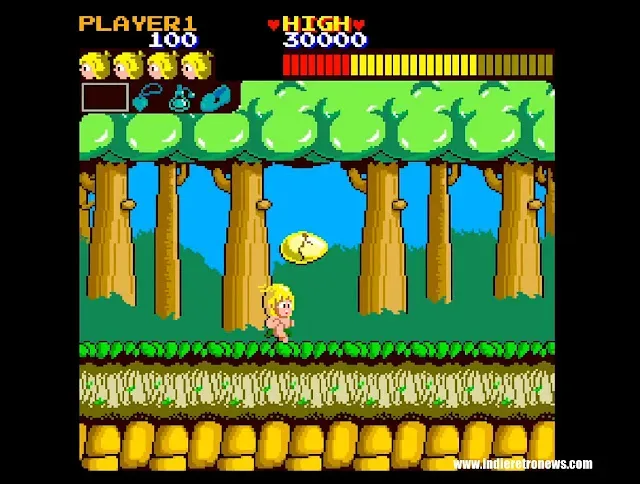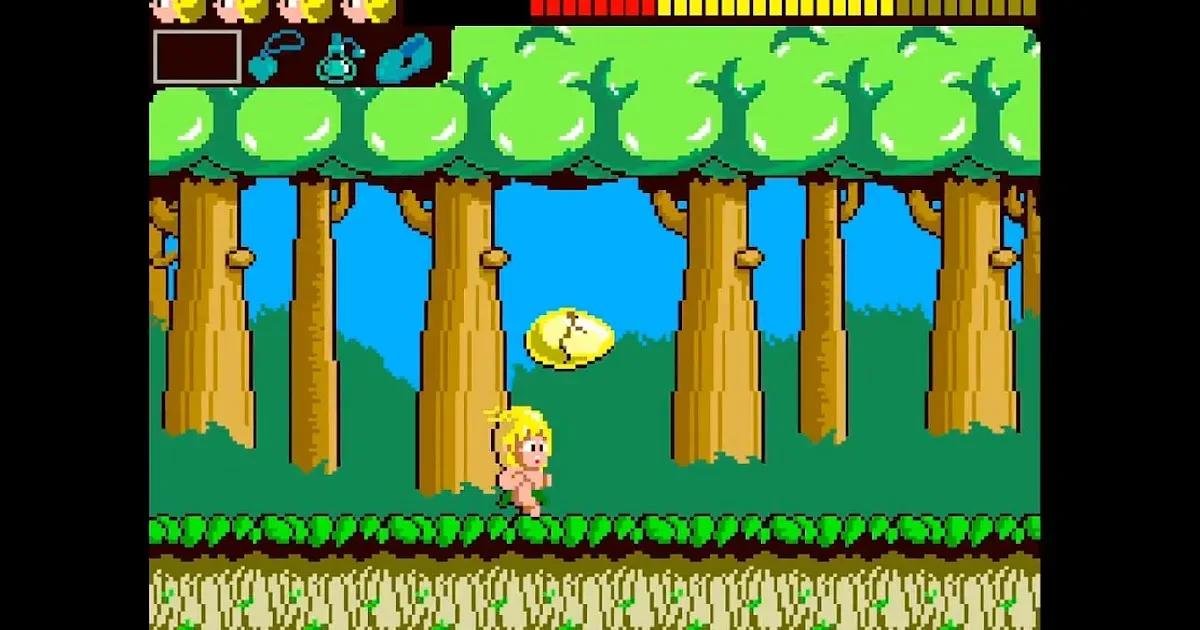
Tom-Tom’s fruit-powered dash through Wonder Boy has a new route onto two classic home-computer and console families. Developer ShinobiZ has produced versions of the 1986 arcade game for Commodore Amiga and Sega Mega Drive/Genesis, described as a native rewrite in 68000 assembly based directly on the original Sega System 1 arcade program logic, with AI assistance used in the development process.
The project’s stated ambition is substantial: preserve the arcade game’s full-speed action, enemy behaviour, collision detection and scoring while making use of the distinct audio hardware in Sega’s 16-bit console and Commodore’s machines. It also adds the sort of operating and settings options that matter enormously on original hardware, from PAL/NTSC detection to high-score saving and configurable arcade rules.
That means this is not framed simply as a visual recreation of an old game. Its focus is the original game’s rules: a brisk platform run in which a constantly declining vitality meter makes fruit collection part of basic survival rather than decoration. For players who know Wonder Boy chiefly through its bright scenery and iconic skateboard, that pressure is the important reminder. The game asks for forward movement, quick reactions and route knowledge, then keeps raising the stakes by making hesitation costly.
A port built around the arcade game’s underlying behaviour
ShinobiZ describes the release as a “native 68000 assembly rewrite.” In practical terms, native means software made to run directly on the target machine rather than relying on an external compatibility layer. Assembly is a low-level programming language closely tied to a processor’s instruction set. A 68000 is the Motorola-family processor associated with both the Mega Drive/Genesis and many Amiga configurations.
That shared processor family gives the project a meaningful technical common ground, but it does not make the two targets identical. The machines handle sound and the wider system environment differently. The stated approach is to adapt the game for each platform while retaining the gameplay logic that governs what enemies do, when collisions register and how points are counted.
Those last details can decide whether a classic arcade conversion merely resembles the original or genuinely feels coherent under the player’s hands. Collision detection is the code that determines whether Tom-Tom has struck an obstacle, landed on an enemy, collected fruit or been hit. Enemy behaviour covers the patterns and reactions of hazards encountered on a run. Scoring systems establish how the game recognizes the actions worth points. Alter any of those without care and players can face jumps that look familiar but resolve differently, or runs whose risk-and-reward balance has changed.
The developer says both versions run at full arcade speed. That is a claim about performance rather than a substitute for a frame-by-frame comparison, but it identifies the priority clearly: the rapid arcade pacing is meant to be retained rather than softened for home hardware. For a game built around a draining vitality meter, speed is not an incidental flourish. It dictates how long players have to read hazards, collect food and commit to jumps.
The old arcade loop is still the point
Wonder Boy casts players as Tom-Tom, who travels through eight distinct areas and 32 rounds on a mission to rescue Tanya after she is kidnapped by the evil King. The port keeps the recognizable ingredients of that journey: running, jumping, throwing stone axes, riding skateboards and gathering fruit.
Related coverage includes Wonder Boy Returns to Amiga and Mega Drive in New 68000 Port.
Fruit is central because Tom-Tom’s vitality is continuously falling. The player is therefore managing two demands at once. There is the immediate platforming problem—getting past enemies and terrain—and there is the ongoing need to replenish the resource that keeps the run alive. A missed pickup is not necessarily a harmless lapse in score optimization; it can reduce the margin for error later in the stage.
That makes the game a useful contrast to slower exploratory platformers. Its levels may invite players to admire their themes and obstacles, but the rules encourage momentum. The skateboard compounds that feeling. It is part of the game’s action vocabulary, alongside the jump and stone axe, and reinforces a design in which maintaining control at speed matters as much as spotting danger.
Completion-minded players have another objective: finding all 28 hidden dolls. The port description says collecting every doll unlocks a secret eighth area. That wording sits alongside the description of the main journey as eight areas and 32 rounds, so it is best read as a stated hidden-area reward rather than an attempt to infer how the game counts its standard areas. Either way, the dolls give repeat runs a purpose beyond survival and score.
They are also a good example of why arcade-era games can reward knowledge as much as reflex. A hidden-item requirement turns familiar stages into spaces to study. Players may need to weigh a safer line against one that appears to lead toward a secret, all while the vitality clock continues to apply pressure. The result is a different kind of challenge from a straightforward clear: not just reaching the end, but reaching it after making the right discoveries.
Platform-specific sound, shared gameplay goal
Both editions have music and sound effects tailored to their respective hardware. The Mega Drive version uses the console’s dedicated sound chips, while the Amiga version uses Paula, the Amiga audio chip. The supplied details do not set out a track-by-track comparison, and it would be premature to treat either version as definitively superior on sound alone. What is clear is that the project is not presenting one generic audio output copied unchanged between systems.
That distinction matters because sound is part of a fast arcade game’s feedback. Effects can reinforce an attack, a pickup, a hit or a successful leap; music sets the energy of the run. Hardware-specific implementation does not automatically guarantee identical audio character, but it recognizes that the Mega Drive and Amiga have their own technical identities.
There is a broader retro-development lesson here. Preserving a game’s rules does not always mean forcing every output to be exactly the same. A thoughtful port can aim to reproduce the gameplay structure while using each machine’s own sound facilities. The key question is whether those differences support the original’s pace and clarity rather than obscuring them.
Readers interested in the craft of rebuilding older game technology may also want to see how a different kind of legacy feel was approached in a playable JavaScript reconstruction of early GTA-style driving physics. The projects are not the same kind of game or platform, but both illustrate how much of a classic experience resides in underlying rules rather than surface appearance.
Options for home hardware and repeat sessions
The new Wonder Boy ports include a complete demo mode, a free-play option, taking-turns multiplayer, high-score saving and an arcade settings menu. These features do not change Tom-Tom’s core goal, but they make the conversion more practical for different ways people use old systems.
- Demo mode typically lets the game demonstrate its action without player input, echoing the attract-mode role of an arcade cabinet.
- Free play removes the usual credit constraint, which is particularly useful for practice and for learning demanding routes.
- Taking-turns multiplayer is a shared-session format in which players alternate attempts instead of playing simultaneously.
- High-score saving preserves records through Mega Drive cartridge memory or Amiga floppy disk, depending on the version.
- Arcade settings allow adjustments including starting lives and difficulty, giving players more control over challenge level.
For a game with a fast fail-and-retry structure, these options have practical value. Free play can let newcomers learn the rhythm of fruit collection and hostile encounters without repeatedly restarting a credit cycle. Difficulty and life settings can make the game more approachable for a casual session or more demanding for players chasing an arcade-style test. Saved scores, meanwhile, make improvement visible over time and provide a natural focus for turn-based competition.
The mention of automatic PAL and NTSC detection is another hardware-aware detail. PAL and NTSC are television and video standards historically associated with different regions and timing characteristics. Automatic detection is intended to identify the relevant environment without requiring players to manually select it. It is the kind of convenience feature that can matter when software is used across original regional machines and compatible setups.
What each version requires
The Mega Drive version is listed as compatible with any PAL or NTSC Mega Drive/Genesis. It can also be used with emulators including Genesis Plus GX, BlastEm and MAME. This gives players a choice between original console hardware and software emulation, without suggesting that every setup will necessarily produce the same display, controller or audio experience.
On Amiga, the baseline requirement is an OCS/ECS machine with Kickstart 1.3 or later and 1 MB of memory, specified as 512 KB chip memory plus 512 KB. The game is also listed for enhanced mode on AGA machines, including the Amiga A1200 and A4000.
The terminology is worth unpacking. OCS/ECS and AGA refer to generations of Amiga chipset capabilities, while Kickstart is the Amiga firmware environment identified in the compatibility requirement. Chip memory is memory accessible to the machine’s custom chips, hence its relevance in a game requirement. The supplied information identifies AGA as offering an enhanced mode, but does not detail precisely which visual, audio or performance differences that mode introduces.
Amiga users can boot the game from floppy disk, start it from Workbench or install it to a hard disk. Workbench is the Amiga desktop environment. The stated emulator options are WinUAE and FS-UAE. Together, those choices accommodate several common Amiga habits: using a physical floppy, launching from a system environment, installing to storage, or configuring a virtual Amiga setup.
AI assistance is part of the project’s stated provenance
The developer explicitly describes AI as having assisted the rewrite. That will be relevant to some prospective players, particularly because retro ports often attract attention not only for the resulting game but for the methods used to create it. The supplied details identify AI assistance, but they do not specify which parts of development involved it, what tools were used or how much of the implementation it covered. It would therefore be inaccurate to make broader claims about authorship, quality or the process beyond that disclosure.
Players who prefer a non-AI-assisted alternative have another named option: Acidbottle released a Wonder Boy version using the Scorpion Engine in 2023. The existence of more than one contemporary route to the same arcade classic is notable in itself. It shows the continuing interest in bringing foundational arcade designs to systems that were not their original home, while leaving players to decide which interpretation and development approach they wish to support.
For the ShinobiZ release, the clearest appeal is its stated combination of arcade-logic preservation, native 68000 development, platform-specific sound and useful home-system amenities. At its heart remains the same urgent proposition: keep Tom-Tom moving, keep collecting fruit, and do not let a deceptively cheerful sprint become a very short one.