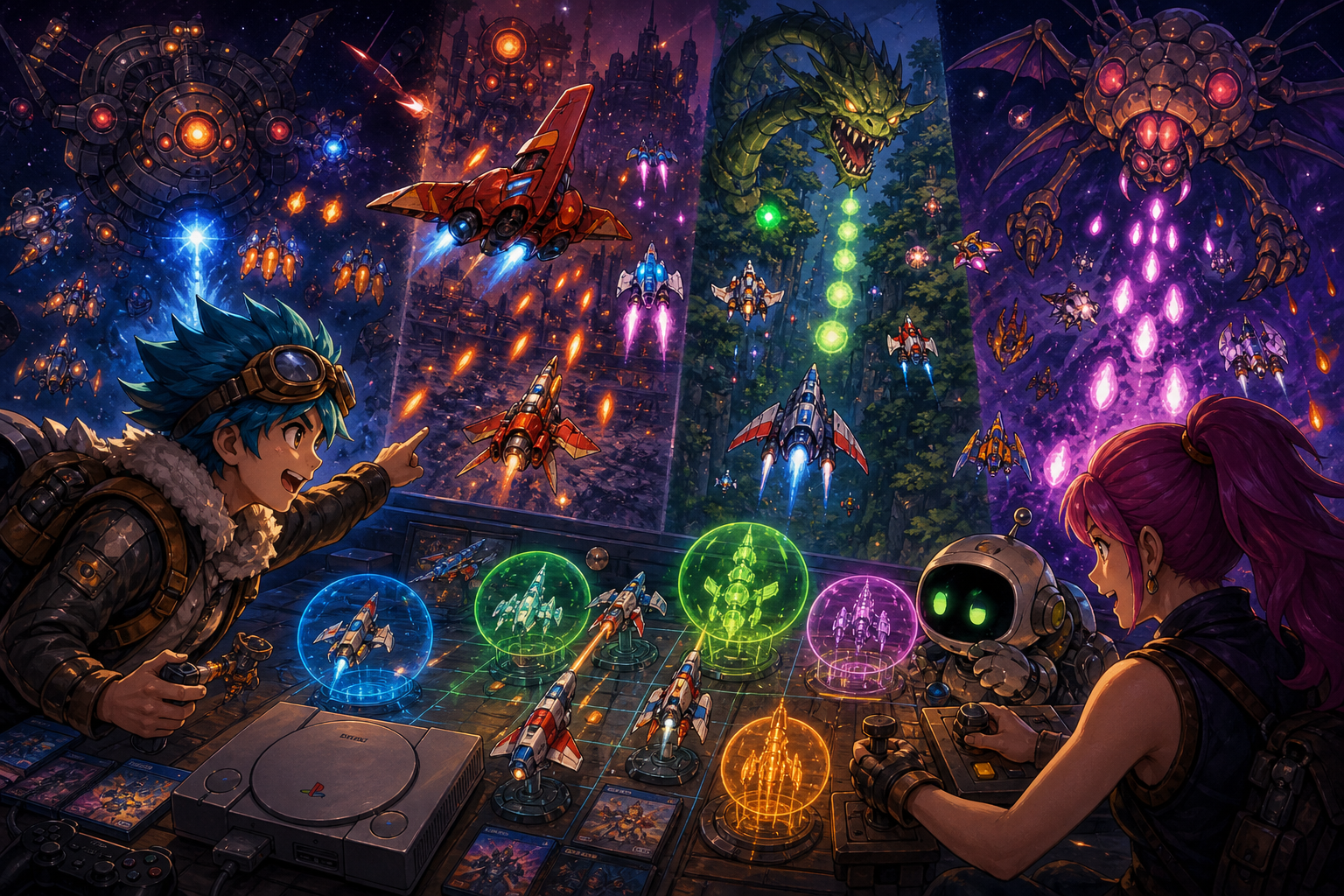
The original PlayStation’s shoot-'em-up library is easy to overlook. Sony’s 32-bit console became associated with polygonal adventures, cinematic role-playing games and fighting games, while many of its best shooters remained imports, late releases or ports from arcade and Saturn hardware. Look more closely, however, and the system offers a useful cross-section of the genre: deliberate Force control, branching routes, lock-on targeting, power meters, adaptive weapons and spectacular mechanical bosses.
This ranking considers ten shoot-'em-ups released for the original PlayStation. Weapon strategy comes first, followed by scrolling and stage variety, scoring or survival depth, arcade identity, presentation and the importance of each particular PlayStation edition. The list includes horizontal and vertical shooters, original console projects, arcade conversions and one unusually valuable compilation. It does not treat every game as bullet hell, and it does not confuse regional availability with quality.
10. Philosoma
Philosoma is an unusual place to begin because it does not behave like a straightforward arcade conversion. Its campaign moves between vertical and horizontal perspectives, producing a deliberately disorienting journey in which the direction of scrolling can change the player’s relationship with incoming threats. That structural oddity gives the game a stronger identity than its reputation as an early PlayStation shooter might suggest.
Its four main weapon types, upgrade levels and secondary weapons make survival more than a matter of holding the fire button. The system rewards learning which tools suit each encounter, although the presentation and pacing can feel less immediately readable than the more polished games higher on this list. Philosoma is best for players interested in early PlayStation experimentation rather than pure arcade efficiency.
The tradeoff is consistency. Its perspective shifts and weapon choices are memorable, but they do not always create the same elegant rhythm found in R-Type Delta or Einhänder. Still, it earns a place by showing Sony’s console attempting a distinctly atmospheric space shooter instead of simply reproducing a familiar cabinet.
- Best for players who want an unconventional, console-focused shooter.
- Expect varied scrolling rather than one consistent arcade perspective.
- Its weapon system is more important than score-chasing refinement.
9. The Raiden Project
The Raiden Project is an excellent gateway to the PlayStation’s shooter library because it places two established arcade games on one disc: the original Raiden and Raiden II. That structure gives the package a useful historical range. The first game establishes the series’ direct, readable shooting, while the sequel expands the arsenal and visual spectacle without abandoning the fundamentals of deliberate positioning and enemy-pattern recognition.
Its one- or two-player cooperative play is a major part of the appeal. A second player changes the screen from a private pattern-reading exercise into a shared contest over space, targets and survival. Difficulty settings, credit limits, remixed music and memory-card high-score saving also help the package feel designed for home use rather than treated as a bare arcade transplant.
The Raiden Project ranks below more distinctive PlayStation games because its weapon strategy remains comparatively traditional. That is also its strength. Players who want a clean vertical shooter with familiar rules, immediate feedback and a strong two-player option should start here, while experimenters may soon want something more structurally unusual.
- Best entry point for traditional vertical shooting.
- The package contains both Raiden and Raiden II.
- Two-player cooperation gives it value beyond solo score attacks.
8. Darius Gaiden
Darius Gaiden brings the series’ broad horizontal battlefields, enormous mechanical bosses and route selection to PlayStation. Its branching stage structure makes each run a choice rather than a fixed march, and repeated play reveals different encounters, patterns and tactical demands. That branching is especially valuable in a home game, where the player can return to a familiar opening while deliberately pursuing a different route.
The game’s capture mechanic is more limited than the one later associated with G-Darius: Darius Gaiden lets players capture certain midbosses and use them temporarily, rather than turning nearly every ordinary enemy into an ally. That distinction matters because capturing a midboss becomes a carefully timed tactical opportunity instead of a routine part of every encounter. Choosing when to preserve the opportunity, destroy the target or rely on the black-hole bomb changes the rhythm of a run.
This is not the same game as G-Darius. Darius Gaiden is a sprite-driven horizontal shooter with its own route structure and boss design, while G-Darius pushes the series toward polygonal spectacle and a broader capture system. The PlayStation edition is a strong choice for players who prefer branching exploration and giant boss encounters to the tighter lane discipline of a vertical shooter.
- Choose it for branching routes and horizontal stage flow.
- Capture is focused on selected midbosses, not nearly every enemy.
- Do not use Darius Gaiden and G-Darius as interchangeable names.
7. RayStorm
RayStorm changes the central question from “Which weapon should I equip?” to “How many targets can I manage before firing?” Its lock-on attack lets the player mark enemies and release a concentrated volley, creating a rhythm built around target selection, movement and timing. That makes the game feel different from power-meter shooters such as Gradius Gaiden or The Raiden Project.
The vertical stages are supported by a strong 3D visual treatment. Polygonal backgrounds, large structures and changing depth cues give the game a more modern PlayStation-era identity without turning it into a slow cinematic experience. The screen remains focused on attack lanes and enemy formations, but the surrounding world makes each stage feel like a larger assault rather than a sequence of abstract patterns.
RayStorm is less flexible than the most weapon-rich games here, and the lock-on system can take time to read properly. Once understood, however, it offers a satisfying balance between planning and aggression. It suits players who want a shooter built around chaining targets and controlling the screen, not collecting a large inventory of guns.
- Best for lock-on targeting and controlled aggression.
- Its vertical structure is enhanced by polygonal environments.
- A poor target-selection habit can waste the system’s greatest advantage.
6. Zanac X Zanac
Zanac X Zanac is historically valuable because it combines the original Zanac with Zanac Neo, a much more ambitious 32-bit reinterpretation. The package therefore shows two different approaches to adaptive shooting: the older game’s rapid, system-driven pressure and the newer game’s expanded presentation, multiple ships, upgradable arsenals, cutscenes and two-player cooperation.
The original Zanac is notable for how much its enemy activity and weapon pressure can change the player’s priorities. Zanac Neo builds on that idea with a more elaborate visual identity and a broader sense of scale. Rather than treating the compilation as one uniform game, it is better understood as a conversation between two eras of shooter design.
Its position reflects access and focus as much as mechanical quality. Players seeking a single perfectly polished arcade run may find the package less cohesive than Einhänder or R-Type Delta. Players interested in how a classic shooter formula could be expanded for PlayStation hardware will find one of the system’s most revealing sets.
- Best for comparing classic and 32-bit shooter design.
- Zanac Neo adds multiple ships, polygonal effects and cooperative play.
- Treat the package as two related experiences, not one conventional campaign.
5. Thunder Force V: Perfect System
Thunder Force V: Perfect System turns forward momentum into its defining weapon. The side-scrolling stages are built around pressure from ahead, encouraging the player to keep moving while switching weapon behavior and using stronger blast modes at the right moment. Its arsenal does not merely provide cosmetic variety; choosing how to attack can determine whether a crowded section becomes a controlled advance or a desperate retreat.
The PlayStation version matters for regional history. Thunder Force V first appeared on Saturn, then reached PlayStation, and the PlayStation edition was the only version released outside Japan. That makes it especially important to distinguish the game’s original platform history from the particular edition that introduced it to more players in North America through Working Designs.
The game ranks in the middle because its relentless action can be less accommodating than the route-based Darius titles or the lock-on clarity of RayStorm. For players who want aggressive horizontal shooting, weapon behavior and a sense of constantly pushing into danger, it remains one of the PlayStation’s strongest choices.
- Best for fast horizontal action and forward pressure.
- It debuted on Saturn before reaching PlayStation.
- Regional edition history is part of its importance, not a reason to call it a PlayStation original.
4. Gradius Gaiden
Gradius Gaiden is the most refined expression of the classic power-meter formula on this list. Instead of collecting a generic stream of upgrades, the player moves through a carefully ordered meter, deciding whether to prioritize speed, missiles, double fire, lasers, options or defensive equipment. A mistake can leave a ship underpowered, while a well-timed sequence can transform the same stage into a controlled exercise in preparation.
Four selectable starfighters and expanded shield options give the game more variety than a single-character campaign. Two-player cooperation adds another layer of decision-making, because both players must share screen space, manage threats and avoid turning the formation into chaos. The game’s challenge is demanding, but its rules are unusually transparent once the power system is understood.
There is one important edition limitation: the original PlayStation release of Gradius Gaiden was Japan-only. That matters for anyone approaching it through original software, but it does not reduce its value as a game. Import-minded players get one of the most complete classic-style shooters on the system; newcomers should be prepared for a more exacting arcade structure.
- Best for players who enjoy planning a power-meter build.
- Four ships and two-player play expand its replay value.
- The original PlayStation release was Japan-only.
3. G-Darius
G-Darius is where the PlayStation’s polygonal capabilities become part of the Darius identity. The stages remain horizontal and route-based, but the backgrounds and bosses carry a larger sense of depth and mechanical scale. Giant creatures and machines occupy the screen with an intimidating presence, making each route feel like a carefully staged confrontation rather than merely another sequence of enemy waves.
Its capture system remains central. A captured enemy can attack alongside the player, and deciding when to preserve, deploy or sacrifice that resource gives the game a tactical layer that separates it from straightforward weapon collectors. Branching routes further encourage experimentation, since the player can choose different challenges instead of repeating one fixed sequence.
The PlayStation edition also includes additional content such as Beginner Mode and a boss-focused mode. Those additions make it more than a simple home conversion and give different kinds of players a reason to return. G-Darius is the best choice here for players who want spectacular bosses without giving up meaningful control over the route and arsenal.
- Best for giant bosses and enemy-capture strategy.
- Branching routes make repeated runs meaningfully different.
- Its polygonal presentation is central to its PlayStation-era identity.
2. R-Type Delta
R-Type Delta takes the classic R-Type idea of controlled movement and makes it feel severe, deliberate and modern. Its Force weapon remains the foundation: attach it for protection and concentrated fire, detach it to cover another angle, and charge attacks for moments when ordinary firepower is not enough. The player is always balancing position, timing and the safest location for the Force.
Three R-Class ships—the R-9, R-13 and prototype R-X—give the game distinct approaches without turning the campaign into a collection of unrelated characters. The differences encourage replay because the same stage patterns can demand different responses depending on the ship’s behavior and attack profile.
The presentation is stark and heavily 3D, but the spectacle never replaces pattern learning. R-Type Delta expects the player to remember enemy timing, recognize hazards and move with restraint. It is not the most welcoming game on this list, yet its systems are so tightly connected that every successful advance feels earned. Players who prefer precision and memorization over improvisational weapon collecting should put it near the top.
- Best for deliberate movement and Force-weapon control.
- Three ships provide different tactical approaches.
- Its difficulty rewards pattern knowledge more than reckless aggression.
1. Einhänder
Einhänder earns the top position because its weapon system, scoring structure, presentation and stage design all reinforce one another. Square’s side-scrolling shooter lets the player collect modular Gunpod weapons from defeated enemies, turning enemy destruction into an opportunity rather than a routine. The useful weapon is often the one currently available, so the player must decide whether to hold a powerful tool, switch immediately or spend it during a dangerous section.
That decision-making gives Einhänder a distinctive rhythm. Its scoring rewards aggressive play, but aggression must remain controlled because losing the wrong weapon can alter the next encounter. Stages use a striking polygonal presentation and a strong sense of urban-industrial scale, giving the game a PlayStation-specific identity instead of making its 3D visuals feel decorative.
Einhänder is not necessarily the easiest recommendation for a first shooter. Its systems become more rewarding as the player learns enemy placement, weapon behavior and scoring opportunities. It is the strongest overall package because it feels designed around the console’s strengths while remaining recognizably arcade-minded. For weapon tinkerers, score chasers and players who want an original PlayStation shooter rather than a famous port, it is the essential starting point.
- Best overall for weapon decisions and PlayStation-specific presentation.
- Gunpods collected from enemies create changing tactical options.
- Learn enemy placement before treating the game as a pure reflex challenge.
The best starting point depends on the kind of shooting you want. The Raiden Project offers the clearest traditional arcade foundation, Gradius Gaiden rewards power-meter planning, R-Type Delta favors precision, and Darius Gaiden or G-Darius make route selection and enemy capture central. RayStorm is the lock-on specialist, while Thunder Force V is the pick for relentless horizontal momentum.
Einhänder stands above the group because its weapon collection, scoring, stage presentation and enemy design form one coherent identity. Together, these ten games show that the original PlayStation was not merely a home for famous role-playing games and polygonal adventures. It was also a remarkably varied machine for shooters, provided players were willing to look beyond the most visible parts of its library.