The Nintendo DS puzzle library is broader than its most famous brain-training and puzzle-adventure releases. Some games turn the touchscreen into a precise logic board; others make it an aiming surface, a battlefield or a frantic space for manipulating falling pieces. The best examples do not merely move familiar puzzles onto a handheld. They make the DS hardware part of the answer.
This ranking weighs the quality of each central puzzle loop, touchscreen ingenuity, replay value, dual-screen usefulness, challenge variety and suitability for short or extended sessions. It includes pure logic games, reflex-driven puzzlers and hybrids where solving puzzles directly affects combat or exploration. Professor Layton is left out because its puzzle-adventure identity overlaps with existing Nintendo DS adventure coverage. Original Nintendo Wi-Fi Connection features are described historically because the service ended on May 20, 2014.
The list also accounts for regional naming. The North American Clubhouse Games is known as 42 All-Time Classics in Europe, so the opening entry refers to both titles rather than treating them as separate games. Puzzle Quest is included as its Nintendo DS release, not the later DSiWare version.
10. Clubhouse Games / 42 All-Time Classics
Clubhouse Games, known as 42 All-Time Classics in Europe, earns the final place because it understands one of the DS’s simplest strengths: the system can turn a collection of tabletop rules into quick, readable activities controlled with buttons, stylus gestures or both. Its broad selection includes card, board and logic-style diversions, making it useful for players who want variety rather than one deep mechanical system.
That breadth is also the limitation. A dedicated puzzler can refine one idea through escalating layouts, speed pressure or increasingly demanding deductions. Here, individual activities have less room to develop, and the package’s appeal depends on finding a few favorites among many compact diversions. It is best for short sessions, simple local multiplayer and households with different tastes, not for someone seeking a single puzzle system to master. Its regional title difference is worth remembering when searching for the correct release.
- Best for: short sessions, varied tastes and simple local multiplayer.
- Tradeoff: breadth replaces the sustained depth of a focused puzzle game.
- Edition note: Clubhouse Games is the North American title; 42 All-Time Classics is the European title.
9. Peggle: Dual Shot
Peggle: Dual Shot makes every level a question of trajectory, risk and controlled repetition. The player aims a shot, studies the arrangement of targets and tries to convert a limited number of attempts into a clear board and a strong score. The touchscreen gives the act of aiming a direct physical quality, while the DS presentation keeps the next decision visible without overwhelming the playfield. The cartridge also packages Peggle and Peggle Nights content, giving the release more scope than a single short campaign.
Its replay depth comes from the difference between merely finishing a stage and learning its angles. Bounces, target placement and remaining shots create a small planning problem inside an approachable arcade loop. The structure is less about deduction than prediction and refinement, so players who prefer nonograms or tile logic may find it light. For those who enjoy experimenting with lines and improving a nearly successful attempt, it is unusually readable and satisfying.
- Best for: trajectory planning and score-chasing without complicated rules.
- Tradeoff: repeated attempts matter more than long-form logical deduction.
- Control note: aiming can be handled through the DS interface, with the stylus giving the game its most distinctive handheld feel.
8. Henry Hatsworth in the Puzzling Adventure
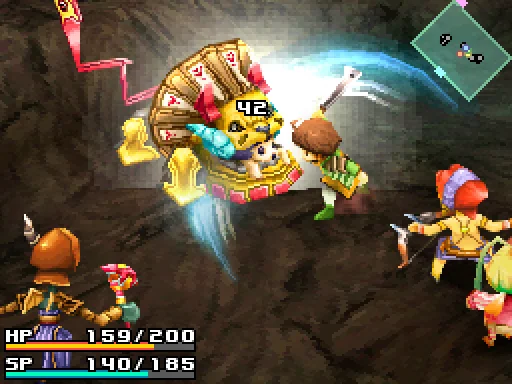
Henry Hatsworth is a hybrid, but its puzzle system is too important to treat as a decorative minigame. The game divides attention between platforming on the upper screen and a tile-based puzzle field below. Clearing pieces can manage enemies, create opportunities and influence what happens during the action portion, so the player is constantly switching between movement decisions and pattern recognition.
That connection gives the game a distinctive kind of pressure. A puzzle move is not isolated from the adventure; it can determine whether the next action sequence feels manageable or dangerous. The cost is complexity. Players looking for a calm, purely abstract puzzle may dislike the interruptions, while platformer fans may need time to read the lower screen. Its ranking reflects mechanical ambition and integration rather than purity of genre. It belongs here because the puzzle board is part of the game’s central combat economy, not because the adventure sections are incidental.
- Best for: players who want puzzle decisions tied to platforming consequences.
- Tradeoff: the split-screen structure is busier than a dedicated logic game.
- Genre note: this is a puzzle-platformer hybrid rather than a pure abstract puzzler.
7. Magnetica
Magnetica adapts the marble-shooter format to the DS with a track-based arrangement, incoming pressure and touchscreen aiming. The central decision is immediate: place or fire a matching marble before the chain advances too far, while looking for combinations that produce a larger clear. The stylus makes aiming feel deliberate rather than simply selecting from a menu, and short stages suit the DS’s pick-up-and-play character.
Its mechanical identity comes from the relationship between precision and tempo. A technically correct shot may still be poor if it arrives too late, while a quick move can create a better chain than a carefully delayed one. The format is easier to understand than many strategy-heavy puzzlers, but later pressure exposes mistakes quickly. It is a strong choice for players who want arcade urgency, tactile aiming and compact attempts rather than extended deduction.
Magnetica is also a useful example of how the DS could make a familiar puzzle format feel more physical. The touchscreen does not merely replace a cursor. It gives the player a direct way to set direction and commit to a shot, making accuracy part of the challenge.
- Best for: touchscreen aiming, escalating pressure and arcade-length sessions.
- Tradeoff: the core rule set is narrower than the most varied games here.
- Control note: the stylus is central to aiming, while the game remains readable as a traditional marble-matching puzzle.
6. Puzzle Quest: Challenge of the Warlords
Puzzle Quest belongs here because its match-three board is connected to a larger decision system. Matching pieces is not simply a way to earn points between story scenes: different matches can generate attacks, resources or other combat effects, while character progression, equipment and enemy behavior change the value of each move. The same board therefore asks both tactical and immediate questions.
That RPG structure gives ordinary matches consequences that survive beyond a single turn. A strong move can create momentum, but chasing a large combination may expose the player to a dangerous response. The result is more layered than a standalone match game, though it is also less pure. Players who want clean abstract puzzles may find the quests and progression distracting. Those who enjoy planning around character growth get one of the DS’s most effective puzzle hybrids.
The Nintendo DS version is distinct from the later DSiWare release. That matters for anyone researching editions: the cartridge release is the relevant version for a Nintendo DS ranking, while the DSiWare edition was a separate digital release with its own availability history.
- Best for: match-based combat, progression and enemy-specific decision-making.
- Tradeoff: story and RPG systems can overshadow the puzzle board.
- Edition note: distinguish the original Nintendo DS release from the later DSiWare version.
5. Polarium
Polarium is one of the clearest demonstrations of a puzzle mechanic built for a stylus. Its black-and-white grid asks the player to flip tiles in patterns that clear rows, turning a small gesture into a larger exercise in planning. The minimalist presentation helps the rule remain visible: success depends on understanding the effect of a line rather than memorizing a crowded interface.
The main puzzle collection contains 100 puzzles and gives the system room to teach, complicate and surprise. It also supports custom puzzle creation and wireless competition, making the game more than a fixed sequence of challenges. Those network functions should now be treated as part of the original design and preservation history, not as available online services. Polarium’s limitation is that its visual language and deliberate pace will not appeal to players seeking speed. For careful solvers, its restraint is exactly the attraction.
The game’s black-and-white rules also make it unusually easy to understand decades later. There are no complicated character statistics or opaque item systems between challenges. The pleasure comes from recognizing how one marked line changes the entire board.
- Best for: minimalist logic, line planning and stylus-based tile flipping.
- Tradeoff: slower, more deliberate play than the DS’s reflex-heavy puzzlers.
- Historical feature note: wireless play remains a local option, while original online services are discontinued.
4. Picross DS
Picross DS turns number-clue deduction into a particularly natural touchscreen activity. Each row and column supplies information about which squares should be filled, and the stylus makes marking possibilities feel close to working on a paper puzzle. The second screen supports instructions and presentation without interrupting the grid, while selectable visual styles add personality to an otherwise austere format.
Its main Picross mode contains 300 puzzles, ranging from small introductory grids to larger and more demanding problems. Custom puzzle creation, daily challenges, hint systems, unlockable variations and multiplayer features broaden the package beyond a single finite campaign. The original Nintendo Wi-Fi Connection elements are historical now, but the core nonogram design remains intact.
Picross DS ranks highly because it uses the touchscreen for notation and deduction, not merely for convenience. A player can mark squares, cross out possibilities and gradually turn a set of numbers into an image. That makes the hardware feel like a natural puzzle tool rather than a novelty layered over an older format.
- Best for: nonograms, careful marking and a large supply of structured logic puzzles.
- Tradeoff: original online downloads and competition cannot be used today.
- Feature note: custom puzzles, local multiplayer and daily play remain important parts of the original design, but Nintendo Wi-Fi Connection functions are discontinued.
3. Planet Puzzle League
Planet Puzzle League is built around quick recognition, chain construction and the pressure of a rising board. Instead of asking the player to calculate a distant solution, it rewards spotting relationships among tiles and acting before the field becomes unmanageable. That creates a rhythm in which observation and execution constantly trade places.
The game’s replay value comes from the gap between surviving and controlling the board. A player can clear a problem immediately, but better results require seeing future matches, building chains and maintaining composure as the pace rises. Competitive modes give the system another purpose, even though any original online functionality should be regarded as historical.
Planet Puzzle League also makes a notable control decision: players hold the DS sideways like a book and slide blocks with the stylus. That orientation gives the board a comfortable, spacious presentation while keeping the main action on one screen. It is a strong middle ground between calm logic and pure reflex. The rules are simple, but mastery depends on seeing patterns before they become obvious.
- Best for: fast pattern recognition, chain-building and competitive pressure.
- Tradeoff: it rewards speed and visual scanning more than patient deduction.
- Regional note: the European release is titled Puzzle League DS; North American players may encounter the title Planet Puzzle League.
2. Meteos
Meteos makes the touchscreen feel like an active play surface rather than a pointer aimed at buttons. Falling blocks must be manipulated quickly, and the player’s touch input can reposition the pieces that determine whether a line clears, a stack rises or a chain begins. The game’s audiovisual feedback reinforces the sense that every small adjustment can alter the entire field.
Its depth comes from escalation. Early moves are readable, but speed and stacking pressure demand increasingly confident decisions. Players are not only matching symbols; they are managing gravity-like movement, timing and the consequences of clearing one section while neglecting another. Different planets alter the feel of play through varying gravity rules, while additional modes and unlockable content give repeated sessions a reason to continue.
That gives Meteos a more kinetic personality than Picross DS or Polarium. It can be demanding when the board accelerates, but that pressure is central to its identity and makes repeated attempts meaningful. Few DS puzzle games make the stylus feel so directly connected to the motion of the entire playfield.
- Best for: rapid stylus manipulation, chain reactions and rising pressure.
- Tradeoff: its speed can be unforgiving for players who prefer unlimited thinking time.
- Variety note: planet-specific gravity and additional modes give the core system more range than a single ruleset suggests.

1. Tetris DS
Tetris DS takes the most familiar puzzle foundation on the list and gives it a surprisingly broad DS interpretation. Falling-block placement remains immediately readable, but the game uses the system’s screens and input options to present multiple ways of thinking about the formula. Some modes emphasize traditional stacking and speed; others use the second screen, themed presentation or different forms of pressure to make the classic feel newly situated.
That range is why it leads this ranking rather than simple familiarity. Tetris DS works as an accessible first puzzle game, a demanding score-chasing test and a multiplayer challenge, while its basic rules remain clear enough to survive every variation. The game is primarily associated with conventional button controls rather than being a wholly stylus-driven experience, but its dual-screen structure still gives the hardware meaningful work to do.
Tetris DS also benefits from mechanical clarity. A player can understand the basic objective immediately, then spend much longer learning the demands of each mode. That combination of accessibility, variety, replay depth and hardware-aware presentation makes it the strongest overall puzzle package on Nintendo’s handheld. Players seeking the most direct touchscreen interaction may prefer Meteos or Polarium, but Tetris DS offers the broadest complete experience.
- Best for: a complete mix of classic falling-block play, varied modes and multiplayer.
- Tradeoff: players seeking a wholly stylus-driven experience may prefer Meteos or Polarium.
- Control note: the DS hardware expands the presentation and mode design, but traditional Tetris play remains primarily button-led.
These ten games reveal three major Nintendo DS puzzle traditions. Picross DS and Polarium make the touchscreen a place for deliberate notation and deduction. Tetris DS, Meteos, Planet Puzzle League and Magnetica turn it into a space for timing, pattern recognition and controlled panic. The hybrids use puzzles as part of a larger structure: Puzzle Quest attaches matches to character decisions, while Henry Hatsworth makes them part of platforming pressure. Clubhouse Games and 42 All-Time Classics show a different strength, using the DS as a compact tabletop.
The strongest entries do not all use the hardware in the same way, and that is the point. The DS could make a stylus gesture precise, frantic, thoughtful or strategic. Whether a player wants a quiet grid, an arcade challenge or a puzzle system with consequences beyond the board, this library shows why the handheld remains one of the richest homes for inventive puzzle design.