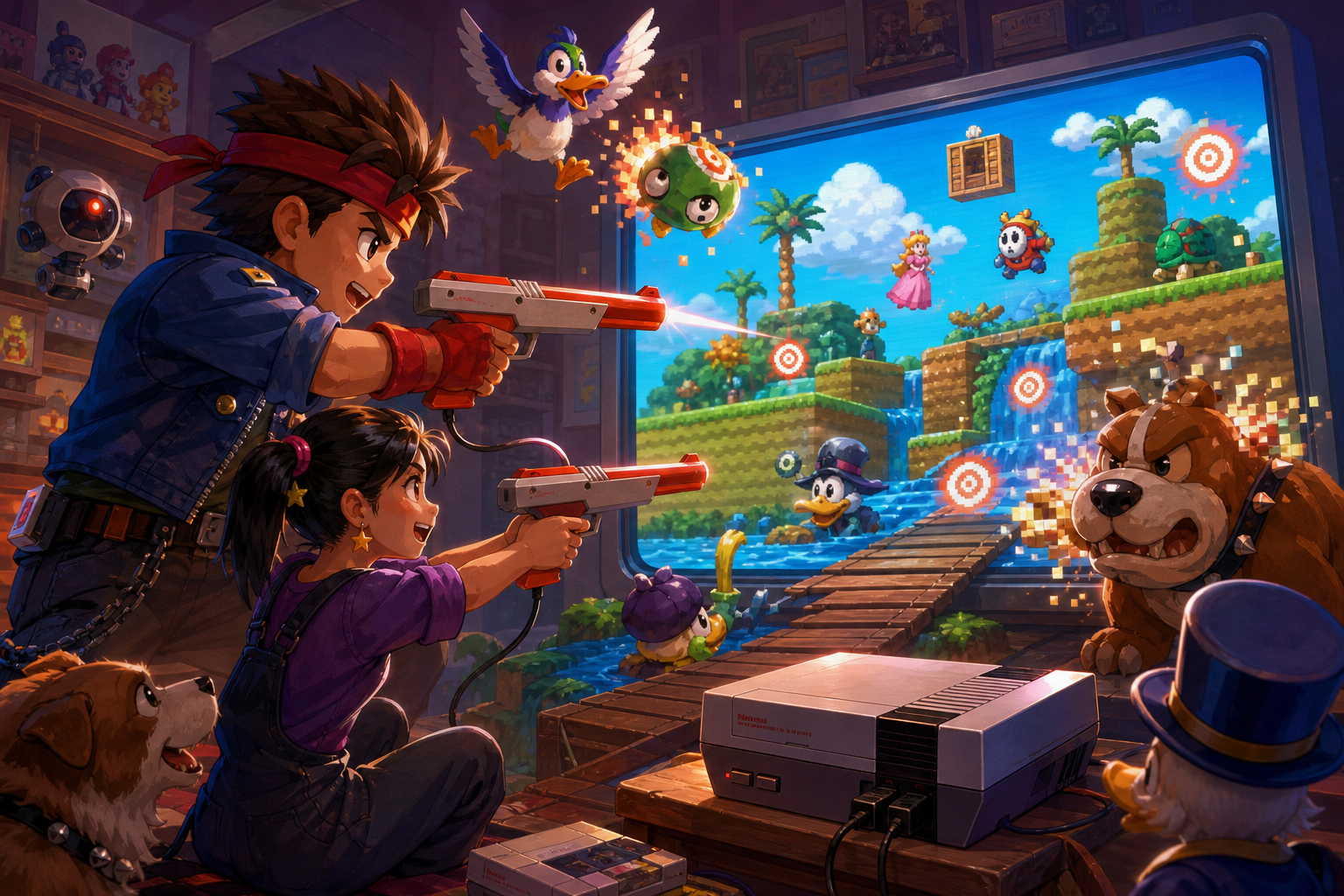
The NES Zapper is usually remembered through Duck Hunt, but the North American Nintendo Entertainment System library gives the accessory a much wider design history. Across licensed releases, the Zapper serves as a reaction test, a target-identification tool, a way to protect a moving character and a pointer for scrolling arcade combat. Some games require it; others also support the standard controller. That distinction matters because a Zapper-compatible game is not automatically built around the same kind of aiming.
This ranking uses North American NES releases as its boundary and judges ten distinct games by five related standards: aiming quality, target clarity, mechanical variety, replay pressure and how meaningfully the Zapper contributes to the design. A game does not rank highly simply because it uses a gun-shaped controller. The best entries make aiming create decisions, rhythm or tension that would be difficult to reproduce with an ordinary button press.
Combination cartridges are not counted as separate games. A package containing Duck Hunt remains a bundle that includes Duck Hunt, not another light-gun title. The list also excludes Famicom-only releases, regional curiosities and games where the Zapper appears only for a small bonus stage. The goal is a focused look at North American NES games whose identity is substantially connected to pointing and shooting at the screen.
10. Wild Gunman
Wild Gunman is the purest reaction duel in this group. Its central idea is simple: watch, wait and fire when the contest opens. The game reduces light-gun play to a contest of timing, restraint and nerve. The player is not sorting safe targets from dangerous ones or managing a long battlefield. The entire experience is about recognizing the moment to draw.
That narrow structure gives every successful shot a satisfying sense of timing, but it also makes the game less flexible than the multi-event galleries and scrolling shooters higher on this list. Its rules are easy to understand, which makes it useful for short sessions or quick challenges between players. There is little need for a lengthy explanation before the action begins.
Wild Gunman also has historical importance within the early North American NES Zapper catalog. Alongside Duck Hunt and Hogan’s Alley, it helped establish the idea that Nintendo’s new home console could reproduce a simple arcade-style shooting experience in the living room. It ranks tenth not because its central idea is weak, but because later games gave the same accessory more room for target selection, movement and sustained pressure.
- Best suited to: players who want a direct reaction challenge.
- Main strength: an immediately readable quick-draw concept.
- Main tradeoff: immediate rules, but very little mechanical variety.
- Why it belongs: it is a licensed North American NES Zapper release, not merely an accessory demonstration.
9. Hogan's Alley
Hogan’s Alley gives the Zapper a more thoughtful job than simply hitting every moving object. The player must identify appropriate targets while avoiding figures that should not be shot, then handle separate moving-object challenges. That change turns aiming into a recognition task. Speed still matters, but careless speed is punished by the rules rather than rewarded.
This distinction gives Hogan’s Alley a stronger design identity than a basic target gallery. The player has to look at what is on screen before pulling the trigger. A fast shot at the wrong figure is not a near success; it is a mistake produced by poor judgment. The game therefore tests visual discrimination as well as hand-eye coordination.
Its compact structure is part of its charm. The scenes are readable, the objective is immediately legible and the target discrimination creates a distinct personality within the launch-era Zapper catalog. Compared with Wild Gunman, it asks more questions of the player. Compared with later entries, it remains relatively small in scope. Hogan’s Alley earns this position because it establishes that light-gun design can test judgment as well as reflexes.
- Best suited to: players who prefer target recognition to pure reaction timing.
- Main strength: clear separation between safe and unsafe targets.
- Main tradeoff: its small set of activities cannot match the breadth of later galleries.
- Why it belongs: target identification is central to its play rather than an incidental bonus.
8. Shooting Range
Shooting Range broadens the gallery format with a more flexible group of target challenges and an unusually strong social angle. Its North American release supports up to four alternating players, giving the game a role beyond solitary accuracy practice. That structure makes each round easy to pass around in a group while preserving the straightforward appeal of aiming at targets.
The game’s documented modes include a normal game and a party-oriented option, giving the cartridge more structure than a single repeated shooting exercise. Its normal mode uses targets attached to characters and places the player under a time limit, while the wider presentation keeps the action approachable for players who may not want a long campaign or complicated control scheme.
Shooting Range does not transform the Zapper into a movement controller, and it does not deliver the continuous battlefield pressure of Operation Wolf. What it provides is a clean, repeatable gallery experience with enough variation to support competitive sessions. The four-player alternating format is especially valuable because the NES Zapper is naturally suited to taking turns: one player shoots, the others watch the score, and the next round begins without requiring a complicated multiplayer setup.
Its value comes from clarity and accessibility rather than dramatic adventure design. That keeps it below the stronger mission-based games, but it also makes Shooting Range one of the more defensible choices for a group looking specifically for a shared Zapper experience.
- Best suited to: groups taking turns with one NES and one Zapper.
- Main strength: four-player alternating support and multiple play options.
- Main tradeoff: short gallery challenges offer less progression than action-oriented entries.
- Why it belongs: the instruction manual explicitly documents Zapper play and the game’s player-count options.
7. To the Earth
To the Earth moves the Zapper into science-fiction defense. Instead of presenting a carnival or police-training gallery, it asks the player to deal with threats in space, giving the aiming format a more urgent visual frame. The mission premise places the player in a spacecraft tasked with reaching Earth while hostile forces attempt to stop the journey.
The game’s structure gives aiming a stronger sense of danger than a simple target board. Enemy ships and other threats must be handled while the player preserves enough defensive capacity to continue. The design also includes supportive items and special resources, so the player is not merely trying to produce the highest possible score from isolated targets. Accuracy has a role within a larger survival problem.
To the Earth remains a focused defense challenge rather than a broad action game with many unrelated systems. That focus helps the Zapper feel purposeful, but it also limits the variety available between sessions. The game is strongest when its space-defense premise, incoming targets and resource pressure work together. It places above the smaller galleries because it gives aiming a stronger sense of escalation, while stopping short of the sustained mission design found in the top four.
Its inclusion also illustrates why a Zapper ranking should not be limited to ducks, clowns or carnival objects. Nintendo’s light-gun format could support a science-fiction scenario without abandoning the directness that made the accessory accessible.
- Best suited to: players who want a space-defense theme around light-gun play.
- Main strength: a clear shift from carnival targets to hostile threats and survival pressure.
- Main tradeoff: its central defensive loop is narrower than the larger action games.
- Why it belongs: the manual identifies the Zapper as required and makes aiming central to the mission.
6. Barker Bill's Trick Shooting
Barker Bill’s Trick Shooting is one of the more colorful attempts to expand the NES gallery. Rather than repeating one target routine, it presents several carnival-style challenges with changing objects, timing demands and visual distractions. That variety helps the Zapper feel like a tool for a collection of short events rather than a device attached to one unchanging test.
The game’s presentation also improves the communication between target and reward. Each activity has its own rhythm, but the carnival framing keeps the collection coherent. Players can understand that they are moving between different trick-shot challenges rather than being dropped into unrelated minigames. The changing tasks encourage a different kind of replay from Wild Gunman: the question is not only whether the player can react, but whether the player can adjust to a new target pattern.
Barker Bill’s position reflects a balance. It is more varied than the early galleries, but it does not give aiming the same strategic weight as hostage rescue or scrolling combat. Its challenges are bite-sized, which makes it approachable, but that same structure limits the dramatic momentum of a longer mission.
The game remains important because it demonstrates how far a developer could stretch the gallery format without abandoning its basic appeal. A Zapper game did not need a military story or a scrolling battlefield to offer variety. It could instead organize several compact tests around a shared carnival identity.
- Best suited to: players who like several short carnival shooting tests.
- Main strength: event variety within a clearly unified theme.
- Main tradeoff: the bite-sized structure provides less dramatic momentum than a mission-based shooter.
- Why it belongs: its multiple carnival-style modes make aiming more varied than a single target routine.
5. Freedom Force
Freedom Force makes target discrimination more consequential by placing the player in a hostage-rescue scenario. The challenge is not simply to clear the screen. The player must distinguish threats from people who should be protected, making restraint part of the aiming skill. That design gives every shot a clearer mechanical consequence than a conventional gallery target.
The game’s manual identifies the Zapper as required, which makes the accessory central rather than optional. That matters to the ranking because Freedom Force is not merely an ordinary action game with a light-gun control scheme added on top. Its core challenge depends on pointing at the correct figure under pressure.
The game earns its middle position because it connects the Zapper to a recognizable action situation without abandoning readable arcade rules. It rewards accuracy, but also asks the player to identify the right target. That combination gives Freedom Force a stronger decision layer than many gallery games. The player’s challenge is partly about firing quickly and partly about refusing the tempting wrong shot.
Freedom Force remains less expansive than the best scrolling shooters, and its scenario does not make the accessory a full movement device. Its hostage-rescue framework is focused rather than sprawling. Still, it demonstrates how much tension can come from deciding when not to fire. In a library filled with games that reward immediate shooting, that restraint gives Freedom Force a distinct mechanical personality.
- Best suited to: players who enjoy target selection and controlled shooting.
- Main strength: identification matters as much as speed.
- Main tradeoff: the rescue framework is more focused than the broader mission games.
- Why it belongs: the Zapper is required and the central challenge depends on distinguishing targets.
4. Duck Hunt
Duck Hunt is the defining NES Zapper experience, but familiarity should not make it an automatic first-place choice. Its strength is the clarity of its core interaction: targets appear, the player aims and the result is immediately understood. The game communicates success and failure with unusual efficiency, making it approachable for beginners while leaving room for players to compete over accuracy and reaction time.
Its activities also provide useful variation. The duck-shooting format emphasizes moving targets and timing, while clay-shooting challenges place greater emphasis on tracking and anticipation. These modes share the same basic control idea, but they do not feel identical. The famous dog, meanwhile, gives the game a recognizable identity that few other Zapper releases match.
Duck Hunt’s greatest advantage is readability. A player does not need to learn a complicated control scheme before taking a shot. The target is obvious, the weapon’s purpose is obvious and the result arrives immediately. That clarity explains why it remained the accessory’s most familiar showcase for so long.
At the same time, its activities remain built around short target encounters rather than a developing mission. There is no hostage-rescue decision layer, scrolling battlefield or character whose movement depends on the player’s shots. Duck Hunt ranks fourth because it is the best gateway to the accessory and one of the clearest examples of accessible aim design, while the games above it use the Zapper for more layered pressure or more ambitious action.
- Best suited to: first-time players and quick competitive rounds.
- Main strength: excellent target readability and immediate feedback.
- Main tradeoff: less strategic progression than the strongest mission-based games.
- Why it belongs: it remains the clearest demonstration of the NES Zapper’s basic interaction.
3. Gumshoe
Gumshoe is the most unusual design in the ranking because the Zapper does more than select targets. Shots influence the movement and survival of the on-screen character, turning the light gun into a timing and navigation tool. The player is not standing outside the action and merely clearing objects; aiming becomes part of helping a character advance through the stage.
That unusual relationship between shooting and movement gives Gumshoe a distinct place in NES history. It demonstrates that a light gun could support a game with forward momentum and character assistance rather than only a stationary gallery. The player’s actions affect what happens to the character on screen, so the trigger is tied to progress as well as offense.
The design can be more demanding to read because the player must connect a shot with movement, hazards and progress. A target is not always valuable simply because it is visible. The player must understand how the shot changes the character’s immediate situation and how quickly another decision will be required. This makes Gumshoe less instantly approachable than Duck Hunt, but considerably more distinctive.
Gumshoe ranks third for originality and for making the accessory alter the game’s structure. It is not the ideal choice for someone seeking a conventional target range, and its unusual rules can create a steeper learning curve. For players interested in the most inventive uses of the Zapper, however, it is one of the strongest examples of the accessory functioning as a genuine gameplay instrument.
- Best suited to: players who want the Zapper to affect movement and timing.
- Main strength: the accessory is a genuine gameplay instrument, not just an aiming cursor.
- Main tradeoff: its unusual rules take longer to understand than a standard gallery.
- Why it belongs: the manual documents Zapper-specific play and the game’s progression depends on shots affecting the character.
2. Mechanized Attack
Mechanized Attack brings the Zapper into a forceful arcade-style combat mission filled with continuous enemy pressure. The player aims through an action scenario rather than waiting for isolated gallery targets, so prioritization and reaction speed matter throughout the stage. Its mechanical identity is stronger than that of a simple shooting range because the player is responding to an unfolding assault.
The mission moves through a hostile environment populated by soldiers, vehicles, creatures and other threats. That broader range of enemies helps the game feel like an arcade conversion rather than a collection of disconnected target exercises. The player is asked to watch the screen, identify the immediate danger and choose between the standard weapon and stronger options.
The important limitation is that the Zapper is optional. The instruction manual explicitly states that the game may be played with either the NES Zapper or a standard controller. That flexibility makes the game more accessible, but it slightly reduces its claim as a pure light-gun showcase. It should be described as Zapper-compatible rather than Zapper-required.
Even with that qualification, the accessory gives its shooting a direct physical quality that fits the arcade combat format. The game’s sustained pressure places it near the top of the NES catalog because it asks the player to keep aiming and prioritizing across an extended mission. It is not simply a more elaborate gallery. It uses the Zapper as the primary way to interact with a continuous action scene, even though the controller provides an alternative.
- Best suited to: players who want continuous arcade combat with optional Zapper support.
- Main strength: energetic enemy pressure, weapon variety and a clear combat mission.
- Main tradeoff: standard-controller support means the Zapper is not essential.
- Why it belongs: the manual confirms both Zapper and controller play while making aiming central to the combat.
1. Operation Wolf
Operation Wolf is the strongest overall blend of aiming, target priority, escalating pressure and arcade ambition on the North American NES. Its military scenario gives the player a scrolling combat mission rather than a series of disconnected target boards. Threats appear as part of an advancing situation, so the player must decide what deserves attention while maintaining enough accuracy to survive the pace.
That sense of forward movement gives Operation Wolf a stronger dramatic structure than the gallery games. The player is not simply waiting for the next target to appear in an isolated frame. The screen presents an unfolding combat route, and the player has to manage threats as they arrive. This makes the Zapper feel connected to the flow of the mission instead of merely placed over a static background.
The game’s best quality is target prioritization. Not every object on screen deserves the same response, and the pressure comes from making the right choice quickly. The design therefore combines the immediacy of a light-gun game with the broader rhythm of an arcade action mission. It has more sustained ambition than Wild Gunman, more forward momentum than Duck Hunt and more conventional mission structure than Gumshoe.
Operation Wolf also handles the Zapper in a practical way: it supports the accessory while allowing standard-controller play. That means it is not a Zapper-required title, but the light gun makes its central action feel more direct and expressive. The controller option is an important edition and control limitation to state clearly, especially for players comparing it with games that cannot be played without the accessory.
Operation Wolf wins this ranking because it combines the clearest sense of a forward mission with the most sustained demand on aiming. It shows the NES Zapper moving beyond the shooting-gallery novelty into a format capable of carrying a full arcade-inspired action concept.
- Best suited to: players who want a scrolling light-gun mission rather than isolated target rounds.
- Main strength: target prioritization, escalating combat pressure and arcade ambition.
- Main tradeoff: controller support changes the hardware requirement, and the action is more intense than a casual gallery.
- Why it belongs: it gives Zapper-compatible aiming a sustained mission structure rather than a collection of disconnected tests.
These ten games reveal that the NES Zapper was not one genre so much as a design prompt. Developers used it for quick-draw timing, target recognition, competitive galleries, character assistance, hostage rescue, space defense and scrolling combat. The most successful games do not merely put a crosshair on the screen; they give aiming a distinct consequence within the larger rules.
Duck Hunt remains the clearest introduction, but Operation Wolf, Mechanized Attack and Gumshoe show the accessory’s greater range. Together, the group makes a stronger case for the NES light-gun library than any single famous cartridge can provide. The Zapper’s legacy is not only the image of shooting ducks. It is the variety of ways developers tried to make pointing at a screen feel like play.