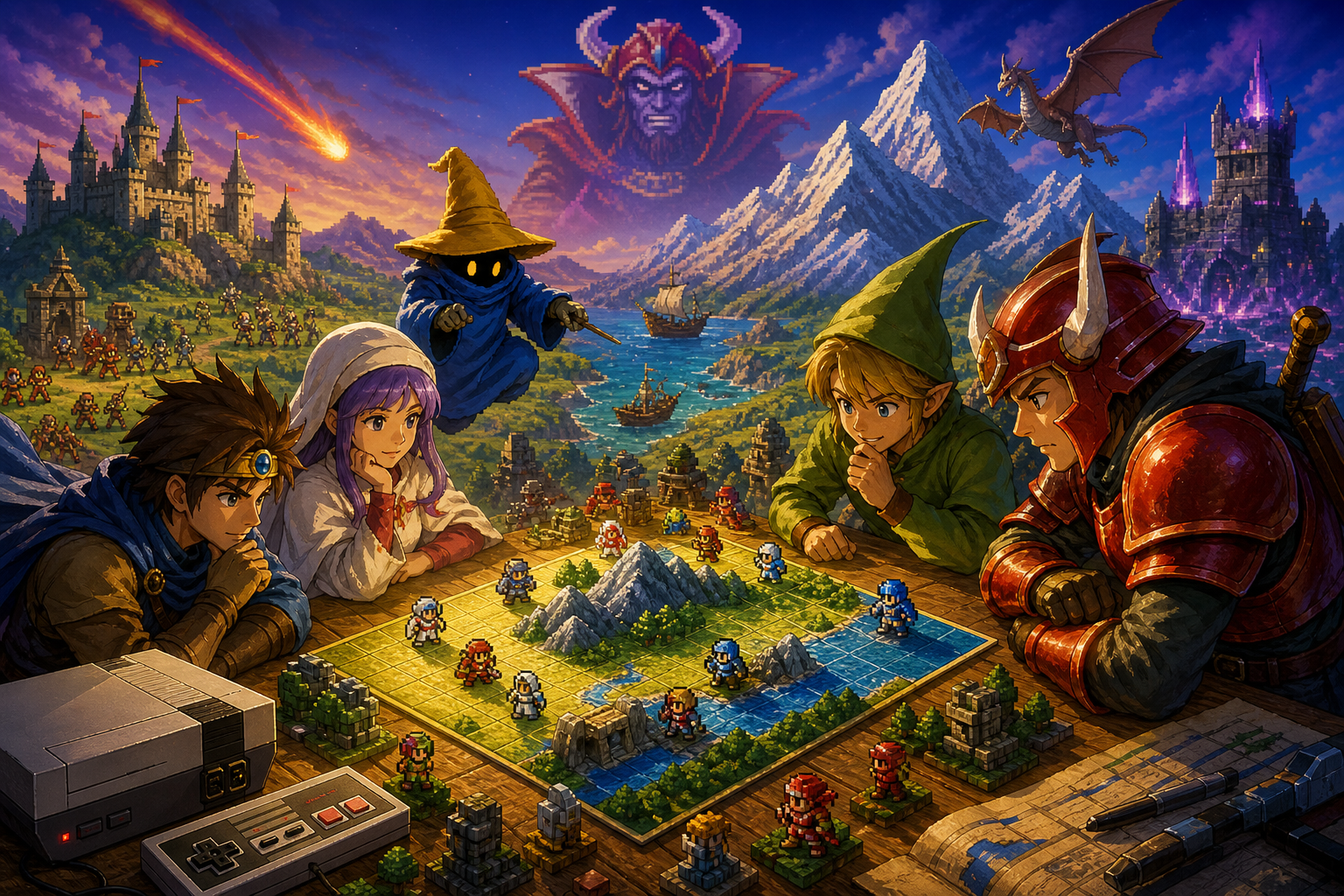
Strategy on the Nintendo Entertainment System rarely looks like a modern real-time strategy game. Its strongest examples use menus, maps, statistics, supplies, diplomacy and turn-based planning, often asking the player to think about a campaign rather than simply win the next battle. Some add action sequences, but their strategic layer remains the organizing idea.
This ranking considers decision density, tactical variety, campaign structure, historical or fictional character, accessibility and replay value. It covers games released for the NES rather than Famicom-only releases, and it excludes role-playing games whose military systems are secondary to character progression. The order is editorial: a more approachable game can rank below a denser simulation because depth and long-term variety matter most here.
10. Overlord
Overlord is the oddest game on this list, and that is precisely why it earns a place. Instead of historical rulers and recognizable battlefields, it presents a science-fiction campaign involving multiple galaxies, spacecraft conflict, economic resources and enemy starbases. The setting gives the NES strategy format a welcome change of costume without abandoning its central demand: decide where limited resources and military strength matter most.
Its appeal is strongest for players who want a strategic campaign with a clearer science-fiction identity than a historical simulation can provide. The game also benefits from contrast between planning and direct conflict. That makes it easier to approach than the most menu-heavy Koei games, although players seeking detailed diplomacy or character administration may find its systems comparatively focused. Overlord is not the deepest entry here, but its galaxy-scale framing and conquest structure demonstrate that NES strategy was not limited to recreating medieval or early-modern history.
- Best fit: players who want a science-fiction strategy setting.
- Tradeoff: less administrative texture than the strongest historical simulations.

9. Conflict
Conflict strips strategy down to a modern military contest. The player commands a general, moves units across a battlefield, occupies cities and pursues victory points. That concentration gives it a cleaner identity than games that combine national administration, diplomacy, family politics and long-term economic management. The important decisions are easier to see: position forces, protect useful territory and determine when an advance is worth the risk.
Its narrower scope is both its strength and its limitation. Conflict is a good recommendation for someone who wants a command game but does not want to begin with a thick historical framework. It communicates the basic pleasure of strategic positioning without requiring the player to understand a large roster of officers or a complicated dynastic structure. On the other hand, players who enjoy campaign storytelling and multiple political routes may eventually want something broader.
The game ranks below the more varied entries because its replay value comes mainly from solving its battlefield problems differently, rather than choosing among many rulers, scenarios or national strategies. Still, its focused design makes it an important bridge between board-game-style planning and more immediate console play.
- Best fit: players who prefer battlefield positioning and territorial control.
- Tradeoff: a focused system offers less campaign variety than Koei’s simulations.
8. North & South
North & South is one of the most immediately readable strategy games on the NES because it places a simplified strategic map beside direct battle sequences. The campaign layer asks the player to move armies and contest territory across the United States, while the action portions turn those decisions into more physical confrontations. That structure gives the game a rhythm that traditional menu simulations often lack.
The hybrid design makes North & South a particularly useful entry point. A player who finds resource screens and officer statistics intimidating can understand the broad objective quickly: take territory, move forces intelligently and survive the battles that follow. The direct sequences also give each strategic decision a more visible consequence than a purely statistical result would.
It does not rank higher because its strategic model is less administratively deep than the games above it. The map is a framework for battles rather than a highly detailed political or economic simulation. Its historical setting is also presented through a playful, simplified lens. That is not a defect for an arcade-minded audience, but it means North & South should be chosen for accessible campaign pressure and variety, not historical detail.
- Best fit: newcomers who want strategy connected to direct battles.
- Tradeoff: its strategic layer is lighter and more simplified than the historical simulations.
7. Gemfire
Gemfire shows how Koei’s strategy structure could survive outside documented history. Its fantasy setting replaces historical warlords with selectable rulers, magical forces and a more colorful approach to territorial conquest. Underneath the presentation, however, are familiar strategic concerns: develop territory, manage resources, choose where to apply military strength and make decisions that improve a ruler’s position over time.
That combination makes Gemfire a good recommendation for players who like the density of Koei’s historical games but want a setting with more imaginative freedom. Fantasy also changes the texture of the campaign. The player is not simply reenacting a known political struggle; the setting invites attention to its rulers and unusual military possibilities as parts of a game system.
Gemfire ranks below the more historically grounded entries because its campaign structure does not create the same sense of documented context. It also asks the player to accept a larger distance between fictional flavor and administrative mechanics. Even so, that distance is part of its value. Gemfire proves that the NES strategy format could support fantasy without reducing itself to a conventional role-playing game.
- Best fit: players who want Koei-style management in a fantasy world.
- Tradeoff: fictional flavor is distinctive, but historical context is naturally absent.
6. L’Empereur
L’Empereur turns the Koei formula toward Napoleon-era France, combining political administration, military campaigns and historical progression. Its appeal comes from the feeling of directing a national war effort rather than merely commanding one battlefield. Decisions about preparation and administration matter because military expansion depends on a broader campaign structure.
The game is a strong choice for players who enjoy strategy that treats war as a national project. Armies do not exist in isolation from the condition of the state, and the historical setting gives the campaign a recognizable direction. That context also makes the game feel different from Sengoku-era simulations, even though both rely on menus, territorial decisions and long-term planning.
L’Empereur can be demanding for players who want immediate action. Its strongest qualities are deliberation and campaign management, not rapid feedback. It ranks sixth because it offers a compelling historical frame and meaningful administrative decisions, but its appeal depends heavily on patience. Players who enjoy a large national-scale simulation should place it much higher on their personal list; players looking for short tactical encounters should begin elsewhere.
- Best fit: history-minded players who enjoy national-scale planning.
- Tradeoff: deliberate administration can feel slow beside hybrid games such as North & South.
5. Genghis Khan
Genghis Khan broadens the conquest simulation by linking territorial expansion with dynastic management. Military movement is only one part of the campaign. Marriages, succession and appointments create decisions about continuity and leadership, giving the game a longer strategic horizon than a simple map-control contest. Expansion matters, but so does the ability to keep a growing power organized.
That family and personnel structure is the reason Genghis Khan ranks above L’Empereur. It gives the campaign a human framework, where the future of the state depends on more than the location of an army. Players who enjoy planning several turns ahead will find more to consider than immediate attacks and defenses. The game also has a strong historical identity without relying on a single famous battlefield as its entire appeal.
The tradeoff is complexity. Dynastic decisions can feel like an additional layer to manage rather than a direct extension of combat, and the game is not the ideal first stop for someone seeking a quick strategy lesson. Its replay value comes from the interaction between military ambition and succession planning, making it especially suitable for players who regard a campaign as a political structure as well as a series of battles.
- Best fit: players who enjoy conquest combined with family and succession systems.
- Tradeoff: its broader campaign demands more patience than focused military games.
4. Bandit Kings of Ancient China
Bandit Kings of Ancient China begins from a more precarious position than many grand conquest simulations. Based on the Water Margin tradition, it emphasizes recruitment, territory development and personnel management while asking the player to build power from a vulnerable foundation. The result is a campaign defined less by effortless expansion than by the challenge of assembling the people and resources needed to survive.
Its one-move-per-month structure gives the game a distinctive rhythm. Time is not an abstract backdrop; every decision consumes part of a limited campaign calendar. That pressure encourages planning rather than random experimentation. Recruiting the right people, improving territory and deciding when to risk confrontation all become connected problems.
The game ranks fourth because its premise and pacing reinforce each other so effectively. It has a clearer dramatic arc than many administrative simulations: start weak, gather capable allies and turn a fragile position into a credible force. The main drawback is that its systems can be unforgiving, particularly for players who expect every turn to produce obvious progress. Bandit Kings is best for strategy fans who enjoy recovery, preparation and the tension of acting before the calendar closes in.
- Best fit: players who like difficult starts, recruitment and time pressure.
- Tradeoff: the campaign’s deliberate pace and vulnerability can be demanding.
3. Nobunaga’s Ambition
Nobunaga’s Ambition is one of the clearest foundations of NES historical strategy. Set during Japan’s Sengoku period, it asks the player to pursue unification through resource management, diplomacy and warfare. The campaign is not simply about defeating an opponent in battle. A ruler must build enough strength to make military action possible, manage regional conditions and choose when political pressure is preferable to open conflict.
That breadth gives the original Nobunaga’s Ambition an enduring identity. It presents history as a network of competing interests rather than a linear sequence of battles. The player’s selected position changes the shape of the challenge, and the goal of unifying Japan provides a strong long-term direction without dictating one fixed route.
It ranks third because it makes the connection between historical context and strategic decision-making unusually clear. The game can be slower and more opaque than accessible hybrids, and its menus require patience. Yet those qualities are also why it matters. Nobunaga’s Ambition helped establish that a home console could host a serious political and military simulation rather than only an arcade interpretation of war.
- Best fit: players who want Sengoku politics, diplomacy and resource management.
- Tradeoff: its interface and pacing demand more patience than the lower-ranked hybrids.
2. Nobunaga’s Ambition II
Nobunaga’s Ambition II develops the same Sengoku foundation into a more scenario-focused campaign experience. Rather than treating the original and sequel as interchangeable, it is useful to see the second game as a stronger recommendation for players who enjoy preparation and historical starting conditions. Scenario-based planning changes the question from simply how to expand to how a particular political situation should be solved.
Army preparation and campaign planning give the sequel a more developed sense of strategic staging. The player has reasons to think about the state of a campaign before committing to a major move, and the broader scenario framework improves replay value. Different starting situations can change which regions, alliances and resources deserve attention first.
The sequel ranks second because it makes the original’s central ideas more flexible without abandoning their identity. It remains menu-heavy and can be intimidating to players who want immediate tactical feedback. Its reward is a campaign in which preparation feels consequential. For a player already interested in historical simulations, Nobunaga’s Ambition II is the stronger starting point; for someone new to the form, its density may justify trying a more approachable game first.
- Best fit: experienced strategy players who want scenarios and deeper preparation.
- Tradeoff: its expanded planning makes the learning curve steeper.
1. Romance of the Three Kingdoms II
Romance of the Three Kingdoms II is the strongest overall NES strategy package because it combines broad scenario variety with detailed administration and a memorable political setting. Its campaigns place competing warlords in different historical situations, while city statistics, food supplies, disasters, officers and territorial control create a web of decisions that extends well beyond battlefield movement.
The game’s greatest strength is how its systems reinforce one another. Officers are not just names on a roster; personnel affect the ability to administer and wage war. Cities are not merely spaces to occupy; their conditions shape what a ruler can support. Supplies matter because an army’s reach depends on the state behind it. Those connections give the player multiple ways to recover from a bad position or turn a strong one into an advantage.
Romance of the Three Kingdoms II also offers the best replay framework in this group. Multiple historical scenarios and competing rulers change the opening conditions, while the underlying systems allow different approaches to territorial control. It is not the easiest recommendation, and its administrative detail may overwhelm players seeking a quick console strategy game. For anyone willing to learn its structure, however, it captures the NES’s most ambitious version of strategic play: political, economic, military and historical choices sharing one campaign.
- Best fit: players seeking the deepest combination of scenarios, officers, supplies and administration.
- Tradeoff: its broad systems are less immediately accessible than North & South or Conflict.
These ten games reveal a side of the NES that is easy to miss when the system is viewed only through its fastest action genres. Its strategy catalog moved between historical simulation, fantasy conquest, science-fiction warfare and hybrid battlefield design. Koei’s strong presence is not an artificial attempt to fill the list; the publisher supplied many of the console’s most ambitious management-heavy games.
For an accessible starting point, North & South or Conflict provides a clearer path into campaign decision-making. Gemfire and Overlord suit players who want fantasy or science fiction, while Nobunaga’s Ambition II and Romance of the Three Kingdoms II reward patience with more substantial historical systems. The NES did not reproduce computer strategy in full, but it created a distinctive bridge between administration-heavy planning and console-friendly play.