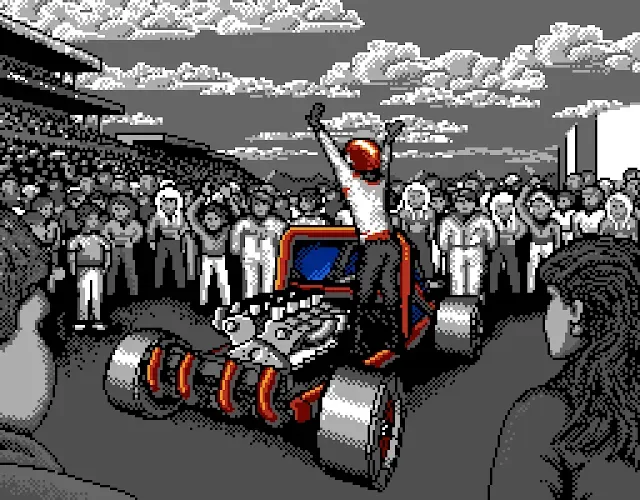
An unofficial NES adaptation of Geoff Crammond’s Stunt Car Racer has been created by cobbpg, bringing the high-risk, elevated-track racer to hardware not normally associated with filled-vector 3D racing. The project draws together code from the Commodore 64 version and a visual approach modeled after the Amiga release, then substantially reworks that material by hand for the NES.
That combination matters because this is not simply a visual conversion of an older racing game. Stunt Car Racer is built around a demanding perspective: cars charge along narrow raised courses where crests, drops and long jumps can make the next section of road hard to judge. The new version is attempting to preserve the broad visual impression of the Amiga art while producing its road and scenery within strict NES constraints. It is the sort of project where the technical solution is closely tied to the feel of the game: the farther the player can see across the track, the more convincing and more dangerous those ramps and horizons become.
A full-width view comes with deliberate trade-offs
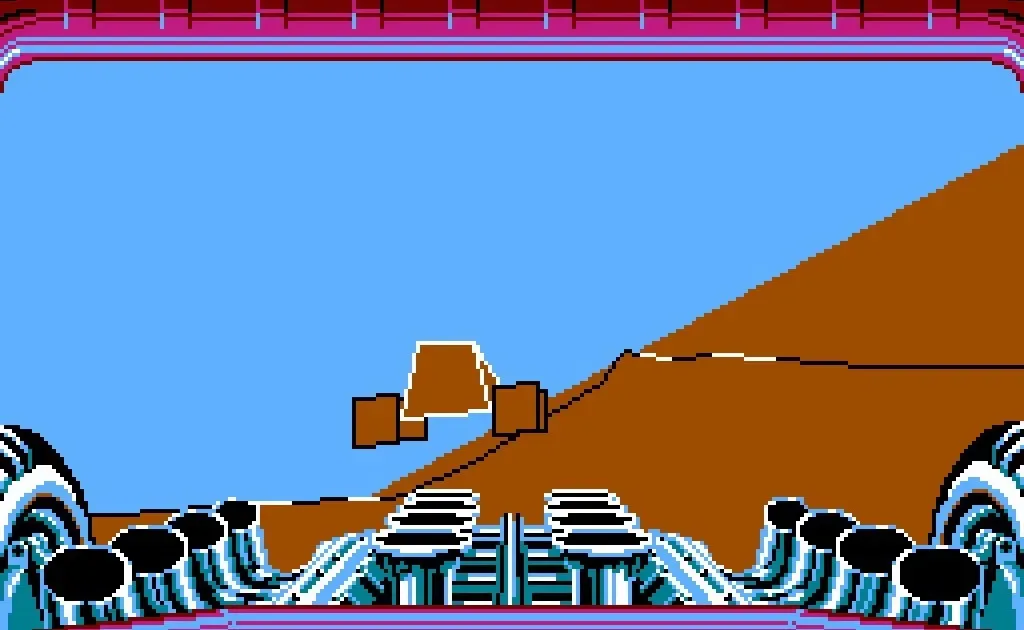
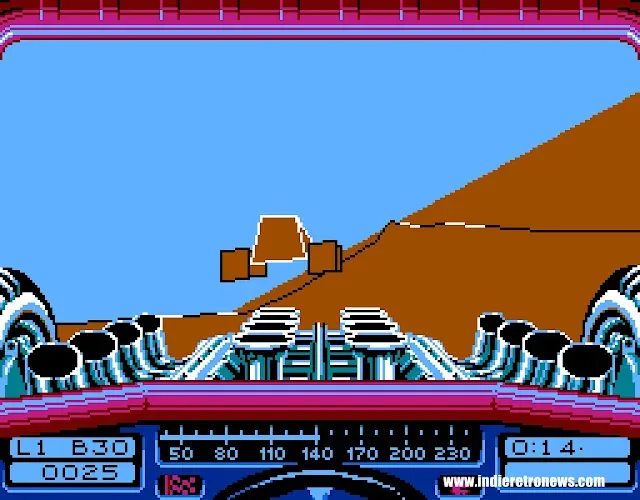
The NES port uses a 256-by-128-pixel viewport, spanning the full width of the screen. That decision is intended to retain the look of the Amiga-inspired presentation, rather than narrowing the action into a smaller play area. For a racing game based on reading the terrain ahead, a wide view has an obvious practical benefit. It gives drivers more lateral context as the course rises, falls and bends, helping them identify the road’s direction before a jump commits the car to a line.
It also creates two limitations that players should understand in advance. On older CRT televisions, the outer edge of the image may not be fully visible because of overscan. In practical terms, the car’s wheels can be cut off at the sides of the display even though the game is rendering a full-width image. This is a display characteristic, not necessarily an error in the game’s drawing routine.
The second limitation is more directly related to the port’s rendering technique. The game assigns graphical tiles dynamically as they are needed. A tile is a small reusable graphic unit used to build a screen image on the NES. Instead of keeping every possible piece of a complex 3D scene permanently prepared, the game allocates those units on demand while constructing the current frame. That approach lets the port attempt a larger, more detailed viewpoint than a static allocation would comfortably allow.
There is a ceiling, however. Frames that contain many long or complicated vectors can exhaust the available tiles. A vector here is part of the line-based geometry used to describe the visible road, skyline and other perspective-driven elements. When the scene becomes especially complex, temporary blocky artifacts can appear around the horizon. The important distinction is that these visual artifacts are not described as a gameplay stall: the game continues to run smoothly. Players may see a momentary compromise in image detail, rather than the race slowing down when the course becomes visually demanding.
Why the mapper and memory configuration are central
The port is built for an MMC3 mapper configuration with 256K of PRG-ROM, 16K of CHR-RAM and 8K of WRAM. These terms describe how a cartridge can expand and organize what the base console can access.
- PRG-ROM holds the game program and fixed data. The 256K allocation gives the project room for its code and content.
- CHR-RAM is memory that can hold graphics tiles and be rewritten as the game runs. That flexibility is particularly relevant to the dynamic tile allocation behind the 3D display.
- WRAM is working memory that can retain changing data, including the player’s records and career state.
- MMC3 is a cartridge mapper chip. In broad terms, a mapper extends the NES cartridge’s capabilities by managing banks of program or graphics data and supporting more ambitious software designs.
Those specifications are not a checklist of cosmetic extras. They describe the foundation that makes this particular version possible. A game attempting filled-vector 3D imagery has to constantly balance what it wants to show against the console’s finite graphics resources. The use of CHR-RAM and on-demand tiles is a direct response to that challenge, while the MMC3 setup provides the cartridge-side framework needed for the game’s memory arrangement.
The project also uses cycle-exact visual techniques. “Cycle-exact” means the timing is controlled with exceptional precision, down to processor-cycle-level expectations. On hardware such as the NES, timing can be as important as the underlying artwork because the system’s picture-generation behavior occurs on a tightly structured schedule. Techniques of this kind can produce effects that would otherwise be difficult to display, but they also demand careful compatibility work.
Testing has been carried out in the Mesen emulator, and the build is designed to support Sharp and NEC variants of the MMC3 chip. That is useful information for people evaluating cartridge compatibility, but it should not be read as a final original-hardware verdict. The port has not yet been benchmarked on an original NES. Its behavior on a real console therefore remains an open question, particularly for enthusiasts equipped to test it across actual hardware and displays.
Save protection is an unusually player-friendly priority
For all the attention the graphics will understandably receive, one of the most practical details is the treatment of persistent progress. The game retains record track times and overall career progress when it boots, and it uses WRAM write protection outside gameplay. Put simply, the memory that stores a player’s accomplishments is guarded against writes when the game is not actively being played.
That matters in a career-based racing game. A time trial record or a hard-earned promotion represents repeatable progress, not a one-off score visible only for the current session. Protecting WRAM outside gameplay is intended to reduce the risk of those stored results being overwritten accidentally. It is a technical safeguard with a very human purpose: a player who survives a punishing season should not have to wonder whether the next boot will erase that effort.
Separate versions have been fine-tuned for NTSC, PAL and Dendy hardware configurations. These labels matter because regions and compatible systems can operate with different display timing characteristics. Providing tailored versions acknowledges that a timing-sensitive game should not assume one configuration will serve every machine equally. For a project that relies on precise graphics tricks, that attention to platform variation is especially relevant.
The league structure gives the driving consequences
At its core, Stunt Car Racer asks players to rise through a competitive racing league rather than merely sample disconnected courses. The standard league contains four divisions. Drivers work through short four-race mini-seasons, with outcomes leading to promotion into the next tier or demotion to the previous one. Clearing the standard league unlocks the Super League, where conditions are significantly more severe.
That structure makes consistency as valuable as raw speed. A single quick run is useful, but four-race seasons mean a mistake has a place in a larger campaign. Promotion creates momentum, while demotion forces a return to an earlier division. The stakes are clear without needing an elaborate progression system: every race helps determine whether the player moves closer to tougher competition or loses ground.
Practice runs are available between competitive seasons, and they are more than a convenient menu option. The raised raceways demand familiarity, especially on tracks such as Ski Jump. A course with dramatic elevation changes can punish drivers who react only after a crest reveals what is ahead. Practice offers a chance to learn the shape and rhythm of a track before career standing is on the line.
A practical approach for new drivers
- Use practice before treating a division as a time-attack challenge. First learn where rises, landings and hazardous transitions occur.
- Focus on clean completion. Four-race seasons reward results that hold up across several events, not just a spectacular opening lap.
- Read the horizon early. On elevated courses, the visible route ahead is crucial information; avoid committing to a correction only after a jump or crest has reduced the available time.
- Keep expectations realistic around visual artifacts. A blocky horizon during a particularly complex frame is a known resource limitation, while smooth game operation is the intended behavior.
- Check the appropriate regional build. NTSC, PAL and Dendy users have separately tuned versions, so selecting the correct one is part of setting the game up properly.
An NES project defined by choices, not brute force
The interesting part of this adaptation is not merely that an older 3D racer now has an NES version. It is how the port answers the system’s constraints. The full-width viewport favors a stronger sense of scale but may expose CRT overscan. Dynamic tiles allow a large, vector-heavy scene but can produce brief horizon artifacts under pressure. Cycle-exact techniques offer ambitious visuals but make real-hardware validation an important next step. Persistent WRAM records respect the player’s career while requiring deliberate protection outside active play.
Each trade-off is visible in the design, and that is what makes the project compelling for retro-gaming enthusiasts. The version is not pretending that the NES has infinite graphics capacity or identical display conditions everywhere. Instead, it sets a clear technical target—bringing this form of 3D stunt racing to the console—and builds around the compromises necessary to chase it.
It also sits neatly within the broader appeal of revisiting older hardware: familiar games can reveal new possibilities when developers approach their constraints from a different direction. For more context on how original systems shaped the ways people played, see this look at handheld gaming history. In this case, the focus is not portability but the distinctive challenge of fitting a broad, filled-vector racing view and a full league career onto the NES.
For players, the immediate draw is a stern stunt-racing campaign with practice, promotion, demotion and a Super League waiting beyond the standard divisions. For technical observers, the unanswered original-NES benchmark is just as significant. Emulator testing and support for Sharp or NEC MMC3 variants provide encouraging groundwork, but real-console results will determine how this carefully timed, full-width rendering strategy behaves in the environment it was built to challenge.