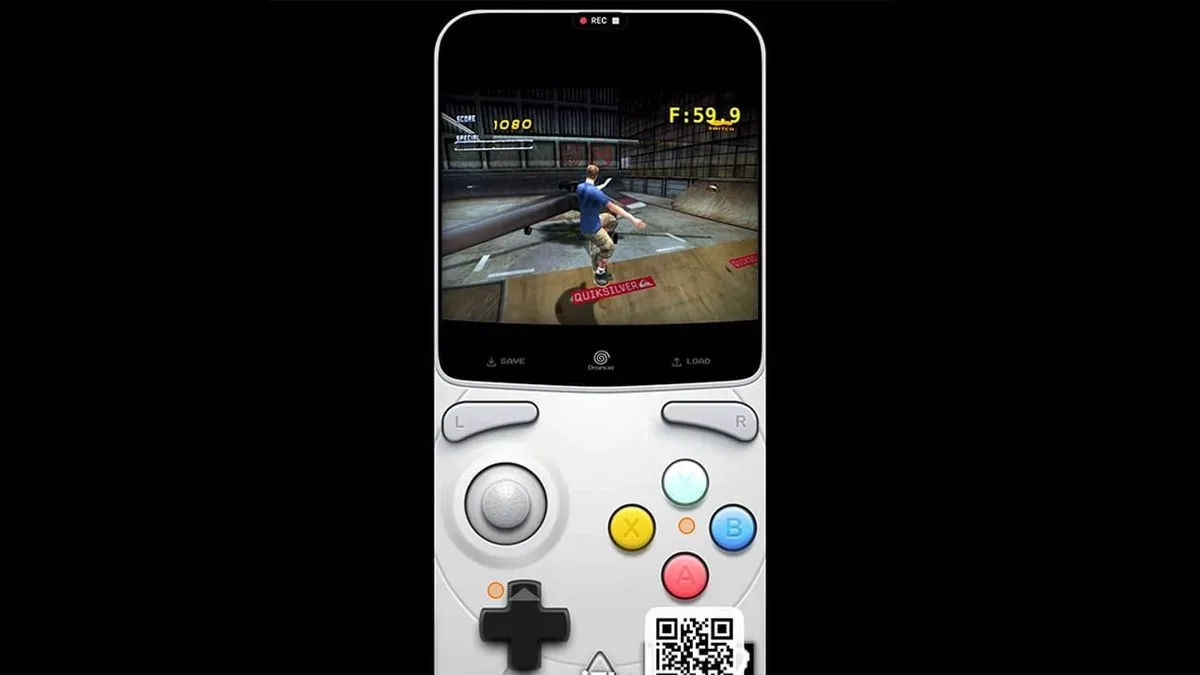
Dreamcast emulation may be edging closer to Apple hardware without depending on the performance technique that has complicated many higher-end emulator projects on iPhone and Apple TV. iFly, a free and open-source emulator derived from Flycast, has opened TestFlight spots as its developers look for people to help test the software across iOS and tvOS.
The significant part is not simply that another emulator is targeting iPhone. iFly has been developed without JIT, or just-in-time compilation, an approach commonly used by emulators to improve speed. That decision is central to the project’s compatibility with Apple devices, where JIT-related restrictions have narrowed the practical choices for emulating more demanding systems.
Early information describes iFly as an offshoot of Flycast with its dynamic recompiler removed. It is intended to work on both older iPhones and current models, while also supporting Apple TV through tvOS. The TestFlight phase is therefore an important reality check: a chance to find bugs and assess how the JIT-free approach behaves on a range of Apple hardware before expectations harden around the finished experience. Readers looking for the current TestFlight availability can find the relevant details here.
Why JIT matters to emulation
An emulator is software that recreates the behavior of one piece of hardware on another. In this case, the goal is to run Dreamcast software on Apple devices rather than an original Sega Dreamcast. That work can involve translating instructions written for the console’s architecture into instructions the host device can execute.
For more context, explore Helldivers Movie Moves to June 2028 as Alan Ritchson Replaces Jason Momoa.
JIT is a method of doing that translation while a program is running. Rather than interpreting every instruction in a slower, step-by-step way, a JIT compiler can turn code into a form that the current device can execute more directly. In emulation, this is frequently associated with better performance, especially on systems that ask more of the host hardware.
A related term here is dynamic recompilation, often shortened to “dynarec.” It is a technique used to translate and recompile code dynamically during execution. The iFly project removes Flycast’s dynarec, making it a “JITless” build. In plain language, it is pursuing Dreamcast emulation on Apple platforms by taking a route that does not rely on the dynamic compilation feature at issue.
That comes with an obvious technical trade-off. A project can gain a clearer path around platform constraints while facing a more difficult performance challenge than an equivalent emulator able to use JIT. The available information does not establish how every Dreamcast game will perform, what specific compatibility results testers should expect, or how the app will compare across individual devices. Those are precisely the sorts of questions a TestFlight period can help answer.
Related coverage includes iFly Opens TestFlight Access for Dreamcast Emulation on iPhone and Apple TV.
Apple’s restrictions shape the project’s approach
Apple has treated JIT activity as a security concern. The issue is often described in terms of translating PowerPC code to ARM on the fly and writing code in real time. Whatever the finer technical implementation in a given emulator, the practical consequence for Apple users has been clear: approaches that are routine elsewhere can be much harder to deploy on iOS and tvOS.
That explains why iFly’s architecture is more than a footnote. A Dreamcast emulator that avoids JIT is attempting to fit within a constraint that has influenced what kinds of console emulation are realistic on Apple’s platforms. Earlier iPhone emulator excitement centered on systems such as Nintendo 64 and PSP, but the Dreamcast sits in a more technically demanding conversation.
iFly should not be read as proof that those constraints have disappeared. It is better understood as an engineering response to them. The software’s developers are not presenting a conventional JIT-enabled Flycast port for Apple devices; they have removed the dynarec and are testing what remains viable.
What the TestFlight stage means
TestFlight is Apple’s distribution system for beta apps. A TestFlight opening does not mean a project is feature-complete, nor does it promise that every device, game, control configuration, or use case is already working flawlessly. It means the project is inviting a broader group of users into the testing process.
For iFly, feedback from that process has a practical purpose. Testing on both older and newer iPhones can reveal whether the JIT-free design produces different behavior by device generation. tvOS support also adds another environment with its own interface and controller considerations. Bugs, crashes, usability issues, and performance rough edges are all the kind of findings that can matter at this stage.
The app’s interface has been described as polished and comfortably arranged, with an on-screen controller and layout that aim for a similarly clean mobile feel to Delta. Presentation is useful, but it is only one part of the test. The key question is whether the interface, controls, and underlying emulation remain dependable together as the project is exercised by more people.
For prospective testers, the sensible expectation is participation rather than a finished-product guarantee. Test builds can change, spots can be limited, and software still in beta may expose issues that are not present in a final release. The stated need for testers signals that the project is actively seeking reports that can help it get closer to a stable experience.
Open source is part of the iFly story
iFly is described as free and open source, and as meeting the open-source licensing requirements connected to its foundations. That matters in a moment when emulator projects are also being judged on transparency, provenance, and whether they respect the licenses of the code from which they develop.
The distinction has been particularly visible following criticism directed at the PS2 emulator iPSX2, which was characterized as highly AI-assisted, closed source, and “vibe-coded.” iFly is being positioned differently: as a project built from an established Flycast offshoot, with its own technical adaptation for Apple’s JIT limitations, while remaining open source and free.
“Open source” means that a project’s source code is available under a license that allows inspection and, depending on that license’s terms, reuse or modification. It does not itself guarantee that an app will be fast, fully compatible, or free of bugs. It does, however, give technically interested users and contributors a way to examine the project’s direction rather than treating the software as an opaque package.
That transparency is especially relevant when an emulator has to make substantial architectural compromises. Removing a dynamic recompiler is not merely a marketing label; it changes how the program approaches emulation. An open development model makes it easier for the community to understand that choice and, potentially, contribute to improving the JIT-free route.
A promising test, not a final performance verdict
The Dreamcast has long been an appealing target for enthusiasts because of its distinctive library and place in Sega’s history, but an Apple-friendly emulator for it has to navigate more than nostalgia. The technical reality is that iFly’s developers are working within platform restrictions that can make the usual speed-focused tools difficult to use.
That makes the TestFlight opening worth watching. The project combines iOS and tvOS support, a Flycast-derived base, an explicit JITless design, and a free open-source model. At the same time, the beta status is important: no broad claim about flawless operation, universal compatibility, or final performance should be assumed from the invitation alone.
For now, iFly’s clearest contribution is demonstrating a path being tested for Dreamcast emulation on iPhone and Apple TV without JIT. The next meaningful evidence will come from the bugs users encounter, the fixes that follow, and how well the emulator holds up across the Apple devices it is designed to support.