Sega’s Dreamcast Fishing Controller was not merely a gamepad with a decorative handle. It was an attempt to make the physical language of fishing part of the software: cast with the rod, work the lure, turn the reel and respond to a fish through movements that felt closer to the activity being represented.
That ambition made the accessory memorable, but it also made its future depend almost entirely on compatible games. This history follows the controller’s documented Japanese launch, regional identities and packaging, hardware design, fishing software, unusual secondary uses, limitations and lasting place in Dreamcast control history.
The Dreamcast’s fishing gamble
Sega’s Dreamcast arrived during a period when the company was unusually willing to build hardware around specific play experiences. The console had a microphone, a keyboard, arcade sticks, twin sticks, a light gun and other specialized accessories. A fishing rod belonged to that same philosophy: instead of asking a conventional controller to represent every activity, Sega could make the controller resemble the activity itself.
The idea was not created in a vacuum. Sega’s arcade business had already demonstrated the appeal of dedicated physical interfaces, and fishing games were especially suitable for the transition. A rod gives players an intuitive object to hold, while a reel provides a natural rotational input. On a regular pad, those actions become button presses or stick movements. On the Fishing Controller, they could become the central vocabulary of play.
The accessory’s most important design decision was therefore its focus. It was not intended to replace the standard Dreamcast controller across the library. It was a specialist instrument, most convincing when a game had been designed to interpret its shape, movement and reel. That distinction explains both its appeal and its relatively small software ecosystem.
- Core idea: represent fishing through rod movement and reel input.
- Primary audience: players interested in dedicated arcade-style interfaces.
- Central tradeoff: stronger physical fantasy in exchange for broad software compatibility.
Launch, model numbers and regional packaging
Sega’s official Japanese Dreamcast hardware history lists the accessory as the Tsuri Controller. It records a March 22, 2000 release, model number HKT-8701 and a Japanese list price of 5,800 yen. Sega also documented a bundled version pairing the controller with Get Bass, the Japanese name for Sega Bass Fishing.
Those details should not be casually converted into a universal worldwide launch date. Regional records use different identifiers and packaging. North American catalogues commonly list HKT-8700, while the Japanese Sega page uses HKT-8701. The available evidence supports treating these as regional catalogue or hardware identifiers, not automatically as proof of a major functional redesign.
Manufacturing credits also vary by presentation. Japanese documentation presents the product as a Sega-branded Dreamcast accessory, while regional hardware references identify ASCII as the manufacturer in at least some markets. The important historical point is that the controller circulated through more than one commercial arrangement, including standalone sales and bundles with Sega Bass Fishing.
Availability was uneven. Sega Bass Fishing became the principal official PAL fishing release, and the controller bundle was an important way European players encountered the idea. Other compatible games were restricted to Japan or appeared in selected regions, which limited the accessory’s chance of becoming a familiar part of the broader Dreamcast experience.
- Japanese documentation: Tsuri Controller, HKT-8701, March 22, 2000.
- Regional listings: HKT-8700 appears in North American cataloguing.
- Do not assume regional model numbers prove different internal features.
- Do not treat a PAL bundle as evidence of simultaneous worldwide availability.
Anatomy of the rod
The official controller combines a short fishing-rod form with a reel, an analog stick, A, B, X and Y buttons, Start, vibration and motion-sensing hardware. That combination matters because the rod is not a single-purpose motion toy. It retains enough conventional input to let compatible software assign movement, menu commands and secondary actions without requiring a second pad for every interaction.
The reel is an input device, not a force-feedback mechanism. Specialist documentation describes the official reel as free-spinning rather than providing the clicking resistance associated with some third-party fishing rods. Vibration supplies tactile feedback, but it should not be confused with mechanical resistance in the handle or reel.
The motion sensors allow games to read rod movement for actions such as casting, lure manipulation and directional gestures. This is the part that separates the Fishing Controller from a conventional analog stick mounted inside a novelty shell. The game can react not only to where the player moves an input, but to the implied physical action of moving a rod.
There is, however, a conspicuous omission: the controller does not include the standard Dreamcast controller’s built-in VMU connection. Fishing-game documentation and specialist references indicate that a separate standard controller is needed when VMU functions are required. That makes the rod less self-contained than Sega’s ordinary pad, especially in games that use the VMU for saving or screen-based information.
- Inputs: reel, analog stick, face buttons, Start, rumble and motion sensing.
- The reel spins freely; it is not a force-feedback fishing mechanism.
- The missing VMU slot is a functional limitation, not a cosmetic difference.
- Motion sensing only matters when software has been written to interpret it.
Sega Bass Fishing gives the hardware a purpose
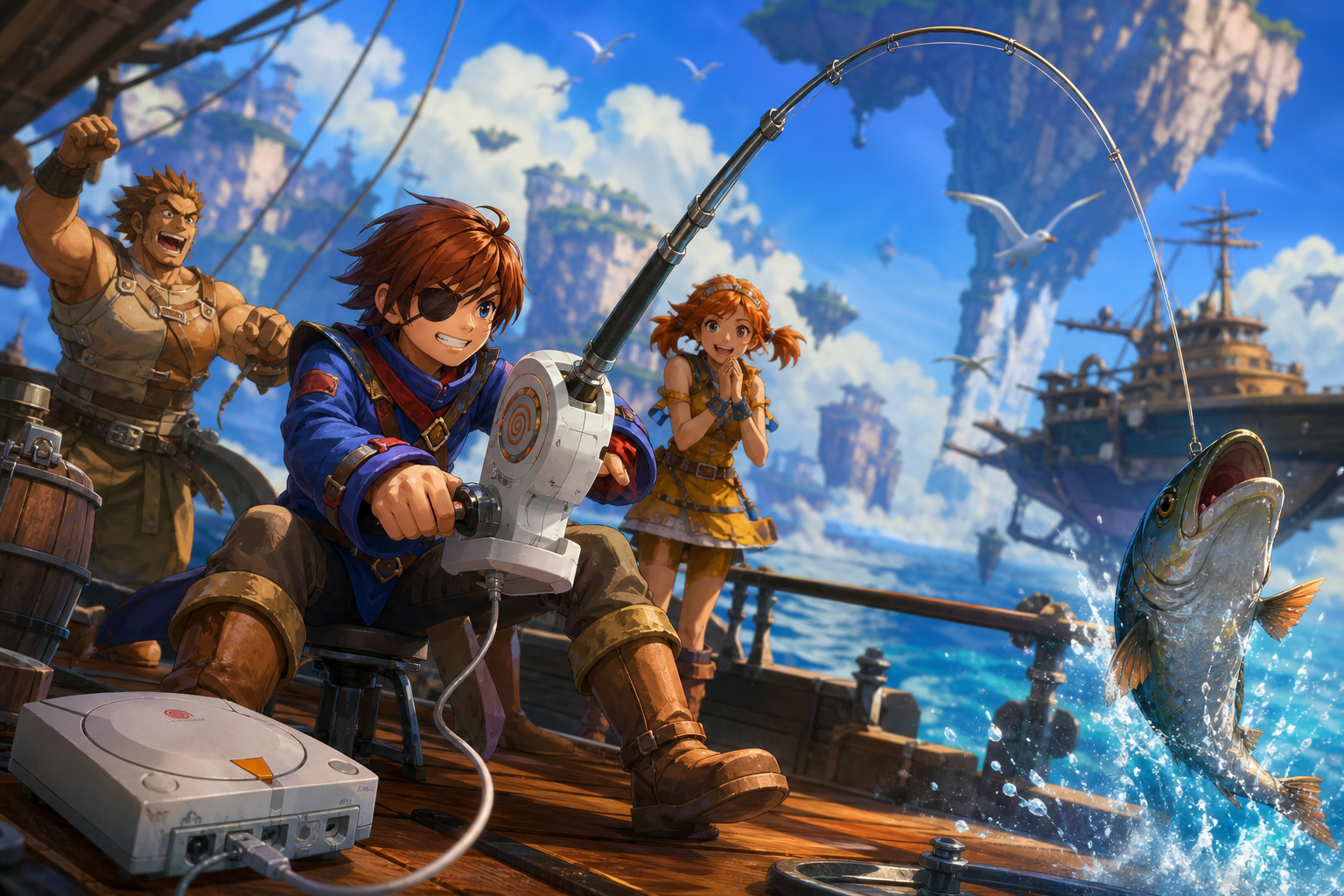
Sega Bass Fishing, released as Get Bass in Japan, was the controller’s clearest argument. Its structure drew from arcade fishing: short challenges, readable objectives and a direct relationship between the player’s actions and the on-screen fish. The controller’s rod movement could participate in casting and lure presentation, while the reel became part of the struggle to bring a catch in.
That relationship gave the accessory more purpose than simply making a regular gamepad look like fishing equipment. A standard controller could still provide the necessary inputs, but the rod made the sequence legible in physical terms. The player was not only choosing a command labelled cast; the player was moving an object that suggested a cast. The same principle applied when working the lure or reacting during a fish fight.
The game also helped Sega avoid the biggest danger of specialist peripherals: requiring a complicated simulation before the hardware becomes enjoyable. Its arcade heritage made the concept approachable. A player could understand the fantasy quickly, even if mastering the timing and fish behavior took longer.
Yet the game also revealed the controller’s dependence on software design. Without Sega Bass Fishing or another compatible title, the rod was simply an unusual Dreamcast input device. Its success as a product was tied to whether players wanted more than one fishing experience after the initial novelty.
- Launch application: Sega Bass Fishing, known as Get Bass in Japan.
- Rod movement, lure presentation and fish-fighting actions give the hardware its strongest justification.
- Arcade-style structure made the concept more immediately accessible than a purely technical simulation.
- The game’s success did not automatically create a large accessory library.
Marine Fishing and Bass Fishing 2 broaden the experiment
Sega Marine Fishing expanded the concept beyond bass lakes into ocean environments. It supported both the standard Dreamcast controller and the Fishing Controller, an important distinction because Sega treated the rod as an enhancement rather than an absolute requirement. The game also included aquarium elements, minigames, free-fishing modes and network-related features, giving the accessory a broader software setting than a sequence of isolated arcade challenges.
Contemporary coverage praised the physical feel of the rod but also found that a standard controller could be easier for some portions of the game. That split is revealing. A dedicated interface may make the central fantasy more convincing while making ordinary navigation, menu work or precise conventional input less efficient. Specialized hardware can improve one layer of a game and complicate another.
Sega Bass Fishing 2, also known as Get Bass 2 in Japan, continued support for the rod while adding a more exploratory structure involving boat movement and fish-finding systems. The sequel therefore pushed the series toward a larger fishing environment rather than simply repeating the first game’s compact challenges.
Together, the two follow-ups show Sega testing different meanings of physical authenticity. Marine Fishing widened the setting and activities; Bass Fishing 2 expanded the structure. Neither eliminated the central limitation: players still needed software that considered the rod worth supporting.
- Sega Marine Fishing supports both the rod and the standard controller.
- Its aquarium, minigame and free-fishing features broaden the surrounding experience.
- Bass Fishing 2 adds boat movement and fish-finding elements.
- A standard pad can remain more efficient for some non-fishing actions.
The forgotten fishing library
The Dreamcast rod ecosystem extended beyond Sega’s best-known games, although the additional titles were unevenly distributed by region and visibility. Specialist catalogues identify Bass Rush Dream: Ecogear PowerWorm Championship and Lake Masters Pro Dreamcast Plus! among the principal fishing releases associated with the platform. These names show that the accessory was not limited to Sega’s own Bass Fishing line.
Fish Eyes: Wild, also known as Reel Fishing: Wild depending on region and naming, adds another complication. Different catalogues do not always present the title under the same English name, so a historical account should not treat the naming difference as evidence of two unrelated games without checking the regional edition. The same caution applies to compatibility claims: being a fishing game does not by itself establish identical rod support across every release.
This library was large enough to prove that the concept had more than one application, but not large enough to make the controller a routine Dreamcast standard. Some games were Japan-only, while others had limited North American or European availability. A player’s experience of the accessory therefore depended heavily on region.
The result was a curious middle ground. The rod was neither a one-game novelty nor a widely supported platform feature. It occupied a specialist niche populated by games that shared a subject but did not necessarily share the same balance of arcade immediacy, simulation detail and regional accessibility.
- Additional associated releases include Bass Rush Dream and Lake Masters Pro Dreamcast Plus!.
- Fish Eyes: Wild and Reel Fishing: Wild are regional naming variants to handle carefully.
- Fishing software was unevenly distributed across Japan, North America and Europe.
- Do not assume every fishing title used the controller in the same way.
When a fishing rod became a racket or sword
The most surprising part of the controller’s history is what happened outside fishing. Virtua Tennis could interpret the rod’s movement as a racket swing while using the analog stick for player movement. This was not the accessory’s primary purpose, but it demonstrated that a motion-oriented controller could be repurposed when software assigned meaning to its inputs.
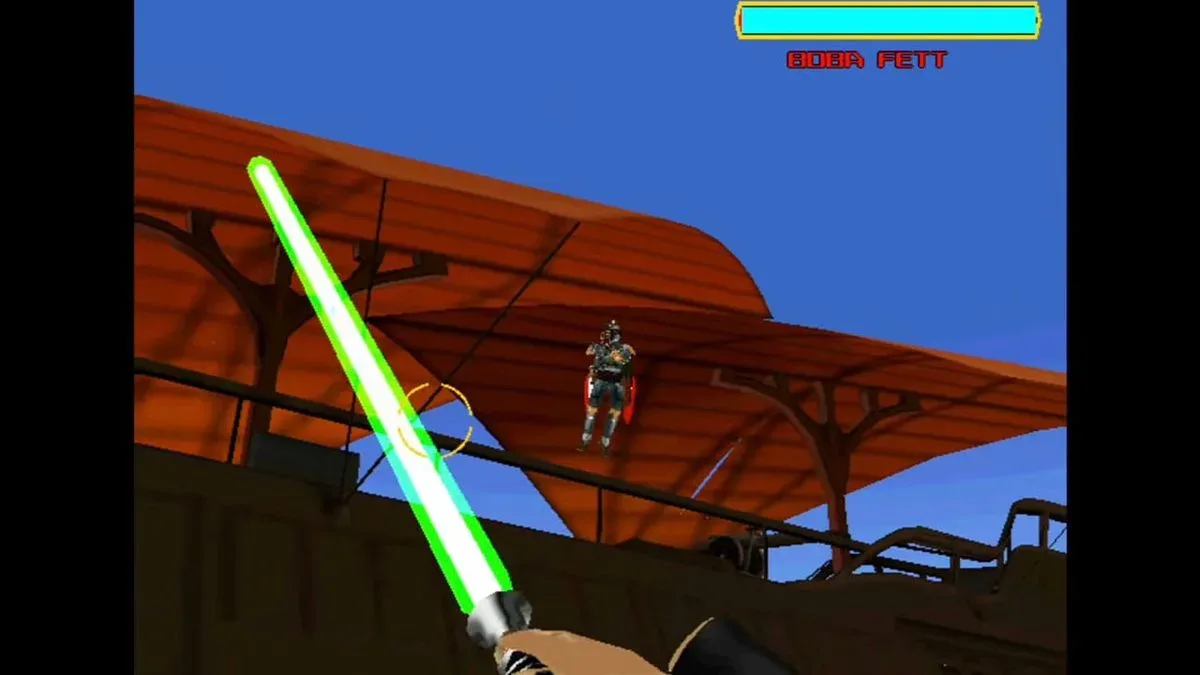
The experiment also reached Soulcalibur, where the rod could be used in a limited way for sword actions. That compatibility is historically interesting precisely because it was narrow. It does not turn the Fishing Controller into a general-purpose motion platform, nor does it make Soulcalibur a full motion-control game in the later Wii sense. It shows developers probing the Dreamcast’s input possibilities with software-specific mappings.
These examples are more useful as evidence of creative input interpretation than as recommendations for replacing ordinary controllers. A fishing rod can suggest a tennis swing or sword movement, but the physical metaphor does not automatically make every related action better. The games were built around conventional Dreamcast controls first, and their unusual compatibility sat at the edges of those designs.
Still, the experiments mattered. They showed that Sega’s accessory was not electrically or conceptually trapped inside one genre. Its motion sensors could become a platform for alternate interpretations, even if the commercial software support remained small.
- Virtua Tennis maps rod movement to a racket-like action in a limited compatibility mode.
- Soulcalibur offers another restricted movement interpretation.
- These are software-specific experiments, not a universal motion-control standard.
- The rod’s strongest use remains fishing, where shape and action agree.
Reception, limitations and legacy
The Dreamcast Fishing Controller earned its strongest praise from the physical fantasy it created. Holding a rod, turning a reel and moving the controller toward an on-screen fish made the activity immediately understandable. For players who wanted an arcade-like fishing experience, that directness could be more valuable than the efficiency of a normal pad.
The objections were equally clear. The software library was small and regionally uneven. The free-spinning reel did not provide mechanical resistance. The missing VMU connection meant that a separate standard controller could be necessary for VMU functions. Outside compatible games, the accessory offered little reason to exist beyond its ordinary buttons and analog input.
Reception of Sega Marine Fishing captured the central compromise: the rod could feel better for the activity it represented, while a regular controller could be easier for certain tasks. That is not a contradiction. It is the defining problem of specialized hardware. The more precisely a controller expresses one action, the less likely it is to be the best tool for everything surrounding that action.
Its legacy therefore rests less on market reach than on clarity of purpose. Years before motion control became a mass-market selling point, Sega had already explored sensors, rumble and physical metaphors in a living-room accessory. The Fishing Controller did not establish a universal standard, but it demonstrated an idea that later systems would revisit: the shape and movement of a controller can change how a game communicates its actions.
The accessory remains memorable because it committed completely to one idea. It did not ask the Dreamcast pad to imitate a fishing rod. It built a rod and asked software to meet it halfway. That partnership was too narrow to transform the platform, but it was coherent enough to become one of the Dreamcast’s clearest examples of hardware designed around a particular kind of play.
- Strength: tactile connection between physical action and on-screen fishing.
- Limitations: narrow software support, regional availability, free-spinning reel and no VMU slot.
- Secondary compatibility proves flexibility, not broad general-purpose usefulness.
- Historical significance: an early console experiment with motion-oriented, activity-shaped control.
Sega’s Dreamcast Fishing Controller succeeded on its own terms when a game treated it as an instrument rather than a novelty. Sega Bass Fishing supplied the clearest demonstration, while Marine Fishing and Bass Fishing 2 showed that the idea could support larger and more varied structures. The wider library and unusual Virtua Tennis and Soulcalibur compatibility added depth to the story without solving its basic dependency on specialized software.
That is why the accessory remains an important Dreamcast footnote. It was not a universal controller and it was not supported broadly enough to become ordinary hardware. It was a focused experiment in translating an activity into shape, movement and feedback—and one of Sega’s clearest early attempts to make console controls feel like the thing they represented.