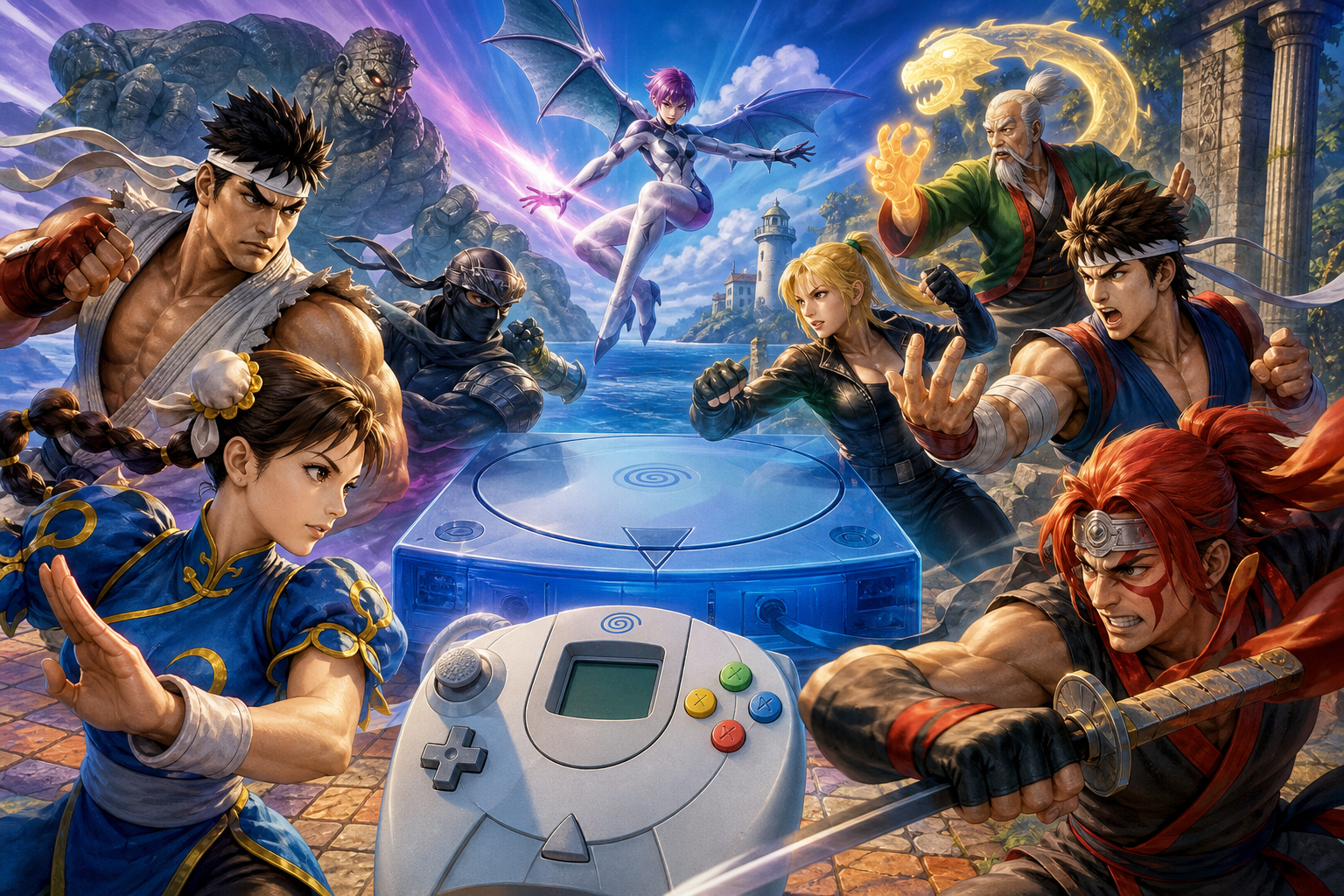
The Dreamcast is an unusually strong fighting-game system because it received a wide range of arcade-derived releases, including polished 2D fighters, technical 3D combatants, tag-team games and arena brawlers. Its library is broader than a simple list of Street Fighter alternatives. The best choices do not all reward the same skills: some emphasize parries and spacing, others focus on assists and team construction, while Power Stone 2 turns direct combat into a four-player scramble.
This ranking treats a fighting game as a title built primarily around direct character-versus-character combat. That includes Power Stone 2 because its arena battles are structured around fighting opponents, even though items and moving stages make it unlike a conventional tournament fighter. The order weighs mechanical depth, quality of the Dreamcast version, single-player content, replay value, local multiplayer and individuality. Rarity and resale value do not determine quality. Regional availability is noted separately, since an import-only release can be excellent without being equally accessible to every Dreamcast owner.
10. Guilty Gear X
Guilty Gear X is the import-focused choice for players who want fast, aggressive 2D combat with a personality all its own. Its four primary attack buttons, strong air mobility, unusual character designs and Roman Cancel system create a fighter that rewards players who understand momentum rather than simply memorizing a few special moves. The cast supports different approaches to pressure, zoning and counterattacks, giving the game a sharper identity than its comparatively modest roster might suggest.
Its limitation is accessibility in more than one sense. The Dreamcast version is region-limited and was not a standard North American release, so players outside its main markets need to verify the edition they are buying. Its speed can also make the opening hours intimidating. Players seeking a slower, immediately readable fighter may prefer SoulCalibur or Dead or Alive 2. For experienced 2D fans, however, Guilty Gear X offers an important early version of the aggressive systems that later became central to the series.
- Best for players who want fast 2D combat and unusual character mechanics.
- Tradeoff: region-limited Dreamcast availability and a demanding pace.
- Why it ranks tenth: highly distinctive, but less accessible than the games above it.
9. Virtua Fighter 3tb
Virtua Fighter 3tb brings Sega AM2’s technical 3D fighting design to Dreamcast with team-battle rules layered onto the Virtua Fighter 3 framework. Its appeal is not spectacle. The important decisions involve spacing, movement, punishment, timing and understanding what each fighter can safely do at different distances. Team Battle adds another planning layer without replacing the series’ emphasis on deliberate fundamentals.
That focus is also the game’s barrier. Virtua Fighter 3tb has a smaller and more specialized appeal than crossover fighters with enormous rosters, and the team-battle format does not make it as immediately approachable as a conventional one-on-one game. Players who want flashy assists or elaborate environmental destruction should look elsewhere. Those who enjoy studying movement and finding reliable responses will find a valuable Dreamcast alternative to SoulCalibur’s weapon-based flow. The release history also varies by territory, so buyers should identify the regional edition rather than assuming every copy has the same packaging or video standard.
- Best for technical 3D-fighter fans who value spacing and punishment.
- Tradeoff: demanding fundamentals and a narrower audience.
- Regional note: Dreamcast editions exist in more than one territory, so verify the release before buying.
8. Dead or Alive 2
Dead or Alive 2 builds its identity around fast 3D movement, holds, counters and interactive stages. The counter system gives defense an unusually active role: reading an opponent’s attack type can turn pressure into an opening. Three-dimensional movement and a dodge option make positioning important, while multi-level stages can send fighters through walls, over railings or into another section of the arena.
The Dreamcast edition also includes tag-oriented play alongside standard arcade, story, versus and sparring modes, giving it more variety than a purely one-on-one presentation suggests. Its strongest matches still depend on defensive timing and matchup knowledge, so players who dislike counter-heavy systems may find its rhythm less intuitive than SoulCalibur’s weapon spacing. Choose Dead or Alive 2 when you want a 3D fighter that combines readable basics with reversals, stage interaction and a lively sense of motion.
- Best for players who want 3D combat with an active counter game.
- Tradeoff: defensive timing can dominate the learning curve.
- Strongest appeal: a middle ground between technical dueling and arcade spectacle.
7. Garou: Mark of the Wolves
Garou: Mark of the Wolves is one of the Dreamcast’s most focused 2D fighters. Rather than relying on a huge crossover roster, it presents a largely new generation of characters and gives each one a clear combat identity. The T.O.P. system adds a strategic choice about where a fighter’s enhanced abilities become active, turning health management and positioning into part of a larger round plan.
That focus gives Garou a clean competitive shape. Neutral play, spacing and carefully chosen offense matter more than selecting a famous character and overwhelming an opponent with assists. Its smaller cast may feel restrictive beside Marvel vs. Capcom 2, and its SNK lineage can make the controls feel less familiar to players raised on Street Fighter. Regional naming also matters: the North American Dreamcast release is commonly identified as Fatal Fury: Mark of the Wolves, while Garou: Mark of the Wolves is the name used in Japan and in much later references. The Dreamcast release was available in Japan and North America, not as a broadly distributed European title.
- Best for focused 2D combat and players who enjoy learning a compact roster.
- Tradeoff: less spectacle and fewer characters than crossover games.
- Naming note: Garou: Mark of the Wolves and Fatal Fury: Mark of the Wolves identify the same Dreamcast series entry in different markets.
6. Project Justice
Project Justice, also known as Rival Schools 2 in some territories, stands apart through its team-based structure, tag mechanics, cooperative team-up attacks and anime-styled school setting. It is not merely a conventional fighter with school-themed costumes. Team construction and assists shape how a match develops, while the unusual cast gives the game a tone and identity that crossover-heavy competitors cannot replicate.
The Dreamcast version received documented releases in Japan, Europe and North America, although the release timing and packaging differ by territory. That makes it more accessible than many import-only choices, even if surviving copies are not equally common in every region. Its largest limitation is that team mechanics and cooperative attacks can make matches feel less controlled than a strict one-on-one fighter. Players looking for carefully isolated footsies may prefer Garou or 3rd Strike. Players wanting personality, tag interplay and memorable team attacks should move Project Justice higher on their personal list.
- Best for players who want team combat, tag mechanics and a strong setting.
- Tradeoff: cooperative attacks and team systems make matches less austere than traditional fighters.
- Regional note: Japan, Europe and North America received documented Dreamcast releases, but editions differ.
5. Power Stone 2
Power Stone 2 is the Dreamcast’s clearest argument for including arena brawlers in a fighting-game discussion. It expands the original formula with four-player support, larger changing stages, environmental hazards, items and more opportunities for players to collide away from a fixed 2D or 3D plane. Matches can shift dramatically as the arena changes, making every round feel like a compact party battle rather than a formal martial-arts demonstration.
That chaos is precisely why it does not rank first. Items and stage events introduce unpredictability, so Power Stone 2 is a weaker choice for players seeking a strict tournament environment. Its strengths emerge with a group: movement, opportunistic attacks and awareness of the whole arena matter as much as memorizing a traditional combo route. Choose it for four-player energy, not laboratory precision. It belongs on this list because its core loop remains direct combat between selected fighters, not because it resembles Street Fighter or Virtua Fighter.
- Best for four-player sessions and players who enjoy changing arenas.
- Tradeoff: items and hazards reduce the consistency prized by tournament fighters.
- Genre boundary: an arena brawler, not a conventional one-on-one fighter.
4. Capcom vs. SNK 2: Millionaire Fighting 2001
Capcom vs. SNK 2 is a fighter for players who enjoy building a team around a ruleset. Its six selectable grooves change important systems such as meter behavior, defensive options and movement, allowing the same roster to support very different strategies. The crossover concept is appealing, but the real depth comes from choosing a groove and team that complement one another rather than treating the character list as a museum display.
The game offers enormous replay value because players can approach match construction from multiple directions. It is also less immediately welcoming than a simpler arcade fighter: the roster, grooves and differing character philosophies create several layers to learn. Players who want one stable system may find the choice overload distracting, while experienced fans can spend a long time refining teams. Compared with Marvel vs. Capcom 2, it is more deliberate and system-focused. Compared with 3rd Strike, it gives up some roster cohesion for breadth and experimentation.
- Best for team-building and experimenting with different combat systems.
- Tradeoff: six grooves and a large roster create a substantial learning load.
- Decision point: choose it over Marvel vs. Capcom 2 if system variation matters more than maximum spectacle.
3. Marvel vs. Capcom 2
Marvel vs. Capcom 2 turns three-character teams, assists and rapid tagging into a spectacular fighting language. The roster combines Marvel and Capcom personalities, while assist selection affects neutral play, pressure and defensive options. A player is not choosing only three fighters; they are choosing a group of tools that can control space, extend combos or create openings for a partner.
Its large cast and energetic presentation make it one of the strongest local multiplayer choices on the system. The same breadth can make it difficult to read, especially for players who prefer grounded one-on-one exchanges. Balance and visual density are also meaningful tradeoffs: the game’s appeal comes from explosive possibilities rather than the measured symmetry of Virtua Fighter. It ranks below 3rd Strike and SoulCalibur because its best qualities are more specialized, but for a group that wants recognizable characters, assists and constant motion, Marvel vs. Capcom 2 is exceptionally effective.
- Best for spectacle, three-character teams and local multiplayer.
- Tradeoff: visual density and balance concerns may frustrate methodical players.
- Choose it over Capcom vs. SNK 2 when assists and rapid tag pressure matter more than groove experimentation.
2. Street Fighter III: 3rd Strike
Street Fighter III: 3rd Strike rewards players who want precision to matter. Its defining parry system turns defense into a timing challenge, while Super Arts and a distinctive roster give each character a clear strategic route. Neutral play is especially important: advancing safely, controlling the right distance and recognizing an opponent’s habits can matter more than simply forcing a long combo.
The Dreamcast edition is particularly valuable for practice-minded players because it includes a training-record option and system-direction settings. The record function can repeatedly reproduce an attack or combination for parry practice, while system direction allows selected rules to be adjusted. Those additions do not make the game easy. Parrying demands confidence, and matchup knowledge can be demanding for newcomers. Players who prefer a more forgiving first fighting game should begin with SoulCalibur. Players who want a precise 2D fighter with a strong competitive identity will find 3rd Strike difficult to displace.
- Best for players who value parries, neutral play and matchup study.
- Tradeoff: the precision demanded by parries can make early sessions unforgiving.
- Dreamcast advantage: training-record and system-direction features make practice more purposeful.
1. SoulCalibur
SoulCalibur is the most complete fighting-game package on the Dreamcast. Its weapon-based roster makes spacing immediately legible: each character’s reach, stance and attack rhythm feel different, while eight-way movement opens up the arena beyond a simple horizontal line. Guard Impacts, ring-outs and stage positioning add meaningful decisions without burying beginners under an enormous rulebook.
The console edition also goes beyond a bare arcade conversion. Mission-based battles, survival and tournament modes give solo players more reasons to return, while local versus play remains the central attraction. Completing objectives also supports additional unlocks, giving the single-player side a clearer sense of progression than many arcade ports. That mixture explains the ranking: SoulCalibur welcomes a first-time player with readable controls, then continues offering depth through movement, defensive timing and matchup knowledge. It is less focused than 3rd Strike and less chaotic than Power Stone 2, but it serves more kinds of players successfully. For a Dreamcast owner choosing one fighting game first, SoulCalibur is the safest recommendation.
- Best overall for newcomers, local multiplayer and players who want weapon-based 3D combat.
- Tradeoff: players seeking highly technical 2D systems may prefer 3rd Strike or Garou.
- Why it ranks first: the strongest balance of accessibility, depth, solo content, identity and Dreamcast-specific value.
The best starting point depends on the kind of fighting you want. SoulCalibur is the broadest recommendation, while 3rd Strike and Garou suit technical 2D specialists. Virtua Fighter 3tb and Dead or Alive 2 cover contrasting 3D approaches, and Capcom vs. SNK 2 rewards players who enjoy building teams around systems. Marvel vs. Capcom 2 and Power Stone 2 are especially strong choices for lively local sessions, while Project Justice offers the most distinctive team-fighter identity.
Import-focused players can also investigate Fighting Vipers 2, Vampire Chronicle and The Last Blade 2, but their regional limitations should be treated as access considerations rather than proof of higher quality. The Dreamcast’s fighting library works because it does not reduce competition to one formula: it offers careful duels, explosive teams, weapon spacing and arena chaos on the same system.