May el-Toukhy’s Woman Unknown is a period drama built to feel like a locked room even when it steps outside. Set in post-Second World War Copenhagen, the 126-minute Danish-language film follows Marie, played by Mathilde Arcel, a maid and nanny whose precarious climb toward respectability is shadowed by secrets, surveillance and a society eager to turn women’s private lives into public punishment.
The film screened in competition at the Venice Film Festival on September 6, 2026. It comes from el-Toukhy, whose 2019 drama Queen of Hearts was later reworked by Catherine Breillat as Last Summer. Here, el-Toukhy again approaches sexual power through discomfort rather than easy catharsis. The result is a chilly, intensely controlled work that can be potent in individual scenes, even where its heavy symbolism and tightly signposted dramatic turns leave little room for ambiguity.
A house where every object is judging you
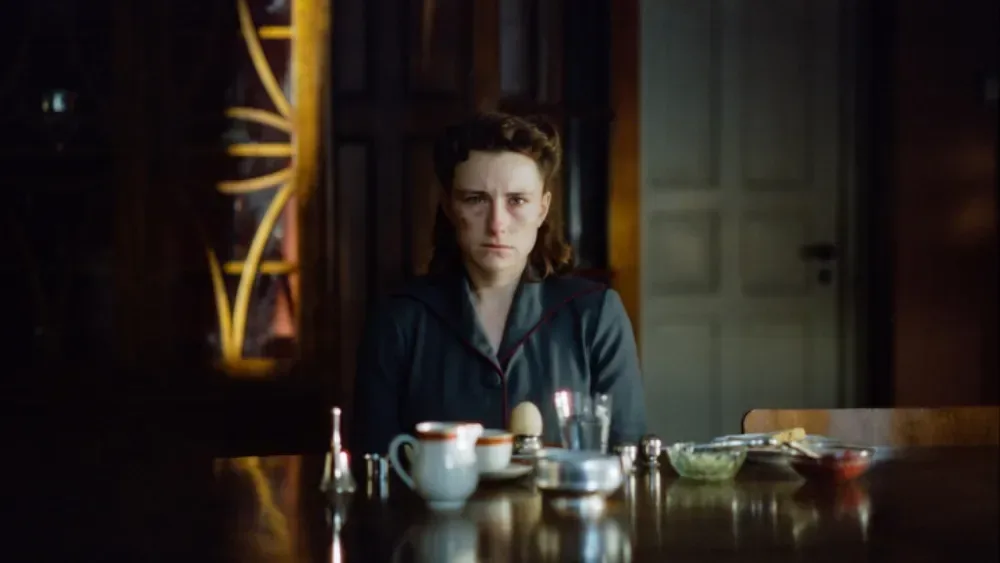
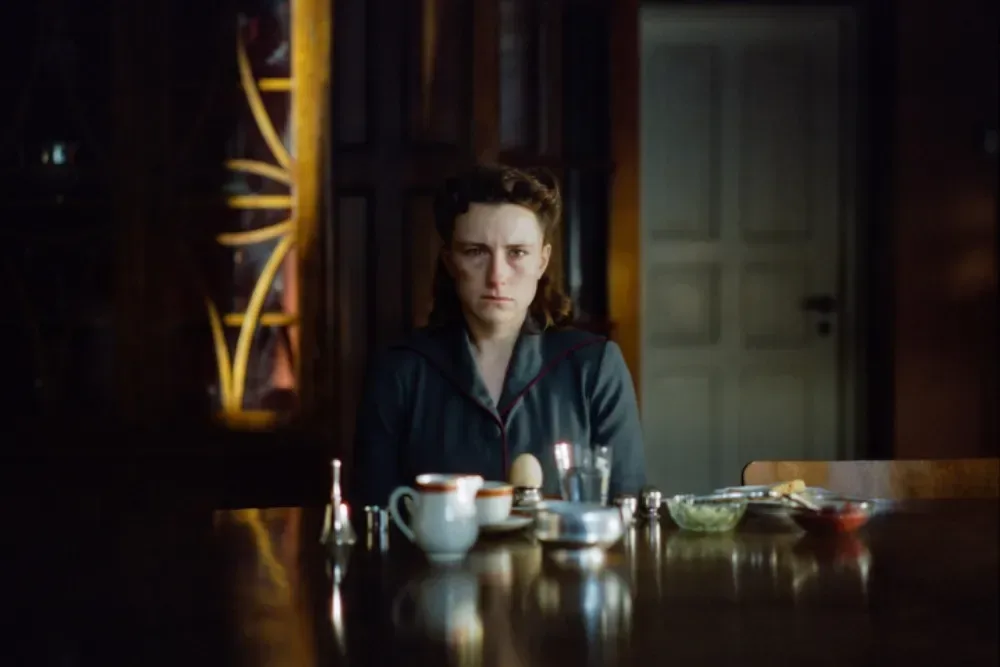
Marie works in the home of Christian, a widower who owns a glove factory and is played by Carsten Bjørnlund. She also cares for his young daughter. At first, the household itself supplies the film’s menace: formal rooms, rigid etiquette and a head maid, Esther (Marina Bouras), whose watchfulness turns domestic labor into an ordeal. Place settings must be exact. Every movement looks capable of becoming a violation of a rule Marie was never permitted to write.
Arcel gives Marie a compressed, anxious physicality. Her posture and guarded expression suggest someone attempting to make herself smaller without disappearing. That quality matters because the character’s position in the household is never simply professional. Christian’s attention makes clear that Marie may be moving toward a more privileged status, but the opportunity is inseparable from dependence. A wedding dress hanging in an otherwise empty closet becomes an especially blunt but effective visual promise: security is being presented to Marie as a prize, and that prize can just as easily become a trap.
El-Toukhy and co-writer Maren Louise Käehne establish that Marie has left something behind. Karl, an old acquaintance from her hometown played by Thorbjørn Hedegaard, recognizes her and proves much more interested in reconnecting than Marie would like. A doctor’s visit, involving liquid opium Marie uses to numb pain associated with sex, adds another fragment to the picture. Marie once had a son, and that history was central to her decision to flee her former life.
The screenplay withholds a full explanatory account, but its implications are deliberately close to the surface. That gives the story a strange duality. It is structured like a psychological mystery, with the past advancing through looks, fragments and threats; yet the film makes sure the audience understands the social danger awaiting its protagonist.
The historical wound at the center
Woman Unknown draws on accounts of women in Nazi-occupied countries who were publicly punished for relationships with German soldiers after the war. The film portrays groups of men attacking women in public, cutting their hair, stripping them and marking them with swastikas. These images establish a brutal context for Marie’s terror and underline the central injustice: female bodies become the place where a community stages its rage, nationalism and supposed moral cleansing.
The premise has force because it is not limited to history. The movie asks what happens when sexual conduct is treated as evidence of a person’s entire worth, and when a crowd decides it has the authority to expose, humiliate and discipline a woman. Marie is endangered by obvious political violence, but also by class hierarchy, gossip, male entitlement and the supposedly refined world she wants to enter. In that sense, the glove factory is not merely Christian’s business. It is another reminder that touch, appearance and possession are embedded in the film’s visual language.
Related coverage includes ‘Woman Unknown’ Turns Postwar Shame Into a Chilling Chamber Drama.
Once Karl locates Marie, the threat spreads through whispers among the household staff and through the building itself. A Nazi symbol appears on the door. The private refuge Marie hoped to build begins to look porous. Her life is governed by the possibility that someone else will tell her story first, simplify it, and use it against her.
For readers interested in another upcoming big-screen conversation about how familiar characters can be reinterpreted, Joking Joystick has also covered Robert Pattinson’s comments on the changing direction of The Batman Part II. Woman Unknown, though, is working on a far more austere register: less franchise reinvention than an extended study in the cost of being watched.
Crimson warnings and an escalating panic
Jasper Spanning’s cinematography gives the film much of its character. Copenhagen is rendered through ash-gray surroundings, dark wood and restrained interiors, while red repeatedly cuts through the frame. The device is intentional enough to announce itself early, later appearing in the painted insignia on Marie’s door and eventually as blood. It is a stark symbolic strategy, but it fits a narrative in which shame is literally imposed as a visible mark.
The camera language also changes alongside Marie’s state of mind. Early compositions hold characters at a distance in static, shadow-filled spaces, making the home feel cavernous and impersonal. As Marie spirals, the film moves into closer, shallower-focus images. The world does not become more intimate; it becomes more claustrophobic. The change helps convey how every room and every face becomes an immediate threat.
That visual control is paired with scenes of sexual coercion that are intentionally difficult to endure. Karl’s abuse is filmed as an assertion of power over a body Marie cannot safely claim as her own. The movie connects that violation to other, colder forms of objectification: a tailor measuring Marie, or Christian using her hand to display a new glove design. These moments are not equivalent in scale, but they rhyme thematically. Marie is assessed, handled and assigned meaning by others.
There is a risk to repeating that point so often, and the film sometimes takes it. Its imagery and plotting can feel determined to ensure that no viewer misses the thesis. The most striking passages nevertheless derive real dread from this insistence. In el-Toukhy’s Copenhagen, control is never only exercised by someone shouting. It can arrive as etiquette, charity, desire, employment, fashion or a hand placed too familiarly on a cheek.
Arcel holds the film together
Arcel is the crucial element in making Marie more than a symbol. Her performance preserves a fragile tenderness beneath the character’s vigilance, especially in scenes with children. Those glimpses show that Marie is capable of care and attachment even as the narrative pressures her toward isolation. They also make the surrounding cruelty feel more personal: the film is not merely describing a social mechanism; it is tracing what that mechanism denies one particular woman.
Still, the emotional architecture around Marie is uneven. A next-door neighbor, a single mother whose relative independence also attracts scrutiny, arrives with intriguing possibilities but receives limited development. The relationship seems designed to support the film’s late emotional and moral movement, including a suggestion of betrayal among women, yet the groundwork is comparatively thin. As a result, the final escalation may land as an idea the film wants the audience to feel rather than a fully earned transformation.
That tension defines Woman Unknown as a whole. It is formal, forceful and often harrowing, with Arcel’s nervous performance and Spanning’s severe imagery generating real pressure. But its symbolism is broad, and its script can lead viewers so firmly from one connection to the next that the psychological complexity suggested by the premise narrows. Marie’s predicament is powerful precisely because it should resist simple moral accounting. The film recognizes that, even when its own design occasionally makes the answer look too prearranged.
Key credits and cast
- Director: May el-Toukhy
- Screenplay: May el-Toukhy and Maren Louise Käehne
- Cinematography: Jasper Spanning
- Editor: Rasmus Stensgaard Madsen
- Music: Mikkel Hess
- Cast: Mathilde Arcel, Carsten Bjørnlund, Thorbjørn Hedegaard, Marina Bouras, Mia Plantin, Sofia Nolsøe, Flora Yde Sander, Mikael Birkkjær and Joen Højerslev
- Production countries: Denmark, Sweden and Latvia