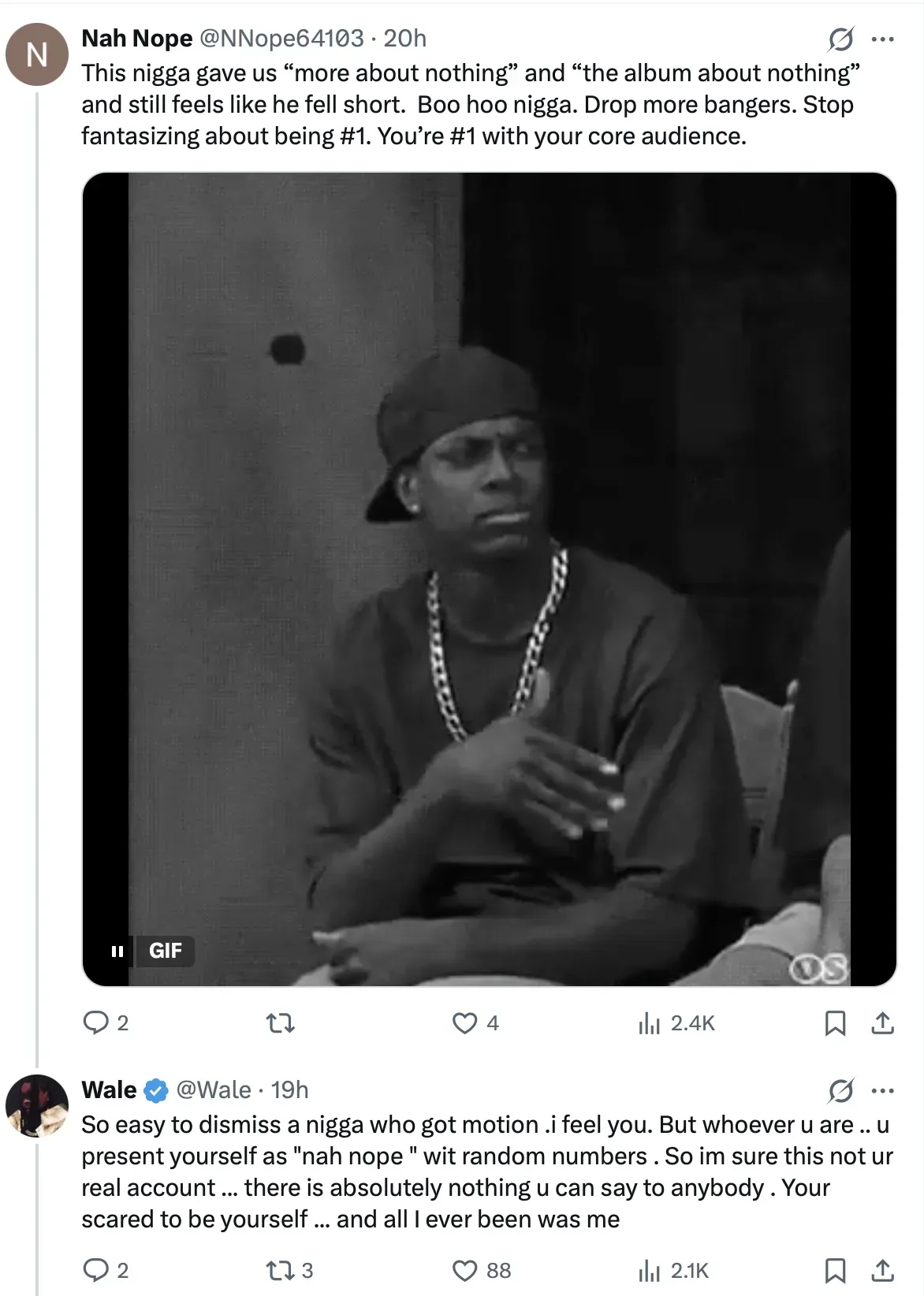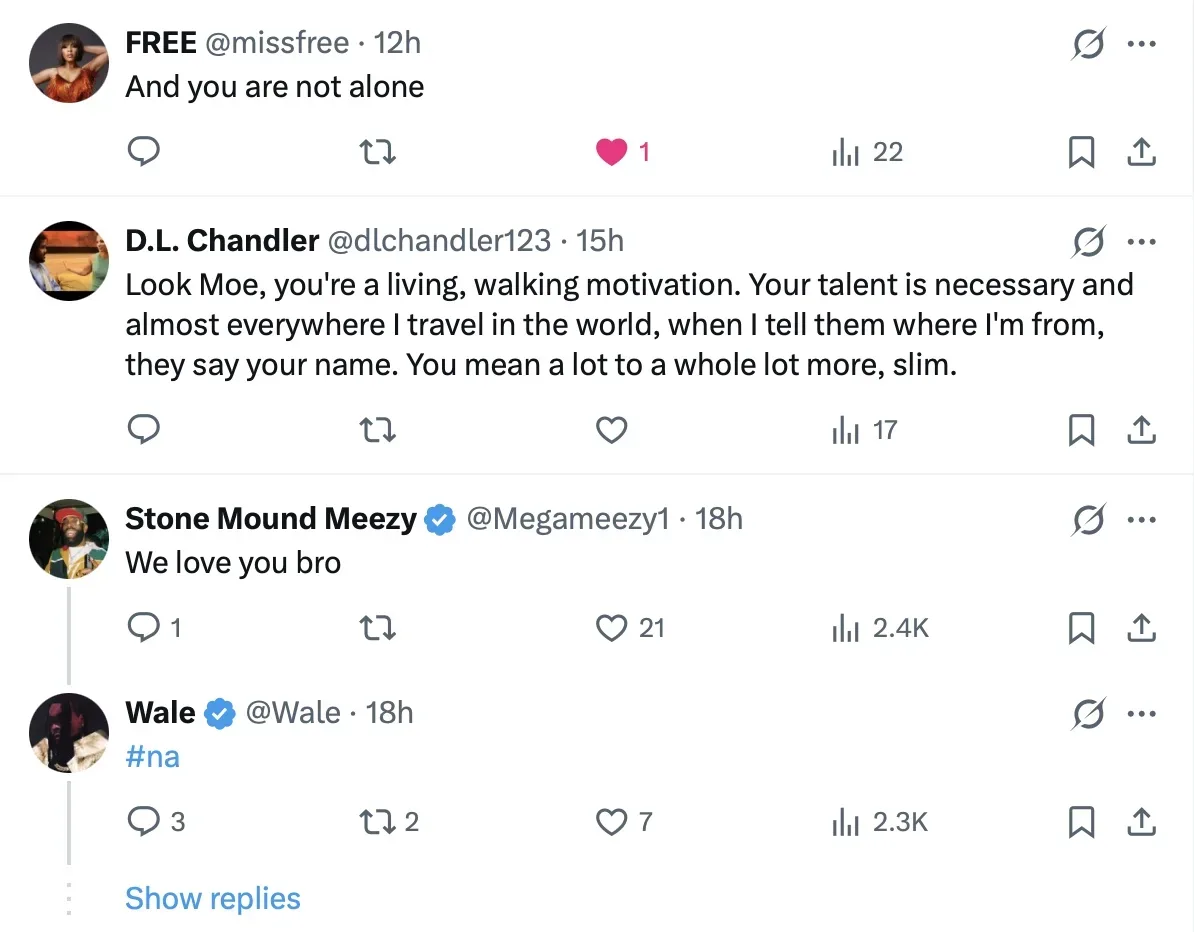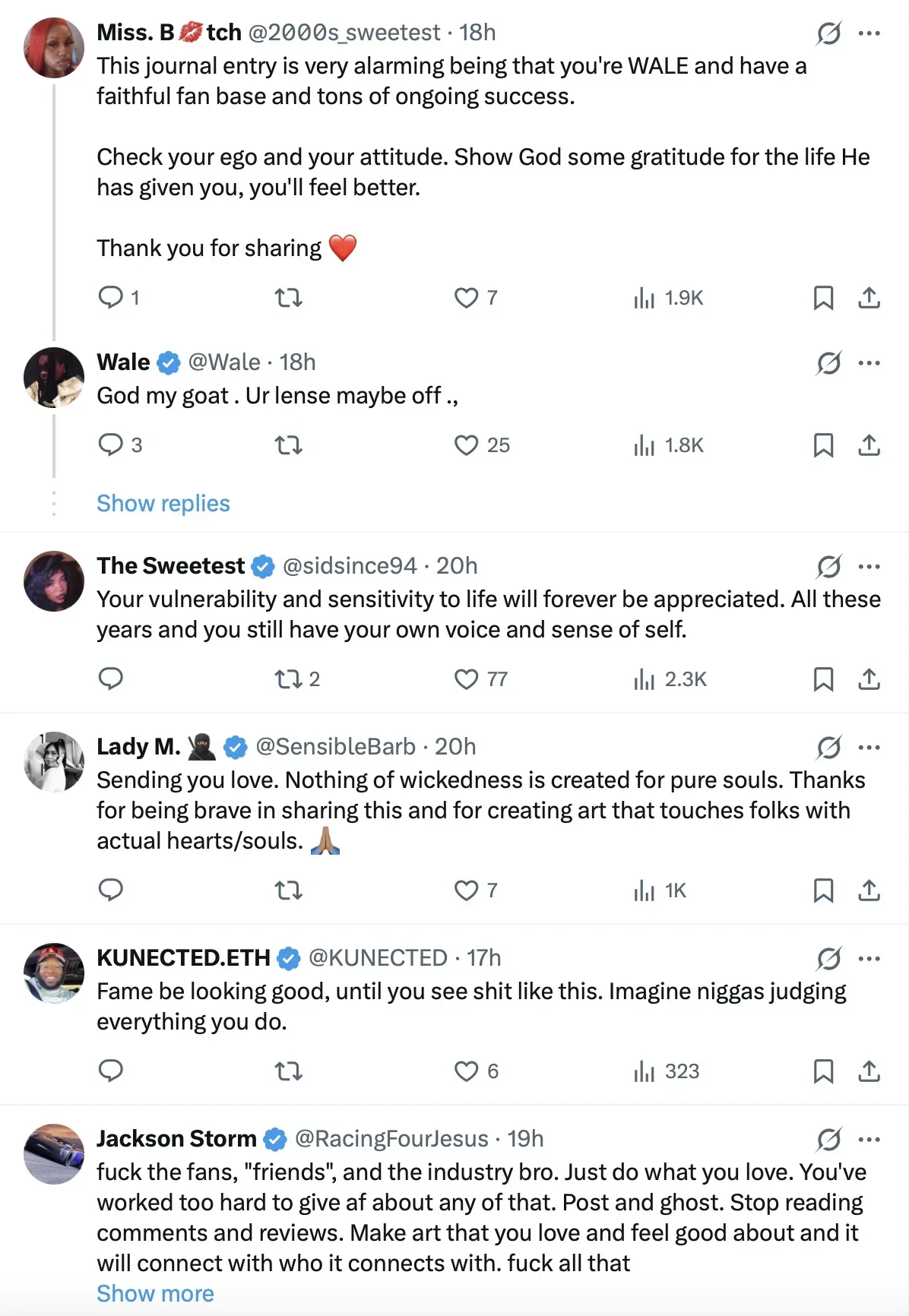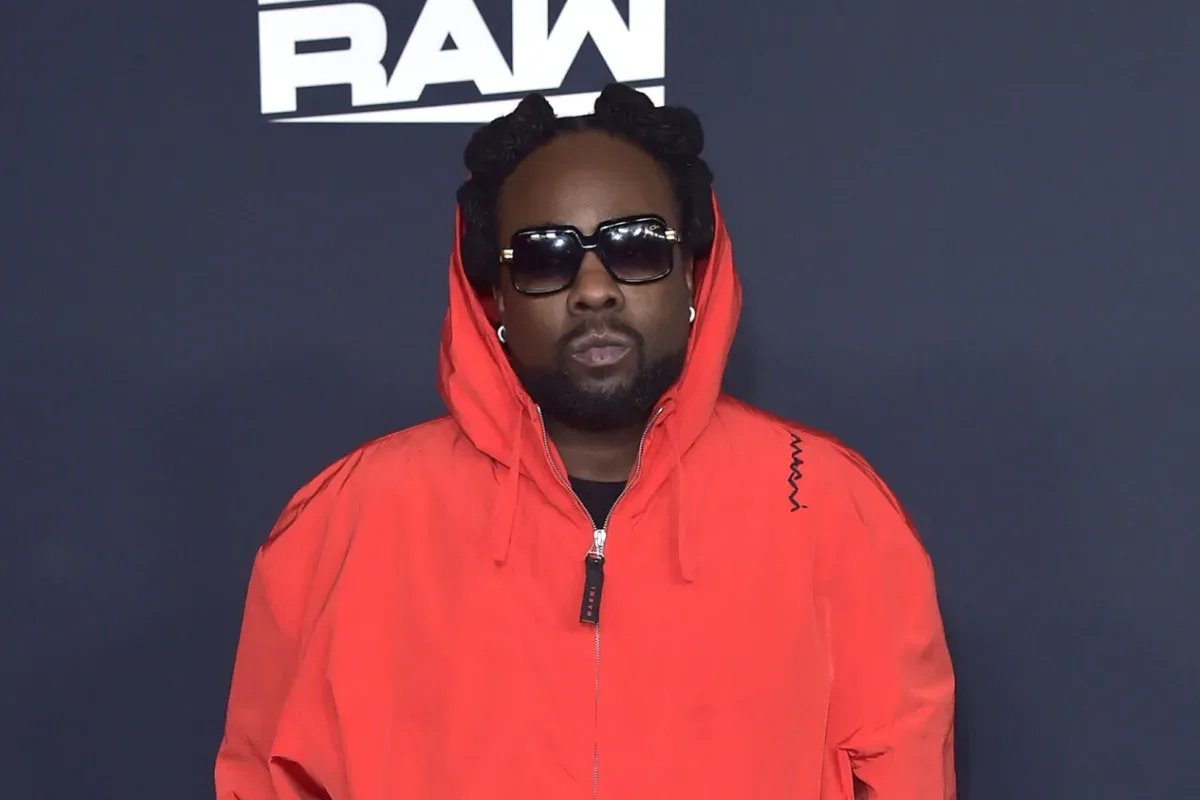
Wale briefly gave followers an unusually direct account of what prolonged visibility in the music business can do to a person. In a post on X that was later deleted, the Washington, D.C. rapper apologized to people who care about him and described feeling trapped between the demands of creativity, responsibility to loved ones, personal loss and the relentless evaluation that comes with an online audience.
The message did not identify a particular event, relationship or recent dispute behind it. That absence matters: it makes the post less a statement about a single controversy than a broad reflection on sustained pressure. Wale framed his concerns around nearly two decades in music, saying that life inside the industry can distort someone’s sense of what is real and whom to trust.
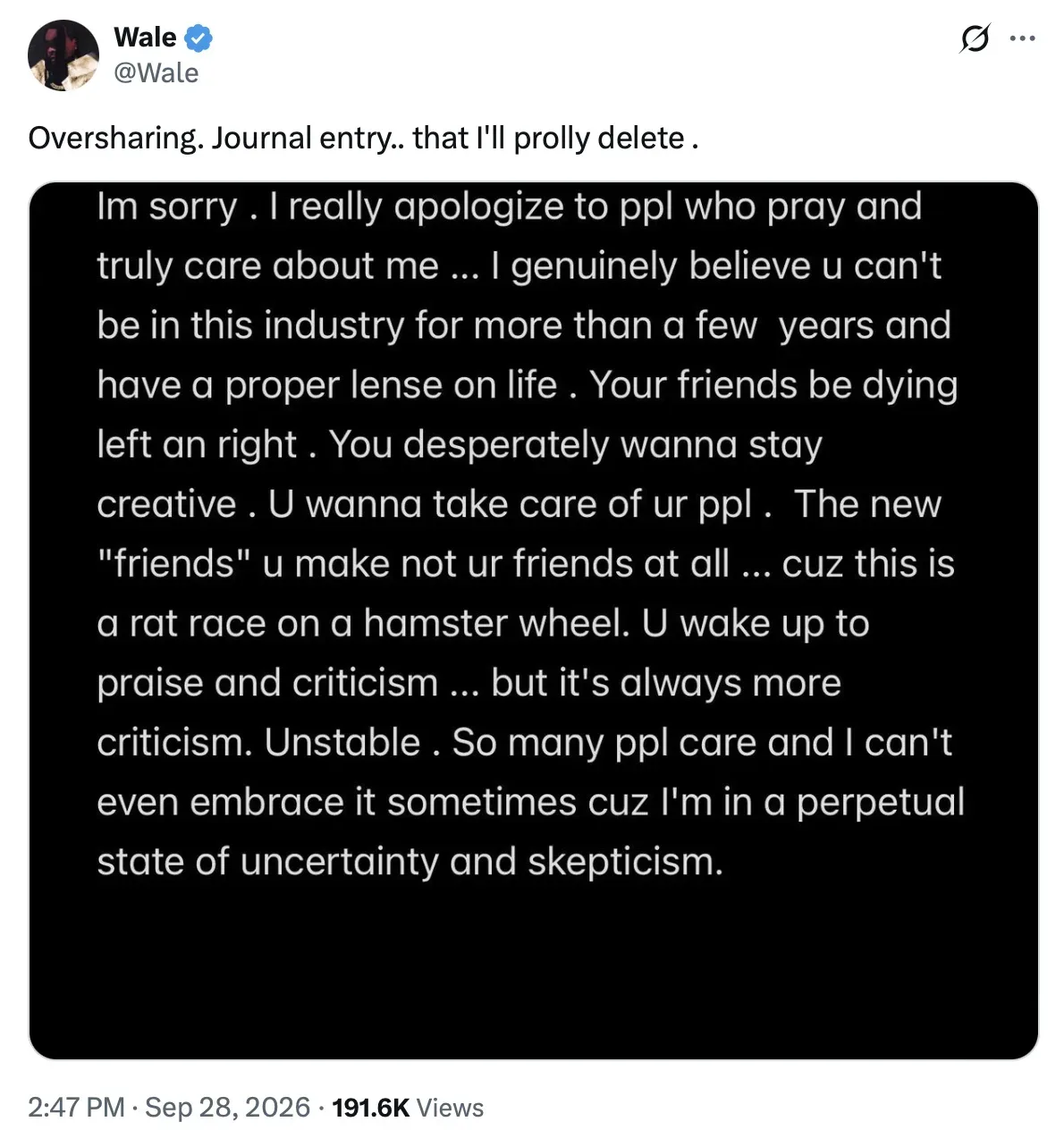
“I genuinely believe u can’t be in this industry for more than a few years and have a proper lense on life,” Wale wrote, describing friends dying, pressure to stay creative and a struggle to tell true friends from people drawn to the career.
A post about uncertainty rather than a specific grievance
Much of Wale’s message turns on uncertainty. He wrote about wanting to provide for his people, maintain creative momentum and receive the care offered by supporters, while also being unable to fully accept that support because of skepticism. He called the business a “rat race on a hamster wheel,” a concise image for work that demands constant movement without offering much room to step back and assess the cost.
That skepticism was not directed at one named individual. Instead, Wale described new relationships that can be difficult to evaluate when status, opportunity and proximity to a successful artist are involved. He also placed public praise and criticism in the same daily stream, noting that a person can wake up to both through the same device.
That distinction is important in a social-media setting. A post can look like a request for an answer or an invitation to decode a hidden feud, but Wale did not provide evidence for a specific target. Treating it as one would turn a personal expression of exhaustion into speculation. The clearer reading is the one contained in his words: a public figure trying to explain why affection, attention and even encouragement can become difficult to process after years of instability.
What the “algorithm” pressure means in practical terms
Wale has previously spoken about frustrations with music, social-media noise and the algorithm. In this context, an algorithm is the automated system that helps determine which posts, clips and conversations are shown to users. It does not simply deliver an artist’s work to fans in a neutral way; it can also elevate criticism, arguments and reaction-driven discussion because people engage with them.
For an artist, that creates an awkward overlap between career maintenance and personal exposure. The phone is a work tool for promoting music, speaking to fans and observing public response. It is also the place where grief, insults, compliments, rumors and demands arrive. Wale’s post captured that collision without pretending there is an easy switch that separates the professional part of public life from the human one.
“Stay creative” is especially significant in that framing. Creativity is often discussed as if it is an endless resource, but Wale presented it as something he still feels compelled to produce amid uncertainty. The post also connects that creative pressure to caretaking: he wants to take care of the people around him. In other words, the career is not just about maintaining relevance or handling feedback; it is tied to obligations beyond the artist himself.
Supportive replies cannot erase the tension he described
Responses to the post were largely supportive, although critics and trolls were also present. That mix almost illustrates Wale’s point. A supportive reply may be sincere, but it exists in the same feed as hostility and mockery. And when someone says they are already in a “perpetual state of uncertainty and skepticism,” a positive response does not automatically overcome the conditions that produced those feelings.
This is not an argument that supportive messages do not matter. Wale explicitly acknowledged people who pray for him and genuinely care. Rather, the post recognizes a harder emotional truth: knowing that people care and being able to emotionally receive that care are different things. Public attention can make that gap more visible, but the gap itself is deeply personal.
It is also why the deleted status of the post should not be treated as a plot twist or proof of a hidden development. People remove vulnerable posts for countless reasons, and no reason was provided here. The available facts are limited to what Wale chose to share before it disappeared: he was apologetic toward people who care, exhausted by the instability surrounding a long music career, worried about loss and relationships, and struggling to absorb praise amid the criticism.
The wider issue: public access is not the same as understanding
Fans have more direct access to musicians than ever through social platforms, but access can create a misleading sense of familiarity. A post may be immediate, personal and written in an artist’s own words, yet it remains only a piece of a larger life the public cannot see. Wale’s note is candid, but it does not authorize outsiders to fill in the missing names, diagnose him or turn his reflection into entertainment.
It does offer a meaningful account of how long-term public scrutiny can reshape trust. His concern was not merely that criticism hurts. It was that repeated exposure to praise, criticism, changing relationships and loss can make the entire environment feel unstable. That is a more complicated statement than a complaint about bad comments. It is a description of the difficulty of keeping a dependable personal perspective when the career, the audience and social media all demand attention at once.
Recent music news has repeatedly shown how quickly an artist’s digital presence can become a spectacle; even a surprise livestream can invite intense scrutiny around a celebrity’s actions and plans, as seen in coverage of Drake’s surprise Stake stream. Wale’s post points toward the less performative side of that always-on environment: the personal strain of never being entirely outside the conversation.
Why the message resonated
There is no stated next step, project announcement or promised explanation attached to Wale’s deleted post. Its impact comes from the clarity of the conflict he laid out. He wants to create, care for people and acknowledge those who support him. At the same time, he feels worn down by death, unstable relationships, public criticism and the need to question motives.
That is why the most responsible response is not to demand more disclosure. The post already says what Wale elected to say. It is a reminder that a musician’s public profile can invite limitless commentary while leaving the person behind it to sort through an overwhelming amount of emotion, expectation and noise.