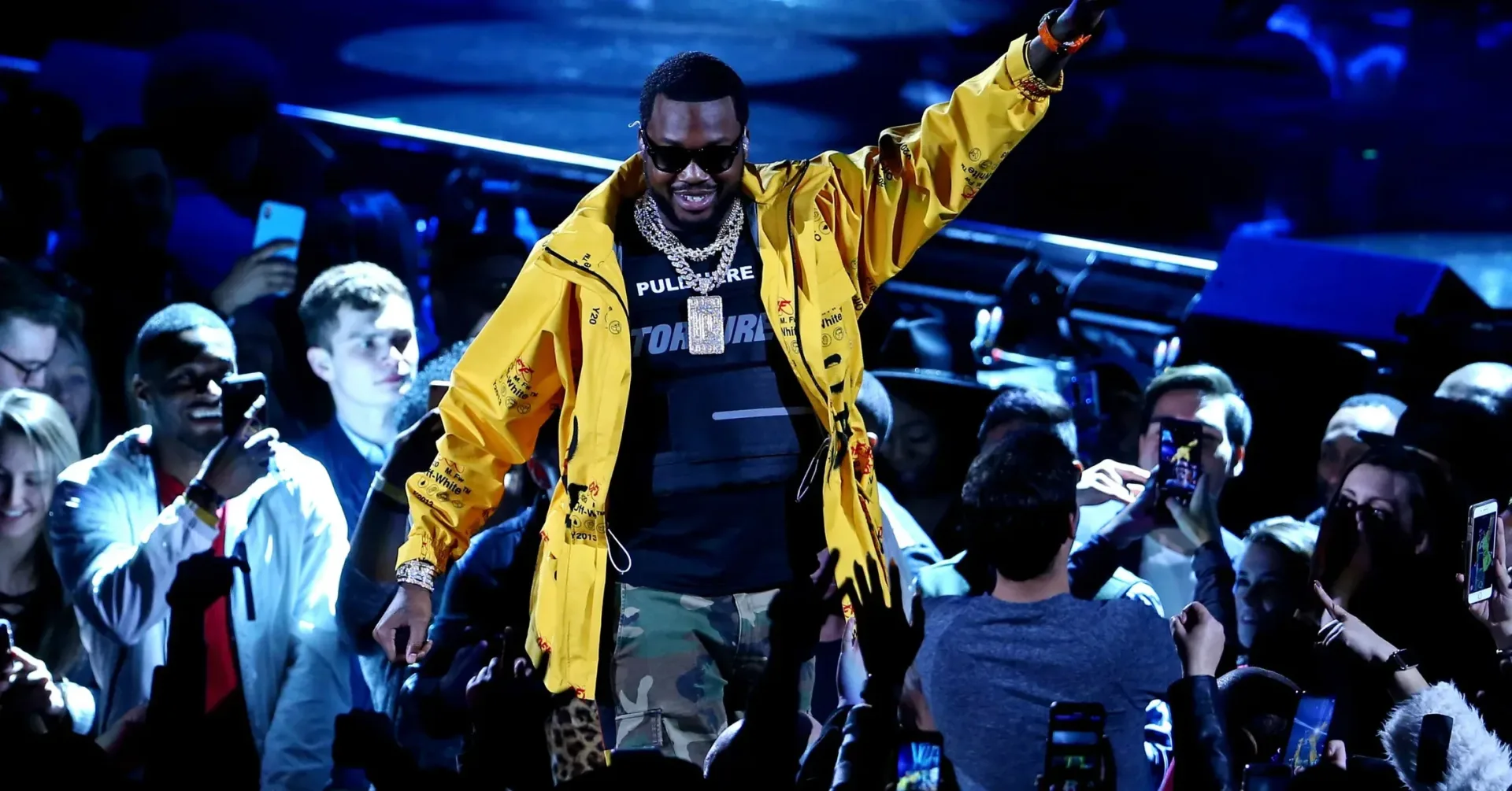
Meek Mill has renewed a familiar but increasingly urgent argument about the streaming era: the industry’s scoreboard may not be measuring music in a way that serves the people who make it. In posts shared on X, the Philadelphia rapper criticized a business he believes has drifted away from artists, particularly smaller acts, and toward decisions that reward fleeting online attention.
His sharpest complaint concerned the conversion rate used to turn on-demand plays into album-equivalent sales. Meek Mill singled out the widely discussed 1,500-stream benchmark, asking how that figure was decided and arguing that its adoption damaged the music ecosystem for both creators and listeners. He also said he intended to release music for free, framing the move as evidence that making music itself is not the hard part; navigating the surrounding business is.
“The business of music has gotten far from our hands,” Meek Mill wrote, arguing that the decisions shaping it do not align with talent and instead favor viral moments.
The posts do not offer a proposed replacement formula, and they should be read as an artist’s critique rather than a detailed policy plan. Still, they put a spotlight on a distinction that can easily get blurred in music discussion: a stream is a measure of consumption, while an album sale is a standardized unit used for chart accounting. Those are related ideas, but they are not naturally identical.
What “streams equal a sale” actually means
Streaming has become the leading way audiences hear music, but charts still need a common way to compare formats. A purchased album is a discrete transaction. A stream is a play of an individual track, often within a subscription service or an ad-supported tier. Album-equivalent formulas are the accounting bridge between those different forms of listening.
For Billboard chart calculations cited in the discussion around Meek Mill’s comments, one album sale can be represented by 1,000 paid-subscription streams or 1,500 ad-supported streams. The difference reflects the fact that paid and ad-supported listening are treated as different tiers. In plain terms, the system requires more ad-supported plays to reach the same album-equivalent benchmark.
That does not mean a listener directly buys an album after reaching play number 1,000 or 1,500. Nor does it mean every artist receives the same payment for every stream. The conversion rate is principally a chart-accounting device: it translates huge volumes of song plays into a format comparable with album sales. Royalty payments, label arrangements, publishing shares, and other financial questions are separate from that headline chart conversion number, even though they are often discussed together.
Meek Mill’s criticism joins those concerns at the point where public recognition and commercial leverage can meet. A high chart position can shape an artist’s visibility and industry narrative. If a conversion formula feels remote from how fans value music, artists may reasonably question whether it is building an accurate picture of success.
Why the viral-moment criticism matters
The rapper’s broader concern is less about a single piece of arithmetic than the incentives produced by the modern music pipeline. When he says the system favors “viral moments,” he is describing an environment in which short bursts of attention can be especially valuable. That does not necessarily mean viral popularity and artistic merit are opposites. A viral song can be great, and a deserving artist can break through online.
But the incentives are plainly different. A viral moment is immediate, legible, and easy to quantify through plays and visibility. Talent is broader and slower to evaluate. It may include live performance, songwriting, consistency, cultural influence, or the ability to develop a lasting catalog. Meek Mill’s complaint is that the former is being allowed to dictate too much of the latter.
For smaller artists, that distinction is especially meaningful. A major act may have a large existing audience, resources, and a label infrastructure that can help translate attention into lasting momentum. An emerging musician can generate a sudden spike in plays without necessarily gaining enough stability to keep releasing work at a sustainable pace. Meek Mill specifically raised the issue of streaming’s impact on small artists, making his comments about more than his own catalog or chart placement.
There is also a consumer side to his argument. Listeners benefit from access: streaming makes it simple to hear a vast amount of music without purchasing each release separately. But access is not the same thing as a healthy creative economy. The tension he identifies is whether the convenience of endless listening, combined with the emphasis on measurable traction, puts too much pressure on music to become instantly shareable rather than durable.
Free releases would make a point, not solve the structure
Meek Mill’s suggestion that he could put out music for free is notable because it challenges the assumption that recorded music must always enter the audience through the same commercial funnel. Free music can remove a barrier between artist and listener. It can also be a statement that the art has value beyond a particular platform’s metrics.
At the same time, a free release would not, on its own, answer the issues embedded in streaming economics or chart methodology. Recording, production, collaborators, rights management, and promotion can all involve work and costs. An established rapper choosing to give music away is not necessarily operating under the same conditions as a newer artist trying to fund a first sustained run of releases.
That is why the most useful part of Meek Mill’s complaint is his focus on control. His posts argue that decisions with consequences for artists are being made at a level that feels distant from the talent affected by them. Releasing a track freely can be an act of independence; it cannot by itself make an industry-wide conversion system more transparent or more representative.
New songs keep the conversation tied to the music
The remarks arrive shortly after Meek Mill released “Philly Heathens” and “Am I Wrong.” The latter interpolates a song by Nico & Vinz and has drawn some pushback over that choice. An interpolation differs from using a direct recording: it incorporates elements of an existing composition into a new work rather than simply inserting the original sound recording. The supplied details do not establish the precise nature of the criticism, but the reaction shows how quickly conversations around a new release can move between music itself, creative decisions, and audience judgment.
That backdrop matters. Meek Mill is not discussing streaming as a detached observer. He is an active recording artist releasing new material while challenging the systems that convert listening into industry success. Fans hoping for more frequent music from him may welcome the new tracks, while his posts ask them to consider what “support” means in an on-demand market.
The questions do not end with one rapper or one formula. What should charts reward: repeat listening, broad reach, paid engagement, long-term fandom, or some combination of all of them? How much should a viral surge matter compared with an artist’s body of work? And how should a system built around frictionless access reflect the labor needed to make the music listeners can access so easily?
Meek Mill has not supplied a complete blueprint, but his frustration is specific enough to cut through the usual vague complaints about streaming. He is challenging the conversion math, the power behind it, and the cultural priority it appears to express. Similar uncertainty surrounds other major rap releases, including the limited information available around Young Thug’s next album, where anticipation can race ahead of concrete details. In an attention-driven market, Meek Mill’s point is that excitement should not be mistaken for a system that works fairly for every artist creating the music.