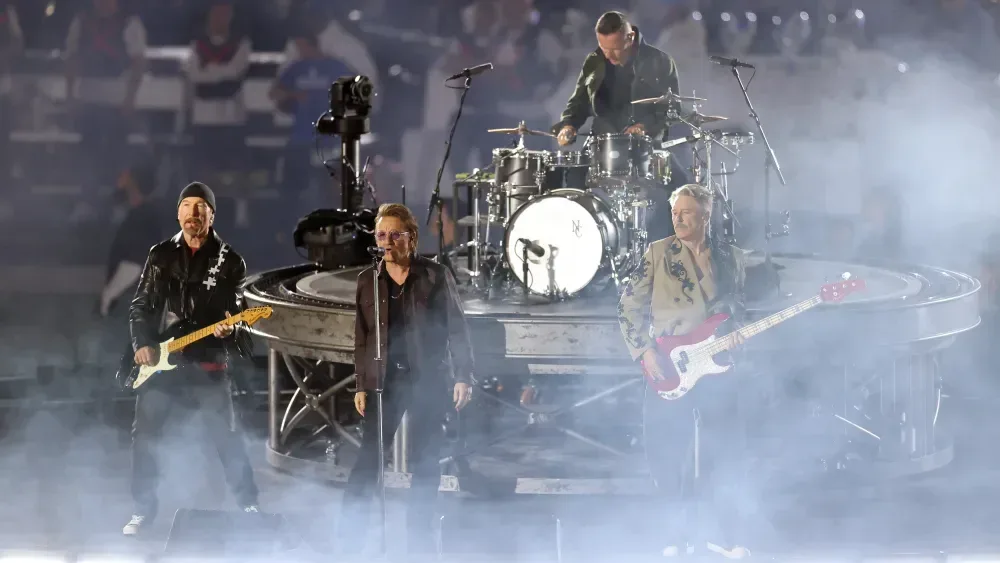
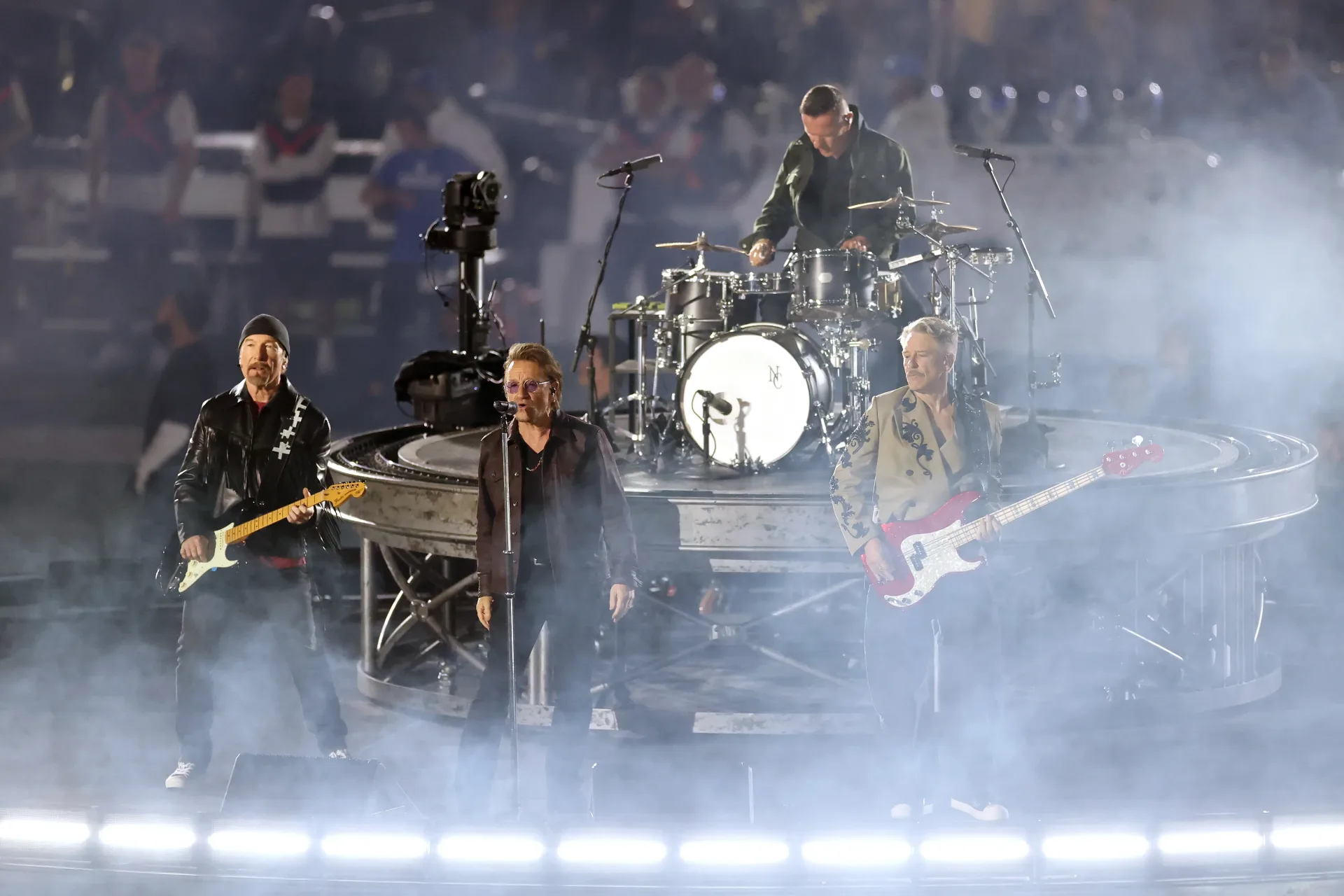
U2 used the NFL’s first Thanksgiving Eve halftime show for a compact, unusually measured performance built around a post-production-style collaboration with Dolly Parton. The band’s 10-minute set at the Los Angeles Rams vs. Green Bay Packers game put Bono alongside a recording of Parton on the new song “Torn,” while projections of the country icon appeared on three towering curtains around the midfield stage.
That presentation was the central idea of the performance rather than a quick celebrity cameo. Parton was not physically on the field; her contribution came from a recording made last summer, paired with Bono’s live vocal and the surrounding projected imagery. In a halftime environment where every second is often used to move through as many recognizable hooks as possible, U2 instead made room for the image, transition and song to land.
The broadcast was streamed on Netflix, and the band’s appearance arrived shortly after the November 13 release of Carnaval de Luz, U2’s first album of new material in nine years. The album opened at No. 4 on the Billboard 200. “Torn” was the only full song from that album represented in the halftime performance, a selective choice that placed the new record within a set otherwise rooted in U2’s long-established catalog.
A halftime show that favored pacing over maximum song count
U2 performed four principal songs: an abbreviated “Sunday Bloody Sunday,” “Torn,” “Where the Streets Have No Name,” and “Pride (In the Name of Love).” A brief fragment of “American Obituary,” from a recent U2 EP, also appeared during “Sunday Bloody Sunday,” making five U2 songs audible in some form.
There is an important difference between a medley and simply playing a group of shortened songs. A medley connects musical sections so that one phrase, lyric, rhythm or staging cue establishes the next. Here, Bono’s repetition of the word “torn” at the end of the opening material functioned as a vocal bridge into “Torn.” The phrase did more than announce the next selection: it linked the emotional vocabulary of the older song to the recent collaboration.
The set also resisted the pressure to make every moment a hard cut. U2 used part of its allotted time walking to the stage at the opening and departing through the assembled performers at the end. That is a notable structural decision for a 10-minute slot. It gives the show an entrance and exit rather than treating the field solely as a platform for rapid-fire song excerpts.
For viewers, the practical effect was clarity. A short performance can become difficult to follow when it contains too many partial choruses, guest appearances and visual changes. U2’s arrangement had a simpler through line: open with conflict and tension, bring in the Parton collaboration, then build toward familiar anthemic material. Whether someone knew the new album or only recognized the band’s major hits, the progression offered distinct chapters.
How the visual design supported ‘Torn’
Roughly 100 extras formed what amounted to a marching choir rather than a conventional marching band. The distinction matters because the staging emphasized bodies, voices and formation over instruments or drill precision. The performers first entered during “Sunday Bloody Sunday,” then later created three concentric circles around the band’s platform after the Parton imagery had been shown.
Concentric circles are rings sharing the same center. On a football field, that geometry naturally focuses attention on the artist at midfield while making the full space appear active on a television wide shot. In this case, the circles also provided a visible transition from the curtain-based Parton sequence into the final U2 material.
The three curtains worked as more than screens. Dropped around the stage, they created a temporary enclosed visual space for “Torn,” giving Parton a prominent presence despite her appearing via recorded audio and projected video. Once the show moved beyond that duet, the curtains fell to the field and the ensemble opened outward into the circular formation. The staging effectively moved from an intimate focal point to a communal field-sized conclusion.
U2 were joined by the Womack Sisters, a vocal trio recently nominated in the Grammy best new artist category. Their role was especially apparent in the early section, where “Sunday Bloody Sunday” included an interpolation of the Supremes’ “Stop in the Name of Love.”
An interpolation is the use of a recognizable musical or lyrical element from one work within a different song. It is not necessarily a full performance of the borrowed work. Here, the familiar Supremes phrase was rendered in a more somber manner by the Womack Sisters to match the serious tone of “Sunday Bloody Sunday.” That choice recast a well-known pop refrain rather than using it as a lighthearted detour.
The Womack Sisters returned as the set moved into “Where the Streets Have No Name” and “Pride (In the Name of Love).” Their placement helped the production scale from Bono’s pairing with the projected Parton to a fuller final-stage arrangement. In a live television performance, guest vocalists can be useful not only for harmony but for making a transition feel deliberate; the shift from recorded duet to on-field singers made the final stretch feel physically live and collective.
Old songs, a new album, and a political undercurrent
Opening with “Sunday Bloody Sunday” gave the performance a serious starting point. The song’s theme concerns civil war, and the added “Stop in the Name of Love” element was shaped to fit that atmosphere. Rather than separate nostalgia from the newer material, the show used its opening to establish a mood of division and grief before bringing in “Torn,” described as a song about a family at war.
The brief appearance of “American Obituary” added another current reference. That recent EP track references the killing by ICE of Renee Good. Because it surfaced within “Sunday Bloody Sunday” rather than as a standalone selection, it operated as a detail for attentive listeners, not a separate segment with its own staging.
This approach is characteristic of a performance constructed around thematic links rather than release-cycle promotion alone. Carnaval de Luz had just arrived, and a football broadcast offered a massive stage for U2’s newer work. But the band did not treat the halftime slot as a sequence of album previews. Only “Torn” was given that spotlight, and it was framed through Parton’s involvement, visual design and a direct musical segue.
The closing pairing of “Where the Streets Have No Name” and “Pride (In the Name of Love)” then supplied the expected large-scale U2 finish. The order described in the performance sequence emphasizes “Where the Streets Have No Name” as the music accompanying the formation of the circles, before “Pride” brought the Womack Sisters onstage. Both are songs with a broad, crowd-facing quality, making them logical choices after the more specifically staged Parton section.
Why the NFL appearance mattered for U2
The Thanksgiving Eve game marked the NFL’s first halftime show on that holiday’s eve, extending the league’s more recent holiday halftime strategy beyond Christmas programming. U2 reportedly brought the idea of doing the performance to the NFL. The timing placed the band’s new album in front of viewers gathering ahead of Thanksgiving, while Netflix carried the game exclusively.
It was also U2’s third significant NFL connection, though its first in two decades. The band performed at the Super Bowl halftime show in 2002 with an emphasis on honoring victims of the September 11 attacks. In 2006, it performed for the reopening of the Louisiana Superdome after Hurricane Katrina. Those appearances establish a pattern of NFL-scale performances that carry a commemorative or emotionally weighty dimension rather than functioning strictly as a standard concert excerpt.
The Thanksgiving Eve set was not a replay of either prior occasion. Its focal point was new music and the unusual Parton recording/projection pairing. Still, the choice of “Sunday Bloody Sunday,” the reference folded in through “American Obituary,” and the choir-like field staging meant that the band again approached a football broadcast as a space for more than uncomplicated celebration.
For audiences who encountered “Torn” for the first time during the game, the performance supplied an immediate explanation of its significance within U2’s current moment: it is the song chosen to represent Carnaval de Luz on a holiday broadcast, and it carries Dolly Parton’s voice even when she is not present in person. For viewers following the broader intersection of music and televised sports, it joins other recent event programming where major performers use sports broadcasts to introduce work beyond the game itself—much like the music-festival angle around the NBA All-Star weekend lineup.
U2 has continued a run of broadcast and streaming appearances around Carnaval de Luz. The group unexpectedly opened the Rock & Roll Hall of Fame ceremony at Los Angeles’ Peacock Theatre on November 14; that event is being edited into a special scheduled for ABC on December 8. Against that backdrop, the NFL show was a high-visibility piece of a wider promotional push, but one with its own defined identity: a 10-minute field production that made space for Dolly Parton, the Womack Sisters, a marching choir and a focused rather than overloaded run through U2’s catalog.