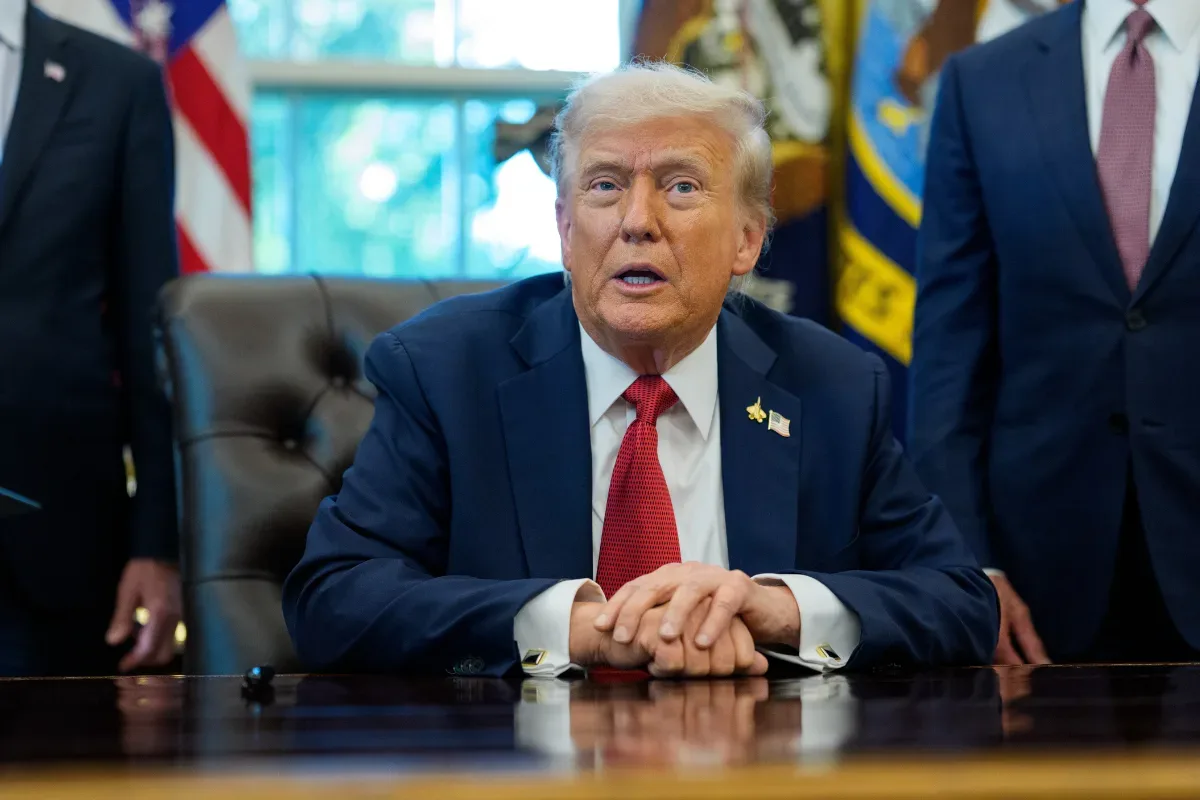
Donald Trump used a rally appearance in Durant, Oklahoma, to joke that former NBA players Enes Kanter Freedom and Dennis Rodman could enter women’s sports, framing the remark as though a presidential pardon could grant them an “exemption.” The comments arrived amid Freedom’s continuing public campaign to join the WNBA in 2027, a proposal that league sources had already rejected.
Freedom subsequently said he had invited Trump to attend his first proposed WNBA game in 2027. He also said Rodman had agreed to coach him during the offseason. Neither statement establishes that Freedom has a WNBA roster spot, draft eligibility, or a scheduled game. The reported position from league sources is that Freedom and former NBA player Royce White could not participate.
The episode is less a basketball transaction than a highly visible collision of sports governance, protest, political rhetoric and a debate over transgender participation. That distinction matters. An invitation, a rally joke, and a stated desire to enter a draft are not the same thing as eligibility under a league’s rules.
What Trump said at the Oklahoma rally
During the Thursday rally, Trump discussed Freedom and Rodman and jokingly said both had permission to participate in women’s sports. He compared that supposed permission to a pardon, saying they could enter whenever they wished.
For more context, explore Absolute Superman #24 Brings Steel Into the Get Brainiac Hunt.
Trump also said Freedom was willing to say he was a woman in order to compete against women, while suggesting he did not believe Freedom genuinely held that identity. He predicted that Freedom and Rodman would break records if they played against women.
Rodman, a retired NBA champion, was part of the exchange as well. Trump questioned whether Rodman, whom he described as older but in good shape, could still compete in women’s basketball. The remarks were presented as a joke, not as an announced sports-policy change or a WNBA decision.
That is the central practical point: WNBA participation is governed by the league and its applicable processes, not by a rally-stage “exemption.” Nothing in the reported comments changes the league’s stated rejection of Freedom’s claim.
Freedom’s proposed 2027 WNBA path
Freedom’s campaign began in August, when he argued that declaring an identity should meet the requirements to join the women’s league. League sources later said that position did not make him eligible and that neither Freedom nor Royce White could take part.
The available reporting also indicated that the WNBA did not have a publicly available policy specifically addressing transgender participation at that time. That absence is important context, but it should not be confused with an open invitation or a guarantee of eligibility. A publicly unavailable policy simply means the precise published framework was not accessible in the material at hand; it does not mean league officials had no ability to determine who could participate.
Eligibility is the set of conditions a league uses to determine whether an athlete may enter its competition, including a draft or roster process. It is separate from an athlete’s public argument about what the rule should be. Freedom can advocate for a different standard, but the reported league response was that his argument did not qualify him to participate.
Freedom played 11 seasons in the NBA and was waived by the Houston Rockets in 2022. His NBA stops included Utah, Oklahoma City, New York, Portland and Boston. Those facts make him a recognizable figure in the argument, but NBA experience itself does not settle any women’s-league eligibility question.
A wider argument that has drawn players and public figures in
The dispute has spread well beyond Freedom’s proposed draft entry. It followed public comments from Sophie Cunningham opposing transgender women’s participation in women’s sports, prompting protest and contrasting responses from other figures.
Gabby Williams expressed support for transgender athletes. Boosie argued against their inclusion and referenced French transgender basketball player Julie Tétart in an online post. The range of responses illustrates why broad claims about “what players think” are unreliable: athletes and entertainers have publicly taken very different positions.
The players’ union addressed the controversy in August, rejecting attempts to use its members as political pawns and warning against attacks on transgender people. Its response adds another dimension often lost in the loudest exchanges. Players are not merely examples in a political debate; they are workers represented by a union, participants in a professional league, and people whose competition is being used to make competing social arguments.
Political pawn is a term used when people are treated chiefly as symbols for someone else’s political message instead of as individuals with their own interests, voices and rights. In this case, the union’s warning was directed at the way WNBA players were being pulled into a conflict that extended beyond the court.
There is also a difference between discussing policy and targeting individuals. Rules concerning eligibility can be debated, challenged, revised or defended. Personal attacks on transgender people, or treating a particular athlete as a prop for ridicule, are a separate matter. The distinction does not erase disagreement, but it does set a basic standard for discussing an already contentious subject without making individuals the target of abuse.
The Sky-Fever removal and Freedom’s lawsuit
Freedom’s campaign also moved into an arena setting in August. Security removed him from the Sky-Fever game at Wintrust Arena after a confrontation with Chicago guard Natasha Cloud. He was wearing a shirt defining women as adult human females.
Freedom later alleged that his removal violated his free-speech rights. He filed suit on September 3 over the August 23 ejection, naming the Chicago Sky, the city of Chicago and the Metropolitan Pier and Exposition Authority, which owns Wintrust Arena.
A lawsuit is an allegation and a request for legal relief, not a ruling on the merits. The filing means Freedom is contesting what happened and asserting that his rights were violated. It does not, on its own, establish that the ejection was unlawful or that any defendant is liable.
The arena incident and the WNBA eligibility question overlap politically, but they are not identical disputes. One concerns conduct, security and speech at a particular game. The other concerns whether a former NBA player can enter a women’s professional basketball competition. Treating them as one issue can obscure the different standards that may apply to each.
Why the language around this story needs precision
The rally comments were built around the premise that retired male NBA players could simply declare themselves women and dominate women’s basketball. But Freedom’s own stated bid, the league’s reported rejection and the lack of a publicly available policy specific to transgender participation create a more complicated picture than that rhetorical setup suggests.
There was no openly transgender active WNBA player at the time described in the reporting. That fact should not be turned into a claim that transgender athletes are absent from all basketball, nor does it resolve the policy debate. It only describes the reported state of the WNBA roster landscape at that time.
Likewise, Rodman’s presence in the story does not indicate a formal candidacy, an application, or an agreement from the league. The only reported connection is Trump’s joking mention of Rodman and Freedom’s claim that Rodman would coach him in the offseason. Calling that a WNBA plan would go beyond what has been established.
For fans trying to separate spectacle from substance, the known points are straightforward:
- Freedom has publicly proposed entering the 2027 WNBA draft.
- He said he invited Trump to his first proposed WNBA game and claimed Rodman would coach him during an offseason.
- League sources previously rejected Freedom’s eligibility argument and said he and Royce White could not participate.
- Trump’s “exemption” remark at the rally was a joke, not a reported league action.
- Freedom has separately sued after being removed from an August Sky-Fever game, alleging a free-speech violation.
The remaining uncertainty is substantial. The material does not identify a changed WNBA rule, a successful appeal by Freedom, a completed draft entry, a scheduled appearance, or a court ruling in the lawsuit. It also does not establish a detailed, public league policy that answers every question raised by the debate.
What happens next is a matter for the league and the courts
Freedom’s invitation to Trump and his claimed coaching arrangement with Rodman are attention-grabbing developments, particularly because both men are well-known former NBA figures. Still, attention is not authorization. The reported league decision remains the key basketball development: sources said Freedom’s claim did not make him eligible to participate.
Separately, the Chicago case will turn on the claims and defenses presented in court rather than on the broader political argument surrounding women’s sports. And any future WNBA participation issue would depend on the league’s own decisions and procedures.
That leaves the current situation in a familiar modern-sports posture: a provocative public statement has generated headlines, but the decisive questions remain institutional. Freedom may continue pressing his position; Trump and Rodman may continue to be invoked in the conversation; players and their union may continue to object to being used as symbols. None of those developments, by themselves, puts Freedom or Rodman on a WNBA floor.