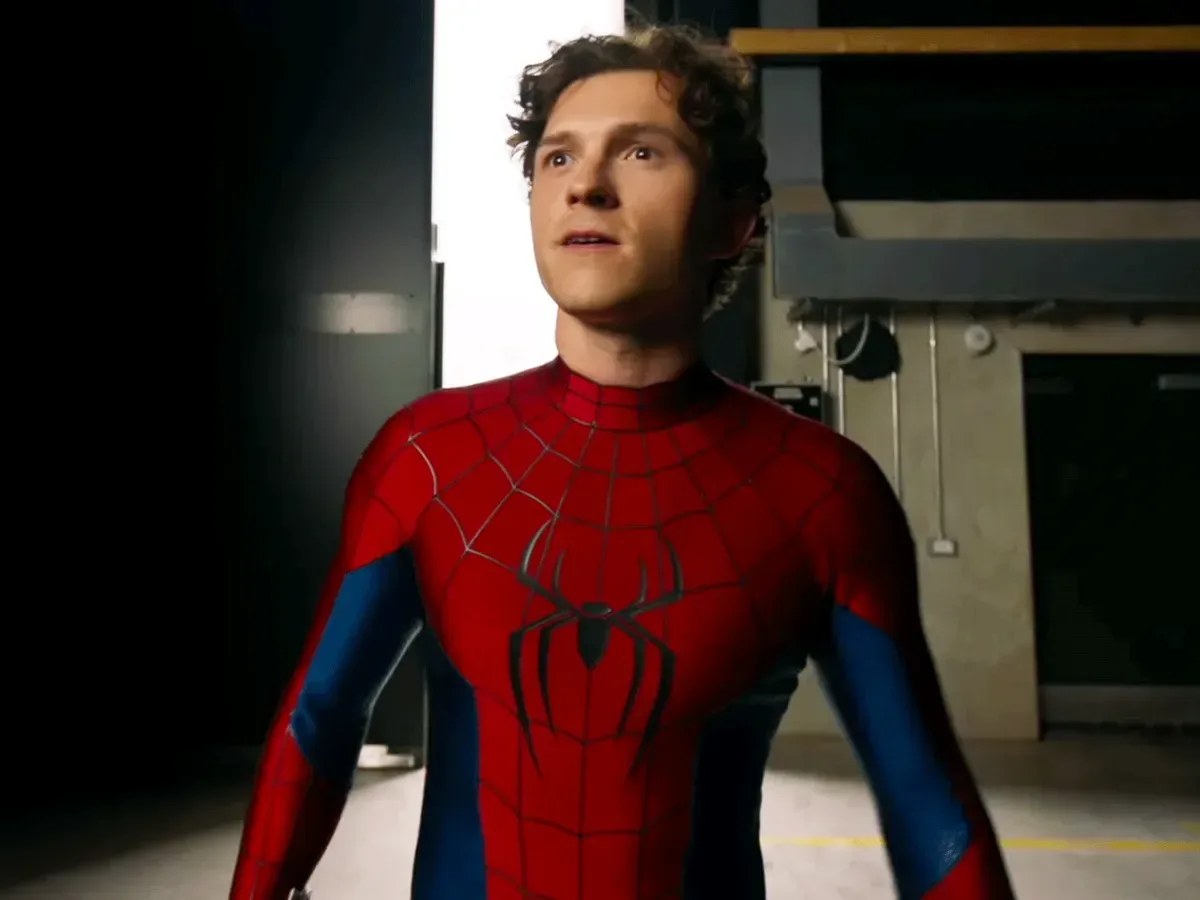
Spider-Man may spend his days swinging across a city, stopping criminals and looking spectacular while doing it, but Tom Holland says the key creative spark for Spider-Man: Brand New Day came from a much smaller, sadder image: a superhero returning home with nobody to share the victory with.
Holland has said that an isolated Batman moment in 2017’s The LEGO Batman Movie helped inform the emotional direction of Peter Parker in Brand New Day. It is not a matter of Spider-Man suddenly taking on Batman’s wealth, gadgets or grim detective routine. The influence is the contrast between the glamorous fantasy people project onto a hero and the unglamorous reality waiting behind a closed front door.
That contrast is particularly useful for Peter Parker. Holland described Brand New Day as following a Peter who is separated from friends, grieving family losses, pursued by criminals and unknown to the people around him despite Spider-Man’s public presence. The hero can be visible everywhere and still be personally invisible. That is a sharp dramatic hook for a character usually associated with quick jokes, motion and youthful energy.
The Batman connection is about solitude, not superhero crossover logic
The LEGO Batman Movie scene Holland pointed to hinges on a deliberately ridiculous reversal. Batman comes home after crimefighting, only to face a solitary evening involving microwaved lobster thermidor and a rewatch of Jerry Maguire. Will Arnett voices the character in the animated film, and the joke works because it punctures the imagined lifestyle of a famous masked vigilante.
As Holland described it, the setup first invites viewers to picture Batman spending his off-hours at parties or dating supermodels. The reveal strips that fantasy away. He is alone in Wayne Manor. The gag is broad, but its emotional point is clear: public accomplishment does not automatically create companionship or contentment.
Holland sent that idea to Brand New Day director Destin Daniel Cretton as a possible model for the film. His reasoning was not that Peter should become a clone of Batman. Rather, building those quiet notes of disconnection into Peter’s story could give the character more dimensions. Holland said he wants viewers to feel Peter’s need to make changes that might eventually lead him toward happiness, peace and love.
That makes the reference more interesting than a simple behind-the-scenes movie nod. It points to an approach sometimes called emotional contrast: placing a character’s outward success beside an opposing private reality. In superhero storytelling, the public side can be enormous—rescues, battles, headlines and spectacle. The private side can be an empty apartment, a missed call, grief or the inability to tell anyone what happened.
For Peter Parker, that split is built into the premise. Spider-Man is a recognizable symbol in the city, but Peter’s civilian life can be precarious. Brand New Day appears to use that friction as more than a passing obstacle. Based on Holland’s comments, the loneliness is part of the movie’s intended emotional throughline rather than merely a gloomy visual beat between action sequences.
Why the idea fits Peter Parker
Spider-Man stories often derive momentum from competing responsibilities. A threat demands action; meanwhile, school, work, relationships or family obligations demand something else. Holland’s description suggests Brand New Day shifts some focus onto what happens after the immediate emergency is over.
Stopping a criminal does not solve isolation. Surviving a dangerous night does not erase grief. And a secret identity, while protective, can prevent the hero from being known by the people whose support would matter most. Those are not new concepts in superhero fiction, but the LEGO Batman inspiration gives the filmmakers a clean tonal reference point: make the sadness recognizable without abandoning the character’s humor.
That balance matters. If a story treats every setback with total solemnity, the central character can become distant. If it treats every painful moment as a punchline, the stakes can lose meaning. The Batman scene Holland highlighted does both at once. The meal and movie choice are funny, yet the loneliness underneath them is real. In theory, that is an effective template for Spider-Man, whose personality has long depended on comedy being used as a response to pressure rather than proof that no pressure exists.
Analysis: Holland’s comments imply that the desired audience reaction is not simply sympathy for Peter in a static low point. He specifically framed the loneliness as a way of making people root for Peter to alter his life. That is an important distinction. The emotional condition is meant to create forward pull: viewers should want restoration, connection and a chance at peace, not just another victory in costume.
It also makes the film’s title resonate in a character-focused way. A “brand new day” can suggest a fresh start, but Holland’s explanation puts weight on the question of what Peter must change in order to reach one. The supplied details do not establish exactly which relationships, choices or events the film explores, so it would be premature to treat that question as answered. What is clear is that Holland sees Peter’s personal future—not only his next fight—as a central part of the story.
Holland’s comments also point to the uncertainty of editing
Holland has separately discussed the difficulty of shaping a major film after shooting. Before Brand New Day arrived, he said he disliked a version that had been altered in response to test-screening feedback. In his view, that cut did not work, even though it reflected what audiences in those screenings had asked for. He added that the team learned from the experience.
A test screening is a showing of an unfinished or developing cut to an audience, often used to gather reactions before the final version is locked. Feedback can affect pacing, clarity, tone, character emphasis or individual scenes. It is useful information, but it is not a mechanical instruction sheet. A requested change can solve one perceived problem while weakening something else that the filmmakers consider essential.
That is the tension Holland was describing when he said a movie can change dramatically in the editing room. An edit is not just the removal of excess footage. It is the arrangement of performance, music, action, silence, transitions and timing into a particular emotional experience. A brief scene of Peter alone, for example, could land as comic relief, sadness, exhaustion or determination depending on what comes immediately before and after it.
His earlier dissatisfaction with a test-feedback-driven version makes the LEGO Batman anecdote more revealing. The Batman reference is a tonal north star: a compact example of the mood Holland and Cretton apparently wanted to preserve. It communicates a specific feeling—funny on the surface, lonely underneath—more precisely than a vague instruction to make Peter “more relatable” or “more emotional.”
That does not mean every creative choice in the finished film can be traced back to Holland, Cretton or the animated Batman scene. Films are collaborative, and the available information does not provide a scene-by-scene account of the production. But Holland’s account does show an actor bringing a character-centered reference to his director and connecting it to a broader dramatic objective.
A record-setting run, with more material planned
Spider-Man: Brand New Day has become the highest-grossing film of all time in the United States, making its emotional emphasis part of a much larger commercial success. The result does not prove that one influence or one editing decision caused the achievement; box-office performance is shaped by many factors, and the supplied material does not break those factors down. Still, the scale of the movie’s run gives added interest to Holland’s explanation of how its Peter Parker was conceived.
A re-release is also planned, with deleted scenes set to be restored to the cut. “Deleted scenes” generally means footage that was filmed but not included in the prior theatrical version. Their return may offer more character material, action or connective story tissue, but the present information does not identify which sequences are coming back or how they will change the film’s rhythm. Until those specifics are known, it is best to view the re-release as an expanded version rather than assume it resolves any particular plot or character question.
For viewers interested in the broader craft of blockbuster filmmaking, Holland’s remarks make a useful companion to other conversations about how performers and directors argue for a movie’s intended shape. A recent story involving Christopher Nolan and Tenet likewise illustrates how individual creative details can prompt unusually lasting discussion.
For Brand New Day, however, the memorable takeaway is wonderfully simple. Spider-Man’s latest emotional blueprint was not another giant battle or a piece of high-tech web equipment. It was the image of Batman, fresh from saving the day, going home to an extremely sad dinner for one. Holland saw the human truth inside the joke—and saw a way to make audiences hope Peter Parker can eventually find something better.