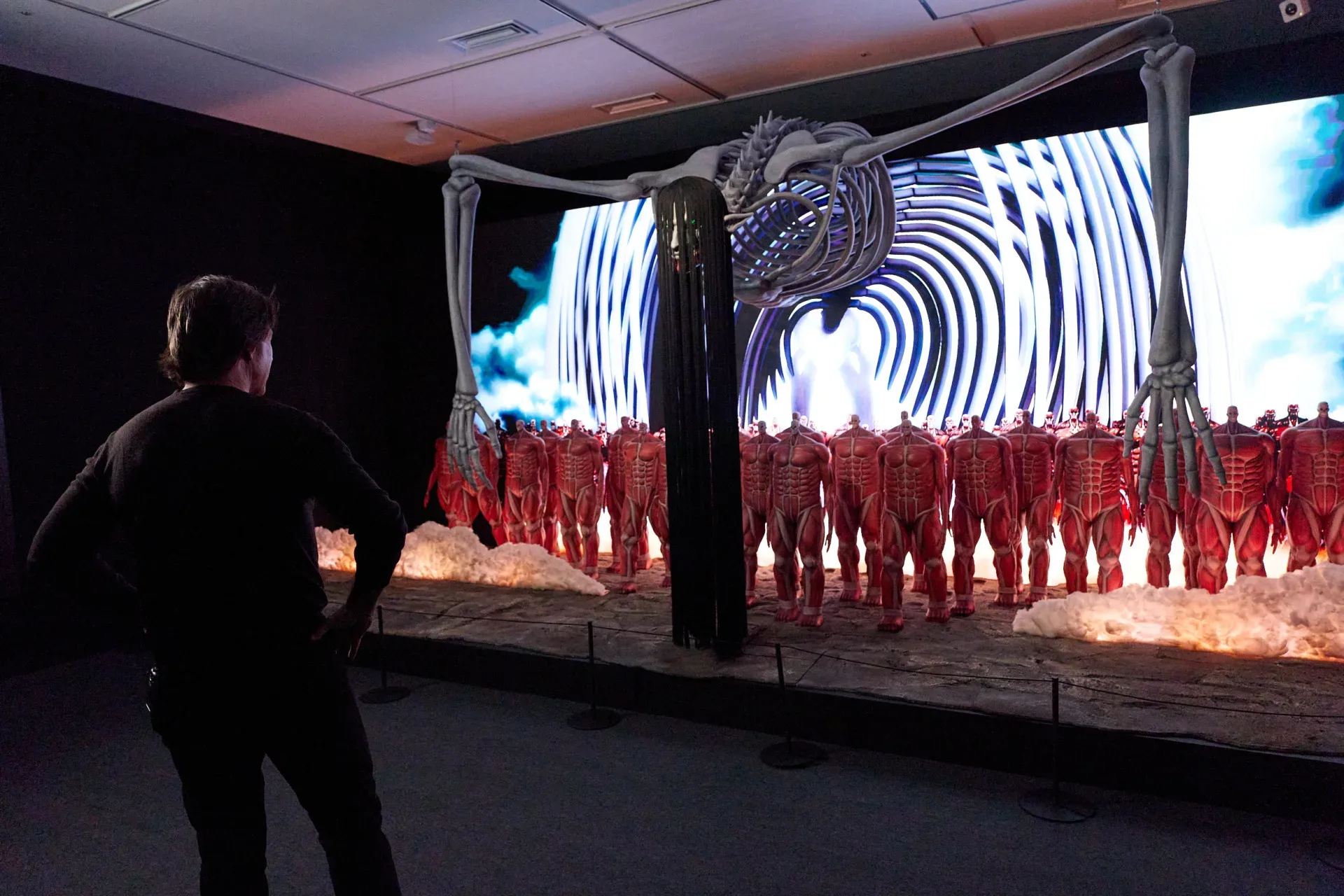
Some crossover images need no caption. Tom Cruise standing in front of Eren Yeager’s towering End Titan form is one of them.
The actor and director Alejandro G. Iñárritu visited MAPPA’s 15th-anniversary Expo during press activity for Digger. MAPPA is the animation studio associated here with Jujutsu Kaisen, Chainsaw Man and Attack on Titan; the last of those supplied the particularly strange, extremely shareable visual of Cruise facing Eren’s final monstrous form.
It is an unusual collision of celebrity publicity, studio celebration and anime imagery. Yet the response makes sense. The End Titan is not a tidy mascot-scale character, while Cruise’s public persona is inseparable from large-scale movie spectacle. Put the two in one frame and the result looks less like a conventional tour photograph than a still from an impossible promotional event.
A visit that became the story
The visit took place as clips from the tour circulated in stages, allowing its individual moments to become their own miniature online events. Cruise and Iñárritu were at the exhibition in connection with the Digger press tour, though the supplied details do not establish a creative link between the film and MAPPA’s productions.
That absence of an obvious franchise tie-in is part of what makes the footage stand out. Audiences are used to a celebrity appearing beside a property they are directly promoting: a cast member at a premiere, a filmmaker visiting a set, or a crossover arranged to sell a shared product. Here, the evident connection is more elemental: a major film performer visiting artists whose work has shaped internationally visible animation.
The photo with Eren’s End Titan distills that into one clean image. It invites jokes because the scale and subject matter are so mismatched, but it also recognizes the cultural weight that anime studios and their characters can carry outside their own releases.
Why Eren’s End Titan is such a loaded image
For readers less familiar with the terminology, the End Titan is Eren Yeager’s immense final Titan form in Attack on Titan. A Titan is a giant humanoid being central to the series’ conflict, and Eren is its protagonist whose role and transformation become increasingly consequential over the story.
Calling the form “End Titan” does more than identify a monster design. It signals finale-scale stakes. This is not simply Cruise posing near an anime character; it is Cruise positioned opposite one of the series’ most extreme and ominous visual ideas. The image therefore plays on a collision between Cruise’s real-world blockbuster image and an unmistakably apocalyptic anime icon.
Related coverage includes Tom Cruise's MAPPA Visit Creates an Unforgettable Eren Yeager Moment.
It also helps explain why a still photograph can be more effective than a lengthy explanation. The visual language is immediately legible even to people who do not know every piece of Attack on Titan lore: one person is small, the other figure is gigantic and unsettling, and neither seems as though they should have met in the first place.
The animation-work angle matters, too
The most revealing part of the visit is not only the viral photo. Cruise’s tour reportedly ended with him asking MAPPA character designer Tadashi Hiramatsu whether he could return and watch the team work in person.
A character designer is an artist who helps translate a character’s defining appearance into forms other artists can consistently animate. In a production environment, that work can involve ensuring that faces, costumes, expressions and proportions remain recognizable from shot to shot. It is a foundational part of building a show’s visual identity, especially when a project needs many artists working from a common design language.
That makes Cruise’s interest in observing the work a meaningful detail, even without attaching larger claims to it. The attraction is not framed solely around a finished franchise display. It points toward the labor and craft that sits behind the headline characters: the people who must turn ideas, drawings and direction into animation that can sustain an entire series.
MAPPA’s exhibition context gives that curiosity a useful focus. A studio anniversary event can celebrate recognizable titles, but it can also put attention on the artists and departments that audiences may not always know by name. The presence of Hiramatsu in the reported exchange makes the artist, rather than only the brand, part of the story.
More than a random celebrity-anime encounter
There is a temptation to treat every unexpected celebrity visit as a disposable social-media moment. This one is funny enough to survive on that level alone. But its appeal also comes from how plainly it bridges two production cultures that are often discussed separately: live-action Hollywood filmmaking and Japanese animation.
Both rely on a huge range of specialized work, even if the finished results and production methods differ. Cruise is strongly associated with ambitious screen spectacle; MAPPA is associated in this context with visually demanding animation projects. A tour through the studio’s anniversary event therefore feels less arbitrary than it initially appears. It creates a space for a film actor and director to look at another branch of screen storytelling built through collective craft.
That broader overlap is increasingly visible across genre entertainment. Adaptations, games and animation all shape conversations around castings, visual worlds and fan communities. For another example of how game properties move into screen-development discussion, see the ongoing conversation around Prime Video’s planned God of War series.
None of that means this MAPPA appearance has to be treated as a hint of a future Cruise anime role, a collaboration, or a production announcement. The supplied information supports a visit, a tour, the photographs and Cruise’s expressed desire to see the animators work again. It does not establish a project beyond that. The responsible reading is also the most entertaining one: a high-profile guest appeared genuinely impressed by artists and encountered an image so perfectly bizarre that the internet could not let it pass quietly.
A publicity moment with a human center
Publicity tours are designed to put a film and its participants in front of people. That basic function is not a secret, and Digger was the stated reason for Cruise and Iñárritu’s presence at the Expo. But visibility alone does not make a moment travel.
The clips appear to have worked because they offered something more specific than another posed campaign stop. Cruise’s reaction to the animators’ work, capped by his request to return, gives viewers a simple emotional hook: an enormously famous actor seems excited to observe people making animation. Whether audiences come for the oddity of the End Titan picture or the warmth of the studio interaction, there is a tangible event behind the meme.
The result is a rare piece of entertainment-news overlap that does not need a complicated pitch. Tom Cruise visited MAPPA. He and Alejandro G. Iñárritu toured the studio’s anniversary Expo. He met Tadashi Hiramatsu, praised the animation work and asked about seeing the process again. Then he stood across from Eren Yeager’s End Titan, giving everyone a photograph that looks wrong in precisely the way a great pop-culture image should.