Friedrich Dürrenmatt’s The Visit is not built to soothe anybody. The 1956 play takes a failing town, gives it an impossibly large financial lifeline, then makes the price of that rescue morally unbearable. Pasadena Playhouse’s new staging, directed by Darko Tresnjak and running through Oct. 4, leans into that cruelly playful premise with an eye-catching mixture of old-world fable, modern visual language and outright menace.
It also reunites Tresnjak with Jefferson Mays only seven months after their Amadeus revival arrived at the Playhouse. Several members of the creative team and cast have returned as well, giving the production an unusual sense of continuity for a major theater. Yet this is a markedly different assignment for Mays. Where Amadeus offered a flamboyant role, The Visit asks him to make an inward, increasingly frightened man compelling.
The result is a production with formidable performances and a confident theatrical vocabulary, even when Dürrenmatt’s purposely pitiless machinery leaves little doubt about where its characters are headed. The show can be lively, absurd and genuinely funny. It can also feel like a fable whose conclusion has been announced so clearly that its middle becomes an extended demonstration of the inevitable.
A town offered a fortune—and a moral catastrophe
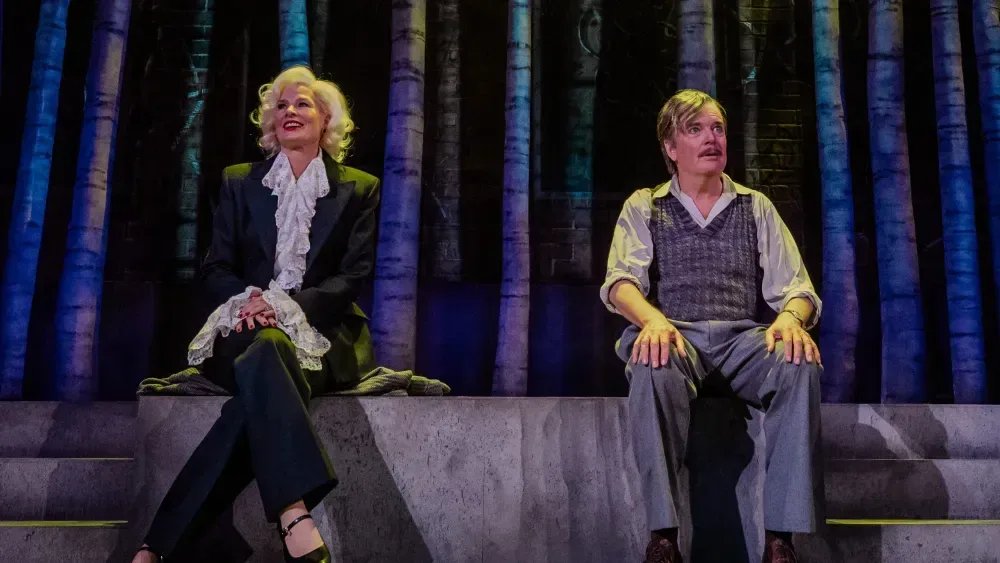
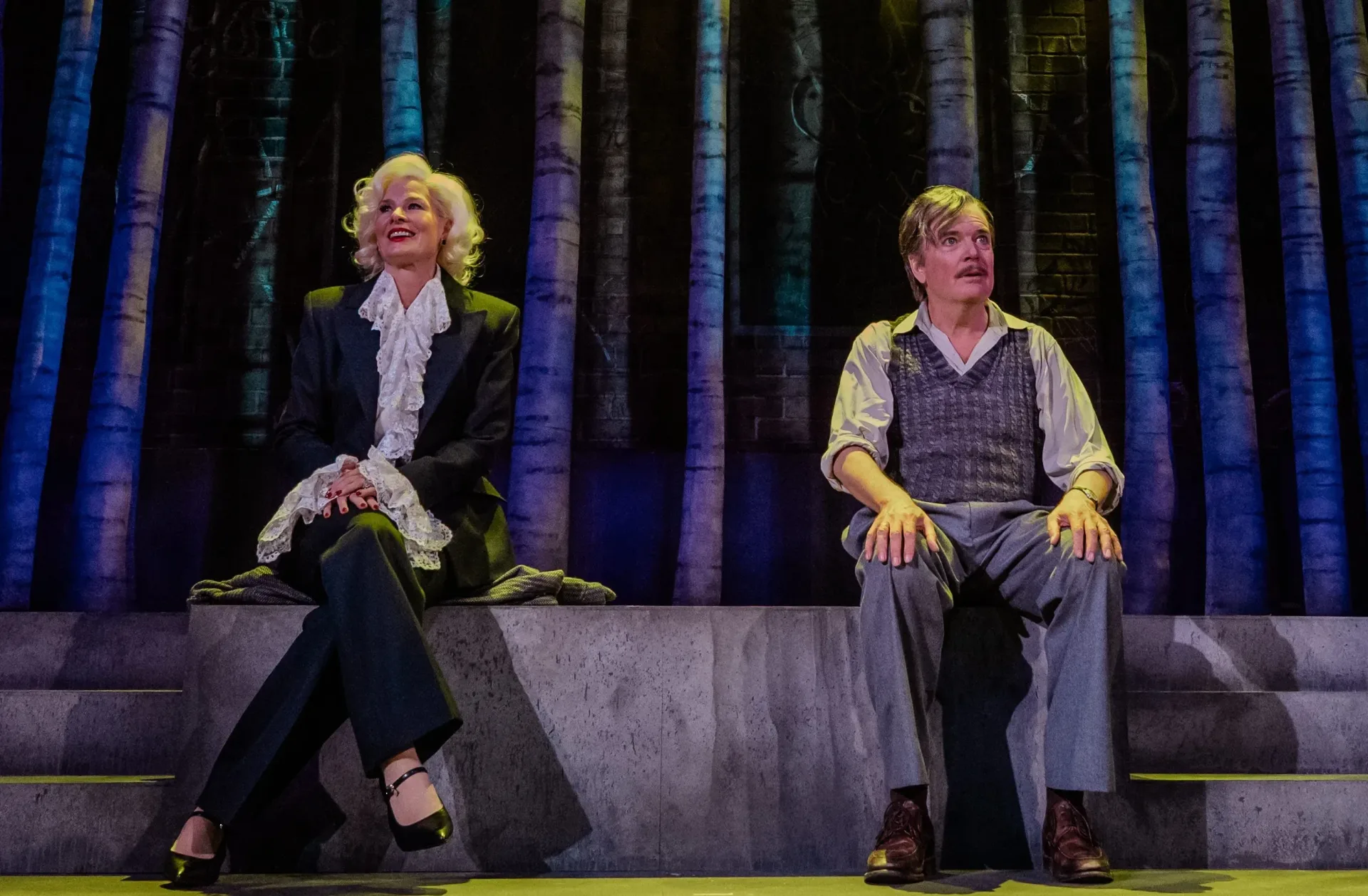
Mays plays Anton Schill, a modest shopkeeper in a poor European town whose past is about to catch up with him. Melinda Page Hamilton plays Claire Zachanassian, the town’s most famous former resident and now an extraordinarily wealthy woman. Claire returns with an entourage, an empty coffin and an immense offer: she will give the town one billion in unspecified currency if its residents kill Anton.
That setup is an established part of the play’s identity, but it remains a startling one. Claire’s proposal is not merely a private act of revenge; it is a transaction designed to test an entire community. The town initially rejects it. Then the show watches its people begin to accommodate the possibility that they might say yes.
That is where the title’s deceptively mild word, “visit,” turns vicious. Claire is not simply returning home. She is arriving as a force that turns economic desperation into a public moral crisis. Her wealth lets her put a price on justice, vengeance, loyalty and human life at once.
Hamilton gives Claire the necessary scale. She enters as someone who is charming enough to hold a room, sharp enough to dominate it and strange enough to make every pleasant exchange feel unstable. The performance makes room for the character’s humor and casual cruelty without reducing either one. Claire’s confidence is not a matter of volume; it is a sense that she has entered a story whose ending she believes she already owns.
That balance matters because the play exists in the difficult space between comedy and horror. Claire can deliver a cutting line with a breezy social ease, even as the situation around her darkens. Hamilton makes the tonal contradiction feel intentional: the laughter does not cancel the dread. It helps smuggle it in.
Mays turns the volume down
Anton is the protagonist and, in a way, the production’s emotional center. But he is not written as a commanding hero who can rally the town, outwit Claire or seize control of the narrative. He is a comparatively ordinary man facing a fate that becomes harder to escape as the people around him discover how much they might gain from abandoning him.
Mays meets that challenge by avoiding showy gestures. His Anton begins with a gentle, almost unassuming quality, which makes the character’s vulnerability more pronounced when the atmosphere changes. This is a less ostentatious role than Salieri in Amadeus, but it still demands precision. The actor has to show a person recognizing that social bonds he took for granted may be conditional after all.
The script’s revelation about Anton and Claire’s shared past further complicates the sympathy the audience may feel for him. The play does not position him as a spotless victim; Claire’s grievance emerges from wrongdoing that cannot be dismissed. But neither does that history make the town’s collective bargain clean or just. The point is not to settle an easy moral account. It is to expose how quickly a community can dress a self-serving decision in the language of righteousness.
In that sense, Mays’ restraint becomes essential. Anton does not need to be a saint for the looming bargain to be monstrous. He needs to remain recognizably human, and Mays makes him so.
What “black comedy” means here
The Visit is frequently described as a black comedy, a term for work that finds comic energy in subjects usually treated with solemnity: death, violence, corruption and despair. The laughter is not an accident or a release valve separate from the plot. It is part of the critique. If audiences laugh at a grotesque situation, they are also made aware of how easily charm, routine and social performance can obscure cruelty.
Dürrenmatt’s play additionally brushes against absurdism. In theatrical terms, absurdism often uses exaggeration, implausibility, circular logic or surreal elements to reveal an emotional or social truth. The goal is not necessarily realism in the everyday sense. A coffin arriving with a wealthy visitor, blind attendants who know the town unnervingly well, and an entire populace shifting toward complicity can function as heightened images rather than naturalistic events.
That framework helps explain Tresnjak’s willingness to let different eras collide. The visual approach begins with a more recognizable town setting but increasingly introduces present-day cues, including cameras, video screens and contemporary footwear. Disco transition music adds another deliberately disruptive layer. Some viewers may find these shifts jarring, but they articulate a clear idea: the corruption in the play is not safely trapped in a mid-century European parable.
That becomes clearest in the production’s use of sneakers. Costume designer Charlotte DeVaux Shields and set designer Alexander Dodge turn colorful shoes into visual evidence of the town’s changing loyalties. When the footwear is revealed and illuminated, it registers as both a gag and a warning. A consumer object becomes a badge of compromise: prosperity is beginning to appear on bodies before anyone will openly admit what it might cost.
The concept is effective precisely because it is so legible. The shoes are funny, conspicuous and hard to ignore. They make the town’s moral slide visible in a way that feels suited to a story about people rationalizing their choices while the evidence accumulates in plain sight.
Fatalism is the production’s sharpest edge—and its limitation
At its strongest, the Pasadena staging presents a world governed by fatalism. Fatalism, in this context, does not just mean that a bad ending is likely. It means that social pressures, money and self-interest seem to arrange themselves so completely that people appear unable—or unwilling—to choose otherwise.
Claire does not need to force every resident to act. Her offer creates the condition under which they begin to police themselves. The town’s initial refusal therefore carries limited comfort. Once the possibility of wealth settles into the collective imagination, the group starts moving toward Claire’s desired result.
That is an incisive and ugly idea. It also creates the production’s main dramatic obstacle. The direction of travel can feel so unmistakable that suspense gives way to observation. The question is less “Will the town do this?” than “How will each person show that they have accepted it?” There is a brief struggle from a cleric, but the larger transformation appears to occur with startling speed.
For audiences who respond to the play as a deliberately exaggerated moral nightmare, that directness may be the point. The town is not meant to offer a nuanced study of every citizen’s conscience; it is a mechanism showing that respectability can be frighteningly fragile. For others, the lack of prolonged resistance may make the second half feel less dramatically alive than the premise deserves.
The compression may be a relevant factor. This Pasadena version is presented as a single act, rather than one of the longer forms the work has taken in other stagings and adaptations. A leaner structure can intensify the trap, but it can also leave less space for the emotional and ethical steps between public refusal and collective surrender.
A horror image inside a social satire
Jake Levy and Lauren Worsham play two of Claire’s most unsettling companions: aging, blind eunuchs whose connection to the town is eventually explained through Claire’s story. Their presence pushes the production toward horror. They are not merely eccentric attendants; they are physical reminders that Claire’s return has been planned, remembered and shaped by past injury.
The overall tone sometimes suggests Grand Guignol, the term associated with a style of theater known for sensational horror and shocking spectacle. Yet The Visit does not fully become a horror play. Its nightmares are bureaucratic, civic and social. People chat, vote, shop and participate in familiar rituals while a murder becomes imaginable.
That is also why its comic surface matters. The town does not fall apart in an explosion of chaos. It appears to keep functioning. The danger lies in the way ordinary language and respectable institutions can absorb an unthinkable act until it begins to seem inevitable.
For a related look at how contemporary drama can turn a fever-dream premise into something disturbing, read this examination of a nightmare-bound theatrical sensibility.
Why this staging is worth seeing
Pasadena Playhouse’s The Visit will likely divide audiences more than the company’s recent Amadeus. Its view of human behavior is relentlessly grim, and its structure may feel too certain of its own conclusion. But those objections sit beside the production’s considerable strengths: Hamilton’s magnetic Claire, Mays’ carefully controlled Anton, and a design approach that makes moral rot vivid, funny and contemporary.
Tresnjak does not attempt to make Dürrenmatt’s world comfortable or psychologically tidy. Instead, the staging embraces its grotesque theatricality: fluorescent sneakers, a waiting coffin, anachronistic sound, screens and characters who appear to have wandered in from a more sinister fable. The style gives a decades-old play an immediate visual argument without pretending its pessimism has become any easier to absorb.
The Visit runs through Oct. 4 at Pasadena Playhouse, 39 South El Molino Ave., Pasadena. Ticket and venue information is available through Pasadena Playhouse.