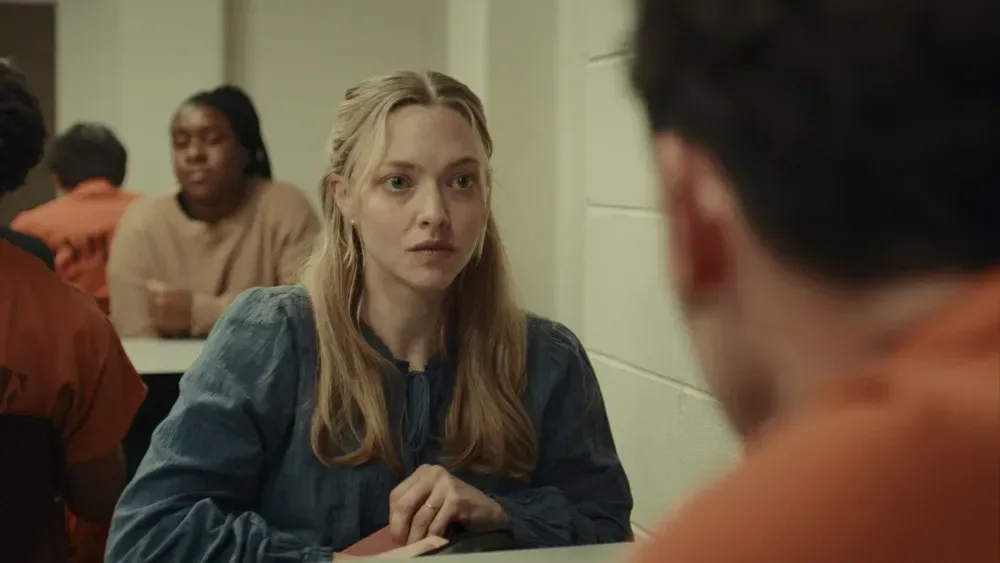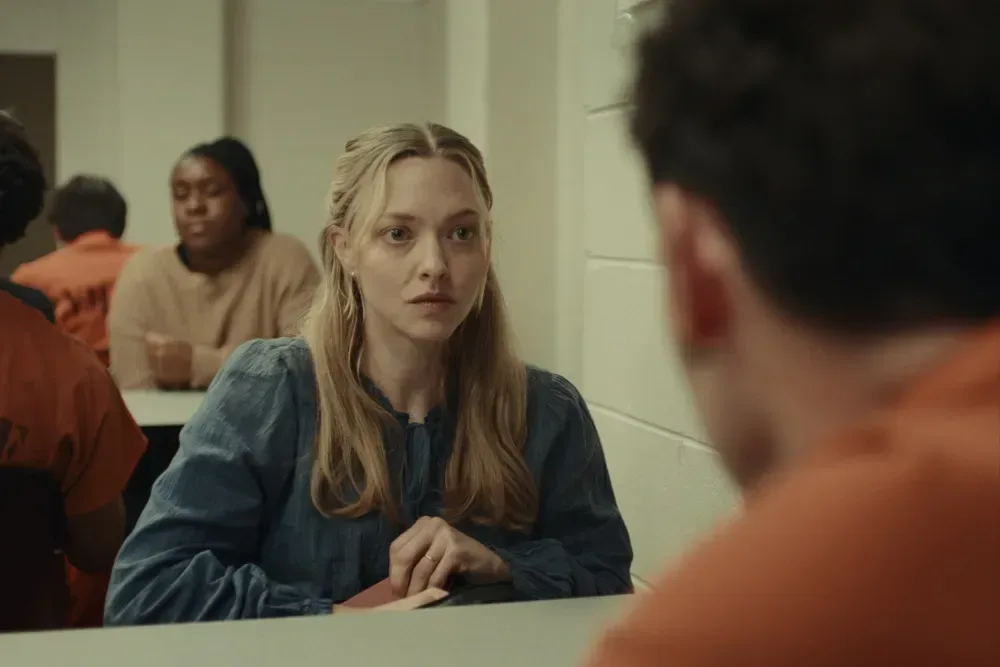
Tim Blake Nelson’s The Life and Deaths of Wilson Shedd arrives as a bleak, deliberately unsettled crime drama built around a volatile relationship: a civilian woman searching for an exit from her life and a violent prisoner who understands exactly how to make vulnerability look like connection. The film, which screened in the Gala Presentations program at the Toronto Film Festival on September 13, 2026, runs 121 minutes and stars Amanda Seyfried as Karen and Scoot McNairy as the incarcerated Wilson Shedd.
Nelson wrote and directed the film, his sixth feature as a filmmaker. The setup places Karen, a teacher trapped in an oppressive marriage and a stagnant existence, at a maximum-security prison in Oklahoma. Her new work involves leading a creative-writing course. It is an environment that can initially appear constructive: literature, personal expression and a classroom framework intended to create some degree of order. Yet the film uses that setting to explore how quickly seemingly safe routines can be turned into points of access.
Wilson is one of Karen’s students. He is intelligent, carries himself with a muted menace and shows a real interest in Hemingway’s short fiction as well as writing of his own. Those details matter because the relationship does not begin as an openly sensationalized prison-romance plot. It grows out of attention, apparent sensitivity and the suggestion that Wilson might be one of the few people in Karen’s orbit who sees her clearly. The danger is that Wilson’s understanding is also a tool.
A relationship shaped by isolation and manipulation
When another prisoner directs threatening, leering behavior at Karen, Wilson intervenes. The threat is eventually dealt with through violence, establishing a crucial ambiguity in how Karen may perceive him. On one level, he seems protective. On another, the film makes clear that protection inside this world can be inseparable from intimidation, control and consequences that spread far beyond a single confrontation.
Wilson’s calm manner is central to the character. McNairy’s performance presents a man whose menace is not dependent on grand gestures or constant explosions of rage. His speech is quiet, his affect controlled, and that restraint gives the character a disturbing pull. Karen begins receiving emotionally revealing letters from him, and the correspondence becomes part of the machinery through which Wilson gains ground in her life.
The story asks viewers to reckon with why a perceptive, outwardly practical person might enter this kind of connection. Karen is not written simply as careless or foolish. Her home life with her husband, played by Grant Harvey, has left her desperate for an escape and susceptible to an idea that love—or the act of rescuing someone—could rescue her in return. The film’s tension comes from the friction between what viewers may want Karen to recognize and the emotional logic that keeps her moving closer to Wilson.
That makes the relationship less about conventional romance than about need, projection and power. Wilson packages damage as honesty. Karen sees possibility where the audience can see a trap forming. Their bond is not portrayed as rational; it is an attraction to peril made stronger by loneliness and by the hope that another person’s brokenness might provide an answer to one’s own.
A crime story that refuses a straight line
The Life and Deaths of Wilson Shedd does not unfold in simple chronological order. Early in the film, the narrative jumps ahead to Wilson and two other prisoners outside prison walls, still dressed in dirty orange uniforms as they use an axe to force their way into a home. The scene signals an escape before the film has fully explained how the characters arrived there.
Related coverage includes ‘The Life and Deaths of Wilson Shedd’ Review: A Fractured Prison Drama of Manipulation and Violence.
That structural choice is more than a surprise. Nelson uses fractured chronology to strip away the reassurance of a tidy cause-and-effect path. Information arrives out of sequence, and the audience is invited to assemble emotional and moral connections gradually. Instead of treating the prison break as a final-act payoff, the film turns it into a looming certainty. The question shifts from whether violence will happen to how the relationships, choices and institutional failures surrounding Wilson feed into it.
The approach recalls the time-shifting architecture Nelson used in his 1997 debut, Eye of God, another severe crime story. It also fits a career that has often approached grave subjects without sanding down their discomfort. Nelson’s 2001 film The Grey Zone, centered on the Sonderkommando in Auschwitz, remains a landmark of uncompromising historical drama. Here, the terrain is different, but the method carries a similar refusal to make suffering clean, easily consumed or safely distant.
For readers following other film projects that use intimate personal stakes rather than spectacle as their foundation, Drake’s FOMO is a self-funded film about friendship and taking the leap. Nelson’s picture occupies a vastly darker register, but both place consequential choices within close personal relationships.
Violence without the usual thriller gloss
Though it involves escapees, criminal behavior and acts of horror, the film is not framed as a conventional action thriller. Its style is grounded and matter-of-fact, favoring an ominous realism over flashy suspense mechanics. That quality affects scenes both inside and outside the prison: Karen’s domestic arguments, Wilson’s calculated efforts to use hardware-store tools smuggled in by Karen, and the escalating fallout once the story reaches the open road.
One especially brutal strand concerns the Lawson family: parents played by William Jackson Harper and Devyn A. Tyler, traveling with their children, portrayed by Xuri Selah and Eric Blount. What happens during a picnic is presented as deeply disturbing. The point is not simply to raise the body count or furnish a shocking detour. The family’s presence expands the film’s moral field, showing the indiscriminate human damage created when Wilson’s violence escapes the contained systems that previously held it.
McNairy’s Wilson is described as magnetic precisely because he remains so contained. His violence has the quality of something long stored rather than newly discovered. Seyfried, meanwhile, gives Karen the sharpness necessary for the role’s central challenge: she must seem capable enough that her choices are painful to watch, while still making the emotional void that Wilson exploits understandable. Their pairing turns the film’s prison saga into a psychological confrontation rather than a mere escape narrative.
What the title suggests about punishment
The title points to the film’s broader interest in death as more than a literal endpoint. Wilson Shedd experiences more than one kind of death across the story: a social and legal death imposed by the system, and an inward destruction suggested by the life he has made through cruelty. There is nothing supernatural in the premise, but the plural “deaths” opens an ethical argument that runs alongside the crime plot.
What does a society owe—or not owe—to someone like Wilson? The film confronts the impulse toward vengeance while also refusing to sentimentalize the man at its center. It raises the possibility that punishment can be both a necessary public response to violence and another expression of it. That is not an easy balance, particularly when the story does not look away from the suffering Wilson causes.
Nelson also appears in the supporting cast alongside Missi Pyle, Elizabeth Marvel, Wunmi Mosaku, Tyler, Harper and Harvey. Benoit Soler served as cinematographer, while Luke Ciarrocchi edited. Producers include Nelson, Ryan Bartecki and Miles David Romney, with V42, Red Barn Films QWGmire and Co Created Media listed as the production companies.
By placing a damaged marriage, a classroom inside a prison, private letters, an escape and the harm done to strangers on the same fractured timeline, The Life and Deaths of Wilson Shedd treats violence as something that does not stay in one place. It moves through institutions, households and imagined acts of salvation. The result is a grim crime drama whose most unsettling question may be whether anyone around Wilson ever had a real chance to control the story he was writing for them.