
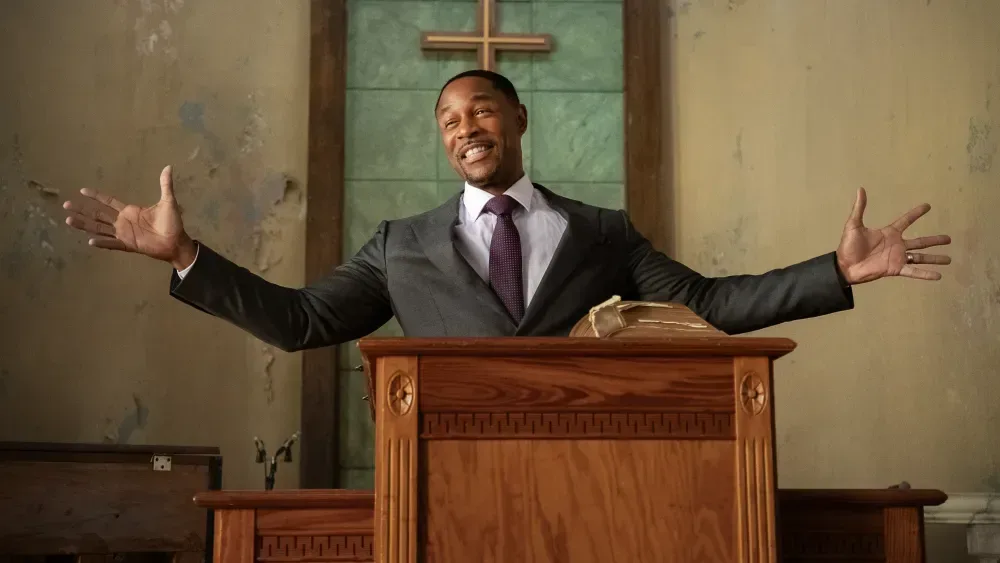
The Gospel of Christmas is built around a premise with real emotional stakes: a man whose faith has gone quiet is asked to take responsibility for his family’s historic Baptist church just as its future is in doubt. Tyler Perry writes and directs the 103-minute musical drama, which stars Durrell “Tank” Babbs as Isaac Jefferson and Fantasia Barrino as his wife, Rebecca. It is a Christmas film in the most explicitly devotional sense, concentrating on belief in Jesus rather than treating the holiday primarily as a backdrop for romance, domestic comedy or seasonal decoration.
That clear spiritual focus gives the movie an identifiable purpose. Yet the story’s central transformation—Isaac rediscovering the capacity to pray and believe—has to carry a great deal of weight, and the character work described by the film’s setup often seems too spare to make every turn feel earned. The movie has gospel and church-soul music, a family crisis, financial pressure and an overtly symbolic temptation. Those ingredients can support a powerful faith-centered musical. Here, the songs appear to make the most immediate impression, while the plotting and exposition leave important questions hanging.
A prodigal son asked to lead
Isaac is introduced as a former pop singer with a provocative past hit, “Gimme Them Panties,” and a career that faded roughly two decades earlier. His father, a clergyman facing death, asks him to assume leadership of the New York City Baptist church established by Isaac’s great-grandfather. Isaac does not want to be a pastor, but accepts the responsibility. He relocates from Georgia with Rebecca and their sons, Jacob and Esau.
The move is not merely a change of scenery. The church is behind on rent, with the debt, penalties and taxes reaching $58,000. That is a tangible deadline for a movie otherwise concerned with interior and spiritual struggle. It creates a practical reason for Isaac to confront both the institution he has inherited and the distance he feels from its faith.
There is a potentially rich conflict in the collision of Isaac’s two identities. He is a performer with a secular pop history, but he is also the reluctant heir to a religious legacy. A church needs leadership, money and communal trust; a singer returning to the spotlight may find a fast route to cash but a more complicated relationship to the values his family is asking him to uphold. The film’s premise understands this pressure point. Its difficulty is that Isaac’s professional collapse, religious estrangement and family dynamics are not substantially filled in, making the layers of his reluctance feel more declared than explored.
The musical numbers offer relief—and a structural challenge
The film is a musical, though “musical” can describe several different storytelling approaches. In some films, characters sing at heightened moments but the songs pause the plot. In others, the numbers are designed to reveal a decision, change a relationship or create a narrative turn that dialogue alone could not achieve. The Gospel of Christmas uses churchy soul and gospel material to move through its story, and the songs are among its more persuasive elements. Several are described as lovely, while others work as pop-gospel crowd-pleasers.
Gospel music is especially well suited to a story about communal faith because its force often comes from participation: a lead voice, a response, a congregation and an emotional release shared across the room. That makes it an apt language for Isaac’s world. Babbs’ casting also puts a performer with a music background at the center of a character whose old fame and possible return to the stage are crucial to the plot. Barrino’s presence gives the household another performer with strong musical associations.
But good songs cannot, by themselves, solve a drama’s pacing problem. When musical passages feel separated from the family drama rather than bound to it, they can become interludes instead of developments. The contrast is important: a number may be stirring on its own terms while also highlighting how little the surrounding plot has progressed. In a story that asks viewers to follow one man from spiritual numbness to renewed conviction, the strongest musical moments need to feel like steps in that transformation, not simply breaks from it.
Related coverage includes The Gospel of Christmas Struggles to Make Its Faith Drama Sing.
For viewers interested in the broader pop-music side of the cast and premise, Joking Joystick has also covered the commercial milestone behind Akon and Eminem’s “Smack That” reaching Diamond certification in the U.S.. That context is distinct from this film’s church-centered soundtrack, but it underlines the contrast The Gospel of Christmas makes between Isaac’s former pop persona and the vocation being placed in front of him.
Faith drama needs lived-in detail
There is nothing inherently slight about a parable-like narrative. A parable reduces detail deliberately so an ethical or spiritual idea can emerge cleanly. But a feature-length drama still needs enough specificity for its people to seem like they existed before the opening scene and will continue beyond the closing one. The reported gap in the film is not its directness about faith. It is the lack of convincing detail around the causes and consequences of Isaac’s fall from fame.
Why did a once-successful singer’s career end? What did that loss do to his marriage? How does a young man with a flashy reputation arrive at such a profound religious and emotional distance? These questions matter because they would give Isaac’s moping, anger and self-pity a particular source. Without them, his suffering risks becoming a generalized signal that he is broken and in need of redemption.
The same challenge applies to the family. Rebecca, Jacob and Esau have major proximity to Isaac’s crisis: they have moved cities for an obligation Isaac did not seek, and the church’s financial emergency affects the household. Yet the premise, as presented, puts Isaac’s inward journey so firmly at the center that the people around him may have limited room to register their own losses, hopes or arguments. A family saga becomes more resonant when every family member has a clear stake in the outcome—not simply a function in the protagonist’s lesson.
Esau is described as around 10 and non-speaking. That is a meaningful character detail, but it requires care in any drama. A non-speaking child should not exist only as an emblem of innocence or a convenient prompt for other characters’ emotions. The supplied story information does not establish how deeply the film develops his viewpoint, so it would be premature to claim that it does or does not. Still, the distinction is worth noting: representation is not only a matter of including a trait; it is also about granting a character agency, presence and a place in the story’s emotional life.
A temptation that is not subtle
The film’s antagonist is Mr. Ehtami Lived, a pawn-shop operator whose role is explicitly linked to temptation. The name itself points toward the movie’s allegorical mode. Allegory is storytelling in which a person, object or event represents a larger idea. Rather than being only a man with independent motives, Mr. Ehtami Lived stands for the pull of compromise and worldly reward.
That concept comes into focus when Isaac is offered $3 million for a concert tour. The offer presents the cleanest version of the movie’s moral test: should he take an enormous chance at renewed celebrity and financial rescue, or reject it because the family recognizes its source as demonic temptation? The stakes are immediately intelligible. The problem is plausibility. If Isaac can command that level of interest and ignite an enthusiastic concert audience, the film invites a question it does not appear eager to answer: what actually caused his career to disappear in the first place?
Symbolic storytelling does not have to document every business detail. But a temptation works best when it exploits a weakness that viewers understand. If Isaac’s old life was carefully depicted as unstable, exploitative or personally destructive, a lucrative comeback would carry a sharper sting. If his history is vague, then the $3 million can read less like the culmination of a credible dilemma and more like a switch introduced to accelerate the lesson.
Ricco Ross, who plays Mr. Ehtami Lived, reportedly brings more dimension to the role than the script’s symbolic function might initially suggest. That is valuable. A villain embodying temptation can become monotonous if the performance merely announces menace. An actor who gives the figure nuance may add tension even when the moral destination is evident.
Christmas without the expected Tyler Perry machinery
Audiences approaching the film for a broadly comic Tyler Perry holiday story should calibrate expectations. Madea is not in The Gospel of Christmas, and Perry does not appear in one of his other relative-character roles. The film also minimizes the flamboyant, high-volume soap-opera energy many viewers associate with parts of his work. Instead, it plays as a serious story of lost and reclaimed faith.
That decision is not a flaw by definition. A filmmaker should not be required to repeat a familiar character or comic formula. In fact, the seasonal setting and gospel-musical framing suggest a chance to pursue a different register. The issue is one of execution: seriousness needs movement, texture and conflict, not just solemnity. The reported presence of a chorus of angels supplies some welcome levity, but the larger drama remains heavily weighted toward Isaac’s unhappiness.
There is a useful difference between earnestness and emotional depth. Earnestness states that a subject matters and treats it sincerely. Emotional depth makes the audience understand why it matters to particular people through behavior, history and change. The Gospel of Christmas is plainly earnest about faith, prayer, forgiveness and the meaning of Christmas. Its weaker passages appear to come where the script assumes that earnest intention can stand in for the details that make spiritual renewal feel personal.
What works, and who may connect with it
For audiences seeking explicitly Christian holiday material with gospel-inflected songs, the movie’s core interests are unusually direct. It does not disguise its concern with belief, nor does it use Christmas only as a decorative frame. The church’s survival, the father’s request and Isaac’s internal crisis all point in the same spiritual direction. Viewers who respond strongly to the music may find moments of genuine uplift in the performances and the gospel numbers.
Those looking for a tightly developed family drama, however, may be less persuaded by a story that leaves central biographical and emotional foundations thin. The church debt is clear. The moral choice associated with the concert tour is clear. Isaac’s need to recover faith is clear. The connective material—why this man has become so lost, what precisely derailed his career, and how each member of the family is changed by the upheaval—seems less secure.
The Gospel of Christmas is a Netflix release from Tyler Perry Studios. Perry directs and wrote the screenplay; the producers are Perry, Angi Bones and Tony L. Strickland. Justyn Moro is credited as camera operator, Nick Coker as editor and Amanda Delores Patricia Jones as music composer. Along with Babbs, Barrino and Ross, the cast includes Mason Douglas, John Gray, Eric Wiltz, Shirley Caesar, Le’Andria Johnson and Yolanda Adams.
The result is a holiday faith musical with a promising collision of sacred calling and secular fame, and with songs that supply much of its vitality. But the tale surrounding those songs appears too schematic to give its redemption arc the force it is reaching for. The movie believes firmly in its message; whether its drama can make every viewer believe in Isaac’s path back to faith is a more difficult question.